Quick Summary: Predictive analytics uses historical data, statistical modeling, and machine learning to forecast future business outcomes. Organizations across industries deploy these techniques to reduce risk, optimize operations, improve customer retention, and gain competitive advantages through data-driven decision-making. Historical data holds patterns that reveal what’s coming next. Predictive analytics transforms those patterns into actionable forecasts, giving businesses the foresight to adapt before markets shift. Companies of all sizes now access tools that were once exclusive to data science teams at Fortune 500 firms. Machine learning algorithms scan millions of transactions to spot trends human analysts would miss. Statistical models predict customer behavior with surprising accuracy. But here’s the thing—predictive analytics isn’t about crystal balls or guesswork. It’s a disciplined approach combining mathematics, technology, and domain expertise to calculate probabilities. Organizations that master these techniques uncover hidden opportunities, prevent costly mistakes, and outmaneuver competitors who rely on intuition alone.
What Predictive Analytics Actually Means
Predictive analytics is a branch of advanced analytics that makes predictions about future outcomes by using historical data combined with statistical modeling, data mining techniques, and machine learning. Think of it as the difference between a weather forecast and yesterday’s temperature reading. Descriptive analytics tells what already happened. Predictive analytics estimates what will happen next. The process examines patterns in past events—sales cycles, customer purchases, equipment failures, market fluctuations—then applies mathematical models to project those patterns forward. When algorithms detect that customers who buy product A typically purchase product B within 30 days, that’s a predictive signal businesses can act on. The core components include:
- Historical datasets spanning relevant timeframes
- Statistical algorithms that identify correlations and trends
- Machine learning models that improve accuracy over time
- Domain knowledge to interpret results correctly
- Data mining techniques to extract meaningful variables
Modern predictive analytics platforms automate much of the technical work, but human judgment remains essential for framing questions and validating outputs.
How Predictive Analytics Works in Practice
The predictive analytics process follows a structured workflow, though specific implementations vary by industry and use case.
- First, organizations define the business question. “Which customers are likely to cancel subscriptions?” or “What inventory levels prevent stockouts without excess holding costs?” Clear objectives drive everything downstream.
- Next comes data collection. Analysts gather historical records from CRM systems, transaction databases, web analytics platforms, IoT sensors, and external sources. Volume matters less than relevance and quality.
- Data preparation consumes significant effort. Raw datasets contain errors, duplicates, missing values, and inconsistent formats. Cleaning this information ensures algorithms work with reliable inputs. Using accurate and updated data is crucial to gaining actionable insights—if algorithms lack high-quality data, predictions fall apart.
- Model selection happens next. Different techniques suit different problems. Regression models forecast continuous values like revenue. Classification models predict categories like “will churn” or “won’t churn.” Time series models handle sequential data with temporal dependencies.
- Training the model involves feeding historical data to algorithms, which learn relationships between input variables and outcomes. A retail model might discover that customers who browse without purchasing three times in a week, then receive a 15% discount email, convert at higher rates.
- Validation tests model accuracy against data the algorithm hasn’t seen. Poor validation performance signals overfitting or inadequate feature selection. Analysts iterate until models generalize well.
- Deployment integrates validated models into business systems. Predictions flow into dashboards, trigger automated actions, or alert decision-makers when thresholds cross.
- Monitoring tracks real-world performance. Models degrade as market conditions shift, requiring periodic retraining with fresh data.

Build Predictive Models That Fit Your Business With AI Superior
AI Superior works with companies that need predictive analytics to function as part of real operations. The focus is on using your data, defining the right approach, and delivering models that can be used in practice. They start by checking data quality and feasibility, then build a working prototype and move toward full integration if the results make sense.
Looking to Apply Predictive Analytics in Your Business?
AI Superior can help with:
- evaluating your data and use case
- building and testing predictive models
- integrating models into existing systems
- refining performance based on real results
👉 Contact AI Superior to discuss your project, data, and implementation approach
Core Predictive Modeling Techniques
Different business problems demand different analytical approaches. Here’s what actually gets deployed in production environments.
Regression Analysis
Regression models predict continuous numerical outcomes—sales revenue, customer lifetime value, product demand, price elasticity. Linear regression maps relationships between variables using straight-line equations. More sophisticated variants like polynomial regression capture nonlinear patterns. A logistics company might use regression to forecast fuel costs based on crude oil prices, route distances, and seasonal demand fluctuations.
Classification Models
Classification assigns observations to categories. Will this transaction prove fraudulent? Does this patient have high disease risk? Should the system approve or deny this credit application? Techniques include decision trees (which create branching rule sets), random forests (which combine multiple decision trees), and neural networks (which mimic brain-like learning architectures).
Time Series Forecasting
Time series models handle data with temporal dependencies—stock prices, website traffic, equipment sensor readings. ARIMA models and exponential smoothing techniques excel here. Retailers forecast inventory needs by analyzing seasonal purchasing patterns, holiday effects, and trend trajectories. Manufacturing operations predict machine failures by monitoring vibration and temperature sensors over time.
Clustering and Segmentation
Clustering algorithms group similar entities without predefined categories. K-means clustering partitions customers into segments based on purchasing behavior, demographics, and engagement patterns. Marketing teams use these segments to personalize campaigns, targeting high-value groups with premium offers while re-engaging dormant accounts with win-back promotions.
Machine Learning Ensembles
Ensemble methods combine multiple models to improve accuracy. Gradient boosting machines, which build sequential models that correct predecessor errors, dominate Kaggle competitions and production systems alike. Financial institutions deploy ensembles for credit scoring, blending regression, classification, and boosting techniques to minimize default prediction errors.
| Technique | Best For | Output Type | Complexity |
|---|---|---|---|
| Linear Regression | Continuous forecasts with clear variable relationships | Numerical values | Low |
| Decision Trees | Classification with interpretable rules | Categories | Medium |
| Random Forests | High-accuracy classification and regression | Both | Medium-High |
| Neural Networks | Complex patterns with large datasets | Both | High |
| Time Series Models | Sequential data with temporal patterns | Numerical values | Medium |
Business Applications Across Industries
Predictive analytics drives value in virtually every sector, though applications vary by operational priorities.
Retail and E-commerce
Retailers predict demand to optimize inventory levels, preventing both stockouts and excess carrying costs. Dynamic pricing algorithms adjust rates based on competitor pricing, demand forecasts, and inventory positions. Recommendation engines analyze browsing and purchase history to suggest products customers will likely buy. These cross-selling opportunities emerge from predictive models that identify patterns like “customers who bought X also purchased Y.” Churn prediction models flag at-risk customers before they defect, triggering retention offers tailored to individual preferences.
Financial Services
Banks assess credit risk using models trained on millions of loan applications and repayment histories. Fraud detection systems scan transactions in real-time, blocking suspicious activity based on behavioral anomalies. Investment firms forecast market movements, though prediction accuracy remains limited by market complexity and randomness. Risk management teams model portfolio volatility under various economic scenarios.
Healthcare
Clinical predictive models identify patients at high risk for readmission, diabetes complications, or adverse drug reactions. Early intervention reduces costs and improves outcomes. Hospital operations teams forecast patient admissions to optimize staffing levels and resource allocation. Equipment maintenance predictions prevent critical device failures during procedures.
Manufacturing and Supply Chain
Predictive maintenance monitors equipment sensors to schedule repairs before breakdowns occur, minimizing unplanned downtime. Research in industrial systems engineering at Georgia Tech, supported by 21 research grants totaling over $2.5 million, has advanced methodologies in predictive maintenance. Supply chain models forecast demand across distribution networks, optimizing inventory positioning and transportation routes. Quality control systems predict defect rates based on production parameters.
Marketing and Customer Experience
Campaign optimization models predict which messaging, channels, and timing combinations drive highest conversion rates. Customer lifetime value predictions guide acquisition spending—companies invest more to acquire customers with higher predicted long-term value. Real talk: according to research from the University of Wisconsin Executive Business Consulting, 82% of marketers believe they are meeting their CX expectations. However, in reality, only 10% of customers strongly agree that most brands deliver what they consider a “good experience.” Predictive analytics helps close that perception gap by surfacing what customers actually value versus what companies assume. 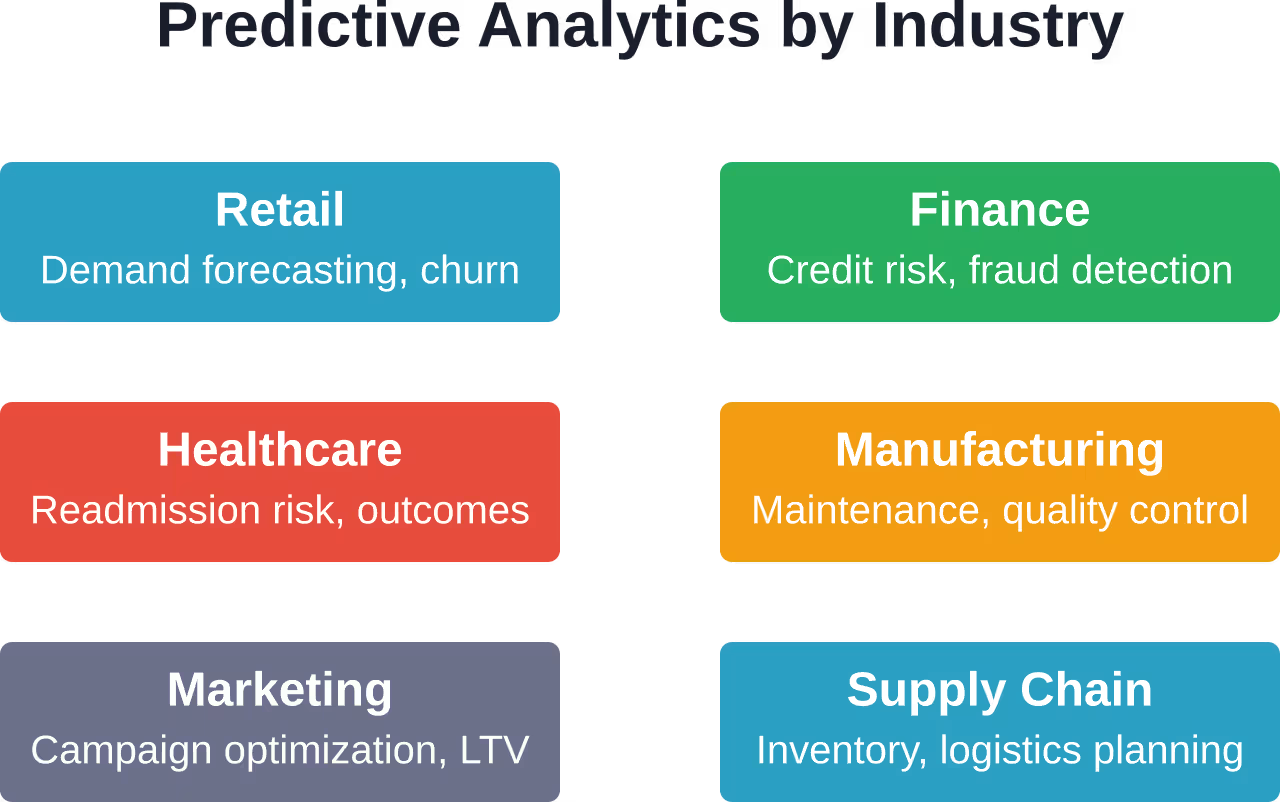
Key Benefits for Organizations
Predictive analytics delivers measurable advantages when implemented strategically.
- Risk reduction stands out as perhaps the most valuable benefit. Financial services firms prevent fraud losses. Healthcare systems avoid adverse patient events. Manufacturers avert costly equipment failures.
- Quantifying risk allows better resource allocation. Insurance companies price policies according to predicted claim probabilities rather than crude demographic averages.
- Operational efficiency improvements emerge from optimized decision-making. Supply chains carrying less excess inventory free working capital. Utilities schedule maintenance during low-demand periods, preventing outages.
- Customer-facing operations benefit enormously. Enhanced customer retention results from identifying dissatisfaction signals early and intervening before cancellations occur. Acquisition costs typically exceed retention costs by 5-25x, making churn prevention highly profitable.
- Personalized offers driven by predictive models increase conversion rates compared to generic promotions. Recommendation algorithms contribute significantly to revenue at companies like Amazon and Netflix.
- Competitive advantages accrue to early adopters within industries. Organizations that forecast market shifts position inventory, staffing, and capacity ahead of demand spikes while competitors scramble.
- Data-driven cultures outperform intuition-driven rivals in dynamic markets. Predictive analytics provides the evidence base for strategic decisions that would otherwise rely on executive hunches.
- Hidden pattern discovery reveals non-obvious relationships humans miss. Algorithms processing millions of variables identify subtle correlations between product features and customer satisfaction, supplier behaviors and quality issues, or employee characteristics and retention rates.
Implementation Challenges and Best Practices
Predictive analytics projects fail more often than succeed. Understanding common pitfalls improves outcomes.
Data Quality Issues
Poor data quality remains the primary failure mode. Incomplete records, inconsistent formatting, duplicate entries, and measurement errors corrupt model training. Best practice: Invest heavily in data governance. Establish clear ownership, validation rules, and cleaning processes before launching analytics initiatives.
Unclear Business Objectives
Technical teams sometimes build sophisticated models solving problems nobody cares about. Predictive projects need executive sponsorship tied to specific business metrics—reduce churn by 15%, cut inventory carrying costs by $2M, improve on-time delivery to 98%. Best practice: Start with the business question, not the data. Work backward from desired outcomes to required predictions to necessary data inputs.
Organizational Resistance
Humans resist algorithmic recommendations that contradict experience or threaten autonomy. Sales teams ignore lead scores. Doctors override diagnostic suggestions. Loan officers distrust automated credit decisions. Best practice: Involve end-users throughout development. Explain model logic. Demonstrate accuracy gains. Allow human override initially while building confidence.
Technical Skill Gaps
Predictive analytics requires expertise in statistics, programming, domain knowledge, and data engineering. Few individuals possess all competencies; teams must blend specialists. Best practice: Build cross-functional teams pairing data scientists with business analysts and subject matter experts. External partnerships with academic institutions can accelerate capability development.
Model Degradation
Models trained on 2023 data lose accuracy in 2026 as market conditions shift. Customer behaviors change. Competitors alter strategies. Economic cycles turn. Best practice: Implement automated monitoring that flags performance drops. Establish retraining schedules—quarterly for stable domains, weekly for volatile markets.
| Challenge | Impact | Mitigation Strategy |
|---|---|---|
| Poor data quality | Inaccurate predictions, wasted effort | Robust governance, validation, cleaning processes |
| Unclear objectives | Low ROI, lack of adoption | Tie projects to specific business metrics |
| User resistance | Models ignored, value unrealized | Involve stakeholders early, prove value incrementally |
| Skill gaps | Project delays, suboptimal results | Cross-functional teams, external partnerships |
| Model degradation | Declining accuracy over time | Automated monitoring, scheduled retraining |
Tools and Technologies
- Enterprise platforms like IBM Watson, Microsoft Azure Machine Learning, and Google Cloud AI provide end-to-end environments with data preparation, model training, deployment, and monitoring capabilities. These suit large organizations with substantial budgets and complex requirements.
- Business intelligence tools including Tableau, Power BI, and Qlik now incorporate predictive features, bringing forecasting capabilities to non-technical business users through point-and-click interfaces.
- Open-source ecosystems centered on Python (scikit-learn, TensorFlow, PyTorch) and R (caret, tidymodels) offer maximum flexibility at minimal cost. Data science teams favor these for custom implementations.
- Specialized solutions address vertical needs—Salesforce Einstein for CRM predictions, Workday for HR analytics, SAP for supply chain optimization.
Selection criteria depend on technical capabilities, budget constraints, integration requirements, and problem complexity. Smaller organizations often achieve success with cloud-based platforms offering pay-as-you-go pricing rather than investing in on-premise infrastructure.
Future Trends Shaping Predictive Analytics
Several developments are expanding what predictive analytics can accomplish.
- Automated machine learning (AutoML) platforms reduce the expertise required to build accurate models. Systems automatically test numerous algorithms, tune parameters, and select optimal configurations. This democratization allows smaller teams to deploy sophisticated analytics.
- Real-time prediction capabilities continue improving. Fraud detection, dynamic pricing, and recommendation systems now operate in milliseconds, analyzing each transaction or interaction as it occurs rather than batch-processing overnight.
- Explainable AI techniques address the “black box” problem. Regulations like the EU AI Act and GDPR demand transparency in automated decisions. New methods visualize how models reach conclusions, building trust and enabling compliance.
- Edge analytics processes predictions on local devices—smartphones, IoT sensors, factory equipment—rather than sending data to centralized servers. This reduces latency and bandwidth costs while improving privacy.
- Prescriptive analytics extends beyond predictions to recommend optimal actions. These systems don’t just forecast customer churn; they suggest which retention offer will prove most effective for each individual.
Integration with natural language interfaces allows business users to query models conversationally: “Which products will see demand spikes next quarter?” without writing code or navigating dashboards.
Getting Started with Predictive Analytics
Organizations new to predictive analytics should approach implementation incrementally. Start with a pilot project addressing a specific, measurable business problem. Choose something important enough to justify investment but contained enough to deliver results quickly—perhaps predicting high-value customer churn in one product line rather than forecasting enterprise-wide revenue. Assess data readiness. Do historical records exist spanning sufficient timeframes? Are relevant variables captured consistently? Gaps may require months of data collection before modeling begins. Secure executive sponsorship. Predictive analytics requires cross-functional collaboration—IT, business units, analytics teams. Leadership support overcomes organizational barriers. Build or acquire necessary skills. Small teams often partner with consulting firms or academic institutions for initial projects while developing internal capabilities. Cloud platforms with built-in training resources lower barriers. Establish success metrics before launch. How will the organization measure whether predictions add value? Revenue impact, cost savings, efficiency gains, or customer satisfaction improvements? Plan for iteration. Initial models rarely achieve production-grade accuracy. Budget time for refinement based on real-world performance. Focus on integration. Predictions deliver value only when embedded in operational workflows—automatically routing high-risk fraud alerts to investigators, populating CRM systems with propensity scores, or triggering inventory replenishment orders.
Frequently Asked Questions
What’s the difference between predictive and descriptive analytics?
Descriptive analytics examines historical data to understand what already happened—sales last quarter, customer demographics, website traffic patterns. Predictive analytics uses that historical data to forecast future outcomes—sales next quarter, which customers will churn, expected traffic volumes. Descriptive looks backward; predictive looks forward.
How accurate are predictive analytics models?
Accuracy varies dramatically by application. Fraud detection models achieve 95%+ accuracy in identifying legitimate transactions but may catch only 60-70% of actual fraud while minimizing false positives. Demand forecasting typically operates within 10-20% error margins. Weather-like domains with high randomness see lower accuracy than structured environments like manufacturing quality control. Models improve with more data, better features, and domain expertise.
Do small businesses need predictive analytics?
Small businesses benefit from predictive analytics when facing specific challenges like inventory optimization, customer retention, or cash flow forecasting. Modern cloud platforms offer affordable entry points. However, organizations must maintain sufficient historical data—typically 12-24 months minimum—and possess basic data literacy. Starting with simple forecasting before advancing to complex machine learning makes sense for resource-constrained teams.
What skills does a predictive analytics team need?
Effective teams blend multiple competencies: statistical knowledge for model selection and validation, programming skills in Python or R for implementation, domain expertise to frame relevant business questions, data engineering capabilities to prepare datasets, and communication abilities to translate technical findings into actionable recommendations. Individuals rarely possess all skills; cross-functional collaboration proves essential.
How much historical data is required for predictive modeling?
Data requirements depend on problem complexity and prediction timeframe. Simple regression models might work with hundreds of observations, while deep learning neural networks require thousands or millions. Time series forecasting generally needs at least two complete cycles of the pattern being predicted—two years for annual seasonality, 24 months for monthly patterns. More complex phenomena demand proportionally more data.
Can predictive analytics replace human decision-making?
Predictive analytics augments rather than replaces human judgment. Models identify patterns and quantify probabilities, but humans provide context, handle exceptions, and make final decisions incorporating factors algorithms miss—ethical considerations, strategic priorities, customer relationships. The most effective implementations combine machine speed and consistency with human wisdom and flexibility.
What industries benefit most from predictive analytics?
Industries with large datasets, measurable outcomes, and high costs of error gain maximum value. Financial services, healthcare, retail, manufacturing, and telecommunications lead adoption. But predictive analytics delivers benefits wherever historical patterns inform future decisions—agriculture for crop yield optimization, education for student success prediction, energy for consumption forecasting, and logistics for route planning.
Conclusion
Predictive analytics transforms historical data into competitive advantage. Organizations that master these techniques anticipate market shifts, optimize operations, and serve customers more effectively than rivals relying on intuition alone. The technology barrier has dropped dramatically. Cloud platforms, AutoML tools, and pre-built models democratize capabilities once exclusive to tech giants. But technology alone doesn’t guarantee success. Winning implementations start with clear business objectives, invest in data quality, secure executive sponsorship, and integrate predictions into operational workflows. Teams blend technical expertise with domain knowledge. Organizations build data-driven cultures where evidence informs decisions. Start small. Choose a specific problem with measurable business impact. Prove value through a pilot project. Build momentum and capabilities incrementally. The future belongs to organizations that leverage their data assets strategically. Predictive analytics provides the framework to unlock that value—identifying opportunities before competitors, preventing problems before they escalate, and making better decisions faster. Ready to implement predictive analytics in your organization? Begin by auditing your current data infrastructure, identifying high-impact use cases, and assembling a cross-functional team. The insights waiting in your historical data could reshape your competitive position.