Quick Summary: Predictive analytics in big data combines machine learning, statistical modeling, and massive datasets to forecast future outcomes with unprecedented accuracy. Organizations across healthcare, finance, retail, and manufacturing leverage these tools to identify patterns, reduce risks, and make data-driven decisions that were impossible just a decade ago. The convergence of predictive analytics and big data has fundamentally changed how organizations approach decision-making. What started as simple statistical forecasting has evolved into sophisticated systems that process terabytes of information in real-time, identifying patterns invisible to human analysts. But here’s the thing—big data alone doesn’t create value. It’s the predictive models built on top of these massive datasets that transform raw information into actionable intelligence. The scale has reached a tipping point. Companies now collect data from IoT devices, social media feeds, transaction logs, and sensor networks simultaneously. Traditional analytics tools simply can’t handle the volume, velocity, and variety.
What Makes Predictive Analytics Different in Big Data Contexts
Predictive analytics is the practice of using statistical algorithms and machine learning techniques to analyze historical data, identify patterns, and predict future outcomes. When applied to big data environments, the scope and capability expand exponentially. Traditional predictive models might analyze thousands of records. Big data predictive systems process millions or billions of data points across structured databases, unstructured text, images, and streaming data sources. The fundamental difference isn’t just volume. Big data introduces three critical dimensions that change everything: variety in data types, velocity of data generation, and the veracity challenges of ensuring data quality at scale.
The Statistical Foundation
At its core, predictive analytics relies on statistical modeling techniques that haven’t changed dramatically. Regression analysis, decision trees, and time-series forecasting remain foundational. What has changed is computational power. Algorithms that once took days to train on modest datasets now process billions of records in hours. Machine learning models iterate through thousands of parameter combinations automatically, optimizing for accuracy without human intervention. Real talk: mathematics hasn’t gotten easier. The tools have just gotten better at hiding the complexity.
Core Techniques Powering Predictive Analytics
Several machine learning and statistical approaches dominate the predictive analytics landscape. Each brings specific strengths to different prediction challenges. 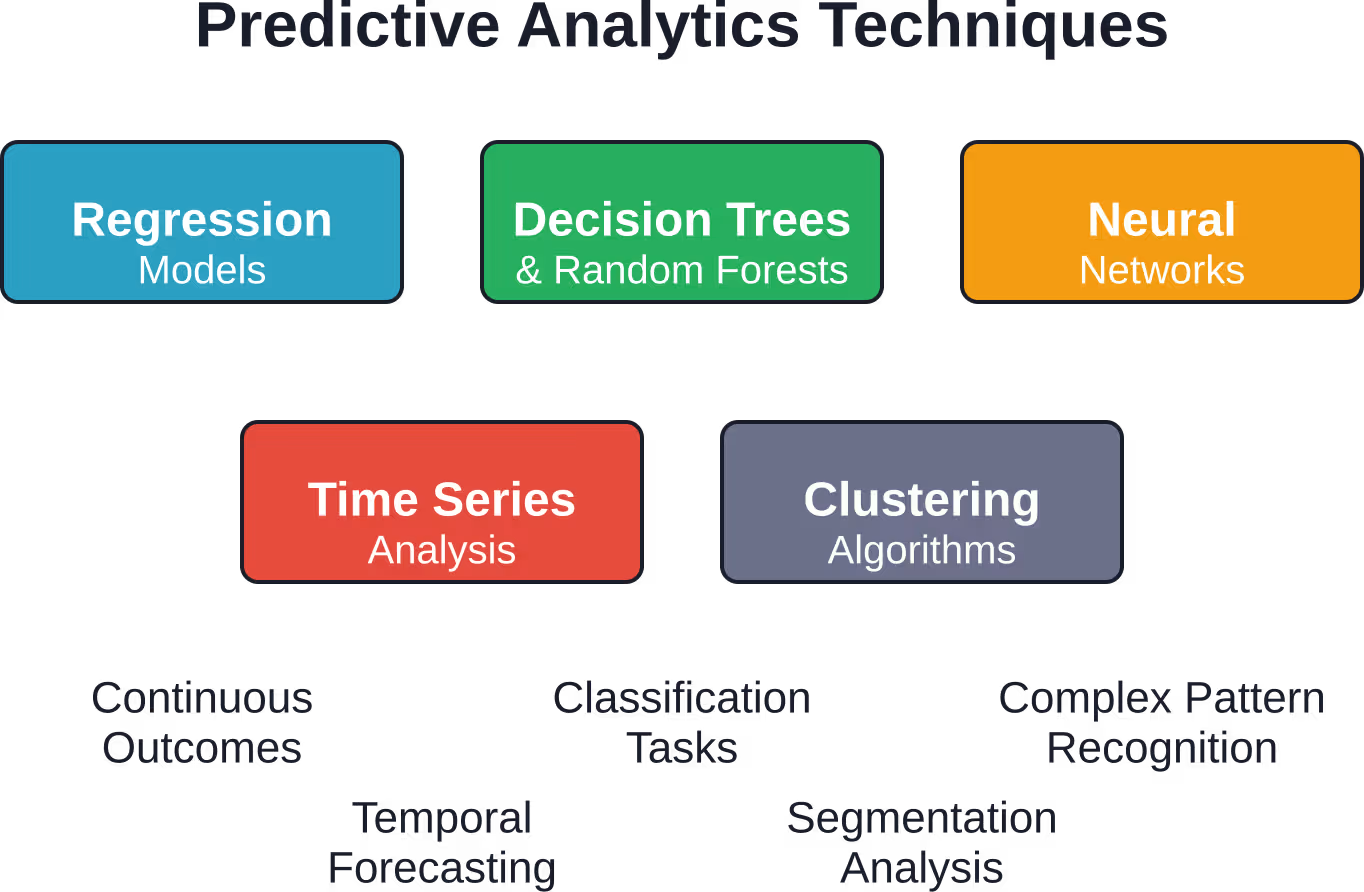
Regression Analysis
Regression models predict continuous numerical values—sales revenue, temperature, stock prices, customer lifetime value. Linear regression remains surprisingly effective for many business problems, especially when relationships between variables are relatively straightforward. But big data environments often require more sophisticated variants. Polynomial regression captures non-linear relationships. Ridge and Lasso regression handle high-dimensional datasets where traditional methods fail.
Machine Learning Classifiers
Decision trees and their ensemble variants—random forests, gradient boosting machines—excel at classification tasks. Will this customer churn? Is this transaction fraudulent? Which marketing segment does this user belong to? These models handle mixed data types elegantly and provide interpretable results. Random forests aggregate hundreds of decision trees to reduce overfitting, a critical concern when training on massive datasets.
Neural Networks and Deep Learning
When patterns become too complex for traditional algorithms, neural networks step in. Deep learning architectures process unstructured data—images, text, audio—extracting features that simpler models miss entirely. Healthcare applications use convolutional neural networks to predict disease from medical imaging. Financial institutions deploy recurrent neural networks for fraud detection across transaction sequences. The trade-off? These models require enormous training datasets and computational resources. They’re also black boxes, making it difficult to explain why a particular prediction was made.
How Big Data Transforms Predictive Capability
The relationship between big data and predictive analytics isn’t just additive—it’s multiplicative. More data doesn’t simply improve existing models; it enables entirely new categories of predictions. Consider recommendation engines. Netflix doesn’t just track what movies individual users watch. The system analyzes viewing patterns across millions of subscribers, time-of-day preferences, pause and rewind behavior, device types, and countless other signals. That level of granularity creates prediction accuracy impossible with smaller datasets. The model identifies micro-segments of users with highly specific preferences, delivering personalized recommendations that feel almost prescient.
Real-Time Processing Capabilities
Traditional batch analytics processes historical data on a schedule—nightly, weekly, monthly. Big data platforms like Apache Spark handle streaming data, updating predictive models as new information arrives. Financial trading systems analyze market data in microseconds, predicting price movements and executing trades faster than human traders can perceive. Manufacturing sensors detect equipment anomalies milliseconds before catastrophic failure. This shift from retrospective analysis to predictive intervention represents a fundamental change in how organizations operate.
| Technology | Role in Predictive Analytics | Best Use Cases |
|---|---|---|
| Apache Spark | Distributed processing of large-scale datasets and real-time streaming | Real-time fraud detection, IoT sensor analysis |
| Hadoop Ecosystem | Storage and batch processing of massive structured/unstructured data | Historical pattern analysis, data warehousing |
| TensorFlow/PyTorch | Deep learning model development and deployment | Image recognition, natural language processing |
| Cloud ML Platforms | Scalable model training and inference without infrastructure management | Rapid prototyping, variable workloads |
Industry Applications Driving Real Value
Predictive analytics in big data environments has moved far beyond theoretical exercises. Organizations across sectors deploy these systems to solve concrete business problems.
Healthcare and Medical Research
Machine learning methods for predictive analytics in healthcare have transformed patient care. Hospitals analyze electronic health records, genetic data, and real-time monitoring to predict patient deterioration hours before clinical symptoms appear. Cancer treatment centers combine genomic sequencing data with treatment outcomes across thousands of patients, predicting which therapies will work for specific genetic profiles. The National Science Foundation has supported high-risk, high-reward interdisciplinary research combining computing, engineering, and data science to tackle biomedical challenges. Predictive models identify high-risk patients for preventive interventions, reducing hospital readmissions and improving outcomes while cutting costs.
Financial Services and Risk Management
Banks and investment firms were early adopters of predictive analytics for stock market trends using machine learning. Modern systems analyze news feeds, social media sentiment, trading volumes, and macroeconomic indicators simultaneously. Credit risk models evaluate loan applications using hundreds of variables beyond traditional credit scores. Fraud detection systems flag suspicious transactions in real-time by comparing current behavior against patterns learned from billions of historical transactions. Insurance companies predict claim likelihood and policy cancellation risk, optimizing pricing and retention strategies.
Retail and E-Commerce
Demand forecasting has reached new levels of precision. Retailers predict product demand at individual store locations, optimizing inventory to minimize stockouts and overstock situations. Dynamic pricing algorithms adjust product prices in real-time based on demand signals, competitor pricing, inventory levels, and customer behavior. Amazon reprices millions of products daily using predictive models. Customer churn prediction identifies at-risk subscribers before they cancel, triggering targeted retention offers.
Manufacturing and Industrial Operations
Predictive maintenance represents one of the highest-value applications. Sensors on industrial equipment generate continuous streams of temperature, vibration, and performance data. Machine learning models detect subtle pattern changes indicating impending failure, scheduling maintenance before breakdowns occur. This approach significantly reduces unplanned downtime compared to reactive maintenance strategies. Supply chain optimization uses predictive analytics to forecast disruptions, route shipments efficiently, and manage inventory across complex global networks.
Building Effective Predictive Models: The Process
Creating predictive models that actually work in production requires systematic methodology. Here’s the thing though—most projects fail not because of algorithmic weakness, but because of poor data preparation and unclear business objectives.
Define Clear Business Objectives
Start with specific questions. “Improve customer retention” is too vague. “Predict which customers will cancel within 30 days with 80% accuracy” provides measurable targets. Quantify the business impact. What’s the value of correctly predicting equipment failure one week early? How much revenue does reducing customer churn by 5% generate?
Data Collection and Integration
Predictive models are only as good as the data feeding them. Organizations often underestimate the effort required to aggregate data from multiple systems into a unified format. CRM databases, transaction logs, web analytics, external data sources—each uses different schemas and update frequencies. Building robust data pipelines consumes 60-80% of most predictive analytics projects.
Feature Engineering
Raw data rarely arrives in model-ready format. Feature engineering transforms basic variables into predictive signals. Instead of just “purchase date,” derive features like “days since last purchase,” “purchase frequency,” “average order value,” and “trend in spending over the last 90 days.” These engineered features often contribute more to model accuracy than the original variables. Domain expertise matters enormously here. Data scientists need to work closely with business experts who understand the underlying processes being modeled.
Model Selection and Training
No single algorithm works best for all problems. Start with simpler models—logistic regression, decision trees—to establish baseline performance. These models train quickly and provide interpretable results. If baseline accuracy isn’t sufficient, progress to ensemble methods or neural networks. But remember: complex models require more training data and computational resources while sacrificing interpretability. Split data into training, validation, and test sets. Train on the training set, tune parameters using the validation set, and evaluate final performance on the test set that the model has never seen.
Validation and Iteration
Accuracy metrics tell only part of the story. A model that’s 95% accurate sounds impressive until it’s predicting rare fraud events where 99% of transactions are legitimate—a model that always predicts “not fraud” would achieve 99% accuracy while being completely useless. Use appropriate metrics for the problem. Classification tasks might track precision, recall, and F1-score. Regression problems focus on mean squared error or mean absolute error. Cross-validation techniques help ensure models generalize well to new data rather than simply memorizing training examples.
Challenges and Limitations
Despite tremendous advances, predictive analytics in big data contexts faces significant challenges that organizations must navigate carefully.
Data Quality and Bias
Massive datasets inevitably contain errors, duplicates, and missing values. Automated collection systems fail silently. Data entry mistakes propagate through pipelines. More insidious are systematic biases. Historical data reflects past decisions and societal biases. Models trained on biased data perpetuate and sometimes amplify those biases in their predictions. Financial institutions have discovered lending models that discriminate based on protected characteristics, not because those characteristics were input features, but because proxy variables correlated with them.
Overfitting and Model Complexity
Big data paradoxically makes overfitting easier. With millions of variables available, models can find spurious correlations that don’t represent genuine causal relationships. Regularization techniques, cross-validation, and thoughtful feature selection help, but there’s no perfect solution. The best defense is domain expertise combined with healthy skepticism about suspiciously accurate results.
Infrastructure and Skill Requirements
Building and maintaining big data predictive analytics systems demands significant investment. Cloud platforms have lowered barriers, but costs escalate quickly as data volumes and computational needs grow. Finding talent combines the challenge of scarce data scientists with the need for engineers who understand distributed systems, statisticians who can validate methodologies, and business analysts who translate between technical and operational teams.
Privacy and Ethical Concerns
Predictive models often require personally identifiable information to achieve high accuracy. Regulatory frameworks like GDPR and CCPA impose strict requirements on data collection, storage, and usage. Organizations must balance prediction accuracy against privacy preservation. Techniques like differential privacy and federated learning show promise but add complexity. Ethical questions extend beyond legal compliance. Just because a prediction is accurate doesn’t mean acting on it is appropriate. Predictive policing and hiring algorithms have generated significant controversy.
The Future: Where Predictive Analytics Is Heading
Several trends are reshaping predictive analytics capabilities and applications.
AutoML and Democratization
Automated machine learning platforms handle model selection, feature engineering, and hyperparameter tuning with minimal human intervention. This democratizes predictive analytics, allowing domain experts without deep statistical training to build effective models. But wait. Automation doesn’t eliminate the need for expertise—it shifts focus from technical implementation to problem formulation and result interpretation.
Edge Computing and Real-Time Predictions
Moving predictive models to edge devices enables real-time inference without cloud connectivity. Autonomous vehicles can’t wait for round-trip communication to cloud servers for every decision. Edge deployment poses new challenges around model size, computational efficiency, and updating deployed models without manual intervention.
Explainable AI
Regulatory pressure and business requirements are driving demand for interpretable predictions. Techniques like SHAP values and LIME provide explanations for individual predictions from complex models. Healthcare providers need to understand why a model flagged a patient as high-risk. Loan officers must explain why an application was rejected.
Integration with Causal Inference
Correlation drives most current predictive models, but causation matters for intervention decisions. Emerging approaches combine predictive accuracy with causal inference frameworks to answer “what if” questions. What happens if pricing changes? How does operational process modification affect customer satisfaction? Traditional predictive models struggle with these counterfactual scenarios.
| Challenge | Current Approaches | Future Directions |
|---|---|---|
| Model Interpretability | SHAP values, feature importance scores | Causal explanation frameworks, inherently interpretable architectures |
| Data Privacy | Anonymization, access controls | Federated learning, homomorphic encryption, synthetic data |
| Real-Time Processing | Stream processing frameworks, distributed systems | Edge AI, neuromorphic computing, optimized inference engines |
| Bias Mitigation | Fairness metrics, bias detection tools | Adversarial debiasing, causal fairness criteria |
Getting Started: Practical Recommendations
Organizations beginning predictive analytics journeys should follow pragmatic paths rather than attempting everything simultaneously. Start small with well-defined use cases where data is readily available and business impact is measurable. Early wins build organizational support and funding for larger initiatives. Invest in data infrastructure before sophisticated algorithms. Clean, accessible, well-documented data enables many modeling approaches. Poor data quality dooms even the most advanced techniques. Build cross-functional teams. Data scientists, domain experts, and IT operations must collaborate closely. Siloed efforts produce models that either don’t solve real problems or can’t be deployed effectively. Establish clear evaluation criteria before model development begins. What accuracy is “good enough”? What are the costs of false positives versus false negatives? How will model performance be monitored in production? Plan for maintenance. Predictive models degrade over time as underlying patterns change. Automated monitoring and retraining pipelines prevent silent performance deterioration. 
Turn Big Data Into Forecasting Signals for Business Decisions
Big data platforms collect massive volumes of information, but most of it remains unused beyond reporting. Predictive analytics adds a layer that turns raw data into forward-looking signals. AI Superior develops custom AI software with predictive analytics that processes large-scale structured and unstructured data to reveal patterns and generate forecasts that can support business decisions across different functions.
Make Big Data Work for Future Outcomes
AI Superior helps:
- Identify patterns across large and fragmented datasets
- Combine multiple data sources into one predictive framework
- Generate forecasts that support operational and strategic decisions
Contact AI Superior to turn your big data infrastructure into a predictive decision system.
Frequently Asked Questions
What’s the difference between predictive analytics and business intelligence?
Business intelligence focuses on understanding what happened and why through historical reporting and dashboards. Predictive analytics uses that historical data to forecast what will happen in the future. BI answers “What were last quarter’s sales?” while predictive analytics answers “What will next quarter’s sales be?”
How much data is needed for effective predictive modeling?
Required data volume depends on problem complexity and model type. Simple linear regression might produce useful results with hundreds of examples. Deep learning models typically require thousands or millions of training examples. More important than absolute volume is data quality, representativeness, and feature relevance.
Can small businesses use predictive analytics, or is it only for large enterprises?
Cloud-based analytics platforms and AutoML tools have dramatically lowered barriers to entry. Small businesses can access sophisticated predictive capabilities without massive infrastructure investments. The key is starting with focused use cases where available data can drive actionable insights—customer churn prediction, inventory optimization, or demand forecasting.
How do you measure the ROI of predictive analytics projects?
Effective ROI measurement requires quantifying both costs and benefits. Costs include technology, personnel, and integration effort. Benefits vary by application—reduced customer churn translates to retained revenue, improved fraud detection saves losses, optimized inventory reduces carrying costs and stockouts. Establish baseline metrics before implementation to measure improvement accurately.
What programming languages and tools are most common for predictive analytics?
Python dominates predictive analytics work, with libraries like scikit-learn, TensorFlow, and PyTorch providing comprehensive machine learning capabilities. R remains popular for statistical analysis. SQL handles data extraction and preparation. Cloud platforms offer managed services that abstract much of the technical complexity.
How often do predictive models need to be updated?
Update frequency depends on how quickly underlying patterns change. Financial fraud models might retrain daily as fraudsters adapt. Customer preference models might update monthly. Manufacturing predictive maintenance models could retrain quarterly. The right approach monitors model performance continuously and triggers retraining when accuracy degrades beyond acceptable thresholds.
What role does artificial intelligence play in predictive analytics?
Machine learning—a subset of artificial intelligence—provides the algorithms that power most modern predictive analytics. Traditional statistical methods remain relevant for many applications, but AI techniques excel at handling complex, high-dimensional data and identifying non-linear patterns. According to NSF, the foundation has invested in artificial intelligence research since the early 1960s. NSF has made investments of over $700 million each year in AI research.
Final Thoughts
Predictive analytics has evolved from academic curiosity to business necessity. The combination with big data platforms has unlocked prediction capabilities that seemed impossible just years ago. Organizations that successfully implement predictive analytics gain competitive advantages through better decisions, reduced risks, and operational efficiencies. Those that ignore these tools increasingly fall behind competitors who use data-driven insights to anticipate market changes and customer needs. The technology will continue advancing. Algorithms become more sophisticated, computational power grows cheaper, and data volumes expand exponentially. But fundamental principles remain constant: clear objectives, quality data, appropriate methodologies, and rigorous validation. Success requires balancing technical capability with business acumen, algorithmic sophistication with interpretability, and prediction accuracy with ethical responsibility. The organizations that master this balance will thrive in an increasingly data-driven world. The question isn’t whether to adopt predictive analytics—it’s how quickly organizations can build the capabilities, infrastructure, and culture to leverage it effectively. Ready to transform data into foresight? Start with one focused use case, assemble the right team, and build from there. The journey from reactive reporting to predictive intelligence begins with a single step.