
Quick Summary: Predictive analytics in travel uses machine learning and historical data to forecast demand, optimize pricing, personalize experiences, and reduce costs. Travel companies implementing analytics-driven systems achieve measurable ROI through improved booking forecasts, dynamic pricing, and proactive spend controls. The technology is reshaping everything from hotel revenue management to corporate travel expense forecasting.
The travel industry generates massive amounts of data every single day. Booking patterns, flight searches, hotel occupancy rates, customer reviews, weather conditions, seasonal trends—it all adds up.
But here’s the thing: collecting data isn’t the challenge anymore. Making sense of it is.
That’s where predictive analytics comes in. Instead of looking at last quarter’s numbers and making educated guesses, travel businesses now forecast what’ll happen next week, next month, or next year with remarkable accuracy.
Academic research from Northwestern University demonstrates that hotel demand prediction models using Random Forest algorithms achieve a Mean Absolute Percentage Error (MAPE) of just 12.2% with only 4 weeks of initial training data. Compare that to older methods requiring 20 weeks of data and delivering 22% MAPE—the efficiency gains are dramatic.
Real talk: predictive analytics isn’t some futuristic concept anymore. It’s actively reshaping how airlines price seats, how hotels manage inventory, and how corporate travel managers control budgets.
What Actually Is Predictive Analytics in Travel?
Predictive analytics uses historical data, statistical algorithms, and machine learning techniques to identify the likelihood of future outcomes. In travel contexts, that means forecasting everything from booking volumes to customer preferences.
The process typically involves:
- Collecting structured data (bookings, transactions, occupancy rates) and unstructured data (reviews, social media sentiment)
- Cleaning and preparing datasets for analysis
- Training machine learning models on historical patterns
- Validating predictions against actual outcomes
- Deploying models to generate real-time forecasts
Think of it as the difference between driving while looking in the rearview mirror versus having a forward-looking radar system.
How It Differs From Standard Business Intelligence
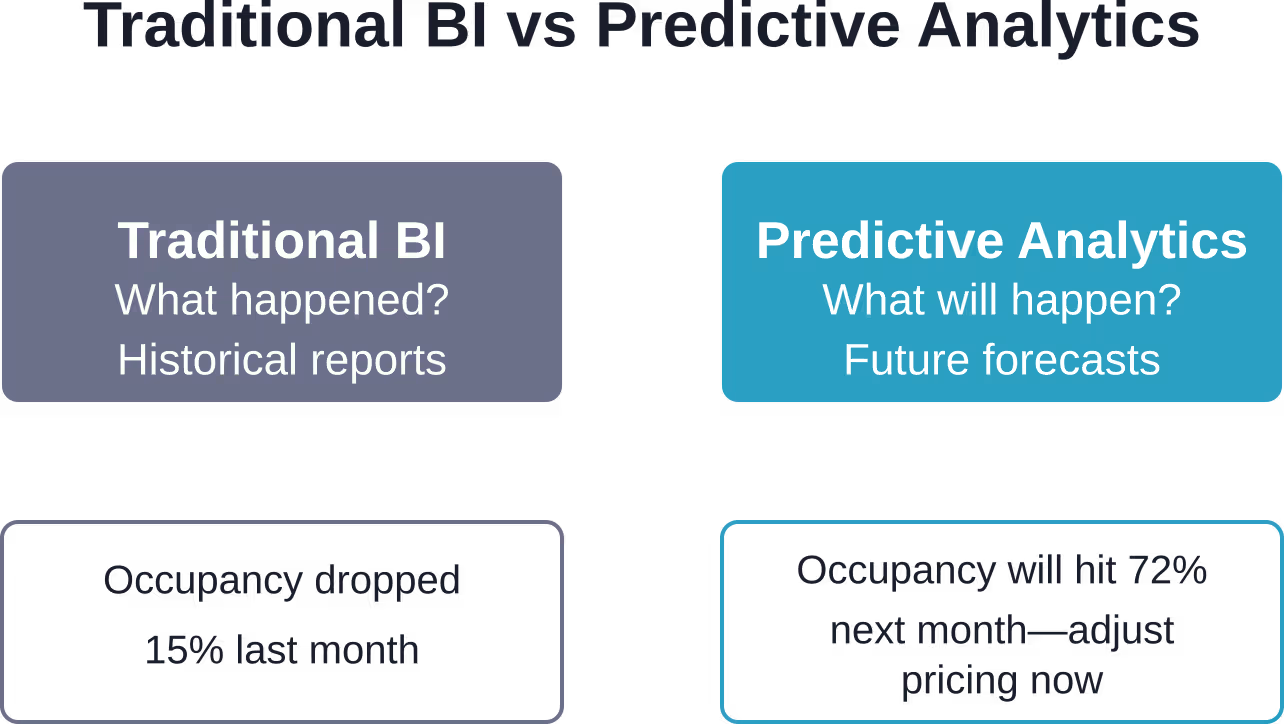
Traditional business intelligence answers “What happened?” and “Why did it happen?” through dashboards and historical reports. Predictive analytics tackles “What will happen?” and “What should we do about it?”
A hotel might use BI to see that occupancy dropped 15% last month. Predictive analytics would forecast next month’s occupancy based on forward bookings, competitor pricing, local events, weather patterns, and dozens of other variables—then recommend optimal room rates.

Apply Predictive Analytics with AI Superior
AI Superior builds predictive models based on customer behavior, booking data, and operational trends.
The focus is on supporting forecasting, pricing, and planning decisions with models that can be integrated into existing systems.
Looking to Use Predictive Analytics in Travel?
AI Superior can help with:
- evaluating booking and customer data
- building predictive models
- integrating models into existing tools
- improving results over time
👉 Contact AI Superior to discuss your project, data, and implementation approach
Demand Forecasting: Getting Inventory Right
Accurate demand forecasting might be the single most valuable application of predictive analytics in travel. Hotels need to know how many rooms to make available at various price points. Airlines need to predict seat demand months in advance.
Boston University research examining hotel occupancy data found an overall mean monthly occupancy of 68.34% with variance of just 1.29%. That kind of stability makes forecasting viable—but only with the right models.
Hotel Booking Predictions
Northwestern researchers built models predicting weekly total room nights up to four weeks into the future using previous bookings, air passenger traffic volume, air shopping data, holidays, and seasonality indicators.
Three model types were compared:
| Model Type | MAPE Accuracy | Training Data Required | Run Time |
|---|---|---|---|
| Prophet | 25% | 12 weeks | 2 minutes |
| SARIMAX | 22% | 20 weeks | 1 minute |
| Random Forest | 12.2% | 4 weeks | 4 minutes |
The Random Forest model delivered the lowest error rate while requiring the least historical data. For hotels operating with thin margins, a 12.2% forecast error versus 25% translates directly to better revenue management decisions.
Air Travel Demand Patterns
According to IATA forecasting data, air passenger demand shows clear regional growth patterns through 2043. Asia-Pacific leads with a 5.1% compound annual growth rate (CAGR), driven by India’s exceptional 6.4% annual increase. Airlines use these long-range forecasts for fleet planning, route development, and capacity allocation. Individual route forecasting, however, requires granular models incorporating competitive pricing, seasonal patterns, economic indicators, and booking pace data.
Dynamic Pricing and Revenue Optimization
Ever noticed how the same hotel room costs $150 on Tuesday and $320 on Saturday? That’s revenue management powered by predictive models.
Dynamic pricing adjusts rates in near-real-time based on predicted demand, competitor pricing, remaining inventory, and historical conversion data. Research published in the Journal of Heuristics demonstrates that dynamic pricing with demand disaggregation increases hotel revenue by approximately 6% compared to fixed pricing policies.
A leading global hospitality group introduced an AI-based pricing engine tracking over 80 demand variables, doubling its previous predictive capabilities. The result? A 22% increase in Revenue Per Available Room (RevPAR) compared to traditional revenue management models.
How Pricing Engines Actually Work
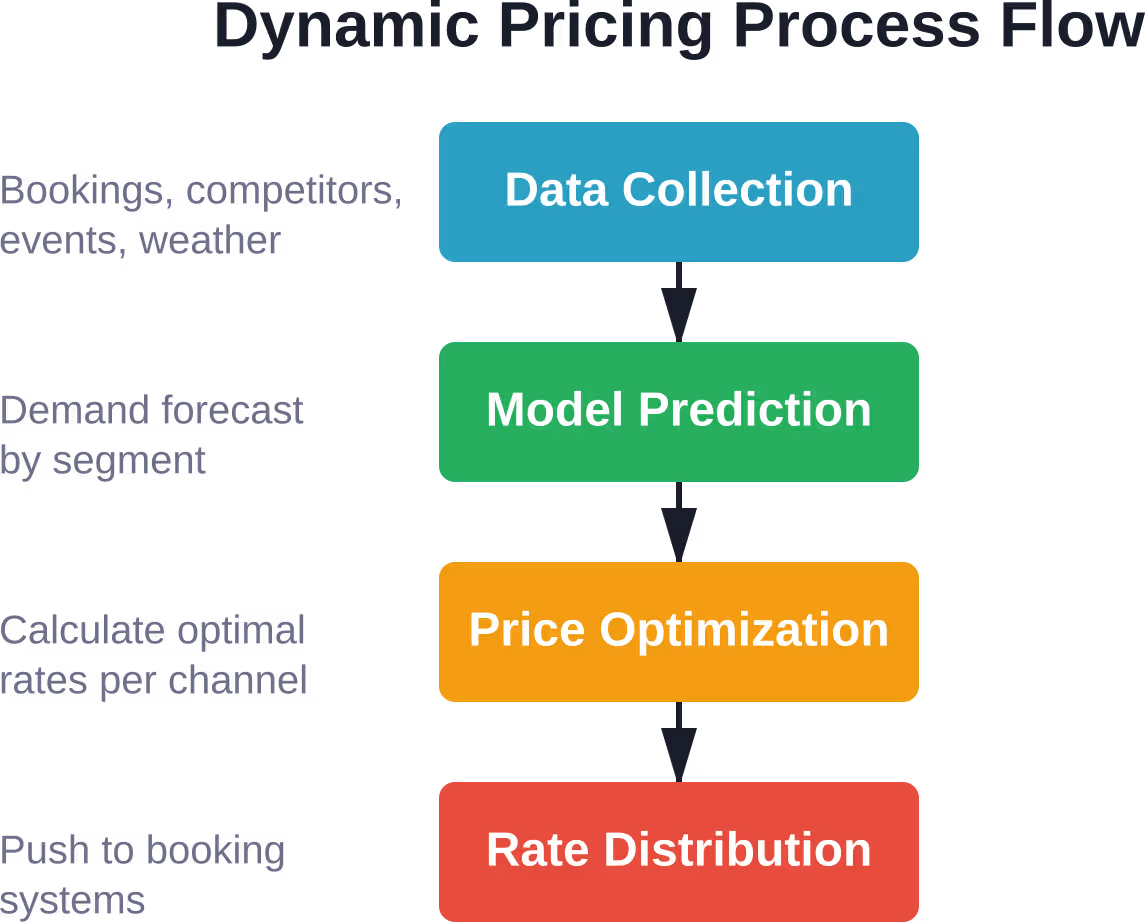
Modern revenue management systems continuously ingest:
- Forward booking pace (how quickly inventory sells at current prices)
- Competitor rate shopping data
- Local event calendars and holiday schedules
- Weather forecasts
- Web traffic and search volume
- Historical conversion rates at various price points
Machine learning models process this data to recommend optimal rates for each room type, distribution channel, and customer segment. The best systems update recommendations multiple times daily.
Personalization at Scale
According to an EY survey, 89% of people planned to take at least one trip in recent periods, with 50% planning business travel. That’s millions of travelers with different preferences, budgets, and behaviors.
Generic marketing doesn’t cut it anymore. Predictive analytics enables true personalization by forecasting what individual travelers want before they even search.
Recommender Systems
Travel recommendation engines analyze past booking behavior, browsing patterns, demographic data, and similar user profiles to suggest relevant options. These systems power:
- Hotel recommendations based on previous property characteristics and guest reviews
- Flight options matching preferred departure times, airlines, and connection preferences
- Destination suggestions aligned with historical travel patterns
- Ancillary services (car rentals, activities, insurance) timed to booking stage
Social media analysis adds another dimension. Monitoring platforms track sentiment analysis and profiling across networks. It’s been estimated that 90% of American travelers with smartphones share photos and experiences during trips—creating rich behavioral data.
Behavioral Prediction
Advanced systems predict not just what travelers prefer, but when they’ll book, which channels they’ll use, and what price points trigger conversion.
For example, a model might identify that a specific user segment:
- Books tropical destinations predominantly
- Searches 6-8 weeks before departure
- Converts when prices drop below $800
- Prefers properties with ratings above 4.2 stars
Marketing systems can then trigger personalized offers at optimal moments with messaging tailored to those preferences.
Corporate Travel Expense Management
Business travel represents a massive expense category—one where predictive analytics delivers measurable ROI. Organizations implementing analytics-driven travel and expense management achieve 376% ROI over three years, according to a Forrester study commissioned by Navan.
Here’s why that matters: corporate travel budgets historically operated reactively. Finance teams reviewed expense reports after trips occurred, flagged policy violations after money was spent, and adjusted budgets after overruns happened.
Proactive Spend Controls
Predictive models flip that script by forecasting spend before bookings occur. Systems analyze:
- Historical trip patterns by department, role, and individual
- Upcoming calendar events (conferences, client meetings, site visits)
- Seasonal travel trends
- Booking lead times and preferred vendors
This enables finance teams to forecast quarterly travel budgets with surprising accuracy, identify potential overruns weeks in advance, and adjust policies proactively.
Policy Enforcement at Booking
Instead of auditing expenses after the fact, intelligent booking platforms enforce policy in real-time. If a traveler selects a flight outside policy guidelines, the system can block the booking or trigger an approval workflow—before any money is spent.
Unified travel and expense platforms that integrate booking, expense, payment, and reporting data provide the complete foundation required for accurate predictive models. Without integration, predictions remain fragmented and less reliable.
Real-World Implementation Challenges
Okay, so predictive analytics sounds great in theory. But implementing it? That’s where companies hit obstacles.
Data Quality and Integration
Models are only as good as the data feeding them. Many travel companies struggle with:
- Siloed data across booking systems, property management, CRM, and financial platforms
- Inconsistent data formats and definitions
- Historical gaps where data wasn’t captured or was captured incorrectly
- Real-time data latency making predictions stale
Cleaning and integrating data sources typically consumes 60-80% of analytics project time and budget.
Model Accuracy and Trust
Early implementations often disappoint when predictions miss the mark. A forecast that’s 25% off doesn’t inspire confidence.
That’s why model selection matters. The Northwestern research showed dramatic accuracy differences between approaches—12.2% error versus 25% error depending on algorithm choice. Organizations need to test multiple model types and validate rigorously before deployment.
And here’s the thing: even accurate models face adoption challenges when stakeholders don’t trust algorithmic recommendations over gut instinct.
Skills and Resources
Building predictive models requires data science expertise that many travel companies lack internally. Options include:
- Hiring specialized talent (expensive, competitive market)
- Partnering with analytics vendors (faster but less customized)
- Training existing staff (slower but builds internal capability)
Small to medium-sized travel businesses often find vendor solutions more practical than building in-house capabilities from scratch.
The Technology Stack Behind Predictions
What actually powers predictive analytics in travel? Several technology categories work together:
| Technology Layer | Purpose | Examples |
|---|---|---|
| Data Collection | Capture booking, search, behavior data | APIs, web tracking, PMS integration |
| Data Storage | Warehouse structured and unstructured data | Cloud data platforms, data lakes |
| Processing | Clean, transform, aggregate data | ETL pipelines, data preparation tools |
| Modeling | Train and deploy ML algorithms | Python/R frameworks, AutoML platforms |
| Visualization | Present predictions to decision-makers | BI dashboards, reporting tools |
The trend is toward integrated platforms that bundle these layers rather than stitching together point solutions. Integration reduces latency and improves prediction accuracy.
Machine Learning Approaches
Different prediction problems require different algorithms. Common approaches include:
- Time series models (ARIMA, Prophet, SARIMAX) for demand forecasting based on historical patterns and seasonality
- Random Forest and gradient boosting for multi-variable predictions incorporating diverse data sources
- Neural networks for complex pattern recognition in large datasets
- Regression models for price optimization and sensitivity analysis
Government research on traffic flow prediction demonstrates that Graph Convolutional Recurrent Neural Networks (GCRNN) achieve 27% better accuracy than traditional Gradient Boosted Decision Tree methods for transportation forecasting. Similar deep learning approaches are increasingly applied to travel demand prediction.
Future Directions and Emerging Applications
Where is predictive analytics in travel headed? Several trends are gaining momentum.
Real-Time Prediction and Adjustment
Current systems often operate on hourly or daily update cycles. Next-generation platforms will predict and adjust in true real-time, responding to booking surges, competitor pricing changes, or external events within minutes.
Voice and Image Recognition
Predictive models are expanding beyond structured data into image and voice analysis. Applications include predicting traveler satisfaction from photo content analysis, forecasting destination popularity from social media image trends, and voice-based sentiment prediction from customer service interactions.
Sustainability Forecasting
As environmental concerns grow, predictive models are being applied to carbon footprint forecasting, sustainable travel demand prediction, and optimization of eco-friendly routing options.
The World Travel & Tourism Council projects US$12.5 trillion in travel investment through 2035, with investment growing at 4.6% CAGR compared to 3.3% demand growth. That investment gap signals capacity expansion—and expanded need for accurate demand forecasting.
Regional Growth Patterns
Middle East travel showed 5.3% growth in 2025, outpacing the global 4.1% average, with Saudi Arabia driving regional expansion. International visitor spending in the Middle East rose 5.2% compared to 3.2% globally.
These regional variations require localized prediction models that account for cultural, economic, and infrastructure factors specific to each market.
Getting Started: Practical First Steps
For travel businesses ready to implement predictive analytics, a phased approach works best:
Phase 1: Data Foundation
Audit existing data sources, establish integration between core systems, implement consistent data capture practices, and build a centralized data repository.
Phase 2: Pilot Use Case
Select one high-impact application (demand forecasting or dynamic pricing typically), implement with limited scope (single property, route, or market segment), validate accuracy against actual outcomes, and refine models based on results.
Phase 3: Expand and Scale
Roll out proven models across additional properties, routes, or segments, add complementary use cases (personalization, expense forecasting), integrate predictions into operational workflows, and train staff on interpreting and acting on predictions.
Phase 4: Continuous Improvement
Monitor model performance over time, retrain with fresh data regularly, adjust for market changes and new variables, and expand to emerging applications.
Organizations don’t need massive budgets or data science teams to start. Cloud-based analytics platforms and vendor solutions make entry points accessible even for smaller operators.
Measuring Success and ROI
How do travel companies know if predictive analytics investments are paying off? Key performance indicators include:
- Forecast accuracy improvement – reduction in MAPE or similar error metrics
- Revenue impact – RevPAR increases, yield improvements, revenue per booking growth
- Cost reduction – lower marketing spend per acquisition, reduced overbooking penalties, decreased operational waste
- Operational efficiency – faster decision cycles, reduced manual forecasting time, automated pricing updates
- Customer satisfaction – improved personalization scores, higher conversion rates, increased repeat bookings
The 376% three-year ROI figure for corporate travel analytics provides a benchmark—though results vary widely based on implementation quality and organizational maturity.
Common Misconceptions and Realities
Let’s clear up some myths about predictive analytics in travel:
- Myth: Predictive analytics requires perfect data.
- Reality: Models can deliver value even with imperfect data. The key is understanding data limitations and setting realistic accuracy expectations.
- Myth: Algorithms will replace human decision-makers.
- Reality: Predictions augment human judgment rather than replacing it. Revenue managers and travel planners still make final decisions—just with better information.
- Myth: Implementation requires years and massive budgets.
- Reality: Cloud platforms and vendor solutions enable pilot projects in weeks or months with modest budgets.
- Myth: Small travel businesses can’t benefit from predictive analytics.
- Reality: Scaled-down implementations and vendor solutions make analytics accessible to operators of all sizes.
Frequently Asked Questions
What is predictive analytics in the travel industry?
Predictive analytics in travel uses historical data, machine learning algorithms, and statistical models to forecast future outcomes like booking demand, optimal pricing, customer preferences, and expense trends. It enables travel businesses to make proactive decisions based on predicted future conditions rather than reacting to past performance.
How accurate are hotel demand forecasting models?
Accuracy varies by model type and data quality. Academic research shows modern Random Forest models achieve Mean Absolute Percentage Error (MAPE) of 12.2% for hotel booking predictions with just 4 weeks of training data, while older SARIMAX approaches require 20 weeks of data and deliver 22% MAPE. Real-world accuracy depends on data completeness, forecast horizon, and market volatility.
What ROI can companies expect from predictive analytics investments?
ROI varies significantly by application and implementation quality. Organizations implementing analytics-driven corporate travel management achieve 376% ROI over three years according to research. Hotels deploying AI-based dynamic pricing see RevPAR increases up to 22%, while basic demand disaggregation approaches deliver approximately 6% revenue improvements compared to fixed pricing.
Do small travel businesses need predictive analytics?
Small operators can absolutely benefit from predictive analytics, though implementation approaches differ from enterprise deployments. Cloud-based vendor solutions provide accessible entry points without requiring in-house data science teams. Even basic demand forecasting and pricing optimization deliver measurable improvements for properties with limited inventory where each booking decision matters.
What data sources feed travel prediction models?
Comprehensive models integrate multiple data sources including historical booking and transaction records, competitor pricing and availability, local event calendars and holiday schedules, weather forecasts, web traffic and search patterns, customer reviews and social media sentiment, economic indicators, and air traffic volumes. More data sources generally improve accuracy, but even limited datasets enable useful predictions.
How is AI different from predictive analytics?
Predictive analytics is a specific application of artificial intelligence focused on forecasting future outcomes. AI is the broader field encompassing machine learning, natural language processing, computer vision, and other techniques. In travel contexts, AI powers various applications including chatbots, image recognition, and voice interfaces—while predictive analytics specifically tackles forecasting problems like demand prediction and pricing optimization.
Can predictive models account for unexpected events?
Models trained on historical data struggle with truly unprecedented disruptions. However, well-designed systems can incorporate real-time signals that indicate changing conditions and adjust predictions accordingly. Ensemble approaches combining multiple models and including scenario planning help build resilience. The key is treating predictions as probabilistic forecasts with confidence intervals rather than absolute certainties.
Conclusion: The Predictive Future of Travel
Predictive analytics has moved from experimental to essential in the travel industry. Companies leveraging forecasting, optimization, and personalization gain measurable advantages in revenue, efficiency, and customer satisfaction.
The technology continues advancing rapidly. Models grow more accurate, training requirements decrease, and implementation barriers lower each year. Regional growth patterns show Asia-Pacific and Africa leading expansion with 5.1% and 4.2% projected CAGRs respectively, while global travel investment reaches US$12.5 trillion through 2035.
But here’s what matters most: predictive analytics isn’t about replacing human judgment with algorithms. It’s about giving travel professionals better tools to make smarter decisions faster.
Whether forecasting hotel occupancy weeks in advance with 12.2% error rates, optimizing pricing to boost RevPAR by 22%, or helping corporate finance teams achieve 376% ROI on travel programs—the applications deliver real value.
The question isn’t whether predictive analytics works in travel. It’s whether your organization is ready to implement it before competitors gain an insurmountable advantage.
Start with one high-impact use case. Validate with a pilot. Scale what works. The future of travel is predictive—and that future is already here.
 English
  German
  Arabic
  French
  Dutch
Dutch  Spanish