
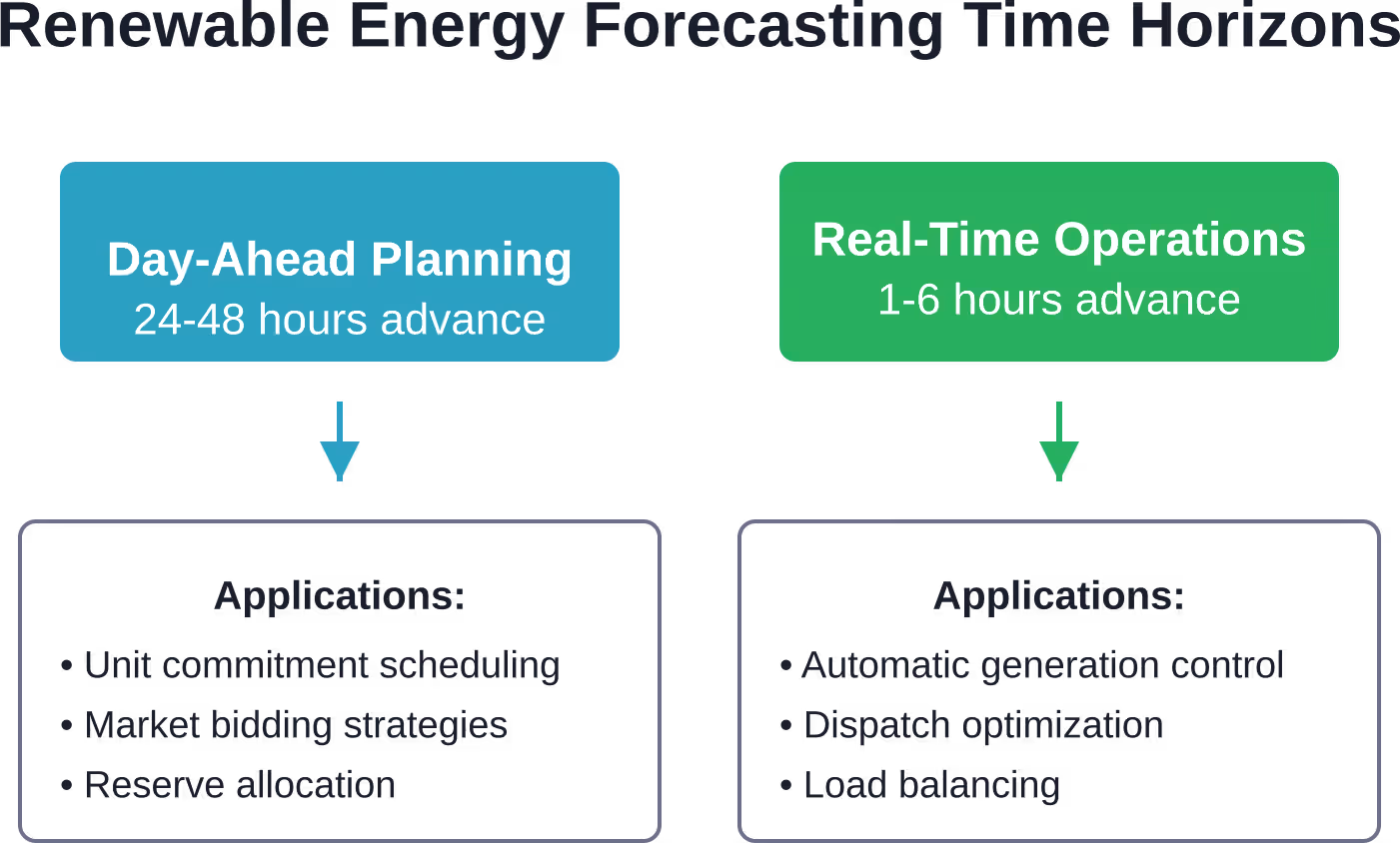
Quick Summary: Predictive analytics transforms renewable energy by enabling accurate forecasting of solar and wind generation, optimizing grid integration, and reducing operational costs. Advanced machine learning models can predict solar irradiance 24-48 hours ahead for day-ahead planning and 1-6 hours ahead for real-time operations, while wind forecasting uses lidar and radar sensing to improve accuracy. These technologies are critical as renewables are expected to reach 50% of global electricity generation by 2030, requiring sophisticated demand-supply balancing.
The renewable energy sector stands at a crossroads. With global solar PV generation is projected to reach approximately 600 TWh annually from 2025-2030, the need for accurate prediction systems has never been more urgent. And here’s the thing: traditional forecasting methods simply can’t keep pace with the variability inherent in wind and solar resources.
Predictive analytics has emerged as the critical technology bridging this gap. By leveraging machine learning, statistical modeling, and real-time sensor data, energy operators can now forecast generation patterns with unprecedented accuracy. This isn’t just about improving efficiency—it’s about making renewable energy reliable enough to displace fossil fuels at scale.
According to the International Energy Agency, renewables and nuclear will reach 50% of global electricity generation by 2030. But this transition depends entirely on solving the forecasting problem.
Why Predictive Analytics Matters for Renewable Energy
Renewable energy sources face a fundamental challenge that coal and natural gas plants don’t: you can’t control when the sun shines or the wind blows. This variability creates grid management headaches that predictive analytics directly addresses.
Grid operators need to balance supply and demand in real time. When solar generation suddenly drops because clouds roll in, they need backup power ready—or they risk blackouts. When wind farms produce more than expected, they need to either store that energy or curtail generation, wasting potential clean power.
The U.S. Department of Energy’s Solar Forecasting 2 program specifically targets this problem. By improving solar irradiance and power prediction, grid operators can better manage variability and uncertainty. The program focuses on two critical time horizons: 24 to 48 hours in advance for day-ahead planning, and 1 to 6 hours in advance for real-time grid operation.
Real talk: without accurate forecasting, renewable energy will always play second fiddle to dispatchable fossil fuel generation. Predictive analytics changes that equation entirely.
The Economic Impact of Better Forecasting
Forecasting accuracy directly impacts operating costs. When predictions miss the mark, utilities must activate expensive peaker plants or purchase power on spot markets at premium prices. Better predictions mean lower costs, which makes renewables more competitive.
The market understands this value. Significant investment continues in advanced forecasting capabilities as utilities recognize the operational and economic advantages.

Apply Predictive Analytics with AI Superior
AI Superior builds predictive models for operational and sensor data to support forecasting, maintenance planning, and performance monitoring.
They focus on connecting models to existing systems so outputs can be used in daily operations, starting with data assessment and a working prototype before scaling.
Looking to Use Predictive Analytics in Renewable Energy?
AI Superior can help with:
- evaluating operational and sensor data
- building predictive models
- integrating models into existing systems
- refining outputs based on real usage
👉 Contact AI Superior to discuss your project, data, and implementation approach
Solar Power Forecasting Technologies
Solar forecasting combines multiple data sources: satellite imagery, ground-based sensors, weather models, and historical generation data. Machine learning models process this information to predict how much power solar arrays will generate.
The challenge lies in cloud dynamics. A single cloud passing over a solar farm can reduce output by 50% or more in seconds. Sky imaging cameras now track cloud movement in real time, feeding data into prediction algorithms that anticipate these fluctuations.
Advanced systems use LSTM (Long Short-Term Memory) neural networks—a type of deep learning architecture particularly good at time-series prediction. These models learn patterns from years of historical data, understanding seasonal variations, daily cycles, and weather-related impacts.
Distributed Solar PV Challenges
The Distributed Generation Market Demand (dGen) model from NREL simulates customer adoption of distributed energy resources through 2050. As rooftop solar expands, forecasting becomes exponentially more complex. Instead of predicting output from a few large solar farms, grid operators must now account for millions of residential and commercial installations.
This distributed generation creates visibility problems. Many utilities can’t directly measure rooftop solar output—they only see net load (customer consumption minus solar generation). Predictive analytics must untangle these combined signals to understand what’s actually happening on the grid.
The Department of Energy’s Solar Energy Technologies Office funds research into systems that can simulate distribution systems with more than 75% inverter-based resources—a future that’s rapidly approaching in some regions.
Wind Energy Prediction Systems
Wind forecasting relies on different technologies than solar. NREL’s wind sensing and modeling work uses lidar (laser-based measurement), sodar (acoustic measurement), and radar systems alongside traditional meteorological towers.
Here’s where it gets interesting: wind patterns are more complex than solar irradiance. Wind speed and direction vary significantly with altitude, creating vertical wind shear that affects turbine performance. Terrain, surface roughness, and atmospheric stability all influence local wind resources.
According to the International Energy Agency, cumulative onshore wind capacity additions are projected to increase 45% over the 2025-2030 period compared to 2019-2024. This massive expansion makes accurate forecasting essential for grid integration.
Offshore wind presents additional challenges. Offshore wind capacity is projected to expand significantly from 2025-2030. Marine wind resources behave differently than land-based wind, requiring specialized prediction models.
That said, offshore wind stands apart with a weaker growth outlook—around a quarter lower than in last year’s report due to policy changes and supply chain bottlenecks. This highlights how predictive analytics must account for non-technical factors like regulatory environments and equipment availability.
Machine Learning and AI in Energy Forecasting
Machine learning has revolutionized renewable energy forecasting over the past five years. Traditional statistical methods like ARIMA (AutoRegressive Integrated Moving Average) have given way to neural networks that can capture non-linear relationships and complex patterns.
But wait—there’s a paradox here. AI systems themselves consume substantial energy. Community discussions highlight concerns about data centers potentially consuming significant portions of regional electricity within a decade. Research from Carnegie Mellon University forecasts that data center and cryptocurrency mining will increase electricity demand by 350% by 2030.
The sustainability paradox of AI means that predictive analytics must deliver energy savings that exceed the computational costs of running the models. Fortunately, analyses suggest AI-driven efficiencies can neutralize increased energy consumption if adoption leads to even modest improvements in energy efficiency across the economy.
Deep Learning Architectures for Energy Prediction
LSTM networks excel at renewable energy forecasting because they maintain memory of past states—critical for understanding how yesterday’s weather patterns influence today’s generation. These models process sequences of data points, learning temporal dependencies that simpler models miss.
Convolutional neural networks (CNNs) also play a role, particularly in processing satellite imagery and sky camera data for solar forecasting. CNNs can recognize cloud patterns and predict their movement more accurately than traditional computer vision techniques.
Ensemble methods combine multiple models to improve accuracy. One model might excel at clear-sky predictions while another handles cloudy conditions better. By blending their outputs, ensemble systems achieve lower error rates than any single model.
Grid Integration and Smart Grid Technology
Predictive analytics enables the smart grid vision—an electricity network that automatically balances supply and demand using real-time data and forecasts. This capability becomes essential as variable renewable energy grows.
The Department of Energy funds transmission and distribution co-simulation platforms that model interactions between distribution systems (where solar PV connects) and transmission networks. These platforms enable simulation of distribution systems with more than 75% inverter-based resources.
Storage systems benefit enormously from predictive analytics. Batteries can charge when forecasts show excess renewable generation and discharge when production is expected to drop. Without accurate predictions, storage systems can’t optimize their charge/discharge cycles effectively.
Look, grid balancing with high renewable penetration is genuinely difficult. When renewables and nuclear reach 50% of generation by 2030, grid operators will need predictive systems running continuously, updating forecasts every few minutes as conditions change.
| Grid Challenge | Predictive Analytics Solution | Key Benefit |
|---|---|---|
| Renewable variability | Generation forecasting models | Improved unit commitment scheduling |
| Demand spikes | Load prediction algorithms | Reduced need for peaker plants |
| Grid congestion | Power flow optimization | Better transmission utilization |
| Equipment failures | Predictive maintenance models | Higher reliability, lower costs |
| Market pricing | Price forecasting systems | Optimized bidding strategies |
| Storage optimization | Charge/discharge scheduling | Maximized battery value |
Regional Deployment and Global Trends
Southeast Asia provides a compelling case study. The region faces one of the fastest electricity demand growth rates globally, with consumption set to double by 2050. Yet the IEA notes the region’s growing reliance on imported fossil fuels exposes countries to volatile prices and supply disruptions.
Predictive analytics helps these regions integrate variable renewable energy despite grid infrastructure limitations. When the grid is unreliable, distributed solar PV with storage becomes attractive—and forecasting systems optimize these distributed assets.
South Africa and Pakistan demonstrate this trend. Uptake in commercial and large-scale off-grid solar PV systems is rising rapidly, improving electricity access. These systems use predictive analytics to manage battery charging and ensure reliable power despite intermittent solar generation.
China’s Offshore Wind Dominance
China will account for 50% of offshore wind capacity increases from 2025-2030, according to the International Energy Agency. This concentration reflects both aggressive renewable energy targets and sophisticated forecasting capabilities developed specifically for offshore environments.
Energy Management Software and Analytics Platforms
Commercial energy management platforms now integrate predictive analytics as a core feature. These systems collect data from meters, sensors, weather services, and market sources, then apply machine learning models to optimize operations.
The software market has matured significantly. Platforms can now handle diverse use cases: predicting building energy demand, optimizing HVAC systems, scheduling EV charging, managing microgrids, and trading in electricity markets.
Integration with IoT devices provides granular data that improves prediction accuracy. Smart meters, building automation systems, and industrial sensors create massive datasets that machine learning models thrive on.
Challenges and Limitations
Predictive analytics isn’t a silver bullet. Forecast accuracy still degrades as the prediction horizon extends. Predicting conditions 48 hours ahead will always be less accurate than 6-hour forecasts, regardless of model sophistication.
Extreme weather events pose particular challenges. Models trained on historical data may struggle with unprecedented conditions. Climate change is shifting baseline weather patterns, potentially making historical data less relevant for training future-oriented models.
Data quality issues persist. Missing sensor data, calibration drift, and communication failures can corrupt input data, leading to poor predictions. Robust systems need data validation and gap-filling algorithms to maintain accuracy despite imperfect inputs.
The Cold Start Problem
New renewable installations lack historical data. Machine learning models perform best with years of training data, but a newly commissioned solar farm has no track record. Transfer learning—using models trained on similar sites—helps address this, but accuracy improves significantly once local data accumulates.
The computational burden also matters. Running sophisticated deep learning models in real time requires significant processing power. Edge computing and model optimization techniques help, but there’s always a tradeoff between accuracy and computational efficiency.
Future Directions and Emerging Technologies
The next generation of forecasting systems will integrate quantum computing for optimization problems, advanced satellite sensing for better atmospheric data, and federated learning to share insights across regions while maintaining data privacy.
Digital twin technology—virtual replicas of physical energy systems—will enable operators to simulate different scenarios and test forecasting strategies before deploying them on actual grids. This testing environment accelerates innovation while reducing risk.
The renewable energy growth forecast shows average annual solar PV generation expected to reach 600 TWh from 2025-2030, contributing more than half of the 1,050 TWh total annual renewable electricity generation increase.
Policy uncertainty remains a wildcard. Policy changes have significantly impacted renewable growth forecasts in some markets. Predictive models must somehow account for these non-technical factors, perhaps by incorporating policy risk indices into their calculations.
| Technology Area | Current State (2026) | Emerging Innovation |
|---|---|---|
| Solar Forecasting | LSTM models, sky cameras | Satellite-based nowcasting, quantum optimization |
| Wind Prediction | Lidar, numerical weather models | AI-enhanced turbulence modeling, wake effect prediction |
| Demand Forecasting | Statistical models with weather inputs | Behavioral AI, EV charging pattern prediction |
| Grid Optimization | SCADA integration, rule-based control | Autonomous grid management, self-healing networks |
| Storage Management | Price-based arbitrage models | Multi-objective optimization, degradation modeling |
Practical Implementation Strategies
Organizations looking to implement predictive analytics for renewable energy should start with clear objectives. What exactly needs predicting? Generation output? Equipment failures? Market prices? Each application requires different data sources and model architectures.
Data infrastructure comes first. Before building models, establish robust data collection, storage, and quality control systems. Garbage in, garbage out—no amount of sophisticated modeling can overcome poor-quality input data.
Start simple, then iterate. A basic statistical model that runs reliably beats a complex deep learning system that fails in production. Deploy simpler models first, validate their performance, then gradually introduce more sophisticated approaches.
Building Internal Capabilities
Cross-functional teams work best. Data scientists understand machine learning, but domain experts understand renewable energy systems. Both perspectives are essential for building forecasting systems that actually work in operational environments.
Cloud platforms now offer pre-built machine learning services that reduce development time. Rather than building everything from scratch, many organizations use cloud-based tools for data processing, model training, and deployment.
Open-source tools have democratized access to advanced forecasting capabilities. Libraries like TensorFlow, PyTorch, and scikit-learn provide the building blocks for sophisticated models without licensing costs.
Measuring Success and ROI
Forecast accuracy metrics matter. Mean Absolute Error (MAE), Root Mean Square Error (RMSE), and Mean Absolute Percentage Error (MAPE) quantify how well predictions match reality. But operational metrics matter more: did better forecasting reduce costs, improve reliability, or enable higher renewable penetration?
Financial impact should be measurable. Calculate savings from reduced imbalance penalties, avoided equipment failures, optimized energy purchases, or improved market bidding. These concrete benefits justify the investment in analytics capabilities.
Continuous improvement requires ongoing monitoring. Model performance degrades over time as conditions change. Automated retraining pipelines keep models current without manual intervention.
Frequently Asked Questions
How accurate are renewable energy forecasts?
Accuracy varies by time horizon and weather conditions. For solar forecasting, 1-6 hour ahead predictions typically achieve 10-15% error rates under normal conditions, while 24-48 hour forecasts may see 15-25% errors. Wind forecasting generally has slightly higher error rates due to greater atmospheric complexity. Clear-sky conditions enable much better accuracy than highly variable weather.
What data sources do predictive models need?
Effective renewable energy forecasting combines numerical weather prediction models, satellite imagery, ground-based sensors (temperature, wind speed, irradiance), historical generation data, and equipment specifications. Advanced systems also incorporate sky cameras for solar forecasting and lidar/sodar measurements for wind prediction. The more diverse and high-quality the data sources, the better the forecast accuracy.
Can small renewable installations benefit from predictive analytics?
Absolutely. While large utilities and grid operators were early adopters, cloud-based analytics platforms now make sophisticated forecasting accessible to smaller players. Commercial buildings with rooftop solar, community microgrids, and even residential systems with battery storage can optimize performance using predictive analytics. The key is choosing solutions appropriate to the scale and complexity of the installation.
How do forecasts improve grid stability?
Accurate predictions allow grid operators to prepare for renewable generation fluctuations by scheduling backup generation, allocating reserves, and optimizing storage charging cycles. When operators know solar output will drop in 4 hours due to incoming clouds, they can spin up natural gas turbines gradually rather than scrambling for emergency power. This reduces grid stress, prevents frequency deviations, and lowers operating costs.
What’s the difference between forecasting and nowcasting?
Forecasting predicts future conditions hours or days ahead, while nowcasting focuses on immediate conditions (next few minutes to an hour). Nowcasting uses real-time data like sky cameras and radar to detect rapid changes—a cloud about to cover a solar farm, for instance. Both are essential: forecasting for planning, nowcasting for real-time control and rapid response.
How does machine learning improve on traditional forecasting?
Traditional methods rely on physical models and statistical relationships that must be explicitly programmed. Machine learning models automatically discover complex, non-linear patterns in data that humans might miss. LSTM networks, for example, can learn how yesterday’s weather conditions influence today’s generation patterns in ways that simple statistical models can’t capture. This generally results in 20-40% better accuracy compared to older approaches.
What role does predictive analytics play in energy storage optimization?
Battery storage systems need to know when to charge and discharge to maximize value. Predictive analytics forecasts both renewable generation and electricity prices, enabling storage to charge when excess solar/wind generation drives prices down and discharge during peak demand when prices spike. This optimization can increase storage revenue by 30-50% compared to simple rule-based strategies, making projects economically viable that otherwise wouldn’t be.
Conclusion
Predictive analytics has become indispensable for renewable energy integration. As global solar PV generation is projected to reach approximately 600 TWh annually from 2025-2030, and as renewables push toward 50% of global electricity generation by 2030, accurate forecasting separates successful grid operations from chaotic ones.
The technology continues to evolve rapidly. Machine learning models improve as they train on more data. Sensor networks expand, providing richer inputs. Computing power increases, enabling more sophisticated analysis. These trends point toward ever-more-accurate predictions that make renewable energy more reliable and cost-effective.
But technology alone isn’t enough. Successful implementation requires quality data infrastructure, cross-functional expertise, appropriate model selection, and continuous validation. Organizations that invest in these capabilities will lead the clean energy transition, while those that rely on outdated forecasting methods will struggle with grid instability and higher costs.
The renewable energy future is here—and it runs on predictive analytics. With the rapid global transition toward clean energy, the energy system is fundamentally transforming. Predictive analytics is the technology making that transformation possible, one accurate forecast at a time.
Ready to improve renewable energy forecasting? Start by assessing current data quality, identifying specific operational challenges that better predictions could solve, and exploring cloud-based analytics platforms that offer pre-built renewable energy models. The investment in predictive capabilities pays dividends in efficiency, reliability, and competitive advantage.
 English
  German
  Arabic
  French
  Dutch
Dutch  Spanish