
Quick Summary: Predictive analytics in agriculture uses machine learning algorithms, satellite imagery, weather data, and historical crop records to forecast yields, optimize resource allocation, and reduce risk. Farmers can improve crop productivity by 15% or more by timing planting and harvesting based on predictive models, while reducing input costs through precision fertilization and irrigation.
Agriculture has always required making predictions before planting the first seed. For more than 10,000 years, experience and observation guided those choices. But today’s predictive analytics brings something different—data-driven precision that removes much of the guesswork.
The global farming industry faces mounting pressure. Population growth drives food demand upward while climate volatility makes traditional methods increasingly unreliable. Predictive analytics offers farmers a way to navigate this uncertainty.
Here’s the thing though—this isn’t about replacing human judgment. It’s about augmenting decision-making with insights that weren’t previously available at scale.
What Predictive Analytics Means for Modern Farming
Predictive analytics applies statistical algorithms, machine learning techniques, and data mining to historical information, generating forecasts about future conditions. In agriculture, this translates to actionable intelligence about crop yields, pest outbreaks, soil health, and market prices.
The foundation relies on three core elements: data collection from multiple sources, sophisticated algorithms that identify patterns, and models that translate those patterns into practical recommendations.
Temperature, rainfall, and soil type represent the most used input features for crop yield forecasting algorithms, according to research from the University of Florida’s Institute of Food and Agricultural Sciences. Satellite imagery from platforms like Sentinel-2 adds another dimension, capturing vegetation health and growth patterns across entire regions.
But wait. The algorithms themselves matter just as much as the data. Artificial Neural Networks emerged as the most applied algorithm for crop yield forecasting in systematic literature reviews, though other approaches show strong performance in specific contexts.

Apply Predictive Analytics in Agriculture with AI Superior
AI Superior builds predictive models using operational and environmental data to support planning and monitoring.
They focus on models that can be integrated into existing systems and used in real-world conditions.
Looking to Use Predictive Analytics in Agriculture?
AI Superior can help with:
- evaluating operational and sensor data
- building predictive models
- integrating models into existing systems
- refining results based on usage
👉 Contact AI Superior to discuss your project, data, and implementation approach
Core Applications Driving Real-World Results
The technology delivers value across several critical farming operations. Crop yield forecasting stands at the center, helping producers estimate output weeks or months before harvest.
Yield Prediction at Multiple Scales
Algorithms like LASSO, linear regression, random forest, and gradient boosting have been evaluated for countywide corn yield prediction across the US Corn Belt. Each approach carries distinct advantages depending on the specific crop, region, and available data granularity.
For wheat production in Australia, support vector machines, random forest, and neural networks enable forecasting at the statistical division level. The geographic scale matters—field-level predictions require different model architectures than regional forecasts.
In Florida citrus groves, gradient boosting, random forest regressions, and linear regression algorithms handle tree-level yield prediction using UAV multispectral imaging. That level of precision allows growers to optimize harvest logistics and labor allocation down to individual trees.
Soil Moisture and Land Initialization
Recent research demonstrates that land initialization alone accounts for a substantial portion of subseasonal forecast skill for root zone soil moisture during both summer and winter conditions. That finding, published in the March 2025 edition of npj Climate and Atmospheric Science by researchers including UCAR, carries major implications.
Sound familiar? Rainfall predictions two weeks out aren’t particularly reliable. But soil moisture forecasts several weeks ahead maintain strong accuracy when the land surface is properly initialized in the models.
This enables better irrigation scheduling, reduces water waste, and helps farmers avoid both drought stress and overwatering that can damage crops or leach nutrients.
Precision Fertilization Without Lab Tests
The AgroLens project developed machine learning methodologies to predict soil nutrient levels—phosphorus, potassium, nitrogen, and pH—without laboratory analysis. The approach combines the LUCAS Soil dataset with Sentinel-2 satellite imagery, then enhances predictions by integrating weather data, harvest rates, and specialized embeddings.
Advanced algorithms including Random Forests, Extreme Gradient Boosting (XGBoost), and Fully Connected Neural Networks (FCNN) achieved root mean square error values meeting stringent accuracy thresholds. The framework is reproducible and scalable, particularly valuable for resource-constrained regions where soil testing infrastructure is limited.
| Algorithm Type | Best Use Case | Data Requirements |
|---|---|---|
| Random Forest | Yield forecasting, soil prediction | Moderate to high volume |
| Neural Networks | Complex pattern recognition | High volume, quality data |
| Gradient Boosting | Tree-level precision tasks | Moderate volume, clean data |
| LASSO Regression | Feature selection, regional forecasts | Moderate volume |
| Support Vector Machine | Classification, wheat forecasting | Moderate volume |
Benefits Farmers Are Actually Seeing
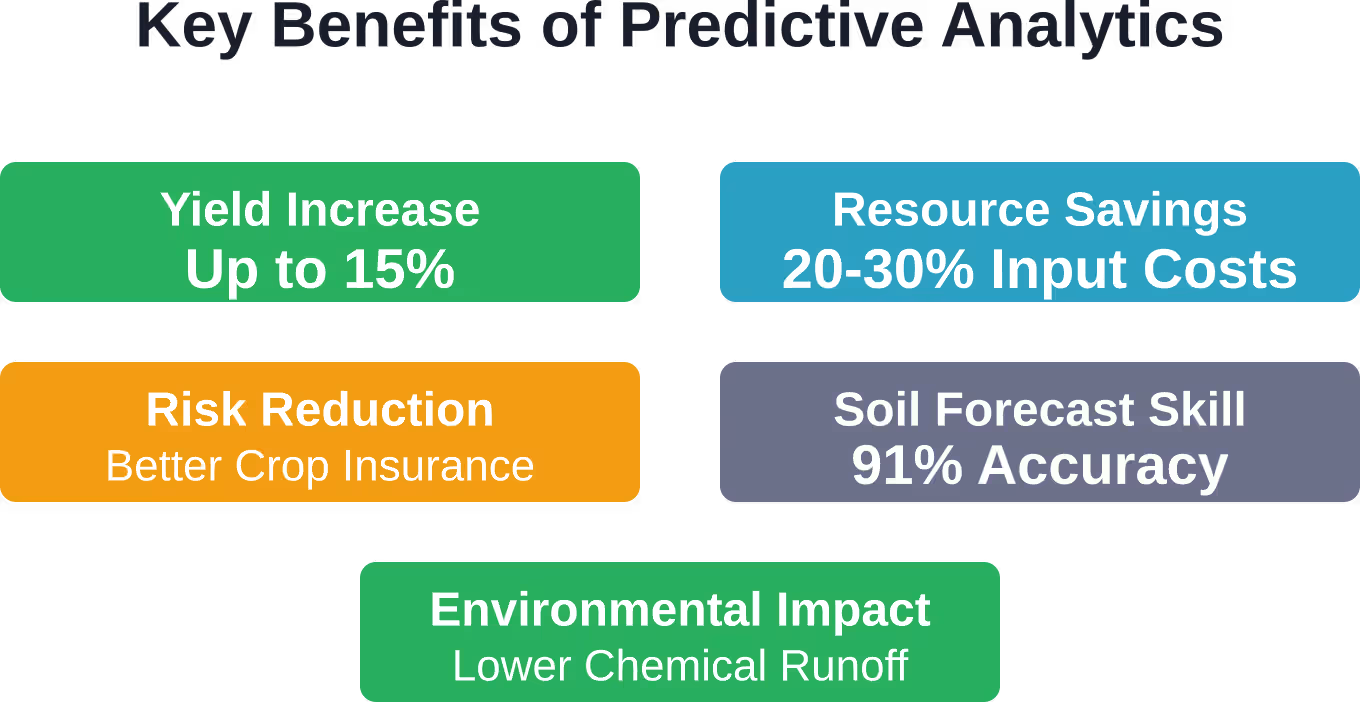
The numbers tell part of the story. A farmer in Iowa increased corn yields by 15% by using predictive models to identify optimal planting windows. That single improvement translated directly to profitability without increasing input costs.
Risk reduction represents another major advantage. Agriculture inherently carries uncertainty around weather, pests, and market fluctuations. Predictive analytics doesn’t eliminate risk, but it quantifies probabilities and helps producers make informed choices about crop insurance, futures contracts, and planting strategies.
Resource optimization might deliver the most consistent benefits across diverse farm operations. Precision agriculture powered by predictive models ensures fertilizer, water, and pesticides get applied where and when they’re needed—not uniformly across entire fields.
Real talk: the environmental benefits matter too. Reduced chemical runoff, lower water consumption, and minimized fuel use align economic incentives with sustainability goals.
Challenges Standing in the Way
Adoption isn’t universal, and barriers remain significant for many producers. Data quality tops the list—models trained on incomplete, inconsistent, or inaccurate information produce unreliable forecasts.
Infrastructure requirements create another hurdle. Soil sensors, weather stations, GPS-equipped equipment, and reliable internet connectivity aren’t available everywhere. Rural areas often lack the broadband necessary to transmit large satellite imagery files or stream real-time sensor data.
The cost structure poses problems too. Small and mid-sized operations may struggle to justify upfront investments in hardware, software subscriptions, and training. The return on investment is clear for large commercial farms, but smaller producers face a steeper adoption curve.
Technical expertise represents a less obvious but equally important constraint. Interpreting model outputs, calibrating sensors, and troubleshooting system failures require skills that traditional farming education programs haven’t always emphasized.
And let’s be honest—trust matters. Farmers who’ve spent decades relying on experience and intuition won’t abandon those methods overnight for algorithm recommendations, especially when early predictions occasionally miss the mark.
| Challenge | Impact Level | Primary Solution |
|---|---|---|
| Data Quality Issues | High | Standardized collection protocols |
| Infrastructure Gaps | High | Broadband expansion, satellite connectivity |
| Cost Barriers | Medium-High | Cooperative purchasing, government subsidies |
| Skills Gap | Medium | Training programs, simplified interfaces |
| Trust and Adoption | Medium | Pilot projects, demonstration farms |
Tools and Technologies Powering the Field
The USDA National Agricultural Statistics Service (NASS) operates the Cropland Data Layer, with related tools including CroplandCROS and VegScape, providing free access to geospatial crop data across the United States. These resources support research, policy decisions, and private sector analytics development.
Satellite platforms like Sentinel-2 deliver multispectral imagery at resolutions suitable for field-level analysis. Complementary tools like VegScape and Crop-CASMA offer specialized views of vegetation health and crop condition.
Commercial platforms have emerged around these public data sources, adding proprietary algorithms, user-friendly interfaces, and integration with farm management systems. The landscape includes everything from enterprise solutions targeting large agribusiness operations to mobile apps designed for individual farmers.
UAV (drone) technology adds another dimension, particularly for specialty crops where tree-level or even fruit-level analysis drives value. Multispectral cameras mounted on drones capture high-resolution data that complements broader satellite coverage.
Implementation Strategies That Work
Starting small makes sense. A pilot project focused on a single crop or field allows producers to test feasibility, build technical skills, and demonstrate value before committing to farm-wide deployment.
Data infrastructure comes first. Install reliable sensors, establish consistent collection protocols, and ensure proper calibration. Predictive models only perform as well as the information they receive.
Don’t overcomplicate models initially. Simple regression approaches often deliver strong results for initial implementations. Sophisticated neural networks can come later as data volume increases and specific needs emerge.
Partner with universities and extension services. Many agricultural research institutions actively seek farm collaborators for field trials and are willing to provide technical support, equipment, and analysis in exchange for access to real-world data.
Integration with existing farm management software streamlines workflows. Standalone analytics platforms create extra work; systems that feed recommendations directly into operational planning get used consistently.
Looking Ahead: Where the Technology Is Headed
Genotype-environment interactions represent a frontier area. Algorithms including deep neural networks, Lasso, shallow neural networks, and regression trees have been evaluated for predicting corn yield based on genetic characteristics across multiple US locations. Breeding programs that incorporate predictive analytics can accelerate development of varieties optimized for specific conditions.
Climate adaptation will drive increased adoption. As weather patterns shift and historical norms become less reliable, data-driven forecasting offers producers a way to navigate unprecedented conditions.
Edge computing and on-farm processing will reduce dependency on constant connectivity. Local model execution allows real-time decision support even in areas with limited internet access.
Integration across the agricultural value chain creates new possibilities. When predictive analytics informs not just farming operations but also supply chain logistics, processing capacity planning, and market forecasting, the entire system becomes more efficient.
Frequently Asked Questions
What data sources are essential for agricultural predictive analytics?
Temperature, rainfall, and soil type represent the most critical input features for crop yield forecasting. Satellite imagery, particularly from platforms like Sentinel-2, adds vegetation health monitoring. On-farm sensors measuring soil moisture, nutrient levels, and microclimatic conditions provide field-specific granularity. Historical yield records and crop management logs complete the foundation.
How accurate are crop yield predictions using machine learning?
Accuracy varies by crop, region, algorithm, and data quality. Soil moisture forecasts several weeks ahead achieve 91% (±3%) skill when properly initialized. Yield forecasts typically achieve strong performance at both regional and field levels, with some implementations showing less than 10% error when conditions remain within historical ranges. Extreme weather events that fall outside training data reduce accuracy.
What’s the typical cost to implement predictive analytics on a farm?
Costs vary dramatically based on farm size, existing infrastructure, and implementation scope. Pilot projects on a single field might require minimal investment if using publicly available data and open-source tools. Farm-wide deployments with comprehensive sensor networks, commercial software platforms, and professional consulting can reach five or six figures. Many producers start small and expand incrementally as value becomes evident.
Which crops benefit most from predictive analytics?
Commodity crops like corn, wheat, and soybeans have extensive research supporting predictive models due to large data volumes and standardized growing practices. Specialty crops including citrus, grapes, and tree fruits increasingly benefit from precision analytics, particularly when UAV imagery enables tree-level or plant-level monitoring. Any crop with significant input costs or market price volatility sees strong return on investment from better forecasting.
Can small farms afford predictive analytics technology?
Cost barriers have decreased substantially. Free government datasets from sources like USDA’s Cropland Data Layer and satellite imagery from Sentinel-2 provide foundational information at no charge. Cooperative purchasing agreements allow multiple small producers to share sensor networks and software subscriptions. University extension programs often provide technical support and training. The challenge lies more in technical expertise than absolute cost for many small operations.
How does predictive analytics handle unprecedented weather conditions?
Machine learning models perform best within the range of conditions represented in training data. Unprecedented events—extreme droughts, record temperatures, unusual frost patterns—reduce prediction accuracy because algorithms haven’t encountered similar situations. Ongoing model retraining with each season’s data gradually expands the range of conditions the system can handle. Ensemble approaches that combine multiple models help manage uncertainty.
What’s the difference between predictive analytics and precision agriculture?
Precision agriculture represents the broader practice of managing field variability to optimize inputs and maximize productivity. Predictive analytics serves as one tool within precision agriculture, specifically focused on forecasting future conditions and outcomes. Precision farming might include GPS-guided equipment, variable rate application, and soil mapping even without predictive models. Predictive analytics adds the forecasting dimension that enables proactive rather than reactive management.
Moving Forward with Confidence
Predictive analytics has moved beyond experimental stage in agriculture. The technology delivers measurable improvements in yields, resource efficiency, and risk management for operations of all sizes.
But implementation requires realistic expectations. Models won’t eliminate uncertainty or replace agronomic expertise. They augment human decision-making with data-driven insights that weren’t previously accessible.
Start with clear objectives. Identify specific problems—yield variability, irrigation scheduling, fertilizer optimization—where better forecasting would create tangible value. Build data infrastructure systematically. Test models on limited acreage before farm-wide deployment.
The farming operations that thrive in coming decades will be those that effectively blend traditional knowledge with modern analytics. The question isn’t whether to adopt predictive analytics, but how to integrate it in ways that align with each operation’s specific circumstances and goals.
Ready to explore how predictive analytics can transform outcomes on your land? Start by assessing current data collection capabilities and identifying one high-impact application area for a pilot project.
 English
  German
  Arabic
  French
  Dutch
Dutch  Spanish