
Quick Summary: Predictive analytics in mining leverages machine learning, real-time sensor data, and statistical models to forecast equipment failures, optimize resource extraction, and enhance safety. By analyzing historical patterns and operational data, mining operations can reduce unplanned downtime by up to 30-50%, cut maintenance costs by 18-40%, and make data-driven decisions that improve productivity and sustainability across exploration, extraction, and processing stages.
The mining industry faces relentless pressure. Equipment operates under extreme conditions, mineral prices fluctuate unpredictably, and safety regulations tighten year after year. Traditional reactive maintenance and gut-feel decision-making don’t cut it anymore.
That’s where predictive analytics steps in. By transforming raw operational data into actionable forecasts, mining companies can anticipate equipment failures before they happen, optimize extraction processes in real time, and make smarter resource allocation decisions. The technology combines machine learning algorithms, sensor networks, and statistical modeling to turn historical patterns into future insights.
Here’s the thing though—predictive analytics isn’t just about preventing breakdowns. It’s reshaping how mining operations approach everything from exploration to environmental compliance.
What Makes Predictive Analytics Different from Traditional Data Mining
Data mining and predictive analytics often get conflated, but they serve distinct purposes in mining operations. Understanding the difference matters when implementing these technologies.
Data mining focuses on uncovering hidden patterns in historical data. It’s past-oriented, looking backward to identify relationships between variables—like correlating ore grade distributions with geological formations or finding unexpected equipment usage patterns.
Predictive analytics takes those discovered patterns and projects them forward. It uses confirmed relationships to forecast future outcomes: when a haul truck will need bearing replacement, what tomorrow’s mill throughput will be, or which exploration sites show highest mineral potential.
| Aspect | Data Mining | Predictive Analytics |
|---|---|---|
| Primary Focus | Uncovering hidden patterns in historical data | Using patterns to predict future outcomes |
| Time Orientation | Past-oriented analysis | Future-focused forecasting |
| Output Type | Pattern identification, correlation discovery | Probability scores, forecasts, risk assessments |
| Mining Application | Identify geological relationships, analyze equipment logs | Forecast failures, optimize production schedules |
Both techniques work together. Data mining provides the foundation—the patterns and relationships—while predictive analytics builds actionable forecasts on that foundation.

Apply Predictive Analytics in Mining with AI Superior
AI Superior builds predictive models on operational and sensor data to support planning, maintenance, and risk control in mining operations.
They focus on models that connect to existing systems, starting with data assessment and a working prototype before scaling.
Looking to Use Predictive Analytics in Mining?
AI Superior can help with:
- evaluating operational and sensor data
- building predictive models
- integrating models into existing systems
- refining outputs based on results
👉 Contact AI Superior to discuss your project, data, and implementation approach
Core Applications Transforming Mining Operations
Predictive analytics creates value across the mining value chain. Several applications deliver measurable operational improvements.
Predictive Maintenance and Equipment Management
Critical assets like crushers, conveyor belts, mills, and ventilation systems operate under extreme conditions. Accelerated wear leads to unexpected failures that halt production and create safety hazards.
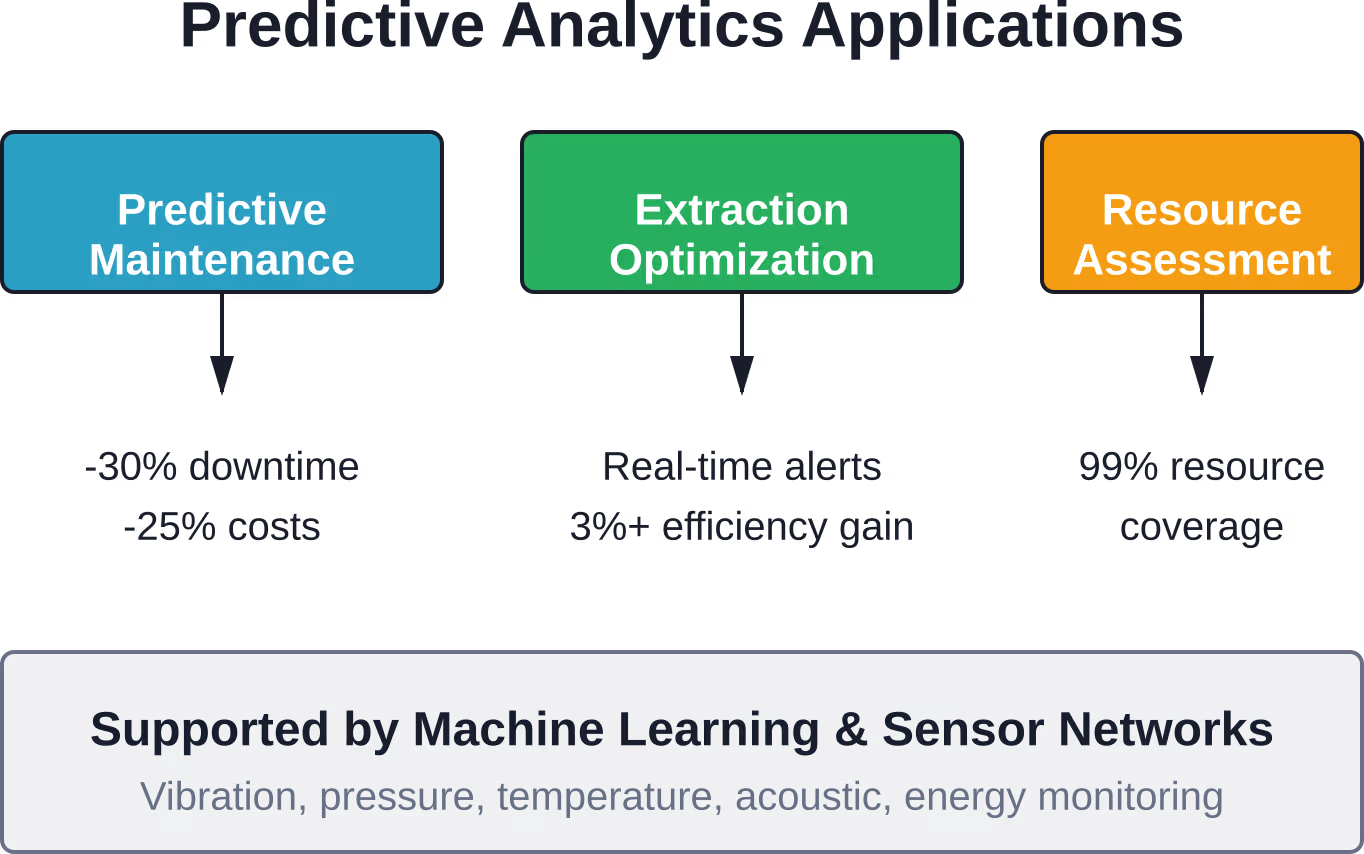
Predictive maintenance models analyze vibration sensors, hydraulic pressure sensors, motor temperature sensors, acoustic sensors, and energy consumption meters to forecast component failures before they occur. Machine learning algorithms detect subtle pattern shifts that signal developing problems.
The impact is substantial. Operations implementing predictive maintenance report 30–50% reductions in unplanned downtime and 18–40% cuts in maintenance costs. Instead of changing bearings on a fixed schedule regardless of condition, maintenance happens precisely when data indicates it’s needed.
Well-implemented machine learning models can achieve high accuracy rates in equipment state forecasting. Machine learning models typically process large training datasets and employ standard validation methodologies.
Resource Extraction Optimization
Cognitive computing systems monitor excavator operations in real time, comparing actual performance against optimal metrics. When an excavator arm consistently over-swings beyond efficient parameters, the system alerts the operator immediately.
According to industry applications, monitoring systems can quantify productivity loss in real time, informing operators of inefficient operation patterns that compound into significant efficiency losses. This immediate feedback loop enables behavioral adjustments that contribute to meaningful efficiency gains.
Exploration and Resource Assessment
The USGS Development of Assessment Techniques and Analysis Project II (DATAP II) modernized mineral resource assessment methodologies. The project includes a database of significant deposits of gold, silver, copper, lead, and zinc in Alaska.
Thresholds identified through this work account for 99% of U.S. past production and remaining identified resources. Deposits meeting minimum criteria—2 metric tons of gold, 85 metric tons of silver, 50,000 metric tons of copper, 30,000 metric tons of lead, or 50,000 metric tons of zinc—represent nearly all economically viable resources.
Predictive models trained on this geological data help exploration teams identify promising sites before expensive drilling programs begin.
Technology Stack Powering Mining Predictions
Effective predictive analytics requires integrating multiple technology layers. The stack typically includes sensor networks, data infrastructure, analytical models, and visualization interfaces.
Sensor Networks and IoT Integration
The Internet of Things provides the raw data foundation. Vibration sensors mounted on rotating equipment, pressure transducers in hydraulic systems, thermal imaging cameras monitoring bearing temperatures—these devices generate continuous data streams measuring operational conditions.
Wireless sensor networks deployed across sprawling mine sites transmit readings to centralized data platforms. The volume can be staggering: a single large operation might generate terabytes of sensor data monthly.
Machine Learning Algorithms
Multiple algorithm families find applications in mining predictive analytics. Ensemble methods combining multiple model types can deliver improved accuracy by updating predictions as new sensor streams arrive.
Deep learning networks excel at pattern recognition in complex, high-dimensional sensor data. Reinforcement learning optimizes sequential decisions like blasting schedules or equipment routing. Bayesian updating techniques quantify uncertainty in predictions, crucial when safety decisions depend on model outputs.
SHAP values and scenario analysis help operators trust and interpret recommendations. Transparency matters when models suggest expensive interventions or highlight safety risks.
Digital Twin Technology
Digital twins create virtual replicas of physical assets or processes. These models ingest real-time sensor data, simulating equipment behavior under various conditions.
When combined with predictive analytics, digital twins enable operators to test “what-if” scenarios without risking actual equipment. What happens if we increase mill throughput by 5%? How will that bearing perform under heavier loads? Digital twins provide answers before implementing changes.
Implementation Challenges and Solutions
Real talk: deploying predictive analytics in mining operations isn’t plug-and-play. Several challenges emerge repeatedly.
Data Standardization and Quality
Legacy systems across different mine sites often use incompatible data formats. One site logs equipment hours in decimal format, another uses hours-and-minutes. Sensor calibration varies. Historical records contain gaps.
Addressing these issues requires establishing data governance standards before model development begins. Clean, standardized data isn’t glamorous work, but it’s foundational.
IT and OT Integration
Operational technology systems controlling physical processes traditionally operated separately from information technology networks. Security concerns, different protocols, and organizational silos kept them apart.
Industry 4.0 requires converging these domains. As one practitioner noted, IT departments initially resist connecting operational systems due to security concerns—even when senior executives sponsor integration programs. The holdout stems from legitimate caution about introducing vulnerabilities into production control systems.
Solutions involve establishing secure data transfer protocols, creating demilitarized zones between networks, and building cross-functional teams that bridge IT and OT expertise.
Model Scalability and Maintenance
A predictive model trained on one crusher type at one site won’t necessarily generalize to different equipment or geological conditions. Scaling requires either developing site-specific models or building more complex models that account for operational variability.
Models also degrade over time as equipment configurations change, new ore bodies introduce different material properties, or operating practices evolve. Continuous model monitoring and retraining processes are essential.
Sustainability and Environmental Compliance Applications
Predictive analytics extends beyond operational efficiency into environmental stewardship. Regulatory pressure increases globally, and environmental metrics directly impact operating licenses.
Predictive analytics applications for energy, water, and tailings management have the potential to optimize resource consumption and reduce environmental impact. These improvements come from optimizing process parameters in real time rather than operating within static setpoints.
Tailings dam monitoring represents a critical safety application. Sensor networks tracking pore pressure, seepage rates, and structural movement feed predictive models that flag developing instability risks. Early warnings enable preventive interventions before catastrophic failures occur.
Looking Ahead: 2026 and Beyond
Industry forecasts suggest significant adoption of predictive analytics for operational optimization among mining and oil-and-gas firms in coming years. The technology is transitioning from competitive advantage to operational necessity.
Several trends are accelerating. Real-time AI applications are replacing batch processing approaches—models update continuously as sensor data streams in rather than running scheduled analyses. Explainable AI methods address the “black box” problem, making model reasoning transparent to operators and regulators.
Mixed-data models that examine both structured numerical data and unstructured text and images will become standard. A comprehensive predictive system might analyze sensor readings, maintenance logs, operator notes, and equipment photos simultaneously.
The convergence of predictive analytics with autonomous operations creates feedback loops where insights automatically trigger actions without human intervention. When a model forecasts bearing failure in 72 hours, the system autonomously schedules replacement during the next planned downtime window.
Frequently Asked Questions
What’s the difference between predictive analytics and descriptive analytics in mining?
Descriptive analytics examines historical data to understand what happened—production volumes last quarter, equipment failure rates, or ore grade distributions. Predictive analytics uses those historical patterns to forecast what will happen—which equipment will fail next month, expected production rates, or resource deposit locations. Descriptive analytics looks backward; predictive analytics looks forward.
How accurate are predictive maintenance models?
Accuracy varies based on data quality, model sophistication, and application specifics. Well-implemented machine learning models can achieve high accuracy rates in equipment state forecasting. Ensemble methods combining multiple algorithms typically deliver improved accuracy compared to single-algorithm approaches. Real-world performance depends heavily on sensor coverage and historical data availability.
What ROI can mining operations expect from predictive analytics?
Documented impacts include 30-50% reductions in unplanned downtime and 18-40% cuts in maintenance costs. Production optimization can yield efficiency improvements. Environmental compliance applications optimize resource consumption and environmental impact. Total ROI depends on operation scale, but payback periods of 12–24 months are common for comprehensive implementations.
Do small mining operations benefit from predictive analytics?
Absolutely. While large operations have more data and resources for sophisticated systems, even small operations gain value from focused applications. Starting with predictive maintenance for critical equipment delivers measurable benefits without requiring enterprise-scale infrastructure. Cloud-based analytics platforms reduce upfront investment, making the technology accessible across operation sizes.
What data infrastructure is required to implement predictive analytics?
Minimum requirements include sensor networks on critical equipment, data storage infrastructure (cloud or on-premises), and analytical computing capacity. Many operations start with existing SCADA and historian systems, adding IoT sensors incrementally. Connectivity challenges in remote locations can be addressed through edge computing that processes data locally before transmitting insights.
How do predictive analytics systems handle geological variability?
Advanced models incorporate geological parameters as input features, learning how ore characteristics affect equipment performance and process behavior. Transfer learning techniques allow models trained on one ore type to adapt to different mineralogy with reduced retraining data. Site-specific customization remains important, but modern approaches reduce the effort required to handle variability.
What skills do teams need to implement and maintain these systems?
Cross-functional expertise is essential: data scientists who understand machine learning, process engineers familiar with mining operations, IT professionals managing infrastructure, and OT specialists maintaining sensor networks. Many operations partner with specialized vendors initially, gradually building internal capabilities through knowledge transfer and training programs.
Taking the Next Step
Predictive analytics has moved from experimental to essential in modern mining operations. The question isn’t whether to implement these technologies, but how quickly and strategically to deploy them.
Start with high-impact, well-defined applications rather than attempting comprehensive transformation immediately. Predictive maintenance on critical equipment provides clear ROI and generates organizational buy-in for broader initiatives.
Data quality matters more than algorithm sophistication. Investing time in data standardization, sensor calibration, and governance processes pays dividends throughout the analytics lifecycle.
And remember—predictive analytics augments human expertise rather than replacing it. The most effective implementations combine algorithmic insights with operator knowledge, creating partnerships between human judgment and machine precision that outperform either alone.
 English
  German
  Arabic
  French
  Dutch
Dutch  Spanish