Quick Summary: Predictive analytics in data mining combines statistical algorithms, machine learning, and historical data patterns to forecast future outcomes and trends. The process extracts hidden patterns from large datasets through data mining techniques, then applies predictive models to make informed business decisions, reduce risks, and optimize operations across industries like healthcare, finance, and marketing. Organizations drown in data but starve for insights. That’s the paradox facing businesses today. Predictive analytics in data mining solves this problem by transforming raw historical data into actionable forecasts. The approach uses statistical algorithms and machine learning techniques to identify patterns that reveal what’s likely to happen next. According to IBM, predictive AI involves using statistical analysis and machine learning to identify patterns, anticipate behaviors, and forecast upcoming events. Organizations use predictive AI to predict potential future outcomes, causation, and risk exposure. The difference between guessing and knowing shapes competitive advantage. Let’s explore how predictive analytics extracts value from data mining.
Understanding the Foundation: Data Mining vs. Predictive Analytics
Data mining and predictive analytics aren’t the same thing, though they work hand-in-hand. Data mining focuses on discovering hidden patterns in historical data. The process examines large datasets to uncover relationships, anomalies, and trends that weren’t obvious before. Think of it as the exploration phase. Predictive analytics takes those discovered patterns and uses them to forecast future outcomes. It’s the application phase that converts patterns into predictions. Here’s the thing though—you can’t have effective predictive analytics without solid data mining. The mining process provides the raw material that predictive models need.
| Aspect | Data Mining | Predictive Analytics |
|---|---|---|
| Primary Focus | Uncovering hidden patterns in historical data | Using patterns to predict future outcomes |
| Time Orientation | Past-oriented | Future-oriented |
| Main Output | Patterns, correlations, anomalies | Forecasts, probabilities, predictions |
| Common Techniques | Clustering, association rules, classification | Regression, decision trees, neural networks |
| Business Question | What happened and why? | What will happen next? |
Research on predictive analytics as the core of data mining has received significant academic attention from academic researchers in this field. 
Use Predictive Analytics in Data Mining with AI Superior
AI Superior works with large datasets to build predictive models that extract patterns and support decision-making. The focus is on selecting the right modeling approach and integrating results into existing workflows.
Looking to Apply Predictive Analytics in Data Mining?
AI Superior can help with:
- assessing data sources
- building predictive models
- testing and refining approaches
- integrating results into workflows
👉 Contact AI Superior to discuss your project, data, and implementation approach
How the Process Actually Works
Predictive analytics in data mining follows a systematic workflow. Each stage builds on the previous one. First comes data collection. Organizations gather relevant historical data from multiple sources—transactional databases, customer interactions, sensor readings, social media, whatever contains the signal needed for prediction. Next is data preparation. Raw data is messy. This stage involves cleaning errors, handling missing values, removing duplicates, and transforming variables into usable formats. Research using predictive models reported extensive data cleaning and preparation, applying validation split ratios for model training. Then data mining techniques extract patterns. Algorithms analyze the prepared data to identify relationships between variables, segment populations, or detect anomalies. After that, predictive models are built. Statistical algorithms and machine learning techniques use the discovered patterns to create models that can forecast outcomes. Common approaches include regression analysis, decision trees, neural networks, and support vector machines. Model validation follows. The predictive model is tested against new data it hasn’t seen before to measure accuracy. Research has demonstrated Naïve Bayes models achieving high accuracy rates in classification tasks. Finally, deployment happens. Once validated, the predictive model is deployed into production environments where it makes real-time predictions based on incoming data.
Core Techniques and Algorithms
Several statistical and machine learning techniques power predictive analytics in data mining.
Regression Analysis
Regression models predict continuous numerical outcomes. Linear regression forecasts values based on relationships between variables, while logistic regression predicts probabilities for binary outcomes (yes/no, true/false).
Decision Trees
These models split data into branches based on decision rules, creating a tree-like structure. Random forests combine multiple decision trees to improve prediction accuracy and reduce overfitting.
Neural Networks
Inspired by biological neurons, these algorithms detect complex nonlinear patterns. Deep learning variants excel at image recognition, natural language processing, and other sophisticated prediction tasks.
Naïve Bayes Classifiers
Based on probability theory, Naïve Bayes algorithms calculate the likelihood of outcomes given certain conditions. Research has demonstrated these models achieving high accuracy rates in classification tasks.
Support Vector Machines
SVMs find optimal boundaries between different classes in data, working well for both classification and regression problems.
Time Series Analysis
Specialized techniques like ARIMA models forecast future values based on temporal patterns in sequential data—essential for stock prices, weather forecasting, and demand planning.
| Technique | Best For | Output Type | Complexity |
|---|---|---|---|
| Linear Regression | Continuous numerical predictions | Numerical values | Low |
| Decision Trees | Classification and interpretability | Categories or values | Medium |
| Neural Networks | Complex nonlinear patterns | Categories or values | High |
| Naïve Bayes | Text classification, spam detection | Probabilities | Low |
| Time Series Models | Sequential temporal forecasting | Future values | Medium |
Real-World Applications Across Industries
Predictive analytics in data mining drives decision-making across virtually every sector.
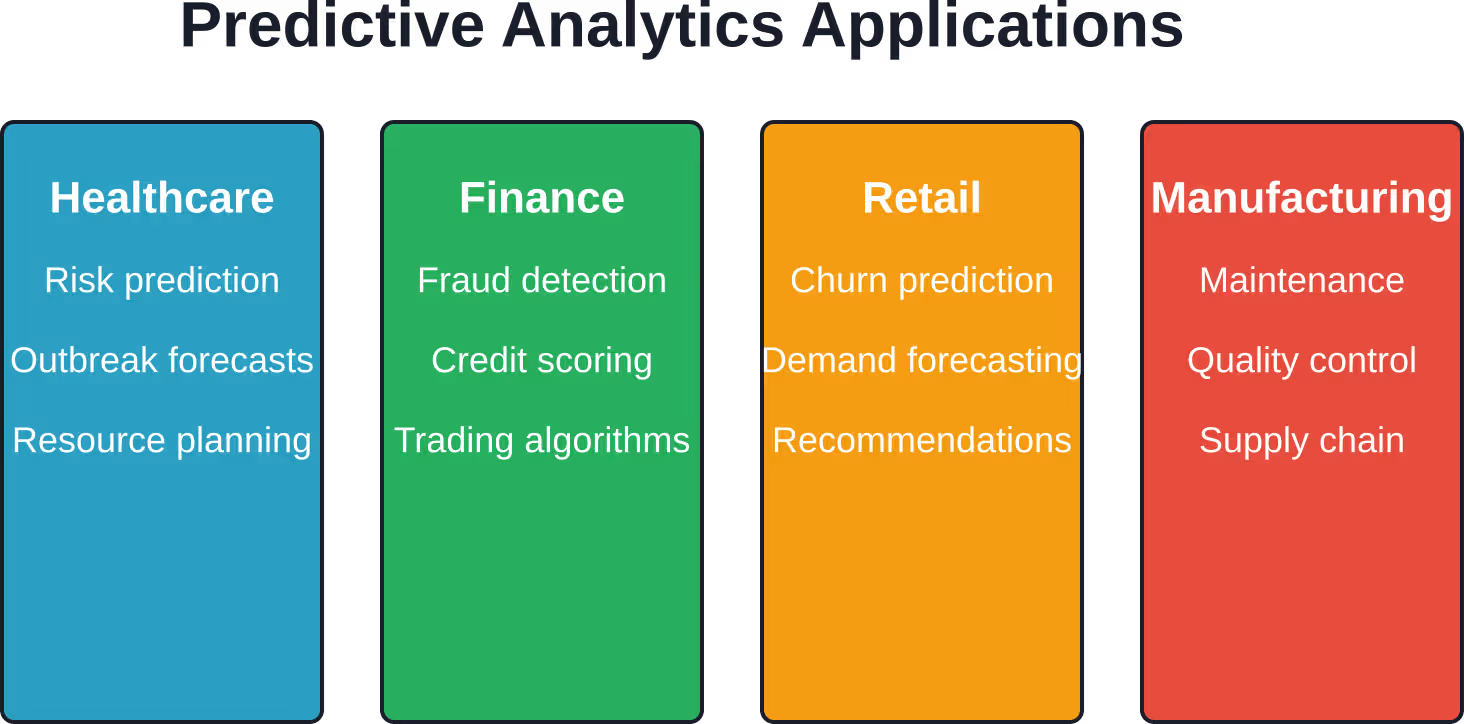
- Healthcare: Hospitals use predictive models to identify patients at high risk for readmission, forecast disease outbreaks, and optimize resource allocation. In cybersecurity procedures, data mining identifies unusual patterns in systems that may indicate breaches—phishing attacks have shown detectable patterns through predictive analysis.
- Finance: Banks deploy predictive analytics for credit scoring, fraud detection, and algorithmic trading. Research on stock market analysis using predictive analytics has been conducted using k-NN algorithm applications and Markov chain analysis in stock index trend prediction.
- Retail: E-commerce platforms predict customer churn, recommend products, and forecast demand. Marketing teams use predictive models to identify which customers are most likely to respond to campaigns.
- Manufacturing: According to NIST, data analytics for smart manufacturing systems helps small and medium enterprises apply data analytics services to improve decision-making and performance. Predictive maintenance forecasts equipment failures before they happen.
- Marketing: Academic research on knowledge creation in marketing emphasizes that predictive analytics uses confirmed relationships between variables to predict future outcomes, most often values suggesting the likelihood a particular behavior or event will take place.
Benefits That Drive Adoption
Why do organizations invest in predictive analytics? The advantages are compelling.
- Risk reduction: Forecasting potential problems allows proactive mitigation. Financial institutions reduce loan defaults by predicting creditworthiness more accurately.
- Operational efficiency: Predictive maintenance prevents costly equipment breakdowns. Manufacturers schedule repairs during planned downtime rather than dealing with unexpected failures.
- Revenue growth: Targeted marketing campaigns based on predictive customer scoring generate higher conversion rates. Retailers optimize inventory to match predicted demand, reducing both stockouts and overstock costs.
- Better decision-making: Data-driven forecasts replace gut feelings and guesswork. Executives make strategic choices supported by statistical evidence.
- Competitive advantage: Organizations that predict market shifts respond faster than competitors still analyzing what already happened.
Challenges and Limitations
Predictive analytics isn’t magic. Real constraints exist. Data quality issues undermine predictions. Garbage in, garbage out remains true. Models trained on biased or incomplete historical data produce unreliable forecasts. The domain must involve many individual cases. Predictive analytics works when sufficient historical examples exist to establish patterns. Forecasting unique one-time events proves difficult. Model complexity creates interpretability problems. Neural networks might predict accurately but offer little explanation for why. Regulated industries like healthcare and finance often require transparent reasoning. Overfitting happens when models memorize training data rather than learning generalizable patterns. The model performs brilliantly on historical data but fails on new cases. Predictions are probabilistic, not certain. A 95% accuracy rate still means 5% error. Businesses must account for the residual uncertainty in planning. Continuous maintenance is required. Patterns change over time—customer behavior shifts, market conditions evolve, new variables emerge. Models need regular retraining to stay accurate.
Machine Learning’s Growing Role
Machine learning has transformed predictive analytics in data mining. Traditional statistical methods required analysts to manually specify relationships between variables. Machine learning algorithms discover patterns automatically. Given enough data, these systems identify complex nonlinear relationships that humans might miss. The distinction matters. Traditional regression analysis needs someone to hypothesize which variables predict the outcome. Machine learning explores thousands of potential patterns simultaneously. Deep learning neural networks achieve remarkable accuracy on tasks like image classification and natural language processing. Research in this field has demonstrated substantial academic impact. But here’s the trade-off: machine learning models often sacrifice interpretability for accuracy. Random forests with hundreds of trees predict well but explain poorly.
Getting Started With Predictive Analytics
Organizations new to predictive analytics should follow a practical approach. Start with a specific business problem. Don’t implement predictive analytics because it’s trendy. Identify a concrete challenge—customer churn, inventory optimization, fraud detection—where forecasting would add value. Assess data availability. Do sufficient historical examples exist? Is the data accessible, clean, and relevant? Begin with simple models. Linear regression and decision trees are easier to interpret and implement than neural networks. Build complexity gradually as needs justify it. Invest in data infrastructure. Predictive analytics requires systems that collect, store, and process data efficiently. Develop analytical talent. Organizations need people who understand both the business domain and statistical methods. Training existing staff often works better than only hiring outside experts. Validate thoroughly before deployment. Test models on holdout data they’ve never seen. Measure accuracy in realistic production conditions, not just controlled experiments.
Frequently Asked Questions
What is predictive analytics in data mining?
Predictive analytics in data mining is the process of using statistical algorithms and machine learning techniques to analyze historical data patterns and forecast future outcomes. Data mining discovers hidden patterns in large datasets, while predictive analytics applies those patterns to predict behaviors, trends, and events that haven’t occurred yet.
How accurate are predictive analytics models?
Accuracy varies by application, data quality, and technique used. Research has demonstrated models achieving high accuracy rates in classification tasks. However, simpler problems with clean data typically perform better than complex scenarios with noisy data. Continuous monitoring and retraining help maintain accuracy over time.
What’s the difference between data mining and predictive analytics?
Data mining focuses on discovering patterns, correlations, and anomalies in historical data—answering “what happened?” Predictive analytics uses those discovered patterns to forecast what will happen next. Data mining is exploration; predictive analytics is application. Both work together in a complementary workflow.
Which industries benefit most from predictive analytics?
Healthcare, finance, retail, manufacturing, and marketing see substantial benefits. Healthcare predicts patient risk and resource needs. Finance detects fraud and scores credit. Retail forecasts demand and customer behavior. Manufacturing anticipates equipment failures. Any industry with sufficient historical data can apply predictive analytics effectively.
What skills are needed for predictive analytics?
Successful predictive analytics requires statistics and probability knowledge, programming skills in languages like Python or R, understanding of machine learning algorithms, data preparation and cleaning abilities, domain expertise in the business problem being solved, and critical thinking to interpret results and validate models.
How much data is needed for predictive analytics?
The amount depends on problem complexity and variability. Simple problems might need hundreds of examples; complex scenarios require thousands or millions. Generally, more data improves prediction accuracy, but quality matters more than quantity.
Can small businesses use predictive analytics?
Absolutely. Cloud-based tools and open-source software have made predictive analytics accessible to organizations of all sizes. NIST research focuses on helping small and medium enterprises apply data analytics services to improve decision-making and performance. Start with focused problems where even modest improvements deliver value.
Looking Forward
Predictive analytics in data mining continues evolving rapidly. Several trends shape the future. Real-time predictions are becoming standard. Organizations want forecasts updated continuously as new data arrives, not batch processes that run nightly. Mixed-data models combining structured numbers with unstructured text and images expand prediction capabilities. Natural language processing extracts signals from customer reviews, support tickets, and social media. Automated machine learning platforms reduce the expertise barrier. AutoML tools handle algorithm selection, feature engineering, and hyperparameter tuning, making predictive analytics accessible to non-specialists. Explainable AI addresses the interpretability challenge. New techniques help neural networks and ensemble models explain their reasoning, crucial for regulated industries. Edge computing enables predictions on devices rather than centralized servers. Smart manufacturing systems and IoT sensors forecast locally with minimal latency. The demand for data analysts continues growing. Academic programs increasingly emphasize quantitative skills so large amounts of information convert to knowledge instead of information overload. Organizations that master predictive analytics in data mining won’t just react to change—they’ll anticipate it. The patterns are already there, waiting in historical data. The competitive question is who extracts them first.