
Quick Summary: Predictive analytics in procurement uses historical data, machine learning, and statistical algorithms to forecast future outcomes—from supplier performance to demand fluctuations. Organizations leveraging predictive models report 20–50% better forecast accuracy and up to 30% inventory cost reductions, transforming reactive purchasing into proactive strategic planning.
Procurement teams have spent decades reacting. A purchase request arrives, approvals get routed, suppliers get contacted, and orders flow out. Rinse, repeat. But here’s the thing: reactive purchasing leaves money on the table and opens the door to risk.
Predictive analytics flips that script. Instead of waiting for problems to surface, advanced models analyze patterns in spend data, supplier behavior, market signals, and demand trends to forecast what’s coming next. That shift—from looking backward to looking forward—gives procurement teams the lead time they need to negotiate better contracts, avoid disruptions, and optimize inventory.
And the numbers back it up. According to authoritative industry research, companies using AI and predictive models in their supply chains during recent volatility achieved 20–50% better forecast accuracy. That translates directly into lower safety stock, fewer stockouts, and tighter cost control.
What Is Predictive Analytics in Procurement?
Predictive analytics applies statistical algorithms, machine learning, and data mining to historical procurement data. The goal? Generate forecasts about future events—supplier delivery performance, price movements, demand spikes, contract compliance, even fraud risk.
Unlike descriptive analytics (which tells you what happened) or diagnostic analytics (which explains why it happened), predictive analytics answers: What’s likely to happen next?
Typical use cases include:
- Forecasting supplier lead times and delivery reliability
- Predicting demand to optimize order quantities
- Identifying contracts at risk of non-compliance or disputes
- Flagging suppliers with elevated financial or operational risk
- Projecting category spend to stay within budget
Modern predictive procurement platforms ingest data from ERP systems, supplier portals, invoices, market indices, even external signals like geopolitical events or weather patterns. Machine learning models then spot correlations humans would miss and surface early warnings before issues escalate.
Why Predictive Analytics Matters Now
Procurement’s operating environment has fundamentally changed. Supply chain visibility beyond Tier One suppliers has shown a recovery trend, reaching approximately 45-50% by early 2026, following the post-pandemic lows of 2024. At the same time, talent shortages are acute—approximately 65% of companies reported a critical skills gap in AI-driven procurement in 2026.
That’s a dangerous combination: less visibility, fewer people, and more volatility. Predictive analytics helps close the gap by automating insight generation and surfacing risks that would otherwise stay buried in spreadsheets.
Consider inventory waste. Industry estimates put annual inventory loss from overproduction and expiration at roughly $163 billion, eroding about 3.6% of profit for high-volume companies. Predictive demand forecasting directly attacks that problem by aligning procurement with actual consumption patterns.
Or take supplier performance. A predictive model might flag: “Supplier A has a 70% likelihood of late delivery next month based on performance trends.” That gives procurement time to line up alternatives or renegotiate terms before a stockout hits production.

Apply Predictive Analytics in Procurement with AI Superior
AI Superior builds predictive models on purchasing and supplier data to support planning, demand estimation, and cost control.
They focus on models that connect to existing systems, starting with data assessment and a working prototype before scaling.
Looking to Use Predictive Analytics in Procurement?
AI Superior can help with:
- evaluating purchasing and supplier data
- building predictive models
- integrating models into existing systems
- refining outputs based on results
👉 Contact AI Superior to discuss your project, data, and implementation approach
Core Components of Predictive Procurement Analytics
Building a predictive analytics capability requires three layers: data, models, and integration.
Data Sources
Predictive models are only as good as the data feeding them. Key sources include:
- Transactional data: Purchase orders, invoices, receipts, payment terms from ERP and procure-to-pay systems
- Supplier data: On-time delivery rates, quality scores, contract terms, financial health indicators
- Demand signals: Sales forecasts, production schedules, inventory levels, seasonal patterns
- Market data: Commodity price indices, currency exchange rates, tariff changes
- External events: Weather disruptions, geopolitical developments, regulatory shifts
Data quality is non-negotiable. Nike, for instance, reported a 10% forecast accuracy improvement after upgrading data quality in planning systems—cleaner point-of-sale data, master data hygiene, and calendarized promotions made the difference.
Predictive Models and Techniques
Several machine learning and statistical methods power procurement predictions:
- Regression models: Forecast continuous outcomes like spend, lead times, or price changes based on historical relationships
- Classification algorithms: Predict categorical outcomes—will this supplier default? Is this invoice fraudulent?
- Time-series forecasting: Capture seasonal and trend patterns in demand or pricing (ARIMA, exponential smoothing, Prophet)
- Neural networks: Handle complex, non-linear relationships in large datasets (especially useful for demand forecasting in retail and CPG)
- Ensemble methods: Combine multiple models (random forests, gradient boosting) to improve robustness
Industry research highlights that leaders applying AI- and ML-enabled demand sensing achieve 8–12% better forecast accuracy and 12–18% fewer stockouts. Those gains compound across categories.
Integration and Workflow
Predictive insights don’t help if they sit in a dashboard nobody checks. Effective implementations embed predictions into procurement workflows:
- Alerts in the procure-to-pay system when a supplier’s risk score crosses a threshold
- Automated reorder recommendations based on demand forecasts
- Contract renewal prompts triggered by predicted compliance drift
- Sourcing event prioritization based on projected spend volatility
Integration also means connecting predictive models to upstream and downstream systems—demand planning, inventory management, logistics, finance. That’s where the full value shows up.
Key Use Cases for Predictive Analytics in Procurement
Demand Forecasting and Inventory Optimization
Predicting future demand is the most common predictive analytics application. Machine learning models analyze historical sales, seasonality, promotions, economic indicators, and even social media sentiment to project what customers will buy.
Better demand forecasts mean procurement can order the right quantities at the right time—reducing both stockouts and excess inventory. Autonomous planning adoption is associated with significant improvements in operational metrics including inventory reduction and supply chain cost efficiency.
Supplier Risk Management
Supplier failures cost companies millions in delayed shipments, quality issues, and emergency sourcing. Predictive models assess financial stability, delivery track records, quality trends, and external risk factors (geopolitical, weather, regulatory) to score each supplier’s risk profile.
When a supplier’s risk score spikes, procurement gets an alert with enough lead time to diversify sourcing or build buffer stock. That early warning is the difference between a minor hiccup and a production shutdown.
Price and Spend Forecasting
Commodity prices, currency fluctuations, and supplier pricing behavior all create budget uncertainty. Predictive analytics tracks historical price patterns, correlates them with market indices and macroeconomic indicators, then projects future costs.
One practical example: a predictive system might warn, “Your MRO category spend is projected to exceed budget by 15% within 45 days.” That gives procurement time to renegotiate contracts, switch suppliers, or adjust consumption before the overage hits the P&L.
Contract Compliance and Renewal
Contracts drift. Suppliers miss service-level commitments, buyers order off-contract, and renewal deadlines sneak up. Predictive models flag contracts with elevated compliance risk based on historical performance, transaction patterns, and clause complexity.
Automation can also predict optimal renewal timing—factoring in market conditions, supplier performance trends, and internal demand forecasts—to ensure procurement negotiates from a position of strength.
Fraud and Anomaly Detection
Procurement fraud—duplicate invoices, phantom suppliers, kickback schemes—is notoriously hard to catch manually. Machine learning excels at spotting anomalies: unusual invoice amounts, payment patterns that don’t match purchase orders, new suppliers with characteristics matching known fraudsters.
Classification algorithms trained on historical fraud cases can flag suspicious transactions in real time, routing them for human review before payment goes out.
Benefits of Predictive Analytics in Procurement
The shift from reactive to predictive procurement delivers measurable business value across multiple dimensions.
Cost Savings
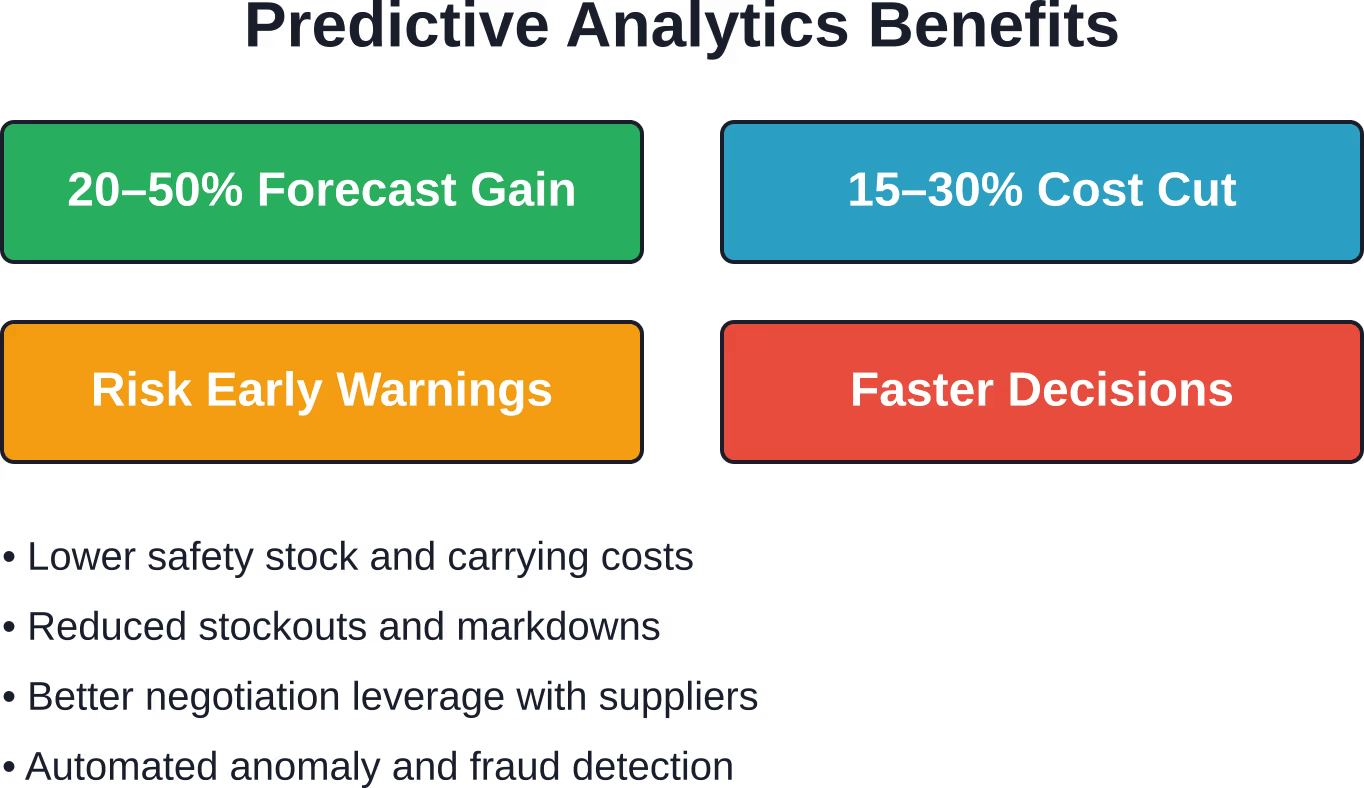
Predictive models reduce waste, avoid emergency purchases, and improve negotiation leverage. Optimized inventory alone can cut carrying costs by 15–30%, and better demand forecasts reduce markdown losses and obsolescence.
Automation of routine tasks also frees up procurement staff. UK businesses lose about 10% of their workday—roughly 160 hours per employee annually—on invoice matching and PO creation. Predictive systems automate much of that, redirecting talent to strategic sourcing and supplier relationship management.
Risk Mitigation
Early warning systems for supplier performance, financial distress, and compliance drift give procurement the lead time to act before risk materializes. That’s especially critical in industries with complex, global supply chains where a single supplier failure can cascade into production delays.
Improved Decision-Making
Predictive analytics replaces gut feel with data-driven recommendations. Instead of guessing which suppliers to prioritize for cost-reduction initiatives, procurement can target those with the highest predicted savings potential. Instead of blanket safety stock policies, inventory levels adjust dynamically based on demand forecasts and supplier reliability scores.
Competitive Advantage
Speed matters. Companies that can forecast demand shifts, adjust sourcing strategies, and reallocate inventory faster than competitors gain market share. Predictive analytics compresses decision cycles and enables agile responses to market changes.
Challenges and Considerations
Predictive analytics isn’t a silver bullet. Implementation comes with real challenges.
Data Quality and Availability
Garbage in, garbage out. If historical data is incomplete, inconsistent, or inaccurate, predictive models will generate flawed forecasts. Data cleansing, master data management, and integration across siloed systems are foundational work that can’t be skipped.
Many organizations also lack the breadth of data needed for robust predictions. External data sources—market indices, weather feeds, geopolitical risk scores—often need to be licensed and integrated.
Talent and Skills Gaps
Building and maintaining predictive models requires data science skills—statistics, machine learning, Python or R programming, SQL. The 90% talent shortage for digitization projects noted earlier hits procurement analytics hard.
Organizations can address this through a mix of hiring, upskilling existing staff, and partnering with analytics vendors or consultancies. Cloud-based analytics platforms with pre-built models and no-code interfaces also lower the technical barrier.
Change Management
Predictive analytics shifts decision-making from experience-based judgment to data-driven recommendations. That can be uncomfortable for procurement veterans used to trusting their gut.
Successful implementations involve procurement teams early, demonstrate quick wins, and build trust in the models through transparency (showing how predictions are generated) and validation (comparing predictions to actual outcomes).
Technology and Integration Complexity
Predictive analytics platforms need to connect to ERP, spend management, supplier portals, and external data feeds. That integration work is often underestimated in scope and complexity.
Adoption rates for procurement technology vary widely by company size. Smaller organizations may need to start with simpler analytics solutions before scaling to full predictive capabilities.
Implementation Roadmap
Rolling out predictive analytics in procurement follows a maturity curve. Most teams start reactive, move to descriptive and diagnostic analytics, then layer in predictive and prescriptive capabilities.
| Stage | Description | Characteristics |
|---|---|---|
| 1. Reactive | Ad hoc reporting | Manual spreadsheets, siloed systems, limited visibility |
| 2. Descriptive | Consistent reporting | Basic dashboards, backward-looking KPIs, some automation |
| 3. Diagnostic | Root cause analysis | Drill-down reports, variance analysis, why things happened |
| 4. Predictive | Forecasting | Machine learning models, early warnings, what’s likely next |
| 5. Prescriptive | Optimization | Automated recommendations, scenario planning, optimal actions |
Here’s a practical path forward:
Step 1: Assess Current State
Audit existing data sources, analytics tools, and reporting processes. Identify gaps in data quality, integration, and skill sets. Benchmark current forecast accuracy, supplier risk visibility, and spend predictability.
Step 2: Define Use Cases
Start with one or two high-value, high-feasibility use cases. Demand forecasting and supplier risk scoring are common starting points because they deliver clear ROI and rely on data most organizations already have.
Step 3: Build Data Infrastructure
Invest in data integration, cleansing, and governance. Establish a single source of truth for supplier master data, transaction history, and key performance metrics. Consider a cloud data warehouse (Snowflake, Databricks, or similar) to centralize procurement data.
Step 4: Pilot Predictive Models
Develop or deploy pre-built models for your chosen use cases. Test on historical data, validate accuracy, and tune parameters. Involve procurement stakeholders to review predictions and provide feedback.
Step 5: Integrate and Scale
Embed predictions into procurement workflows—alerts in the P2P system, recommendations in the sourcing platform, dashboards for category managers. Measure impact: forecast accuracy improvements, cost savings, risk events avoided. Then expand to additional use cases and categories.
Step 6: Continuous Improvement
Predictive models degrade over time as market conditions and supplier behavior change. Establish processes to retrain models regularly, incorporate new data sources, and refine algorithms based on performance feedback.
Technology Landscape
The procurement analytics market includes specialized point solutions, ERP-native analytics modules, and integrated procure-to-pay platforms with embedded predictive capabilities.
Leading categories include:
- Spend analytics platforms: Tools like Coupa, Zylo, and SAP Ariba aggregate spend data, classify transactions, and generate dashboards. Advanced versions layer in predictive spend forecasting and supplier risk scoring.
- Demand planning software: Solutions from Blue Yonder, Kinaxis, and o9 Solutions use machine learning to forecast demand and optimize inventory. These often integrate with procurement to align purchasing with predicted consumption.
- Supplier risk management: Platforms like Resilinc, Riskmethods, and Dun & Bradstreet monitor supplier financial health, operational performance, and external risk factors, generating predictive risk scores.
- Procurement suites: Comprehensive platforms (SAP Ariba, Coupa, Jaggaer) increasingly embed predictive analytics across sourcing, contracting, purchasing, and supplier management workflows.
Industry surveys show 66% of CPOs have procure-to-pay systems in place, 59% use spend analytics, and 50% run contract management software. Predictive capabilities are newer but growing fast as vendors add AI and machine learning modules.
Measuring Success: Key Procurement KPIs
Predictive analytics initiatives need clear metrics to demonstrate value. Common KPIs include:
| KPI | What It Measures | Target Impact |
|---|---|---|
| Forecast Accuracy | Precision of demand predictions vs. actual consumption | 20–50% improvement |
| Inventory Turnover | How often inventory is sold and replaced | 15–30% reduction in carrying costs |
| Supplier On-Time Delivery | Percentage of orders delivered on schedule | Early warning reduces late deliveries by 10–20% |
| Cost Savings | Year-over-year procurement cost reduction | 5–10% from better forecasting and sourcing |
| Contract Compliance | Spend under contract vs. maverick buying | Increase compliant spend by 10–15% |
| Risk Events Avoided | Supplier failures, stockouts, or quality issues prevented | Reduce disruptions by 15–25% |
Track these before and after predictive analytics deployment to quantify ROI. Most organizations see measurable gains within 6–12 months of initial implementation.
Real-World Impact
While specific case studies vary, the pattern is consistent: predictive analytics moves procurement from firefighting to strategic planning.
Retailers using machine learning for demand forecasting report 8–12% accuracy gains and 12–18% fewer stockouts. Manufacturers leveraging supplier risk models avoid costly production stoppages by proactively diversifying sources. Logistics teams using predictive inventory optimization cut safety stock levels while maintaining or improving service levels.
The common thread? Data-driven decision-making replaces guesswork, and early warnings replace reactive scrambling.
The Future of Predictive Procurement
Predictive analytics is rapidly evolving. Emerging trends include:
Generative AI and Large Language Models
Tools like GPT-5 are starting to augment procurement workflows—generating contract summaries, drafting RFPs, and synthesizing supplier research. When combined with predictive models, generative AI can explain forecasts in plain language and recommend specific actions.
Real-Time Analytics
As IoT sensors, RFID tags, and blockchain networks proliferate, procurement systems gain access to real-time data on inventory levels, shipment locations, and supplier operations. Predictive models that update continuously rather than in batch cycles will enable faster, more responsive decision-making.
Prescriptive Analytics
The next step beyond prediction is prescription: not just forecasting supplier risk, but automatically recommending which alternate suppliers to contact, what terms to negotiate, and how much buffer stock to order. Optimization algorithms and reinforcement learning will drive this shift.
Broader Data Integration
Predictive models will ingest more diverse data—sustainability metrics, labor practices, cybersecurity postures, regulatory compliance scores—to support ESG procurement goals and comprehensive supplier evaluation.
Frequently Asked Questions
What is predictive analytics in procurement?
Predictive analytics in procurement uses historical data, machine learning, and statistical algorithms to forecast future events—such as supplier performance, demand fluctuations, price movements, and compliance risks. It enables proactive decision-making rather than reactive responses.
How accurate are predictive procurement models?
Accuracy varies by use case and data quality. Industry research shows companies using AI-driven predictive models achieve 20–50% better forecast accuracy compared to traditional methods. Continuous model tuning and clean data inputs are critical to maintaining high accuracy.
What data is needed for predictive procurement analytics?
Core data includes transactional records (POs, invoices, receipts), supplier performance metrics (on-time delivery, quality scores), demand signals (sales, production schedules), and external factors (market indices, geopolitical risks). Integration across ERP, supplier portals, and external feeds is essential.
Can small companies benefit from predictive analytics?
Absolutely. While large enterprises have more data and resources, cloud-based analytics platforms with pre-built models lower the barrier to entry. Even small procurement teams can start with focused use cases like demand forecasting or supplier risk scoring and scale over time.
What’s the difference between predictive and prescriptive analytics?
Predictive analytics forecasts what’s likely to happen—e.g., “this supplier has a 70% chance of late delivery.” Prescriptive analytics goes further to recommend what action to take—e.g., “contact Supplier B as a backup and increase safety stock by 500 units.” Prescriptive builds on predictive by adding optimization.
How long does it take to implement predictive procurement analytics?
Timeline depends on data maturity, technical infrastructure, and scope. A focused pilot (one use case, clean data sources) can deliver initial results in 3–6 months. Enterprise-wide rollout with multiple use cases and system integrations typically takes 12–18 months.
What are common challenges in adopting predictive analytics?
Key challenges include poor data quality, siloed systems, talent shortages (65% of companies report inadequate skilled staff for digitization), and change management. Successful implementations invest upfront in data governance, skill-building, and stakeholder engagement.
Conclusion
Predictive analytics transforms procurement from a reactive, transactional function into a strategic, forward-looking discipline. By forecasting demand, assessing supplier risk, projecting costs, and flagging compliance drift before issues surface, predictive models give procurement teams the lead time and insights they need to optimize spending, mitigate risk, and support business growth.
The data is compelling: 20–50% forecast accuracy gains, 15–30% inventory cost reductions, and measurable improvements in supplier performance and decision speed. But technology alone isn’t enough. Success requires clean data, integrated systems, skilled teams, and a culture that trusts data-driven recommendations.
Organizations that climb the analytics maturity ladder—from reactive spreadsheets to predictive models embedded in daily workflows—gain a durable competitive advantage. They spot opportunities faster, avoid disruptions earlier, and allocate capital more efficiently than peers stuck in reactive mode.
Ready to move from reactive to predictive? Start with a high-value use case, invest in data infrastructure, pilot a model, measure the impact, and scale. The future of procurement is predictive—and it’s already delivering results for early adopters.
 English
  German
  Arabic
  French
  Dutch
Dutch  Spanish