
Quick Summary: Predictive analytics in accounts payable uses historical data, machine learning, and AI to forecast payment timing, cash flow needs, and vendor behavior. Organizations leveraging these tools report achieving up to 81% accuracy in payment predictions and significant savings in collection processes after implementation. The technology transforms AP from reactive processing into strategic financial planning.
Accounts payable departments process millions of invoices annually. The University of Rochester alone handles over one million invoices each year, making manual oversight nearly impossible. Yet buried in those invoices are patterns—payment cycles, vendor behaviors, seasonal fluctuations—that can predict future cash needs with remarkable precision.
That’s where predictive analytics comes in. Instead of reacting to invoices as they arrive, finance teams can now forecast what’s coming, when it’ll hit, and how much capital they’ll need. Organizations implementing predictive analytics report achieving up to 81% accuracy in forecasting invoice payment timeliness, with some organizations reporting significant monthly savings in collection processes after implementing predictive analytics.
But here’s the thing—predictive analytics isn’t just about forecasting. It’s about transforming AP from a cost center into a strategic function that drives working capital optimization, fraud detection, and supplier relationship management.
What Predictive Analytics Actually Means for AP
Predictive analytics in accounts payable is the practice of using historical invoice data, payment patterns, and machine learning algorithms to forecast future payment obligations and cash flow requirements. It goes beyond simple reporting or dashboards.
Traditional AP systems tell you what happened last month. Predictive analytics tells you what’s likely to happen next month—and what you should do about it.
The technology analyzes variables like invoice amounts, payment terms, vendor payment history, approval workflows, seasonal trends, and even day-of-week patterns. Machine learning models identify correlations humans miss. An algorithm might discover that invoices from certain vendors submitted on Fridays get approved 40% faster, or that discounts are most often missed during quarter-end processing.
Real talk: this isn’t theoretical anymore. The University of Rochester built an automated anomaly and duplicate payment detection system using LODA, Isolation Forest, and OCSVM algorithms. Their solution flagged over 53,000 potential issues and measurably improved operational efficiency.

Apply Predictive Analytics in Accounts Payable with AI Superior
AI Superior builds predictive models on financial and transaction data to support invoice processing, anomaly detection, and cash flow planning. They focus on models that fit into existing accounting systems, starting with data assessment and a working prototype before scaling.
Looking to Use Predictive Analytics in Accounts Payable?
AI Superior can help with:
- evaluating invoice and payment data
- building predictive models
- integrating models into accounting systems
- refining outputs based on results
👉 Contact AI Superior to discuss your project, data, and implementation approach.
Why AP Forecasting Fails Without Analytics
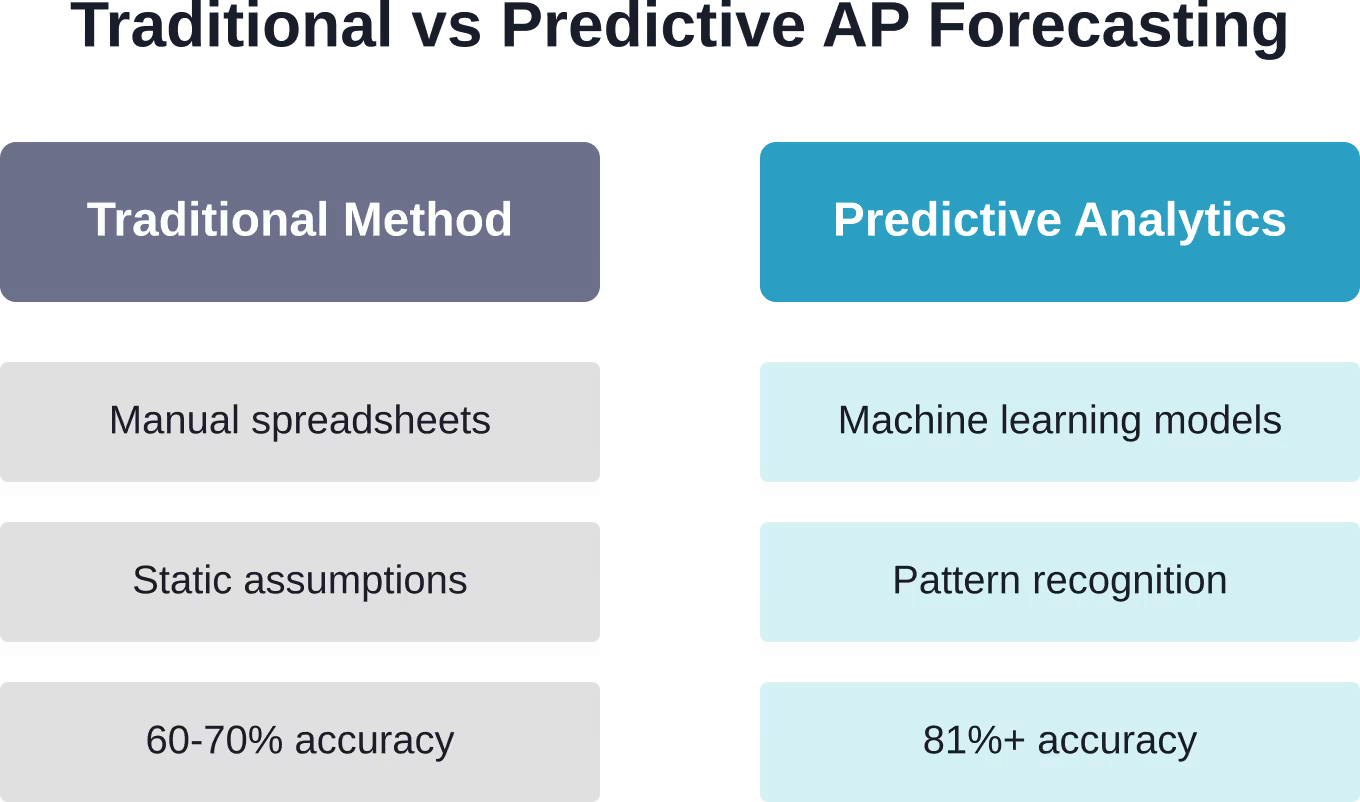
Most organizations attempt accounts payable forecasting using spreadsheets and manual estimates. The results? Consistently inaccurate projections that undermine financial planning.
Several factors sabotage traditional AP forecasts:
- Invoice timing variability: Vendors don’t submit invoices on predictable schedules, creating unexpected spikes in payment obligations
- Approval bottlenecks: Manual approval workflows introduce delays that vary by department, manager availability, and invoice complexity
- Exception handling: Disputed invoices, missing purchase orders, and three-way matching failures disrupt payment timing in unpredictable ways
- Early payment discounts: Opportunistic discount capture changes planned payment dates, scrambling cash flow projections
- Hidden patterns: Seasonal fluctuations, end-of-month clustering, and vendor-specific behaviors remain invisible without data analysis
Predictive analytics addresses each weakness by learning from historical data. The algorithms identify the patterns causing forecast errors, then adjust future predictions accordingly.
Core Benefits Driving Adoption
Organizations implementing predictive analytics in accounts payable report benefits across multiple dimensions. These aren’t marginal improvements—they’re transformative shifts in how AP functions.
Cash Flow Visibility and Optimization
Accurate payment forecasting enables treasury teams to optimize cash positioning. Instead of maintaining excess reserves “just in case,” finance teams know precisely when cash will be needed. This frees working capital for strategic investments or debt reduction.
Research indicates predictive payment models achieve 81% accuracy in forecasting when invoices will be paid. At that precision level, treasury can confidently invest short-term cash or negotiate better credit terms with suppliers.
The financial impact scales with invoice volume. Some organizations report significant monthly savings in collection processes after implementing predictive analytics.
Early Payment Discount Capture
Many suppliers offer 2% discounts for payment within 10 days. But capturing those discounts requires knowing which invoices are approved and ready to pay. Predictive analytics identifies opportunities by forecasting approval completion dates and flagging discount-eligible invoices before the window closes.
This capability alone can offset the cost of analytics implementation. A 2% discount on even 30% of annual AP spend translates to substantial savings.
Fraud and Duplicate Payment Detection
Anomaly detection algorithms spot unusual patterns that signal potential fraud or duplicate payments. The University of Rochester’s implementation flagged over 53,000 anomalies using machine learning models specifically designed for AP data.
These systems learn what “normal” looks like for each vendor—typical invoice amounts, frequency, payment terms. When an invoice deviates significantly, the system flags it for review before payment processes.
Strategic Vendor Management
Predictive analytics reveals vendor payment patterns that inform negotiation strategies. Finance teams can identify which suppliers consistently deliver early, which ones frequently submit corrected invoices, and which payment terms actually get honored in practice.
This data supports more sophisticated vendor segmentation. High-value, reliable vendors might receive faster payments or early payment offers. Problematic vendors get flagged for additional scrutiny or contract renegotiation.
How Predictive Models Actually Work in AP
The algorithms powering AP analytics fall into several categories, each suited to different forecasting challenges.
Time Series Forecasting Models
These models analyze historical payment data to identify seasonal patterns, cyclical trends, and growth trajectories. They’re particularly effective for aggregate cash flow forecasting—predicting total payment obligations across all vendors for upcoming periods.
Time series models account for factors like month-end clustering, quarterly spikes in professional services invoices, and annual contract renewals that create predictable payment patterns.
Classification Algorithms
Classification models predict categorical outcomes: Will this invoice be disputed? Will it get approved within 5 days? Will the vendor accept a later payment date?
These algorithms train on historical invoice data, learning which characteristics correlate with specific outcomes. Features might include vendor ID, invoice amount, submitting department, approval chain complexity, and historical exception rates.
Anomaly Detection Systems
Algorithms like Isolation Forest, LODA, and One-Class SVM identify outliers in invoice data. The University of Rochester implementation used this approach to flag potential duplicates and fraudulent submissions.
Unlike rule-based systems that flag invoices exceeding fixed thresholds, machine learning models learn vendor-specific patterns. An invoice that’s normal for one supplier might be highly unusual for another—and the algorithm recognizes that nuance.
Regression Models for Payment Timing
Regression algorithms predict continuous outcomes—specifically, how many days until an invoice gets paid. These models consider payment terms, approval workflow status, invoice amount, vendor payment history, and current workload in the AP department.
Practical implementations of predictive models achieve approximately 81% accuracy in payment timeliness predictions.
Practical Applications Beyond Forecasting
While cash flow forecasting gets the most attention, predictive analytics enables additional use cases that drive AP efficiency.
Automated Invoice Prioritization
Not all invoices are equally urgent. Predictive models can score and prioritize invoices based on discount opportunities, vendor importance, contractual deadlines, and business impact. This ensures AP staff focus on high-value tasks first.
Automation also surfaces invoices likely to encounter exceptions. If the model predicts a 70% chance an invoice will fail three-way matching, it can route it for early review instead of letting it hit the automated workflow and bounce.
Dynamic Discount Negotiation
Armed with accurate cash flow forecasts, finance teams can proactively offer early payments to strategic vendors in exchange for discounts. The predictive model identifies periods with excess cash available, enabling opportunistic discount capture beyond standard terms.
This flips the traditional dynamic. Instead of vendors offering standard 2/10 net 30 terms, AP teams approach vendors with custom proposals: “We’ll pay in 5 days if you extend a 2.5% discount.”
Supplier Risk Assessment
Changes in vendor invoice patterns can signal financial distress. A supplier that previously submitted monthly invoices but suddenly switches to weekly billing might be experiencing cash flow problems. Predictive analytics flags these behavioral changes automatically.
Early warning enables procurement teams to develop contingency plans before a critical supplier fails. That visibility protects supply chain continuity.
Working Capital Optimization
Predictive AP forecasts feed directly into broader working capital management. Treasury teams combine AP predictions with accounts receivable forecasts to optimize net working capital positions.
The result? Lower borrowing costs, better investment returns on excess cash, and improved liquidity management across the organization.
The Automation Connection
Predictive analytics and AP automation form a powerful partnership. Each technology amplifies the other’s value.
Automation systems capture structured invoice data at scale. That data feeds the predictive models, which in turn improve automation accuracy. It’s a virtuous cycle.
Research indicates 89% of teams already use AI in accounts payable for data processing. That adoption rate creates the data foundation predictive analytics needs. Clean, structured, high-volume data makes models more accurate.
But here’s where it gets interesting. Automation alone processes invoices faster. Predictive analytics makes those processes smarter—identifying which invoices to prioritize, which vendors to pay early, and which payments to delay without relationship damage.
The combination transforms AP from a transactional function into a strategic one. Teams spend less time on data entry and more time on analysis, negotiation, and financial planning.
| Capability | AP Automation Only | Automation + Predictive Analytics |
|---|---|---|
| Invoice Processing Speed | High | High |
| Data Accuracy | High | High |
| Cash Flow Forecasting | Basic reporting | 81% accurate predictions |
| Discount Capture | Rule-based alerts | Proactive optimization |
| Fraud Detection | Fixed rules | ML anomaly detection (53K+ flags) |
| Vendor Risk Assessment | Manual review | Automated pattern analysis |
| Working Capital Impact | Moderate | Strategic savings |
Implementation Considerations and Challenges
Deploying predictive analytics in AP isn’t plug-and-play. Several factors determine success.
Data Quality Requirements
Machine learning models are only as good as their training data. Organizations with inconsistent vendor records, poor invoice coding, or incomplete payment histories will struggle to achieve high accuracy.
Data cleansing often becomes the first—and most time-consuming—phase of implementation. Finance teams must standardize vendor names, categorize spend properly, and backfill missing information before models can train effectively.
Integration Complexity
Predictive analytics platforms need access to ERP systems, procurement databases, payment processors, and banking platforms. Each integration point introduces technical complexity and potential failure modes.
Organizations with modern cloud-based financial systems typically face easier integrations than those running legacy on-premise ERPs. API availability and data accessibility vary widely across platforms.
Change Management
AP staff accustomed to manual processes may resist algorithm-driven prioritization and automated decision-making. Successful implementations invest in training and gradually expand automation scope.
Starting with low-risk use cases—like duplicate detection or payment date forecasting—builds confidence before deploying the system for strategic decisions like dynamic discounting or vendor risk scoring.
Model Maintenance
Predictive models degrade over time as business conditions change. New vendors, revised payment terms, organizational restructuring, and economic shifts all affect accuracy.
Leading implementations establish ongoing model monitoring and retraining schedules. Accuracy metrics get tracked monthly, and models retrain quarterly or whenever performance drops below acceptable thresholds.
What the Future Holds
Predictive analytics in AP continues evolving rapidly. Several trends are reshaping what’s possible.
Real-Time Decision-Making
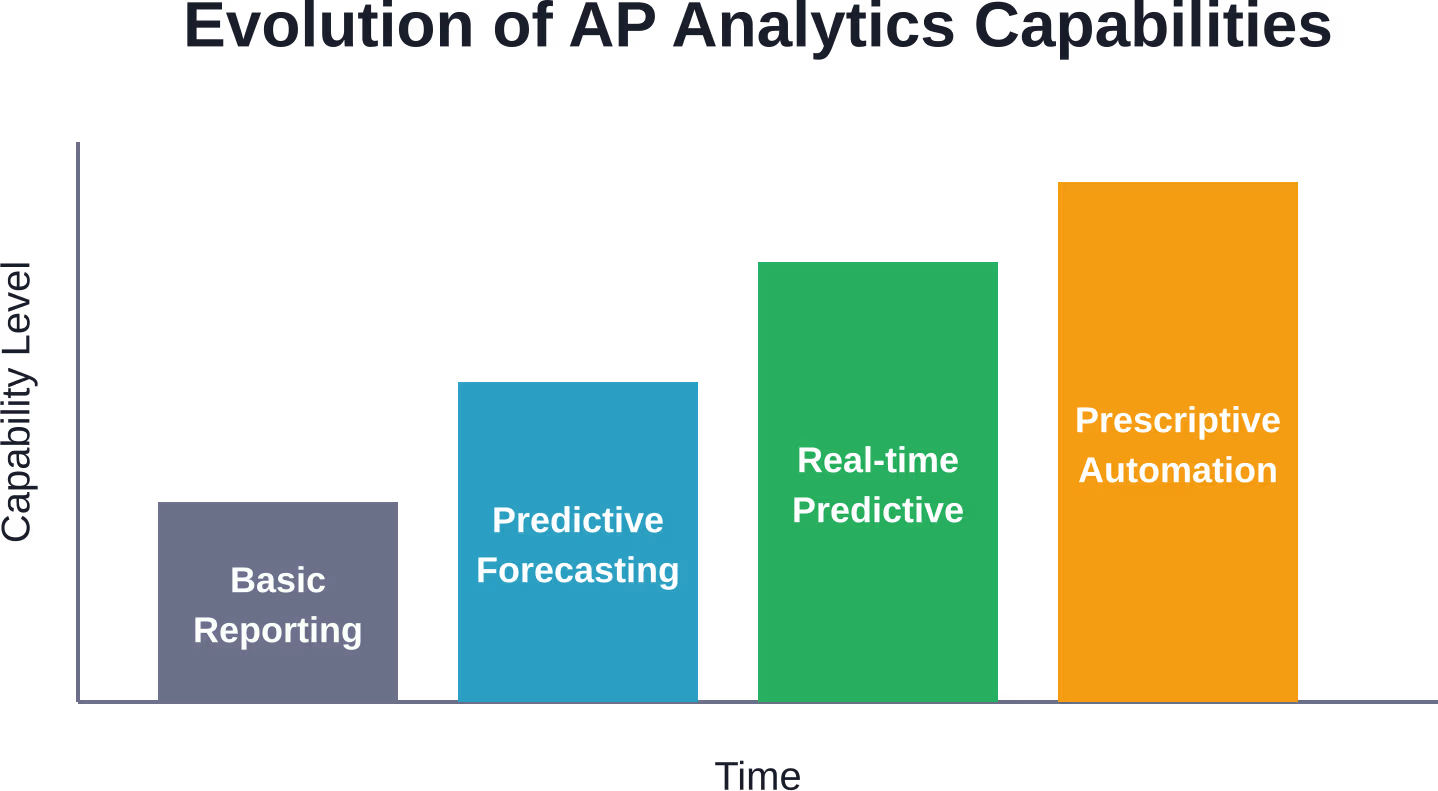
Current systems mostly generate batch forecasts—daily or weekly predictions updated on fixed schedules. Emerging platforms deliver real-time insights, recalculating forecasts as each invoice arrives and gets approved.
This enables dynamic responses. An unexpected large invoice might trigger an automated review of discount opportunities across other pending payments to free necessary cash.
Prescriptive Analytics
The next evolution beyond predictive analytics is prescriptive analytics—systems that not only forecast outcomes but recommend specific actions. Instead of just predicting cash needs, these platforms suggest which invoices to pay, when to pay them, and which discounts to pursue.
Some advanced implementations already use prescriptive models to automatically execute payment decisions within predefined parameters, reducing human intervention to exception handling only.
Enhanced Fraud Detection
As fraud schemes become more sophisticated, detection algorithms must evolve in parallel. Next-generation systems will combine traditional anomaly detection with natural language processing of invoice descriptions, social network analysis of vendor relationships, and external data sources to identify subtle fraud patterns.
Ecosystem Integration
Predictive AP analytics won’t operate in isolation. Platforms are beginning to integrate forecasts across accounts receivable, inventory management, procurement planning, and treasury operations. This holistic approach optimizes enterprise-wide working capital, not just AP in isolation.
Getting Started: A Practical Roadmap
Organizations looking to implement predictive AP analytics should follow a phased approach.
Phase 1: Data Assessment
Audit current AP data quality. Identify gaps in vendor records, payment history, and invoice coding. Establish data governance standards and begin cleanup processes.
Phase 2: Pilot Use Case
Select a focused application—duplicate detection or discount optimization work well as starting points. Deploy a pilot with limited scope to demonstrate value and build organizational confidence.
Phase 3: Automation Integration
If invoice automation isn’t already in place, implement it before or alongside analytics. The two technologies work best together, with automation providing the clean data analytics needs.
Phase 4: Expansion
After validating initial use cases, expand to additional applications. Add payment timing forecasts, then vendor risk scoring, then prescriptive recommendations as maturity grows.
Phase 5: Continuous Improvement
Establish monitoring dashboards, track accuracy metrics, and implement regular model retraining schedules. Predictive systems require ongoing maintenance to sustain performance.
Frequently Asked Questions
What’s the difference between AP forecasting and cash flow forecasting?
AP forecasting specifically predicts outgoing payments to suppliers based on invoice data and payment terms. Cash flow forecasting is broader—it includes AP predictions but also accounts receivable, operating expenses, capital expenditures, and financing activities. AP forecasts feed into comprehensive cash flow models as one component of total liquidity planning.
How accurate can predictive AP models realistically become?
Practical implementations of predictive models achieve approximately 81% accuracy in payment timeliness predictions. Some organizations achieve forecast accuracy thresholds of 95% in specific applications. Accuracy depends on data quality, invoice volume, business consistency, and model sophistication. Organizations with clean data and stable operations typically see better results than those with frequent changes or poor data governance.
Do predictive analytics systems require replacing existing AP software?
Not necessarily. Many predictive analytics platforms integrate with existing ERP systems, accounts payable automation tools, and payment processors via APIs. They operate as an intelligence layer on top of current systems rather than replacing them. However, organizations running very old legacy systems may need to upgrade integration capabilities before analytics platforms can connect effectively.
How much historical data is needed to train predictive models?
Minimum requirements vary by use case and invoice volume. Organizations processing thousands of invoices monthly can often train effective models with 12-18 months of history. Lower-volume operations may need 24-36 months to accumulate sufficient examples. Data quality matters as much as quantity—18 months of clean, well-categorized data outperforms five years of inconsistent records.
What’s the typical ROI timeline for AP analytics implementation?
Organizations report significant savings in collection processes after implementation, though results vary by size and invoice volume. Payback periods typically range from 6-18 months depending on implementation costs and captured benefits. Discount optimization and fraud detection often deliver the fastest returns, while strategic benefits like working capital optimization compound over time.
Can small and mid-sized businesses benefit from predictive AP analytics?
Absolutely. While enterprise implementations get the most attention, cloud-based analytics platforms now offer solutions scaled for smaller organizations. Companies processing as few as 500 invoices monthly can see value from duplicate detection and discount optimization. The key is selecting tools matched to organizational size and starting with focused use cases rather than trying to implement every capability at once.
How do predictive systems handle unusual events or business changes?
This represents one of the bigger challenges. Models trained on historical patterns struggle when circumstances change dramatically—economic downturns, major vendor changes, organizational restructuring, or seasonal events outside historical experience. Leading implementations address this through regular model retraining, accuracy monitoring, and human oversight of predictions during transition periods. Some advanced systems allow manual adjustments to forecasts when users know about upcoming changes the model can’t anticipate.
Making the Shift to Predictive AP
Predictive analytics transforms accounts payable from a reactive processing function into a strategic financial planning capability. The technology delivers measurable results—81% forecasting accuracy, significant monthly savings in collection processes, and over 53,000 flagged anomalies in documented implementations.
But the real value extends beyond individual metrics. Predictive AP enables treasury optimization, improves supplier relationships, reduces fraud risk, and frees finance teams to focus on strategic work instead of manual processing.
The barrier to entry continues dropping. Cloud platforms, pre-built integrations, and scalable pricing models make these capabilities accessible to organizations of all sizes. Meanwhile, the 89% of teams already using AI for accounts payable have created the data foundation predictive analytics needs to thrive.
Organizations still relying on manual forecasting and reactive AP management are competing with one hand tied. The teams achieving 81% forecast accuracy and capturing systematic discount opportunities aren’t just more efficient—they’re fundamentally operating at a different strategic level.
The question isn’t whether predictive analytics will become standard in AP. The question is whether your organization will implement it proactively to gain competitive advantage, or reactively once it becomes table stakes.
 English
  German
  Arabic
  French
  Dutch
Dutch  Spanish