
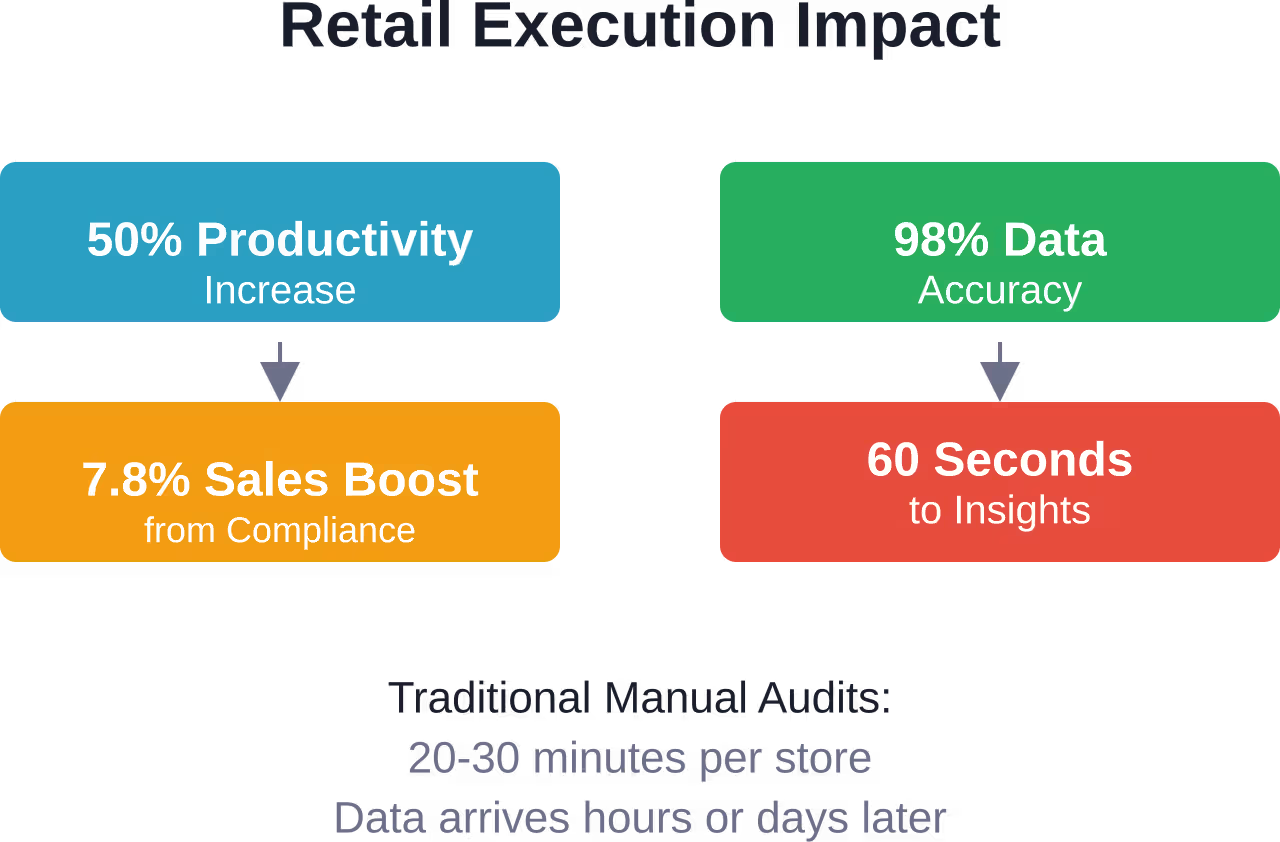
Quick Summary: Image recognition for retail execution transforms how CPG brands monitor in-store performance by converting shelf photos into actionable data. The technology enables field teams to capture compliance, pricing, and share-of-shelf metrics with up to 98% accuracy in seconds, replacing manual audits that took hours. Modern AI-powered systems deliver insights in under 60 seconds, helping brands boost sales, optimize planogram compliance, and increase field productivity by up to 50%.
Retail execution has always been a battlefield of incomplete data and delayed insights. Field teams spend hours manually counting facings, checking prices, and verifying planogram compliance—only to have that data become outdated by the time it reaches decision-makers.
Image recognition technology changes this dynamic entirely. Instead of manual audits taking 20–30 minutes per store, field reps snap a few shelf photos and receive actionable insights within seconds.
But here’s the thing—not all image recognition systems deliver on their promises. The difference between a system that frustrates your team and one that transforms your operations comes down to accuracy, speed, and real-world deployment considerations.
What Image Recognition Does for Retail Execution
At its core, image recognition for retail execution converts shelf photos into structured data. Field teams capture images of retail shelves using mobile devices, and AI models analyze those images to extract key performance indicators.
The technology identifies individual SKUs, counts facings, detects out-of-stock situations, verifies pricing, and measures share-of-shelf against competitors. All of this happens automatically, eliminating the manual effort that traditionally consumed field team time.
Research from arxiv.org shows that modern retail product classification models achieve impressive accuracy benchmarks. RetailKLIP, a zero-shot model requiring no training on new products, achieves 88.6% accuracy on the CAPG-GP dataset. Grozi-120 accuracy data for RetailKLIP was not verified in source material. When models are fully fine-tuned with techniques like ResNext-WSL combined with LCA layers and MaxEnt Loss, accuracy reaches 92.2% on CAPG-GP.
Real talk: those numbers matter because they represent the difference between data you can trust and data that forces your team to double-check everything manually.
The Business Impact of Automated Shelf Audits
Field team productivity improvements are dramatic. Organizations implementing image recognition report field team productivity increases up to 50%, freeing reps to complete more store visits and focus on relationship-building rather than data entry.
Planogram compliance directly affects sales performance. Research published on arxiv.org reveals that typical planogram compliance in stores hovers around 70%. When planograms are properly reset, sales can increase by 7.8% within just two weeks.
That gap between 70% compliance and proper execution represents millions in lost revenue for major CPG brands. Image recognition closes that gap by making compliance monitoring scalable across thousands of locations.
How Modern Image Recognition Systems Work
The technical architecture behind retail image recognition combines computer vision models trained specifically on retail environments. These aren’t general-purpose image classification systems—they’re purpose-built for the unique challenges of retail shelves.
Retail shelves present distinct challenges: varied lighting conditions, occlusions where products block each other, perspective distortions from different camera angles, and the sheer density of similar-looking products packed together.
Advanced systems use deep learning models like ResNext architectures, often pre-trained on massive datasets and then fine-tuned for retail-specific recognition tasks.
But wait. Here’s where deployment reality diverges from lab benchmarks. A system that achieves 95% accuracy on a carefully curated dataset might struggle in stores with poor lighting, unusual shelf angles, or regional SKUs that weren’t in the training data.
The Dataset Challenge
Building effective image recognition requires extensive training data. Traditional approaches suggested collecting video scans of every product—a process that could consume 2,400 minutes for just 20 stores at 120 minutes per location.
Smarter deployment strategies focus on collecting shelf photos rather than individual product scans. This approach reduces collection time to just 100 minutes for the same 20 stores—20 stores × 5 minutes per store. The AI learns to recognize products in their natural shelf context rather than in isolated conditions.
Regional SKU variations pose another challenge. Products appear in certain regions and certain store formats exclusively. Modern systems address this through rapid model updates—some platforms can recognize new SKUs within 24 to 48 hours of receiving sample images.

Build Image Recognition Tools With AI Superior
AI Superior develops custom AI software, including computer vision and image processing solutions. Their team can build systems for image analysis, object detection, image segmentation, OCR, face recognition, and contextual image classification.
For retail execution teams, this can help with product detection, shelf image analysis, store audits, stock checks, or turning retail images into data that can be used in daily operations.
Need Image Recognition Built Around Your Data?
AI Superior can help with:
- building custom computer vision solutions
- detecting and classifying objects in images
- testing ideas through PoC or MVP development
- integrating AI tools into existing systems
👉 Contact AI Superior to discuss your project.
Real-World Accuracy Standards
Speed matters, but accuracy determines whether the technology earns trust or creates frustration. Industry data shows leading platforms achieve high accuracy in real-world retail conditions, with some reporting 97%+ accuracy in dense environments, with shelf-to-insights delivery in under 60 seconds.
Inventory accuracy improvements are substantial. Organizations report inventory accuracy reaching up to 98% when using AI-powered image recognition compared to manual audits that often miss out-of-stock situations or miscount facings.
| Model Type | Dataset | Accuracy | Training Required |
|---|---|---|---|
| RetailKLIP (zero-shot) | CAPG-GP | 88.6% | None |
| RetailKLIP (zero-shot) | Grozi-120 | 82.8% | None |
| ResNext-WSL+LCA+MaxEnt | CAPG-GP | 92.2% | Full fine-tuning |
| ResNext-WSL+LCA+MaxEnt | Grozi-120 | 72.3% | Full fine-tuning |
| Semi-supervised ResNext-WSL | Grozi-120 | 76.19% | Linear layer only |
Data from arxiv.org research demonstrates the performance trade-offs between different model architectures and training approaches.
Implementation Considerations for CPG Brands
Deploying image recognition at scale requires more than selecting accurate models. The entire workflow—from photo capture to insight delivery to action—must fit naturally into existing field operations.
Integration with current retail execution platforms matters enormously. Teams won’t adopt technology that requires switching between multiple apps or manually transferring data between systems. The image recognition capabilities should sit inside the existing workflow tools field teams already use daily.
Mobile device compatibility affects adoption rates. Not all field reps carry the latest flagship smartphones. Systems must perform reliably on mid-range Android devices with varying camera quality and processing power.
Data Privacy and Retail Partner Relationships
Store photos capture more than just your brand’s products. Competitor products, pricing strategies, and promotional displays all appear in the same images. Managing this data responsibly protects relationships with retail partners.
Clear data governance policies should specify who can access which data, how long images are retained, and what protections prevent competitive intelligence from being misused. Some retail chains have explicit policies about in-store photography and data capture that must be respected.
Beyond Basic Recognition: Advanced Analytics
The real value emerges when image recognition feeds into broader retail execution analytics. Identifying products is just the starting point. The insights that drive action come from analyzing patterns across stores, regions, and time periods.
Share-of-shelf tracking reveals where competitive pressure is increasing. Price compliance monitoring catches unauthorized discounting or promotional execution failures. Planogram adherence scoring identifies which stores need support or which planograms aren’t working in practice.
The PRISM dataset (March 31, 2026) demonstrates that fine-tuning on domain-specific retail video data reduces error rates by 66.6% across 20+ evaluation probes, with significant gains of 36.4% accuracy improvement in embodied action understanding.
What does that mean in practical terms? AI systems are getting better at understanding context beyond simple object recognition. They’re learning to identify actions like shelf stocking, planogram resets, and promotional display setups from video feeds.
Choosing the Right Technology Partner
Several factors separate image recognition systems that deliver results from those that disappoint. Accuracy benchmarks matter, but they’re not the only consideration.
Look for proven deployment experience across diverse retail formats. A system that works perfectly in modern, well-lit grocery chains might struggle in convenience stores with cramped shelves and challenging lighting. Ask potential vendors for case studies in retail formats similar to your distribution channels.
Model update frequency determines how quickly new products get recognized. Brands launching seasonal SKUs or limited-edition products need systems that incorporate new items rapidly without requiring complete retraining cycles.
| Evaluation Criteria | Why It Matters | Questions to Ask |
|---|---|---|
| Accuracy in Your Category | Retail environments vary significantly | What’s your accuracy for products similar to ours? |
| New SKU Onboarding | Product portfolios change constantly | How quickly can you recognize new items? |
| Integration Options | Must fit existing workflows | Which retail execution platforms do you integrate with? |
| Deployment Support | Technical implementation complexity | What training and change management support is included? |
Measuring ROI from Image Recognition
Calculating return on investment requires tracking both hard savings and productivity gains. Hard savings include reduced labor costs from faster audits and lower error correction expenses. Productivity gains show up as more store visits per field rep and faster response to out-of-stock situations.
Revenue impact comes from improved planogram compliance and faster promotional execution. Remember that 7.8% sales increase from proper planogram resets? Multiply that by the number of stores where compliance improves, and the revenue impact becomes substantial.
Data quality improvements have downstream effects that are harder to quantify but equally valuable. Better data enables more accurate demand forecasting, more effective promotional planning, and stronger negotiations with retail partners backed by objective shelf performance metrics.
Frequently Asked Questions
How accurate is image recognition for retail compared to manual audits?
Leading image recognition systems achieve 97%+ accuracy in real-world retail conditions, often exceeding manual audit accuracy. Manual audits are prone to human error, especially when counting large numbers of facings or identifying similar SKUs. Research shows AI-powered systems can reach up to 98% inventory accuracy. Manual audits also introduce consistency problems when different field reps use different counting methods.
What types of retail execution metrics can image recognition capture?
Image recognition captures SKU identification, facing counts, pricing verification, out-of-stock detection, share-of-shelf measurements, planogram compliance scoring, promotional display presence, and competitor product positioning. Advanced systems can also identify product orientation issues, damaged packaging, and incorrect product placement within assigned shelf space.
How long does it take to implement image recognition technology?
Implementation timelines vary based on deployment scope. Pilot programs with limited SKU sets and select stores can launch within 4–6 weeks. Full-scale deployments across complete product portfolios and extensive store networks typically require 3–4 months, including model training, integration with existing systems, and field team training. Systems using zero-shot models like RetailKLIP can recognize products without extensive training, potentially shortening deployment timelines.
How quickly can new SKUs be added to recognition systems?
Advanced platforms can onboard new SKUs under 4 hours. This rapid turnaround enables brands to launch seasonal products, limited editions, and regional variations without waiting for lengthy retraining cycles. Zero-shot models offer even faster recognition of new products by leveraging existing knowledge of product categories and visual features, though they may sacrifice some accuracy compared to specifically trained models.
What happens to competitor data captured in shelf photos?
Responsible image recognition platforms implement data governance policies that specify access controls, retention periods, and usage restrictions. While competitor products appear in shelf photos, ethical vendors ensure this data is used only for calculating your brand’s share-of-shelf and competitive context—not for sharing competitive intelligence inappropriately. Clear agreements should define what data can be accessed by which users and for what purposes.
Can image recognition replace field teams entirely?
No. Image recognition is a productivity tool, not a field team replacement. The technology eliminates manual data collection drudgery, freeing field reps to focus on relationship building, merchandising, problem-solving, and strategic activities that require human judgment. Field teams still need to visit stores, execute resets, build displays, and maintain retailer relationships—they just spend less time counting products and more time on high-value activities that drive business results.
The Future of Retail Execution Visibility
Image recognition represents a fundamental shift in how CPG brands understand in-store performance. The technology transforms retail execution from a periodic sampling exercise into continuous, comprehensive visibility across the entire distribution network.
Organizations implementing these systems report dramatic improvements: field productivity gains up to 50%, inventory accuracy reaching 98%, and sales increases of 7.8% from improved planogram compliance. But the real transformation isn’t just operational—it’s strategic.
When decision-makers have accurate, real-time visibility into what’s happening on every shelf in every store, they can respond to opportunities and problems with unprecedented speed. Out-of-stock situations get resolved in hours instead of days. Promotional execution gaps get identified and corrected while promotions are still running. Competitive encroachment gets spotted early enough to take defensive action.
The brands winning at retail in 2026 aren’t necessarily those with the biggest field teams or the largest promotional budgets. They’re the ones with the best information, the fastest response times, and the most efficient execution processes. Image recognition provides the visibility foundation that makes all of that possible.
Ready to transform your retail execution with image recognition technology? Start by evaluating your current audit processes, identifying your biggest data gaps, and defining clear success metrics. Then connect with vendors who have proven experience in your specific retail channels and product categories.
 English
  German
  Arabic
  French
  Dutch
Dutch  Spanish