
Quick Summary: Image recognition technology powered by AI has become essential for brand protection, detecting counterfeits, phishing attempts, and unauthorized logo use across digital platforms with accuracy rates exceeding 99%. Advanced visual analysis systems scan millions of images daily, identifying threats in under 20 seconds and enabling automated takedowns to safeguard brand reputation and revenue.
Brand protection isn’t what it used to be. Counterfeiters don’t need fancy equipment anymore—they need a smartphone and basic design software.
With over 90% of photographs produced with smartphone cameras, the barrier to creating convincing fake product images has essentially vanished. Bad actors replicate logos, packaging, and entire product pages in minutes. Text-based monitoring catches some threats, but visual fraud? That’s where traditional tools fall short.
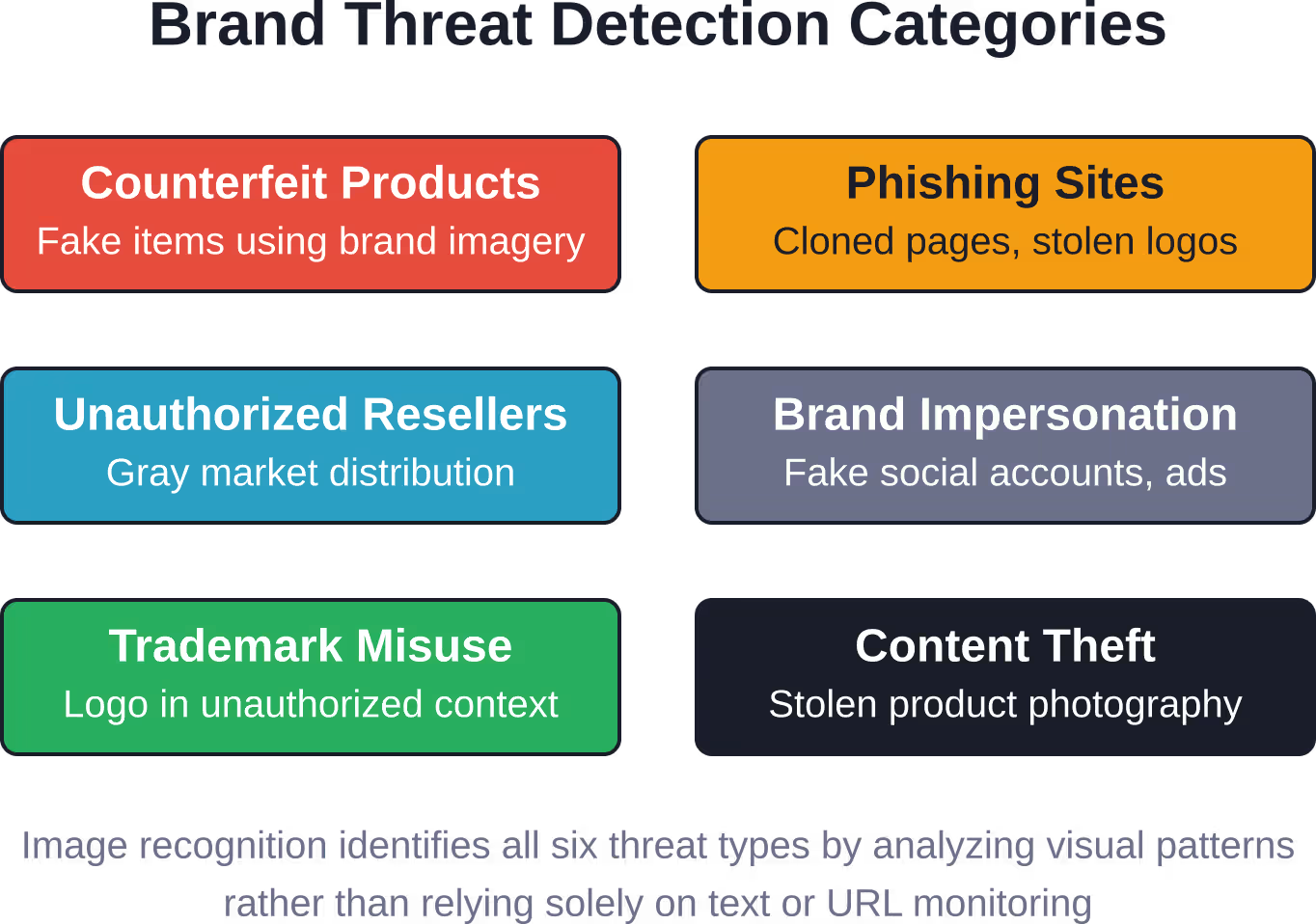
Image recognition has emerged as the defense mechanism brands actually need. Instead of relying solely on keyword monitoring or URL blacklists, visual analysis systems scan the images themselves—detecting copied logos, similar color schemes, and matching product photography that text-based systems miss entirely.
Why Text-Based Brand Protection Misses Visual Threats
Here’s the thing though—most brand protection systems were built for a different era. They scan for your brand name in listings, monitor trademark mentions, and flag suspicious URLs.
But what happens when counterfeiters use slight misspellings? Or host content on obscure domains? Or simply don’t mention your brand name at all, relying instead on stolen product images to sell fakes?
The answer: traditional systems miss them completely.
Research shows phishing websites rely heavily on visual imitation. Studies demonstrate that deep learning approaches using image analysis can detect such threats. Phishing sites now embed brand imagery directly into screenshots and graphics, bypassing text-based detection entirely.
This isn’t theoretical. Systems using only URL and text analysis fail against modern attacks that prioritize visual deception. The technology simply wasn’t designed for threats that operate in the visual layer.
How Image Recognition Technology Actually Works
Image recognition for brand protection relies on deep learning models trained to identify visual patterns—logos, product designs, packaging elements, and overall aesthetic similarity.
The process breaks down into several key stages:
- Visual feature extraction: The system analyzes images to identify distinctive elements like shapes, colors, edges, and textures. For brand protection, this means recognizing your logo even when it’s been slightly modified, compressed, or photographed at an angle.
- Reference database matching: Extracted features get compared against a database of legitimate brand assets. Advanced systems use Siamese neural networks, which measure visual similarity rather than requiring exact pixel matches.
- Semantic analysis: Beyond simple matching, modern systems understand context. They recognize when a logo appears in an unauthorized retail listing versus legitimate brand content, distinguishing infringement from fair use.
- Real-time classification: Once a potential match is identified, the system classifies the threat—counterfeit product listing, phishing site, unauthorized reseller, gray market goods, or false positive.
Speed matters here. Advanced platforms classify threats across 285+ categories in under 20 seconds, a performance level that makes real-time protection feasible across massive digital ecosystems.

Develop Computer Vision Software With AI Superior
AI Superior builds AI-based applications and custom software products using machine learning and AI models. Their team works with computer vision, image processing, predictive analytics, NLP, BI, and big data solutions.
For brand protection, this can support tools that check product images, detect visual similarities, classify listings, or flag suspicious content for review.
Need a Better Way to Review Product Images?
AI Superior can help with:
- building image recognition systems
- detecting visual product and logo patterns
- creating custom AI models for image checks
- connecting AI tools with review workflows
👉 Contact AI Superior to discuss your project.
Detection Accuracy Rates That Actually Matter
Theoretical accuracy means nothing if the system drowns brand teams in false positives. Real-world performance is what counts.
The Phishpedia system, which combines Faster-RCNN with Siamese neural networks, achieved 99.2% accuracy on a benchmark dataset of approximately 30,000 phishing pages and 30,000 legitimate pages. More importantly, it detected over 1,704 zero-day phishing sites—threats that hadn’t been previously cataloged in any database.
Research indicates processing speeds of approximately 0.19 seconds per webpage are achievable with advanced visual detection systems. That’s fast enough to scan thousands of potential threats per hour without building processing backlogs.
For logo-specific recognition, CNN-based visual similarity models reached approximately 96% accuracy on screenshot-based datasets containing roughly 2,852 images. The Phish-IRIS system, using compact visual descriptors optimized for speed, achieved approximately 92% accuracy on a dataset split between 1,313 training images and 1,539 testing images.
| System Type | Accuracy Rate | Dataset Size | Processing Speed |
|---|---|---|---|
| Phishpedia (Faster-RCNN + Siamese) | 99.2% | ~60,000 pages | 0.19 sec/page |
| CNN Visual Similarity | ~96% | ~2,852 images | Real-time |
| CNN + LSTM Hybrid | >97% | Public benchmarks | Real-time |
| Phish-IRIS Descriptors | ~92% | 2,852 images | Ultra-fast |
Context matters, though. A system with 96% accuracy still generates false positives—legitimate authorized uses flagged incorrectly. That’s why the best platforms combine automated detection with human verification workflows, letting AI handle volume while specialists confirm edge cases.
Platform Coverage and Monitoring Scale
Brand infringement doesn’t happen on a single platform. Counterfeiters operate across e-commerce marketplaces, social media, independent websites, mobile apps, and increasingly, emerging platforms that traditional monitoring overlooks.
Leading image recognition systems now monitor 1,500+ platforms simultaneously. That includes obvious targets like major e-commerce sites and social networks, but also long-tail marketplaces, regional platforms, and niche communities where counterfeits thrive under less scrutiny.
Processing scale has reached impressive levels. Some platforms handle 150,000 listings daily per brand, maintaining continuous surveillance across the entire digital ecosystem rather than periodic sampling.
The WIPO’s AI initiatives in intellectual property offices provide additional context. Patent classification systems using AI achieve 70% accuracy for single mark allocation and 90% accuracy for top-five ranking results. While this application differs from brand protection, it demonstrates the maturity of visual and semantic analysis in IP contexts.
Real-World Brand Protection Results
In the food and beverage sector specifically, image recognition addresses unique risks. Counterfeit consumables pose health dangers beyond brand damage. Visual monitoring identifies fake products sold through unauthorized channels before they reach consumers.
Automation and Response Speed
Detection without enforcement is just expensive monitoring. The value proposition of image recognition comes from automated response workflows that eliminate threats faster than manual processes ever could.
Modern platforms connect detection directly to takedown mechanisms. When the system identifies a counterfeit listing, it automatically initiates removal requests through platform-specific procedures—DMCA notices for copyright claims, trademark infringement reports for marketplace listings, abuse reports for domain registrars.
Real-time detection means threats get flagged as they emerge, not days or weeks later during scheduled audits. Automated workflows initiate response actions immediately, without waiting for human review of every case.
Global disruption networks expedite the actual removal process. Partnerships with major platforms—for example, integration with Google’s Web Risk—create fast-track enforcement channels that reduce takedown timelines from weeks to hours.
This matters more than it might seem. Every hour a counterfeit listing remains active represents lost revenue, brand damage, and potential customer harm. Automation converts detection capabilities into actual protection.
The Deepfake Challenge for Brand Protection
Now, this is where it gets interesting. Image recognition systems face an evolving challenge: AI-generated content that’s visually indistinguishable from authentic brand materials.
Deepfake technology has reached a point where the traditional concept of “real” images needs rethinking. Research indicates that over 90% of photographs are produced with smartphone cameras that apply computational photography—AI-enhanced processing that technically makes every smartphone photo partially synthetic.
For brand protection, this creates both challenges and opportunities. Counterfeiters can generate convincing product images without ever possessing the actual items. But the same AI techniques also enable more sophisticated detection—identifying subtle artifacts in synthetic images that human reviewers miss.
The technical reality: detection becomes an arms race. As generative models improve, detection models must evolve in parallel. Static rule-based systems become obsolete quickly. Continuous model retraining against emerging threat patterns becomes mandatory rather than optional.
Integration with Broader Brand Protection Strategies
Image recognition isn’t a standalone solution. It’s most effective as one component of a multi-layered brand protection strategy.
Text-based monitoring still catches threats that operate primarily through keywords and descriptions. URL monitoring identifies suspicious domains. Social media listening detects brand mentions in posts and comments. Image recognition fills the gap where visual deception operates independently of text.
The best implementations combine all these signals. A suspicious listing with both keyword flags AND visual similarity to protected assets receives higher priority than one triggering only a single detection method. Multi-modal analysis reduces false positives while improving true threat identification.
Human expertise remains essential for edge cases, strategic decisions, and handling platforms that require manual intervention. AI handles volume and speed; specialists handle complexity and judgment calls. That combination produces better outcomes than either approach alone.
Selecting Image Recognition Technology
Not all image recognition systems deliver equivalent results. Several factors separate effective solutions from underperforming ones.
- Detection accuracy matters most. Benchmark performance on standardized datasets provides some insight, but real-world accuracy on actual brand assets tells the full story. Request case studies with specific accuracy metrics, not just marketing claims.
- Processing speed determines coverage scope. A system that analyzes images slowly can’t monitor at the scale modern brands require. Processing speeds under one second per image enable comprehensive platform coverage; slower systems force compromises on monitoring breadth.
- Platform coverage defines protection boundaries. Monitoring 50 platforms leaves gaps that counterfeiters exploit. Systems covering 1,000+ platforms, including emerging and regional marketplaces, provide more complete protection.
- Automation depth affects response timelines. Full workflow automation—from detection through evidence collection to takedown submission—produces faster threat elimination than systems requiring manual intervention at each stage.
- False positive rates impact operational efficiency. A system with 99% accuracy that generates thousands of alerts daily still buries teams in false positives. Practical false positive rates under 5% keep human review workload manageable.
| Evaluation Criterion | Minimum Standard | Best-in-Class |
|---|---|---|
| Logo Detection Accuracy | >90% | >96% |
| Processing Speed | <1 second/image | <0.2 seconds/image |
| Platform Coverage | 100+ platforms | 1,000+ platforms |
| False Positive Rate | <10% | <5% |
| Automated Takedown | Major platforms | Global network |
Implementation Considerations
Deploying image recognition for brand protection requires more than licensing software. Several practical considerations affect success.
Asset database quality determines detection effectiveness. Systems need comprehensive reference libraries of legitimate brand assets—logos in all variations, official product photography, approved packaging designs, authorized marketing materials. Incomplete reference databases produce both false positives and false negatives.
Integration with existing workflows prevents operational silos. Image recognition alerts should feed into the same case management systems legal and brand protection teams already use, not create separate tracking requirements.
Performance monitoring ensures sustained effectiveness. Regular accuracy audits, false positive tracking, and coverage verification confirm the system continues performing as threat landscapes evolve.
Staff training bridges the gap between technical capabilities and operational use. Teams need to understand what image recognition can and can’t detect, how to interpret confidence scores, and when manual review adds value versus creating bottlenecks.
Cost-Benefit Analysis
Brand protection budgets face constant scrutiny. Image recognition technology requires investment—the question is whether it delivers sufficient return.
The Federal Trade Commission sued Live Nation and Ticketmaster in September 2025 for illegal ticket resale tactics and deceptive pricing. While this specific case involves ticketing rather than counterfeits, it illustrates the financial scale of digital fraud and the revenue at stake in brand protection.
For brands facing counterfeit problems, the calculation comes down to: what does each undetected counterfeit cost? Lost sale revenue, customer trust erosion, and potential liability exposure all factor in. If image recognition prevents even a fraction of counterfeits from reaching customers, the return typically exceeds the technology investment.
Automation produces additional savings through reduced manual monitoring costs. A team spending 20 hours weekly on manual marketplace searches can redeploy that time to strategic enforcement when automated systems handle routine surveillance.
Future Trajectory
Image recognition technology for brand protection continues evolving rapidly. Several trends will shape capabilities over the next few years.
Multi-modal detection combining visual, text, and behavioral signals will become standard. Systems already moving in this direction analyze not just images but also listing descriptions, seller patterns, pricing anomalies, and customer reviews simultaneously.
Video content monitoring will extend beyond static images. As social commerce grows and short-form video becomes a dominant marketing channel, counterfeiters will exploit video platforms. Detection systems are adapting to analyze video frames, audio tracks, and motion patterns.
Predictive analytics will shift from reactive to proactive protection. Rather than just detecting existing threats, systems will identify high-risk platforms, predict counterfeiter behavior patterns, and flag suspicious new sellers before they list infringing items.
Cross-platform seller tracking will connect related accounts across different marketplaces. When one infringing seller gets removed from a platform, the system will automatically identify and flag their accounts on other platforms, preventing whack-a-mole enforcement scenarios.
Frequently Asked Questions
How accurate is image recognition for detecting counterfeit products?
Leading systems achieve accuracy rates exceeding 96% for logo recognition and 99%+ for comprehensive visual analysis. The Phishpedia system demonstrated 99.2% accuracy on datasets containing approximately 60,000 images. Accuracy depends heavily on reference database quality and the sophistication of the AI models used. Real-world performance includes some false positives, which is why most platforms combine automated detection with human verification workflows.
Can image recognition detect counterfeits on social media platforms?
Yes, comprehensive brand protection systems monitor social media alongside e-commerce platforms. Advanced solutions cover 1,500+ platforms including major social networks, emerging platforms, and niche communities. Detection works on posts, ads, marketplace listings, and profile imagery. Social media monitoring faces unique challenges due to image compression, filters, and user-generated content variations, but modern systems account for these factors.
How fast can image recognition systems process threats?
Processing speed varies by system, but top-tier platforms analyze images in under one second. The Phishpedia system processes webpages in 0.19 seconds, while commercial platforms classify threats across 285+ categories in under 20 seconds. This speed enables real-time monitoring at scale—some systems process 150,000 listings daily per brand. Fast processing is essential for catching threats before they cause significant damage.
What’s the difference between image recognition and traditional brand monitoring?
Traditional brand monitoring relies primarily on text-based detection—scanning for brand names, trademarks, and keywords in listings and content. Image recognition analyzes visual elements: logos, product designs, packaging, color schemes, and overall aesthetic similarity. Counterfeiters increasingly use misspellings or omit brand names entirely, relying on stolen imagery to sell fakes. Image recognition catches these visually-based threats that text monitoring misses entirely.
Does image recognition work for detecting AI-generated fake product images?
Modern systems are adapting to detect AI-generated content, though it represents an evolving challenge. Deepfake and synthetic image technology has advanced significantly—over 90% of smartphone photos now involve AI processing. Detection systems use artifact analysis, pattern recognition, and continuous model updates to identify synthetic images. However, this remains an arms race: as generative models improve, detection methods must evolve in parallel. The most effective approach combines multiple detection methods rather than relying solely on visual analysis.
What happens after image recognition detects a counterfeit?
Advanced platforms automate the response workflow. The system collects evidence (screenshots, metadata, seller information), generates appropriate takedown notices (DMCA, trademark infringement reports, platform-specific abuse claims), and submits removal requests through established channels. Partnerships with major platforms can expedite removal timelines. Some systems achieve 80% successful removal rates on identified threats. Complex cases requiring legal intervention get escalated to human specialists, while routine clear-cut infringements get handled automatically.
How much does image recognition brand protection cost?
Pricing varies significantly based on monitoring scope, platform coverage, and service levels. Enterprise solutions covering 1,000+ platforms with full automation typically cost more than basic packages monitoring major marketplaces only. Most providers use subscription models rather than per-detection pricing. Rather than focusing on software costs alone, evaluate the total cost of brand protection including staff time for manual monitoring, legal fees for enforcement, and revenue lost to counterfeits. For brands facing significant counterfeit problems, automated image recognition typically delivers positive ROI by preventing losses that exceed technology costs.
Conclusion
Image recognition has shifted from experimental technology to essential infrastructure for brand protection. With accuracy rates exceeding 99%, processing speeds under one second, and coverage across 1,500+ platforms, visual analysis now detects threats that text-based monitoring misses entirely.
The technology isn’t perfect. False positives require human review. Deepfakes and AI-generated content pose evolving challenges. But for brands facing counterfeit problems, phishing attempts, or unauthorized trademark use, image recognition delivers capabilities that manual monitoring simply can’t match.
Real talk: if your brand protection strategy still relies primarily on keyword monitoring and manual marketplace searches, you’re operating with one hand tied behind your back. Counterfeiters already use visual deception specifically because they know text-based systems can’t catch them.
The question isn’t whether image recognition technology works—the data confirms it does. The question is whether the cost of not implementing it exceeds the investment required. For most brands with significant digital presence, that calculation tips clearly toward adoption.
Start by auditing your current brand protection gaps. Where are counterfeiters operating that you’re not detecting? Which platforms lack adequate monitoring? How often do visual threats slip through because they don’t trigger keyword alerts? Those gaps define the value proposition for image recognition technology.
 English
  German
  Arabic
  French
  Dutch
Dutch  Spanish