
Quick Summary: Machine learning in manufacturing transforms production through predictive maintenance, quality control, supply chain optimization, and process automation. Industry data shows 34% of manufacturers now view AI as very significant in 2025 (up from 10% in 2024), while 76% expect smart operations within two years. ML applications reduce unplanned downtime, optimize resource allocation, and enable real-time decision-making across factory floors.
Manufacturing floors are changing faster than most realize. Machines now predict their own failures weeks in advance. Quality control systems catch defects invisible to human eyes. Supply chains adjust inventory in real-time based on demand patterns no analyst could spot manually.
This isn’t futuristic speculation. It’s happening right now across automotive plants, semiconductor facilities, and consumer goods factories worldwide.
The numbers tell the story: according to data from the National Association of Manufacturers, 34% of manufacturers see AI as very significant (up from 10% in 2024). Meanwhile, 76% of manufacturers expect to have smart operations within two years, with 28% currently describing operations as ‘smart’ or ‘somewhat smart’.
But here’s the thing — implementing machine learning successfully requires more than enthusiasm. The manufacturing sector has been notoriously slow to adopt new technologies, and deep learning models have remained out of reach for all but the largest manufacturers.
This guide cuts through the hype. Real applications. Actual implementation steps. The obstacles companies actually face.
What Machine Learning Actually Does on the Factory Floor
Machine learning algorithms analyze production data to identify patterns humans can’t see. These patterns drive decisions that improve efficiency, reduce waste, and prevent costly equipment failures.
Unlike traditional programming where engineers write explicit rules, ML systems learn from historical data. Feed them sensor readings, quality metrics, and operational parameters — they discover relationships between variables and make predictions about future states.
The manufacturing sector generates massive data volumes. Every machine, sensor, and production line creates continuous streams of information. Most of that data sits unused. Machine learning converts it into actionable intelligence.
Research from the National Institute of Standards and Technology shows how ML-driven analytics offers high potential to continuously transform manufacturing data into newfound knowledge. Their work on additive manufacturing demonstrates how process-structure-property relationships can be optimized through intelligent analysis.
The Core Technologies Manufacturing Companies Deploy
Several ML approaches have proven practical for industrial settings:
- Supervised learning trains on labeled historical data — defective parts marked as defects, working equipment labeled as normal. The algorithm learns to classify new examples based on those patterns. Quality control and predictive maintenance rely heavily on this approach.
- Unsupervised learning finds hidden structures in unlabeled data. Clustering algorithms group similar operating conditions or identify anomalies that don’t fit normal patterns. Useful for discovering unknown failure modes or optimizing process parameters.
- Reinforcement learning optimizes sequential decisions through trial and error. Production scheduling and resource allocation benefit from this approach, where the algorithm learns which actions maximize long-term objectives.
Deep learning — neural networks with multiple layers — excels at processing complex sensor data, images, and time series. Computer vision systems for defect detection and predictive models for equipment monitoring both leverage deep architectures.

Top Applications Transforming Production Operations
Machine learning isn’t a single solution. Different applications address specific manufacturing challenges. Some deliver immediate ROI. Others require longer implementation timelines but transform entire workflows.
Predictive Maintenance That Actually Prevents Failures
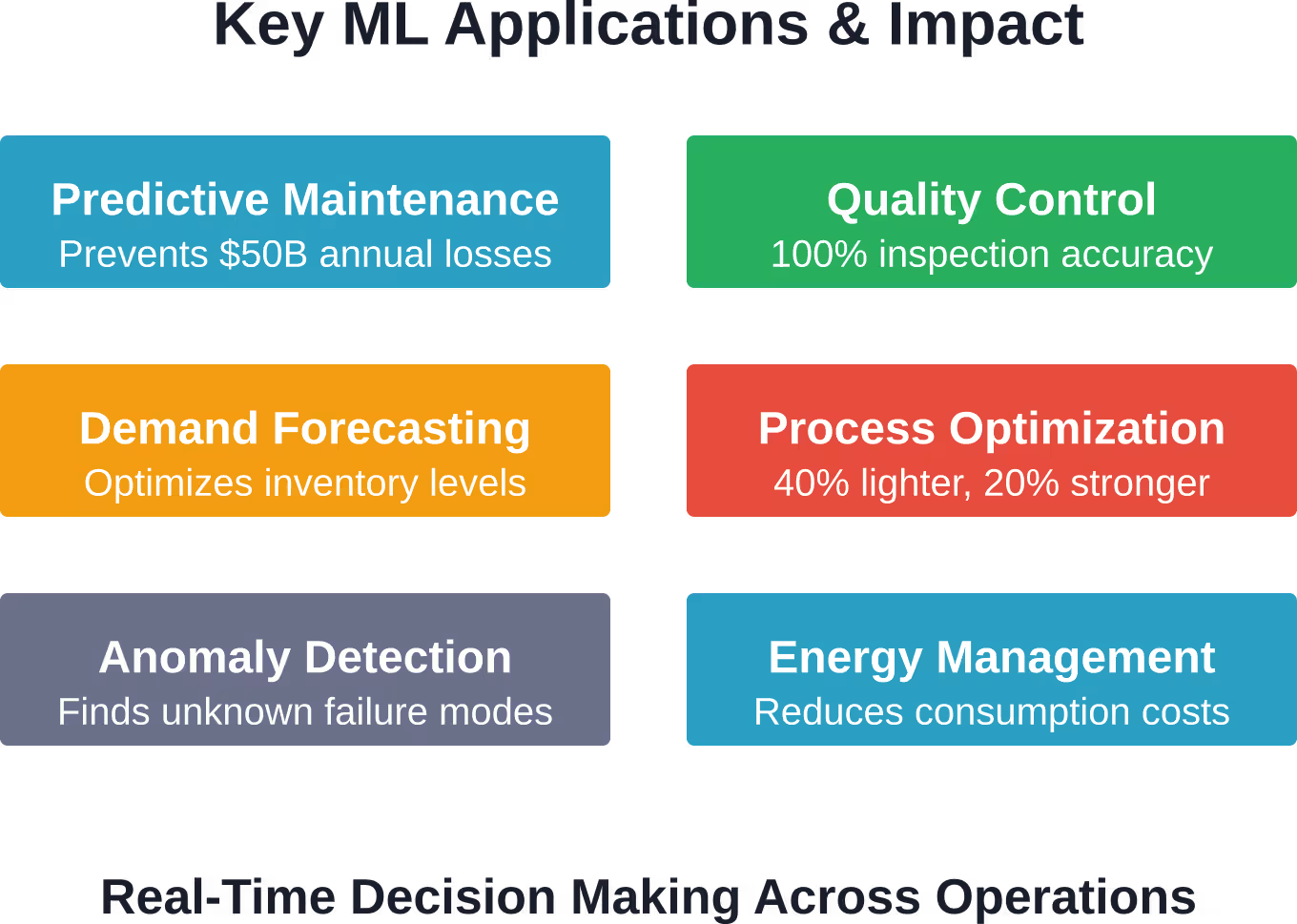
Equipment failures cost money. Unplanned downtime disrupts production schedules and industry analyses indicate unplanned maintenance costs around $50 billion annually across manufacturing sectors.
Predictive maintenance uses ML algorithms to forecast when equipment will fail — before it happens. Sensors monitor vibration, temperature, pressure, and acoustic signals. Machine learning models analyze these patterns to detect early warning signs.
The approach differs fundamentally from traditional preventive maintenance, which replaces parts on fixed schedules. Preventive maintenance wastes money replacing components that still have useful life. Predictive maintenance optimizes replacement timing based on actual equipment condition.
Implementation requires historical failure data. The algorithm learns what sensor patterns precede breakdowns. Once trained, the model flags anomalies that indicate impending failure, typically weeks in advance.
Benefits extend beyond avoiding unplanned downtime. Production schedules remain stable. Maintenance crews handle repairs during planned windows. Parts inventory requirements drop because replacements happen on demand rather than just-in-case stockpiling.
Quality Control Systems That Never Blink
Human inspectors fatigue. Subtle defects slip through. Consistency varies across shifts.
Computer vision systems powered by machine learning inspect every part with identical standards. They catch surface defects, dimensional variations, and assembly errors invisible to human eyes.
These systems train on thousands of labeled images — good parts and defective parts. Convolutional neural networks learn to distinguish acceptable variation from true defects. Once deployed, they inspect products at production speed.
The impact shows in reduced rework and warranty claims. Quality issues get caught immediately rather than reaching customers. Root cause analysis improves because defect data is comprehensive and structured.
Advanced systems don’t just detect defects — they trace them back to specific process parameters. Which machine setting caused this dimensional error? What temperature variation led to this surface finish problem? ML algorithms connect quality outcomes to their upstream causes.
Supply Chain Optimization Through Demand Forecasting
Inventory management involves constant tradeoffs. Too much stock ties up capital. Too little causes stockouts and lost sales.
Machine learning models analyze historical demand patterns, seasonal trends, economic indicators, and external factors to predict future requirements. These forecasts are more accurate than traditional statistical methods because they incorporate hundreds of variables simultaneously.
Production planning becomes more responsive. Manufacturers adjust output based on predicted demand rather than reacting to orders already received. Lead times shorten. Customer satisfaction improves.
Supply chain disruptions get flagged earlier. ML systems monitor supplier performance, shipping delays, and logistics bottlenecks. When anomalies emerge, planners receive alerts with enough lead time to implement contingency plans.
Process Optimization and Parameter Tuning
Manufacturing processes involve dozens of adjustable parameters. Temperature, pressure, speed, feed rates — each affects output quality and efficiency. Finding optimal settings through trial and error takes months.
Machine learning accelerates this optimization. Algorithms test parameter combinations in simulation or small production runs, learn which settings produce the best outcomes, and converge on optimal configurations far faster than manual experimentation.
Generative design represents an advanced application. According to Kevin Quinn, Director of Additive Design and Manufacturing at General Motors, conventional design methods yield two to three design options, but generative design provides over 100 design options for a single component. The resulting part turned out to be 40% lighter and 20% stronger than the original.
Energy consumption drops as processes run more efficiently. Material waste decreases. Throughput increases. The cumulative impact on operational costs can be substantial.

Improve Manufacturing with Practical ML Solutions
Manufacturing companies often struggle to turn AI ideas into systems that support real operational improvements. AI Superior helps businesses build machine learning solutions for process optimization, predictive analytics, automation, and computer vision using operational data.
Need a Machine Learning System Built Around Your Business Processes?
AI Superior supports companies with:
- Predictive analytics and operational insights
- Computer vision for monitoring and detection
- AI PoC and prototype development
- AI integration into existing systems
👉Talk to AI Superior about building a machine learning solution that fits your operations.
The Current State of Manufacturing AI Adoption
Adoption rates are accelerating, but the industry remains at relatively early stages. Understanding where manufacturers stand helps set realistic expectations.
According to the National Association of Manufacturers, 28% of manufacturers call their current operations “smart” or “somewhat smart”. That leaves 72% still in traditional or early-stage digitization.
But momentum is building. The same data shows 76% of manufacturers expect to have smart operations within two years. Even more telling: 60% of manufacturers see digital transformation as redefining the industry.
The perception of AI’s significance shifted dramatically. In 2024, only 10% of manufacturers viewed AI as very significant. By 2025, that figure jumped to 34% — more than tripling in a single year.
Most manufacturers currently operate at midlevel digital maturity. According to NAM data, 75% of manufacturers fall into the midlevel digital maturity category, up significantly from 2024 and 2023. They’ve implemented some digital tools but haven’t achieved full integration or autonomous operations.
Looking forward, expectations are ambitious. According to NAM data, 80% of manufacturers agree that self-managing and self-learning AI facilities are coming.
What’s Driving the Acceleration
Several factors are pushing manufacturers toward faster adoption:
- Economic optimism plays a role: NAM data shows 69% of manufacturers expecting moderate growth and no recession in 2025. Companies invest in new technologies when they’re confident about future demand.
- Competitive pressure matters: Manufacturers who optimize operations with ML gain cost advantages. Their competitors must follow or risk becoming uncompetitive.
- Technology maturity has improved: Early ML implementations required specialized AI talent and custom development. Modern platforms make deployment more accessible to mid-sized manufacturers.
- Cloud infrastructure democratizes access: Manufacturers don’t need massive internal data centers. Cloud platforms provide the computational resources ML algorithms require.
Barriers That Still Exist
Despite growing adoption, obstacles remain. The NAM reports that 80% of manufacturers say the length and complexity of the permitting process is harmful to investment. Infrastructure projects needed for AI facilities face regulatory delays.
Interestingly, 87% of manufacturers indicated they would expand operations, hire more workers, or increase wages and benefits if the permitting process were more streamlined. The regulatory environment impacts deployment speed.
Data quality represents another challenge. Machine learning algorithms require clean, structured data. Many manufacturers struggle with legacy systems that don’t capture information in usable formats.
Talent shortages persist. Finding employees who understand both manufacturing processes and machine learning remains difficult. Training existing staff requires time and investment.
Real Examples From Manufacturing Companies
Theory matters less than results. Several manufacturers have implemented ML systems with documented outcomes.
U.S. Steel’s AI-Optimized Facility
According to reporting from The Wall Street Journal, U.S. Steel’s Big River steel plant in Osceola, Arkansas uses advanced technology to make basic steel mill functions more efficient. The system optimizes the cooling of hot steel coils.
The challenge: if coils are positioned too close together, they take longer to cool. Excessive spacing wastes floor space and reduces throughput. Finding the optimal arrangement manually is complex because each coil’s size and temperature varies.
The ML system analyzes real-time data on coil dimensions and temperatures, then calculates optimal spacing. The result: faster cooling without sacrificing quality or safety. U.S. Steel reported the acquisition of this AI-optimized mill helped boost the company’s bottom line and provided “inspiration about what is possible” in other facilities.
Semiconductor Predictive Maintenance
Multiple IEEE publications document predictive maintenance implementations in semiconductor manufacturing. These facilities operate some of the most expensive and sensitive equipment in manufacturing.
A single fabrication tool can cost tens of millions of dollars. Unplanned downtime means production batches are scrapped and delivery schedules slip. The financial impact of a single failure can reach millions.
ML-based predictive maintenance systems monitor sensor data from fabrication equipment. They detect subtle changes in operating parameters that precede failures — changes too slight for human operators to notice.
Early warning enables planned maintenance during scheduled downtime windows. Production schedules remain stable. Equipment utilization improves because maintenance happens only when actually needed rather than on conservative fixed schedules.
Process Optimization at General Motors
Kevin Quinn at General Motors described how generative design — an ML-powered approach — transformed component development. Traditional engineering methods produced two to three design alternatives for evaluation.
Generative design algorithms explore thousands of possibilities. They optimize for multiple objectives simultaneously: weight, strength, manufacturability, cost. The resulting designs often look unusual because they’re unconstrained by human design conventions.
For one component, the generative design outcome was 40% lighter and 20% stronger than the original. Weight reduction in automotive manufacturing directly improves fuel efficiency and vehicle performance.
The approach also accelerates development cycles. What took months of iterative engineering now happens in days or weeks.
How to Actually Implement Machine Learning
Implementation isn’t plug-and-play. Successful deployments follow structured approaches that address both technical and organizational requirements.
Step 1: Start With Data, Not Technology
According to research from MIT Sloan, the key to AI in manufacturing is focusing on data, not complex AI systems. Manufacturers often jump to algorithm selection before ensuring their data infrastructure is ready.
Audit existing data collection. What sensors are already deployed? What information do they capture? Is it stored in accessible formats? How complete and accurate is the historical data?
Identify gaps. What additional data would enable valuable predictions or optimizations? Installing new sensors costs less than building algorithms that work around missing information.
Clean and structure the data. ML algorithms require consistent formats, timestamps, and labels. This preparation work typically takes longer than model development but determines success or failure.
Step 2: Define Specific Use Cases With Clear ROI
Don’t implement machine learning for its own sake. Identify concrete problems where ML can deliver measurable value.
Good use cases have several characteristics: available historical data, quantifiable outcomes, and significant business impact. Predicting equipment failures meets these criteria if failure data exists, downtime costs are substantial, and interventions can prevent failures.
Poor use cases lack data, have unclear success metrics, or address problems where simpler solutions work fine. Don’t use ML for demand forecasting if a basic moving average performs adequately.
Calculate expected ROI before implementation. What will the solution cost? What savings or revenue improvements will it generate? How long until payback?
Step 3: Start Small and Prove Value
Pilot projects reduce risk. Select one production line, one equipment type, or one process for initial implementation.
The pilot should be large enough to demonstrate real value but small enough to contain failure if things don’t work. A single manufacturing cell works better than an entire plant.
Define success criteria upfront. What metrics must improve? By how much? Over what timeframe? Objective measurement prevents debates about whether the pilot worked.
Document results thoroughly. Successful pilots provide the evidence needed to secure funding for broader deployment. Failed pilots generate learning that improves subsequent attempts.
Step 4: Build Internal Expertise
External consultants can accelerate initial implementation, but sustainable success requires internal capability.
Train existing manufacturing engineers in ML basics. They don’t need to become data scientists, but understanding what ML can and can’t do helps them identify opportunities and interpret results.
Hire or develop data science talent with manufacturing domain knowledge. Pure data scientists without industry context struggle to ask the right questions or validate whether model outputs make physical sense.
Create cross-functional teams. ML implementation requires collaboration between data scientists, manufacturing engineers, IT staff, and operations managers. Each brings essential perspectives.
Step 5: Plan for Integration and Scaling
Pilot success doesn’t guarantee smooth scaling. Production deployments face challenges that controlled pilots avoid.
Integration with existing systems matters. How will ML predictions reach the people or systems that need them? Manual processes create adoption barriers. Automated integration into production management systems drives usage.
Model monitoring is essential. ML algorithms can degrade as conditions change. Real-world data drifts from training data. Equipment upgrades alter sensor characteristics. Ongoing monitoring detects when models need retraining.
Change management determines adoption. Even excellent technology fails if users don’t trust it or understand how to act on its recommendations. Training, communication, and demonstrated value build acceptance.
Common Challenges and How to Overcome Them
Every implementation faces obstacles. Knowing what to expect helps prevent surprises that derail projects.
Data Quality Issues
Garbage in, garbage out. ML algorithms trained on poor data produce unreliable predictions.
Common problems include missing values, inconsistent timestamps, sensor drift, and mislabeled examples. Historical data collected for different purposes may lack the granularity ML requires.
Solutions involve automated data quality checks, sensor calibration protocols, and systematic labeling processes. Sometimes the right answer is spending six months improving data collection before attempting ML implementation.
Integration With Legacy Systems
Manufacturing facilities often run equipment decades old. Legacy systems weren’t designed for data extraction or real-time integration.
Retrofitting sensors onto older equipment can be challenging. Proprietary protocols make data access difficult. Downtime for installation must be scheduled carefully.
Edge computing helps bridge the gap. Small computers installed near equipment can collect data from legacy systems and translate it into modern formats before sending to centralized ML platforms.
Resistance to Change
Experienced operators sometimes distrust algorithmic recommendations. “I’ve run this line for 20 years — why should I listen to a computer?”
This skepticism isn’t irrational. Early ML systems sometimes make suggestions that don’t account for factors not in the training data. Operators who follow those recommendations and create quality problems become permanent opponents.
Building trust requires demonstrating value gradually. Let operators see predictions proven correct. Involve them in defining use cases and interpreting results. Make ML assistive rather than dictatorial — recommendations rather than commands.
Skill Gaps
Manufacturing engineers understand processes but not ML. Data scientists understand algorithms but not manufacturing. Neither shortage has quick fixes.
Training programs help but take time. Hiring is competitive because every industry wants ML talent. Partnerships with universities can create talent pipelines, though benefits arrive years later.
Practical approaches include starting with simpler models that existing staff can understand and maintain. Linear regression and decision trees may not be cutting-edge, but they’re interpretable and useful. Build sophistication gradually as capability develops.
Regulatory and Compliance Concerns
Regulated industries face additional complexity. Pharmaceutical manufacturing must comply with FDA guidelines. Automotive parts require traceability and quality documentation.
Can ML-driven quality control meet regulatory standards? How do companies document and validate algorithmic decisions? These questions lack established answers in many industries.
Conservative approaches work until standards evolve. Use ML to assist human decisions rather than replace them. Maintain parallel traditional processes during validation. Document model development and testing thoroughly.
Looking Ahead: What’s Next for Manufacturing ML
Current applications represent early stages. Several trends will shape the next phase.
Edge AI and Real-Time Processing
Cloud-based processing introduces latency. Sending sensor data to remote servers, waiting for analysis, and receiving recommendations takes time.
Edge AI runs algorithms directly on manufacturing equipment or nearby computers. Latency drops to milliseconds. Real-time control becomes possible.
This enables closed-loop optimization where ML models don’t just recommend adjustments — they make them automatically. Process parameters adjust continuously based on real-time conditions.
Digital Twins
Digital twins create virtual replicas of physical manufacturing systems. Sensors feed real-world data into simulation models that mirror actual operations.
ML algorithms can experiment in the digital twin without risking real production. What happens if we increase temperature by 5 degrees? The digital twin provides the answer without running physical tests.
This accelerates optimization and enables predictive analysis. Simulate different scenarios to identify the best approach before implementation.
Autonomous Factories
The NAM data showing 80% of manufacturers believe self-managing, self-learning AI facilities are coming reflects growing confidence in full autonomy.
Current systems optimize specific processes. Future systems will coordinate entire facilities. Production scheduling, quality control, maintenance, inventory management, and energy usage all optimized simultaneously by interconnected ML systems.
This doesn’t mean zero humans. Rather, humans focus on strategic decisions and exception handling while algorithms manage routine operations.
Sustainability Optimization
Environmental regulations are tightening. Companies face pressure to reduce energy consumption, emissions, and waste.
ML algorithms can optimize for sustainability alongside traditional metrics like cost and quality. Find process parameters that minimize energy while maintaining output. Predict optimal recycling and reuse strategies for materials.
The business case strengthens as carbon costs increase and customers prioritize sustainability in purchasing decisions.
Signs Your Facility Is Ready for Machine Learning
Not every manufacturer should implement ML immediately. Timing matters.
Readiness indicators include:
- Significant volumes of digitized operational data already being collected and stored
- Specific high-cost problems that data analysis could address (frequent equipment failures, quality issues, inventory challenges)
- Leadership support and willingness to invest in multi-year initiatives
- Basic IT infrastructure capable of handling increased data processing
- Staff openness to new approaches and data-driven decision making
Red flags that suggest waiting:
- Minimal data collection — most operations tracked manually or not at all
- Leadership expecting immediate transformative results from small investments
- Recent major system migrations or organizational restructuring consuming attention
- Workforce strongly resistant to any process changes
- Financial constraints preventing necessary infrastructure investments
Sometimes the right move is spending a year improving data collection and building foundational capabilities before attempting ML implementation.
Frequently Asked Questions
What’s the typical ROI timeline for machine learning in manufacturing?
ROI timelines vary significantly based on application and complexity. Simple predictive maintenance implementations may show positive returns within 6-12 months through reduced downtime. More complex process optimization or quality control systems typically require 18-24 months before delivering measurable ROI. Initial investment includes data infrastructure, software platforms, training, and integration work. Benefits accumulate gradually as systems prove reliability and adoption increases across operations.
Do we need to hire data scientists or can existing engineers implement ML?
Both approaches work depending on ambition and complexity. Modern ML platforms with pre-built manufacturing models enable engineers with basic data skills to implement simpler applications. However, custom model development, advanced algorithms, and troubleshooting complex issues typically require specialized data science expertise. Many successful manufacturers start with external consultants or platform vendors for initial implementation, then build internal capability over time through training and strategic hires.
How much historical data is needed to train machine learning models?
Data requirements depend on the complexity of the problem and algorithm type. Simple predictive maintenance models might train effectively on 6-12 months of sensor data if failure events are reasonably frequent. Complex quality control systems analyzing high-resolution images may need thousands of labeled examples. The key isn’t just volume but variety — models need examples covering different operating conditions, failure modes, and edge cases. Starting with whatever data exists makes sense; gaps become clear during development.
Can machine learning work with older manufacturing equipment?
Yes, though retrofitting may be required. Older equipment typically lacks modern sensors and data connectivity, but these can often be added. Aftermarket sensors for vibration, temperature, and acoustic monitoring attach to existing machines. Edge computing devices capture data from legacy control systems and translate proprietary protocols. The challenge is usually mechanical access and installation downtime rather than fundamental incompatibility. Some very old equipment may not justify the retrofitting cost.
What happens if the ML model makes wrong predictions or recommendations?
Model errors are inevitable, especially during initial deployment. Successful implementations include human oversight and validation processes. Critical decisions require human approval rather than automatic execution. Monitoring systems track model performance continuously and flag when accuracy degrades. Most manufacturers implement ML as decision support rather than autonomous control, especially during early phases. Models improve through retraining as more data accumulates and edge cases are incorporated.
Is cloud-based or on-premise infrastructure better for manufacturing ML?
Both have merits. Cloud platforms offer scalability, reduced capital investment, and access to advanced tools without internal maintenance. They work well for non-real-time applications like demand forecasting or quality analysis. On-premise or edge infrastructure provides lower latency, better control over sensitive data, and continued operation if internet connectivity fails. Many manufacturers use hybrid approaches — edge devices for real-time control, cloud platforms for training models and analyzing aggregated data.
How do we handle the cybersecurity risks of connected manufacturing systems?
Connected systems do expand attack surfaces. Best practices include network segmentation separating manufacturing systems from corporate networks, encrypted data transmission, regular security audits, and access controls limiting who can modify ML models or system parameters. Many manufacturers implement air-gapped architectures where critical production control systems have no direct internet access. Edge computing helps by processing sensitive data locally rather than transmitting it externally. Cybersecurity should be designed in from the start rather than added later.
Taking the Next Step
Machine learning in manufacturing has moved past the experimental phase. Real applications deliver measurable value. Adoption is accelerating — the NAM data showing 76% of manufacturers expecting smart operations within two years isn’t just optimism; it reflects active implementation plans.
But successful deployment requires more than enthusiasm. Data infrastructure must be ready. Use cases must align with business priorities. Implementation needs structured approaches that address both technical and organizational challenges.
Start by auditing current data collection. What information already exists? What gaps need filling? Identify specific high-value problems where ML could deliver measurable improvements.
Then run a focused pilot. Small enough to contain risk. Large enough to demonstrate real value. With clear success metrics defined upfront.
The manufacturers who thrive over the next decade will be those who master production optimization through intelligent analysis. The question isn’t whether to adopt machine learning. It’s how quickly implementation can be done effectively.
The data, the technology, and the proven use cases all exist. The differentiator is execution.
 English
  German
  Arabic
  French
  Dutch
Dutch  Spanish