
Quick Summary: Machine learning transforms cybersecurity by analyzing massive data volumes to detect threats, predict attacks, and automate responses faster than traditional rule-based systems. ML models identify patterns in network traffic, malware signatures, and user behavior to catch anomalies that signal breaches, while adapting continuously as adversaries evolve their tactics. Cyber threats grow more sophisticated every day. Traditional security tools—signature databases, static rules, blocklists—can’t keep pace with attackers who constantly change tactics. That’s where machine learning enters the picture. ML models process billions of data points across networks, endpoints, and applications to spot patterns humans would miss. They learn what normal behavior looks like, flag deviations in real time, and adapt as new attack vectors emerge. But machine learning isn’t magic. It introduces new challenges: adversarial attacks that poison training data, false positives that overwhelm security teams, and computational costs that strain budgets. Here’s what security professionals need to know about machine learning in cybersecurity—what it does well, where it falls short, and how organizations deploy it effectively.
What Machine Learning Actually Does in Cybersecurity
Machine learning analyzes data to make predictions without explicit programming for every scenario. Instead of writing rules for each known threat, ML models learn from examples. An American scientist, Arthur Samuel, coined the term machine learning in 1959. He defined it as “the field of study that gives computers the capability to learn without being explicitly programmed.” In cybersecurity, that capability matters because threats evolve faster than humans can write rules. ML systems detect anomalies, classify malware, predict vulnerabilities, and automate incident response. The core advantage? Scale. Organizations see large volumes of data packets traverse firewalls daily. Even if only 0.1% of data gets mis-categorized by machine learning, incorrectly blocking legitimate traffic could severely impact business operations. Early ML implementations faced this challenge, which is why modern systems emphasize precision alongside detection speed.
Three Core Learning Approaches
Machine learning in cybersecurity typically uses three methods:
- Supervised learning trains on labeled datasets: Security teams feed the model examples of malicious and benign files, network traffic, or user behavior. The model learns to classify new inputs based on those examples. It’s effective for malware detection when training data is abundant and representative.
- Unsupervised learning finds patterns without labels: The model clusters similar behaviors or identifies outliers. This approach works well for anomaly detection—spotting unusual network traffic or user activity that might signal a breach. It doesn’t need pre-labeled attack examples.
- Reinforcement learning improves through trial and error: The system takes actions, receives feedback (reward or penalty), and adjusts strategy. In cybersecurity, reinforcement learning can optimize incident response workflows or penetration testing strategies.
Where Machine Learning Makes the Biggest Impact
Machine learning enhances multiple cybersecurity domains. Some applications deliver measurable value today; others remain experimental.
Threat Detection and Classification
ML models analyze network traffic to identify attacks that signature-based tools miss. They detect zero-day exploits by recognizing malicious patterns rather than matching known signatures. Malware classification represents one of the most mature ML applications. Models examine file attributes—API calls, binary structures, behavioral signatures—to determine if a file is malicious. Training on millions of samples produces models that catch polymorphic malware that changes its code to evade traditional antivirus. According to research, when Šrndić and Laskov tested a learning-based PDF malware detector, the most aggressive evasion strategy succeeded for only 0.025% of malicious examples tested against a nonlinear SVM classifier with the RBF kernel. That extremely low evasion rate demonstrated ML’s resilience against basic adversarial attempts.
Anomaly Detection in Network Behavior
Normal network activity follows predictable patterns. Users log in during business hours, access typical file shares, and generate consistent traffic volumes. ML models baseline this normal behavior, then flag deviations. A user account suddenly downloading gigabytes of data at 3 a.m.? Anomaly. A server making outbound connections to unfamiliar geographic regions? Anomaly. Unsupervised learning excels here because it doesn’t require labeled examples of every possible attack. The model learns what’s normal, then alerts on anything outside those boundaries.
Vulnerability Management and Prioritization
Security teams face thousands of reported vulnerabilities. Which ones deserve immediate patching? Which can wait? ML models analyze vulnerability attributes—CVSS scores, exploit availability, asset criticality, threat intelligence feeds—to recommend prioritization. The system learns which vulnerability characteristics correlate with actual exploitation in the wild, helping teams focus on the most dangerous exposures first. 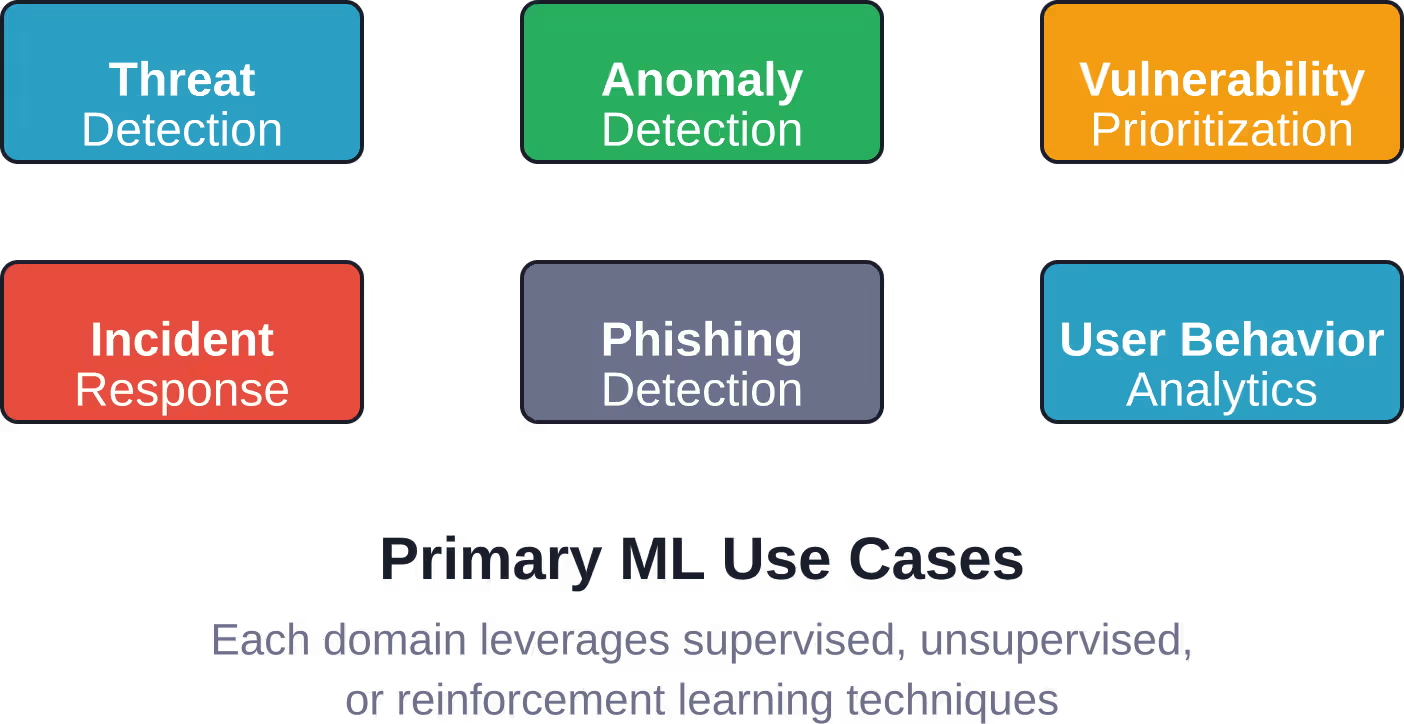
Automated Incident Response
When a security alert fires, someone needs to investigate. Is it a real threat or a false positive? What’s the appropriate response? ML-driven security orchestration platforms analyze alerts, correlate them with threat intelligence, and execute predefined response playbooks. A phishing email detected? The system quarantines it, blocks the sender domain, and notifies affected users—all without human intervention. Speed matters. Reinforcement learning models optimize response workflows based on outcomes, learning which actions contain threats most effectively.
Phishing and Social Engineering Detection
Phishing attacks exploit human psychology more than technical vulnerabilities. Malicious emails often use legitimate-looking domains, credible branding, and urgency to trick recipients. ML models analyze email metadata, content, sender reputation, and link destinations to classify messages. Natural language processing detects manipulative phrasing and urgency cues. Computer vision models spot logo spoofing and visual deception. The approach isn’t foolproof—sophisticated phishing still gets through—but it catches high-volume campaigns that rely on generic templates.
The Benefits Organizations Actually See
Machine learning delivers tangible advantages when implemented thoughtfully:
- Speed at scale: ML processes millions of events per second, identifying threats faster than any human analyst team. That speed matters when attackers move laterally through networks in minutes.
- Adaptive defense: ML models retrain on new data, learning to recognize emerging attack patterns. Rule-based systems require manual updates for each new threat variant.
- Reduced analyst fatigue: Security operations centers drown in alerts. ML filters false positives and prioritizes genuine threats, letting analysts focus on investigations that matter.
- Discovery of unknown threats: Anomaly detection surfaces attacks that don’t match any known signature. Zero-day exploits, insider threats, and novel malware become visible through behavioral deviations.

Apply Machine Learning to Cybersecurity Risk Detection
Modern cybersecurity environments generate more alerts and operational data than most teams can realistically process manually. AI Superior helps companies develop machine learning systems for data analysis, process automation, and operational decision-making using large-scale datasets.
Looking for a Practical Way to Use AI in Cybersecurity?
AI Superior can help organizations with:
- AI models for detecting unusual activity and behavioral patterns
- Data analysis systems built around large operational datasets
- Custom AI prototypes for internal business workflows
👉Contact AI Superior to discuss how machine learning can support your cybersecurity-related processes and data analysis needs.
Real Challenges Nobody Talks About Enough
Machine learning introduces problems that traditional security tools don’t face.
Adversarial Machine Learning
Attackers target ML models themselves. According to NIST research published January 4, 2024, adversarial machine learning encompasses attacks that manipulate ML system behavior through carefully crafted inputs or poisoned training data. Data poisoning injects malicious examples into training datasets, teaching the model to misclassify threats. That same vulnerability affects cybersecurity ML. An attacker who influences training data can teach malware classifiers to ignore specific attack patterns. Evasion attacks craft inputs that fool deployed models. Adversaries modify malware to appear benign, or generate network traffic that mimics normal behavior while exfiltrating data. Model inversion attacks extract sensitive information from the model itself—potentially revealing details about the training data or security infrastructure.
The Cost of Robustness
Building ML models resistant to adversarial attacks isn’t cheap. According to research on arxiv.org, a conventional non-robust ML model costs between $40,000–$100,000 to train. Creating a robust model requires significantly more computational resources—often 100 to 1,000 times the training effort. That’s a capital expenditure many organizations can’t justify, especially when attackers continuously develop new evasion techniques that require retraining robust models from scratch.
False Positives and Alert Fatigue
ML models aren’t perfect classifiers. They flag legitimate activity as suspicious, generating false positive alerts that waste analyst time. The false positive rate matters enormously. If 1% of network traffic gets incorrectly flagged, security teams face thousands of worthless alerts daily. Analysts learn to ignore alerts, and real threats slip through. Tuning models to reduce false positives often increases false negatives—missed attacks. Finding the right balance requires continuous adjustment based on organizational risk tolerance.
Data Quality and Availability
ML models need large, representative training datasets. Collecting sufficient examples of rare attack types proves difficult. Imbalanced datasets—where normal activity vastly outnumbers attacks—bias models toward classifying everything as benign. Privacy regulations limit what data organizations can collect and retain for training. Synthetic data generation helps but doesn’t fully replicate real-world attack diversity. 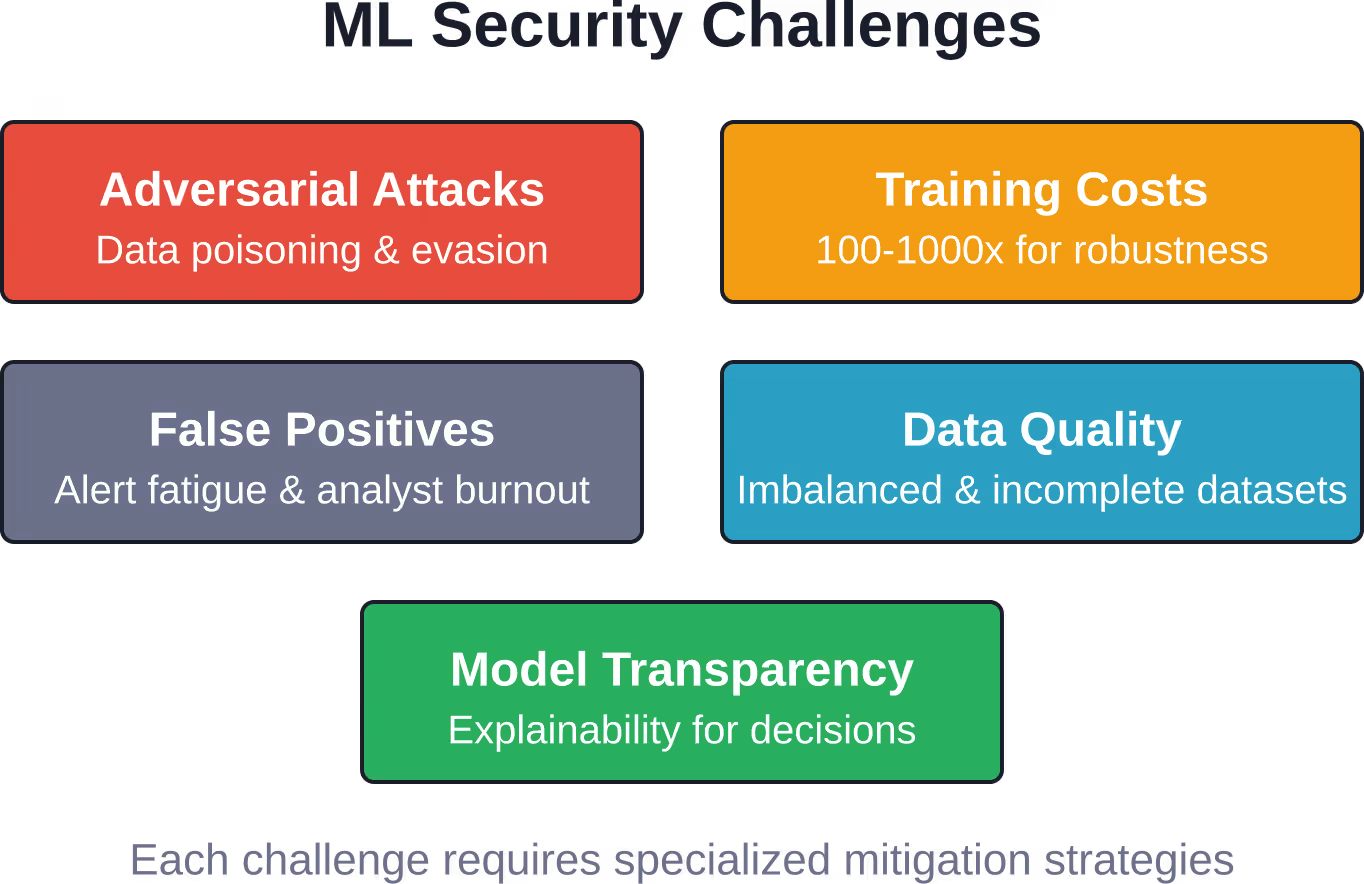
Model Explainability
Deep learning models operate as black boxes. They classify inputs accurately but don’t explain why. When a model flags network traffic as malicious, analysts need to understand the reasoning to validate the alert and respond appropriately. Explainable AI techniques—like LIME (Local Interpretable Model-agnostic Explanations)—provide insights into model decisions. IEEE research explores explainable machine learning-based cybersecurity detection using LIME and SecML frameworks to make model outputs interpretable for security operations. Without explainability, organizations struggle to trust ML recommendations, especially for high-stakes decisions like blocking critical business traffic.
How Government Agencies Are Addressing ML Security
Authoritative organizations recognize both the promise and peril of machine learning in cybersecurity. The Cybersecurity and Infrastructure Security Agency (CISA) published principles for secure integration of artificial intelligence in operational technology on December 3, 2025. That guidance outlines four key principles owners and operators can follow to realize AI benefits in OT systems while reducing risk. CISA and the Australian Signals Directorate’s Australian Cyber Security Centre jointly released guidance advancing secure AI integration in operational technology environments on December 3, 2025, to help organizations mitigate risks and achieve balanced AI integration for OT environments that control vital public services. NIST researchers identified types of cyberattacks that manipulate AI system behavior on January 4, 2024. Their publication lays out adversarial machine learning threats, describing mitigation strategies and their limitations. NIST’s work provides a taxonomy security teams use to categorize and defend against AI-specific attacks. CISA’s AI use cases demonstrate how federal cybersecurity agencies deploy machine learning for cyber defense missions. From spotting anomalies in network data to drafting public messaging, AI tools increasingly form pivotal components of CISA’s security and administrative toolkit.
Evaluating Machine Learning Security Models
Not all ML implementations deliver equal value. Organizations need frameworks to assess model effectiveness.
Performance Metrics That Matter
Accuracy alone doesn’t suffice. A model that achieves 99% accuracy but misses critical attacks fails its purpose. Precision measures how many flagged threats are actually malicious. High precision means fewer false positives. Recall measures how many actual threats the model catches. High recall means fewer false negatives. The F1 score balances precision and recall, providing a single metric for model quality. False positive rate and false negative rate quantify specific error types. Security operations prioritize low false positive rates to prevent alert fatigue.
Testing Against Adversarial Inputs
Models must face adversarial testing before production deployment. Red teams craft evasion attacks—modified malware, disguised network traffic, poisoned training samples—to probe model weaknesses. According to research on arxiv.org on adversarial machine learning from industry and academia, a user study explored perspectives on vulnerabilities and educational strategies among professionals and students. Understanding how practitioners perceive AML threats informs better defensive strategies.
Continuous Monitoring and Retraining
Attack patterns evolve. ML models trained on 2024 threats won’t catch 2026 techniques without updates. Production models require continuous monitoring of prediction accuracy, drift detection (when input data distributions change), and regular retraining on recent attack examples. Automated retraining pipelines keep models current without manual intervention.
Two Common Misconceptions
Misconception 1. ML Eliminates the Need for Human Analysts
Reality: ML augments human expertise but doesn’t replace it. Models generate hypotheses—possible threats that require investigation. Analysts provide context, validate findings, and make judgment calls that algorithms can’t. The most effective security operations combine ML automation for high-volume initial triage with human analysts for complex investigation and response decisions.
Misconception 2. More Data Always Produces Better Models
Reality: Data quality trumps quantity. Training on gigabytes of low-quality, mislabeled, or outdated data produces unreliable models. A smaller dataset of carefully labeled, representative examples often outperforms massive noisy datasets. Garbage in, garbage out applies doubly to machine learning.
Practical Implementation Strategies
Organizations deploying ML for cybersecurity should follow proven approaches:
- Start with well-defined use cases: Don’t deploy ML everywhere at once. Pick high-impact areas—malware detection, phishing classification, anomaly detection—where ML demonstrably outperforms traditional tools.
- Invest in data infrastructure before model development: Clean, labeled training data is more valuable than sophisticated algorithms. Build pipelines for data collection, labeling, storage, and versioning.
- Plan for adversarial resilience from day one: Assume attackers will probe models for weaknesses. Implement input validation, anomaly detection on model inputs, and regular adversarial testing.
- Maintain human oversight for critical decisions: ML can recommend blocking traffic or quarantining files, but humans should approve actions with significant business impact.
- Budget for ongoing costs: Training robust models can cost $40,000–$100,000 for conventional systems, with robust adversarial-resistant models requiring 100 to 1,000 times more computational resources. Factor retraining, monitoring, and infrastructure costs into total cost of ownership.
| Implementation Phase | Key Activities | Common Pitfalls |
|---|---|---|
| Planning | Define use cases, assess data availability, set success metrics | Overly broad scope, unrealistic timelines, insufficient stakeholder buy-in |
| Data Preparation | Collect representative samples, label accurately, balance datasets | Inadequate labeling, class imbalance, outdated training data |
| Model Development | Select algorithms, train initial models, validate performance | Overfitting, ignoring adversarial robustness, chasing accuracy over precision |
| Deployment | Integrate with SOC workflows, configure alerting, establish monitoring | Lack of explainability, alert overload, poor integration with existing tools |
| Operations | Monitor drift, retrain models, tune thresholds, conduct red team testing | Neglecting retraining, ignoring false positive feedback, static configurations |
The Role of Certifications and Training
As ML becomes central to cybersecurity, professional certifications adapt. EC-Council’s CEH v13 AI (Certified Ethical Hacker version 13) represents the latest iteration, focusing on integrating artificial intelligence into ethical hacking practices. According to course information from NICCS (National Initiative for Cybersecurity Careers and Studies), CEH v13 introduces AI-driven penetration testing techniques, where machine learning algorithms enhance ethical hacking practices. The curriculum covers AI-driven techniques for vulnerability discovery and exploit development. CISA’s Artificial Intelligence and Machine Learning Cybersecurity Workshop in Military Operations dives into the intersection of AI, ML, and cyber defense strategies within military environments. Participants explore how intelligent systems detect anomalies, automate threat responses, and enhance situational awareness. The course addresses adversarial AI, data poisoning, and ethical considerations. These educational programs signal industry recognition that cybersecurity professionals need ML expertise to defend modern networks effectively.
Looking Ahead: What’s Next for ML in Cybersecurity
Machine learning in cybersecurity is still maturing. Several trends are shaping its evolution. Federated learning allows organizations to collaboratively train models without sharing raw data. Financial institutions, healthcare providers, and critical infrastructure operators can pool threat intelligence while preserving privacy and regulatory compliance. Explainable AI continues improving. Security tools increasingly provide reasoning for ML-driven alerts, helping analysts understand model decisions and building trust in automated recommendations. Adversarial robustness research advances defensive techniques. New training methods produce models more resistant to evasion and poisoning attacks, though the computational cost remains a barrier. Integration of large language models (LLMs) enables natural language interfaces for security tools. Analysts query systems in plain English; LLMs translate questions into database queries, parse threat intelligence, and summarize complex attack chains. Real talk: ML won’t solve cybersecurity. But it’s becoming indispensable for organizations facing threat volumes and sophistication that overwhelm human-only defenses.
Frequently Asked Questions
What is machine learning in cybersecurity?
Machine learning in cybersecurity refers to algorithms that analyze data to detect threats, predict attacks, and automate responses without explicit programming for every scenario. ML models learn from examples to identify malware, anomalies, phishing attempts, and vulnerabilities at scale and speed beyond traditional rule-based systems.
How does machine learning detect cyber threats?
ML detects threats by learning patterns in network traffic, file attributes, and user behavior. Supervised learning classifies inputs based on labeled training examples (malicious vs. benign). Unsupervised learning identifies anomalies—deviations from normal behavior—that signal potential attacks. Models continuously analyze data streams, flagging suspicious activity in real time.
What are adversarial attacks on machine learning models?
Adversarial attacks manipulate ML systems by poisoning training data or crafting inputs that fool deployed models. Data poisoning injects malicious examples during training to teach models incorrect classifications. Evasion attacks modify malware or network traffic to appear benign. Model inversion extracts sensitive information from the model itself. According to NIST research, these attacks represent a growing threat as ML adoption increases.
How much does it cost to build a robust machine learning security model?
A conventional non-robust ML model costs between $40,000–$100,000 to train, according to research on arxiv.org. Creating a robust model resistant to adversarial attacks requires 100 to 1,000 times more computational resources and expertise. Organizations must balance robustness needs against budget constraints and continuously retrain models as attack patterns evolve.
Can machine learning replace human security analysts?
No. Machine learning augments human analysts but doesn’t replace them. ML excels at processing massive data volumes and flagging potential threats quickly. Humans provide context, investigate complex incidents, make nuanced decisions, and handle scenarios that fall outside training data. The most effective security operations combine ML automation for initial triage with human expertise for investigation and response.
What are false positives and why do they matter in ML security?
False positives occur when ML models incorrectly classify benign activity as malicious. High false positive rates generate thousands of worthless alerts, overwhelming security teams and causing alert fatigue. Analysts learn to ignore alerts, which allows real threats to slip through. Tuning models to reduce false positives requires balancing against false negatives (missed attacks) based on organizational risk tolerance.
How do organizations keep ML security models effective over time?
Production ML models require continuous monitoring, drift detection, and regular retraining on recent attack examples. Attack patterns evolve, so models trained on old threats miss new techniques. Automated pipelines collect new data, retrain models, validate performance, and deploy updates. Organizations also conduct adversarial testing to probe model weaknesses and adjust defenses accordingly.
Conclusion
Machine learning fundamentally changes how organizations defend against cyber threats. It processes data volumes humans can’t handle, detects patterns traditional tools miss, and adapts as attackers evolve their tactics. But it’s not a silver bullet. ML introduces challenges—adversarial attacks, false positives, computational costs, and explainability gaps—that require careful management. Success depends on starting with well-defined use cases, investing in quality training data, planning for adversarial resilience, and maintaining human oversight. The organizations that thrive pair ML automation with human expertise, continuously monitor and retrain models, and stay informed about emerging adversarial techniques. They recognize ML as a powerful tool in the cybersecurity toolkit, not a replacement for foundational security practices. As threats grow more sophisticated and attack surfaces expand, machine learning will become table stakes for cyber defense. The question isn’t whether to adopt ML, but how to deploy it effectively while managing its inherent risks. Start small, measure results, and scale what works. That’s how machine learning transforms cybersecurity from a reactive scramble into a proactive, data-driven defense.