
Quick Summary: Machine learning is reshaping education by enabling personalized learning paths, adaptive assessments, and real-time feedback systems that respond to each student’s pace and style. Federal agencies like NSF have invested heavily in AI education infrastructure, supporting over 6,000 students across all U.S. states through initiatives like NAIRR Classroom. While student adoption grew from 48% to 62% between May and December 2025, concerns about critical thinking skills persist, with 67% of students worried about AI’s impact on their learning depth.
Machine learning has moved from experimental pilot programs to mainstream classroom reality. Educators spot struggling students earlier, researchers accelerate discovery cycles, and students receive instruction tailored to their exact learning needs.
But here’s the thing—this transformation isn’t without tension. The same technology that promises personalized support also raises questions about dependency, equity, and whether students are truly learning or just optimizing for algorithmic feedback.
Federal Investment and Infrastructure Growth
The U.S. National Science Foundation has positioned AI education infrastructure as a national priority. According to NSF data from March 2026, NSF has invested over $700 million each year in artificial intelligence research overall, with specific K-12 teacher professional development funding as part of broader initiatives. That’s not abstract funding—it translates to tangible training programs that equip educators with machine learning literacy.
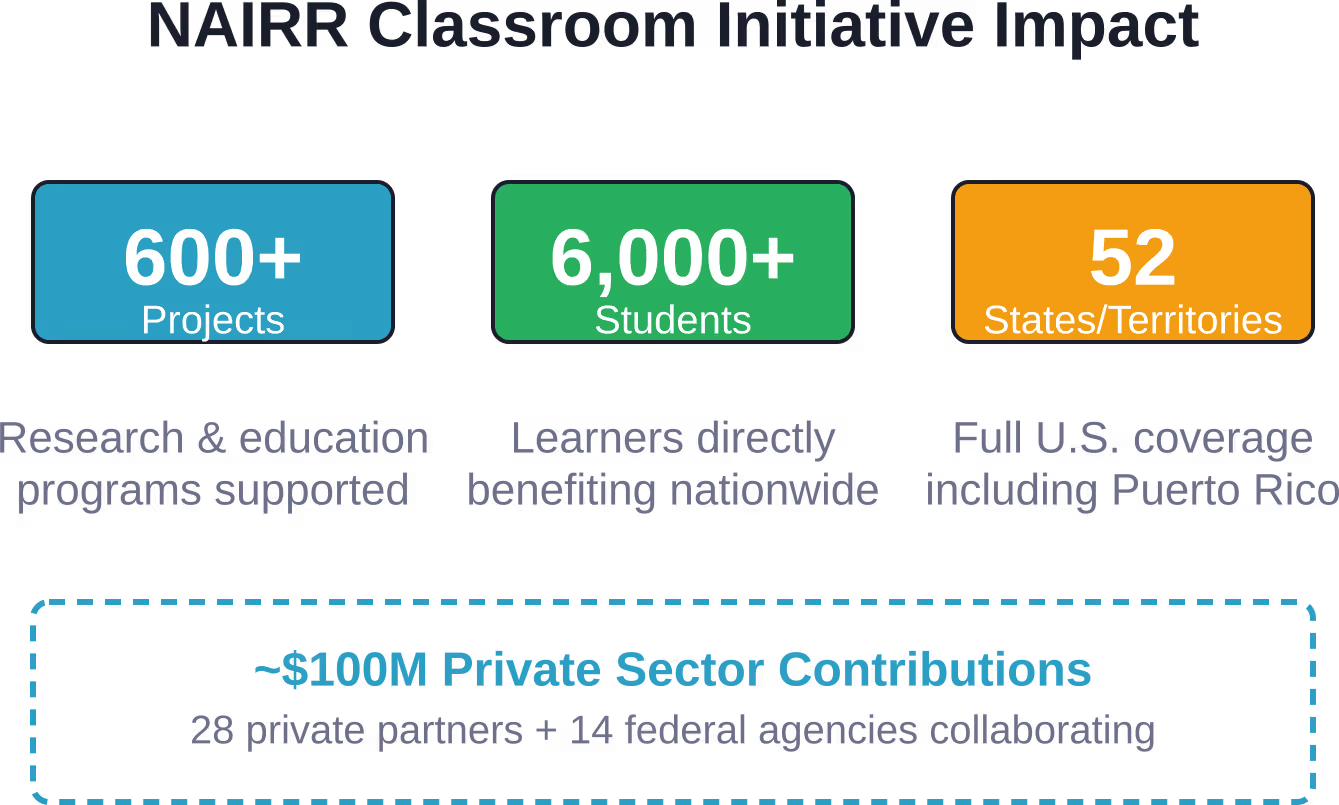
The NAIRR Classroom initiative demonstrates how public-private partnerships scale educational AI. Two years into the program, the initiative has attracted approximately $100 million in private sector in-kind contributions from 28 private partners alongside 14 federal agencies. Geographic reach spans all 50 states plus D.C. and Puerto Rico.
Most telling? NAIRR Classroom supports over 600 research and education projects and more than 6,000 students. These aren’t pilot studies—they’re operational implementations testing machine learning across diverse educational contexts.
Student Adoption Trends and Critical Concerns
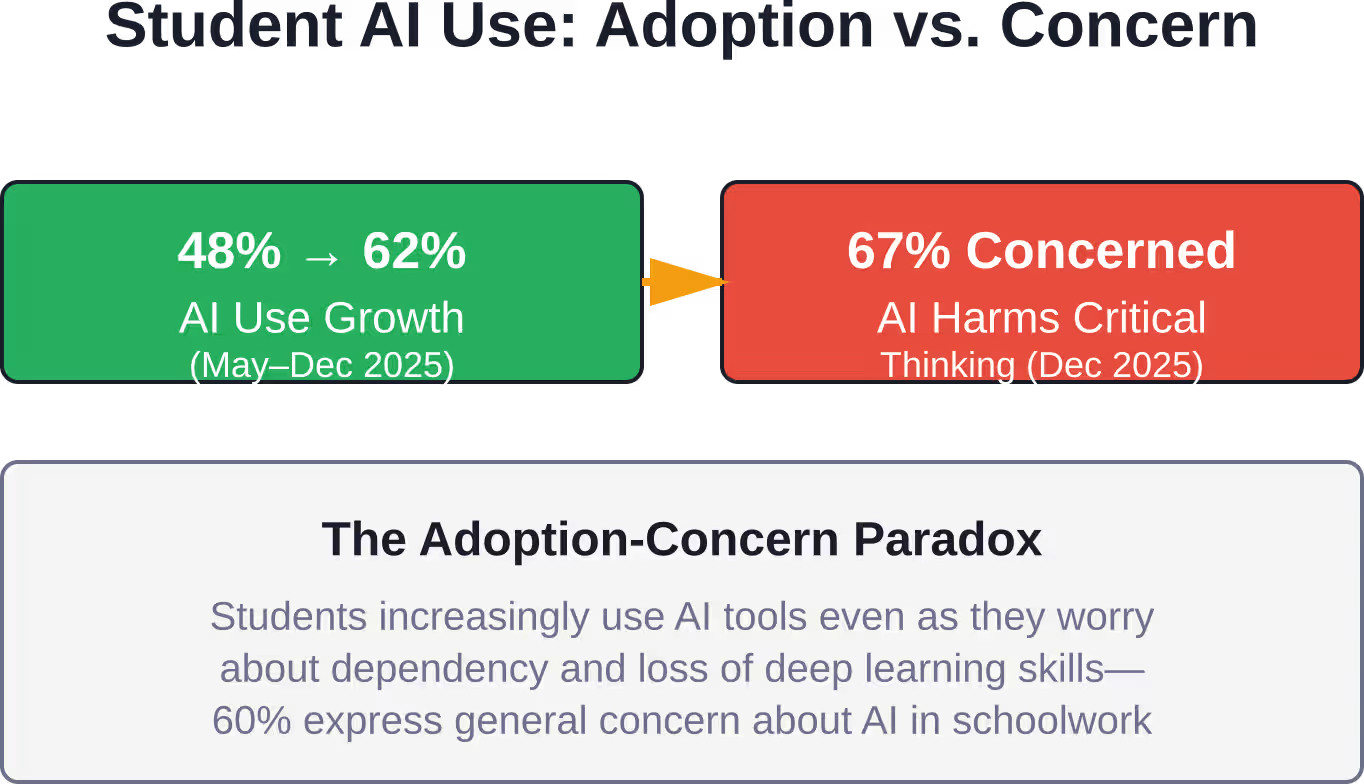
Student use of AI for homework accelerated dramatically through 2025. According to RAND Corporation research, 48% of middle school through college students used AI for homework help in May 2025. By December 2025, that figure jumped to 62%.
Sound familiar? Walk into any university and ask students about ChatGPT usage. A Brookings Institution study found that 100% of students in one university audience reported using ChatGPT, with 80% having used it within the previous 24 hours.
But wait. Higher adoption doesn’t mean uncritical acceptance.
RAND’s December 2025 survey revealed that a significant percentage of students using AI for schoolwork expressed concern that AI use harms critical thinking skills. This represents a notable increase in concern about AI’s impact on critical thinking Most students (60%) expressed worry about using AI for school-related purposes even as they continued using it.
This tension between utility and concern shapes how machine learning tools should be designed and deployed in educational settings. Students recognize the immediate benefit—faster answers, clearer explanations, on-demand tutoring—while simultaneously questioning whether these shortcuts undermine deeper learning.
Adaptive Learning Systems That Actually Work
Machine learning enables instruction that adjusts in real-time based on student interaction patterns. These aren’t static recommendation engines—they’re dynamic systems that modify difficulty, pacing, content sequencing, and assessment types.
Adaptive learning platforms have demonstrated measurable effectiveness. Research showed that students instructed by Yixue (Squirrel AI) scored up to 456% higher in less time compared to traditional classroom instruction. That’s not a typo—properly designed adaptive systems can dramatically compress learning timelines while improving retention.

Bring Advanced Machine Learning Capabilities into Education
Educational organizations increasingly work with digital platforms, large volumes of data, and automated learning environments that require more efficient analysis and decision-making. AI Superior develops custom machine learning solutions that help companies process data, build AI-powered applications, and support operational efficiency through AI technologies.
Implement AI Systems for Smarter Educational Workflows
AI Superior supports organizations with:
- Custom AI applications built around specific business objectives
- NLP solutions for text analysis and language-based interactions
- Big data analytics for large educational datasets
- AI consulting, MVP development, and system integration
👉Talk with AI Superior about machine learning solutions for education platforms, analytics, and AI-driven applications.
Real-World Applications Across Subject Areas
Machine learning deployment in education isn’t evenly distributed across disciplines. Machine learning deployment in education shows concentration in STEM subjects, with particular emphasis on computer science and mathematics
This concentration reveals both opportunity and limitation. STEM subjects lend themselves to algorithmic assessment—right answers exist, problem-solving steps can be decomposed, and feedback can be automated. Humanities subjects requiring nuanced interpretation, creative synthesis, and subjective judgment present harder machine learning challenges.
| Application Area | Primary ML Technique | Key Benefit |
|---|---|---|
| Adaptive Assessments | Reinforcement Learning | Real-time difficulty adjustment based on performance patterns |
| Intelligent Tutoring | Natural Language Processing | 24/7 conversational support with contextual explanations |
| Early Warning Systems | Predictive Analytics | Identification of at-risk students before failure occurs |
| Content Recommendation | Collaborative Filtering | Personalized learning path suggestions based on similar learners |
| Automated Grading | Deep Learning (NLP) | Instant feedback on written assignments at scale |
Natural language processing powers conversational tutors and chatbots that handle functions from content recommendation to 24/7 user support. These systems moderate online learning communities, engage students with adaptive quizzes, and streamline administrative tasks like enrollment.
The Personalization Promise and Its Limits
Machine learning enables teaching that adapts daily to each student’s needs, pace, and style. By analyzing interaction data and learning patterns, systems customize instruction and anticipate learning obstacles.
Platforms like Trivie leverage adaptive learning combined with gamification, boosting retention rates by over 90%. Course Hero uses AWS infrastructure and machine learning for intelligent content search and fraud detection, supporting millions of learners.
Real talk: personalization works best when it augments rather than replaces human instruction. The U.S. Department of Education’s July 2025 guidance emphasized that federal grant funds can improve education outcomes through AI when implementations focus on measurable student achievement rather than technology for its own sake.
Globally, the need is acute. Brookings Institution research notes that Brookings Institution research notes significant learning challenges globally, with some classrooms operating at extremely high student-to-teacher ratios, with some classrooms operating at 60:1 student-to-teacher ratios. Machine learning can’t replace teachers, but it can extend their reach and effectiveness in resource-constrained environments.
Emerging Challenges and Ethical Considerations
The rapid proliferation of machine learning in education has outpaced careful consideration of whether these technologies support holistic education principles. Research from the Proceedings of the National Academy of Sciences highlights a problematic pattern: most machine learning education research obsesses over marginal prediction improvements—”can we predict 62% instead of 61%”—without addressing whether those predictions translate to meaningful interventions.
That gap surfaced in the majority of practitioner interviews (12 out of 15). Educators noted that algorithmic accuracy matters less than actionable insight. A prediction that a student will fail means nothing without an effective intervention pathway.
Equity concerns loom large. Brookings researchers warn of a “third digital divide”—not just access to technology or skills to use it, but meaningful access to AI systems that genuinely enhance learning rather than create new dependencies. Wealthier students access sophisticated, well-designed adaptive systems with proper pedagogical grounding. Less affluent students may encounter poorly designed tools that provide answers without understanding.
Implementation Strategies for Educators
Effective machine learning integration requires intentional design choices. Based on available research and practitioner experience, several patterns emerge:
- Start with clear learning objectives before selecting technology: The U.S. Department of Education guidance emphasizes that AI should serve measurable education goals, not drive them. Technology decisions should follow pedagogical strategy.
- Combine machine learning with human support: Research on generative AI tutoring shows benefits when designed responsibly and used alongside human educators. AI handles routine explanation, practice scaffolding, and immediate feedback. Teachers focus on complex interpretation, motivation, and socio-emotional support.
- Build teacher capacity systematically: NSF’s $11 million investment in K-12 AI professional development recognizes that effective implementation requires educators who understand both the capabilities and limitations of machine learning systems.
- Design for transparency and explanation: Students and teachers need to understand why an adaptive system makes specific recommendations. Black-box algorithms that adjust difficulty or suggest content without explanation undermine learning autonomy and pedagogical judgment.
Looking Forward: Research Directions
Machine learning methods hold potential in developing fundamental knowledge about equitable and effective teaching because they can track complex features, processes, and patterns that conventional statistical methods miss. Teaching involves highly interactive, adaptive, nonlinear, and context-dependent practices—characteristics that simple linear regression struggles to model.
Emerging research explores explanatory machine learning frameworks using neural networks to analyze teaching effectiveness, examining profiles, pathways, and practices that produce student learning across different STEM contexts. These methods can identify how teacher knowledge, culturally responsive self-efficacy, and classroom observation patterns interact in ways conventional analysis cannot detect.
The National AI Research Institutes, funded at approximately $20 million each over five years and consisting of 29 institutes connecting over 500 institutions, focus on foundational AI science and its application in critical sectors including education. These investments aim to build national infrastructure for AI education and workforce development.
Frequently Asked Questions
How widely are students currently using AI for schoolwork?
According to RAND Corporation research, 62% of middle school through college students used AI for homework help as of December 2025, up from 48% in May 2025. Adoption has accelerated significantly, though most students (60%) express concerns about AI’s impact on their learning.
Does adaptive learning actually improve student outcomes?
Research shows properly designed adaptive learning platforms can significantly improve performance. Studies of platforms like Squirrel AI demonstrated students scoring up to 456% higher compared to traditional instruction in less time. Effectiveness depends heavily on pedagogical design, not just algorithmic sophistication.
What federal support exists for AI in education?
The U.S. National Science Foundation invested $11 million in AI professional development for K-12 teachers as of March 2026. The NAIRR Classroom initiative has attracted approximately $100 million in private sector contributions and supports over 6,000 students across all 50 states plus D.C. and Puerto Rico through 600+ research and education projects.
Which subjects benefit most from machine learning applications?
STEM subjects currently dominate educational AI research—35% of studies from 1993-2020 focused on computer science and engineering, and 20% on mathematics. These subjects lend themselves to algorithmic assessment with clear right answers and decomposable problem-solving steps. Humanities applications requiring subjective judgment remain more challenging.
Are students concerned about AI undermining their learning?
Yes. RAND’s December 2025 survey found that 67% of students using AI for schoolwork endorsed the statement that AI use harms critical thinking skills—a 10 percentage point increase in concern from earlier in 2025. This creates a paradox where students simultaneously use and worry about AI tools.
How should schools implement machine learning tools responsibly?
Effective implementation starts with clear learning objectives before selecting technology. The U.S. Department of Education emphasizes that AI should serve measurable education goals rather than drive them. Best practices include combining machine learning with human educator support, building teacher capacity through professional development, and designing systems with transparent explanations for their recommendations.
Can machine learning help address global education inequality?
Machine learning has potential to extend teacher effectiveness in resource-constrained environments. With 70% of students globally experiencing a learning crisis and some classrooms operating at 60:1 student-to-teacher ratios, adaptive systems can provide personalized support at scale. However, Brookings research warns of a “third digital divide” where access to well-designed versus poorly designed AI tools creates new inequities.
Conclusion
Machine learning has moved from educational experiment to operational reality, transforming how instruction adapts to individual learners and how educators identify and support struggling students. Federal investments totaling millions of dollars support infrastructure that now reaches every U.S. state, while student adoption has surged to 62% despite persistent concerns about critical thinking impacts.
The technology works—adaptive systems demonstrate measurable improvements in learning speed and retention when designed with sound pedagogy. But effectiveness requires intentional implementation that combines algorithmic personalization with human judgment, builds educator capacity systematically, and maintains transparency about how systems make decisions.
Schools and districts exploring machine learning integration should start with clear learning objectives, invest in teacher professional development, and select tools that augment rather than replace human instruction. The goal isn’t technology adoption—it’s measurable improvement in student outcomes through thoughtful application of tools that genuinely enhance teaching and learning.
 English
  German
  Arabic
  French
  Dutch
Dutch  Spanish