
Quick Summary: Machine learning consulting helps businesses design, build, and deploy ML systems that solve real problems—from pricing optimization to forecasting. Consultants bridge the gap between raw data and production-ready solutions, handling everything from algorithm selection and training to ethical risk mitigation and integration with existing software. Whether you’re exploring a pilot project or scaling an enterprise platform, ML consultants bring specialized expertise that accelerates ROI and reduces costly missteps.
Machine learning has moved from academic labs into boardrooms. Companies across industries are racing to harness predictive models, natural language processing, and computer vision to automate tasks, personalize experiences, and make faster decisions.
But here’s the thing: building production-grade ML systems isn’t straightforward. Data pipelines break. Models drift. Training sets hide bias. Scaling from prototype to enterprise deployment introduces a dozen new failure modes.
That’s where machine learning consulting comes in. Specialized consultants bring deep technical expertise, cross-industry pattern recognition, and battle-tested frameworks to help organizations move from idea to measurable impact without burning months on dead ends.
This guide unpacks what machine learning consulting actually involves, who benefits most, how to evaluate providers, and what successful engagements look like in 2026.
What Machine Learning Consulting Actually Means
Machine learning consulting covers a spectrum of services designed to help businesses leverage algorithms that learn from data. Unlike traditional software development—where logic is explicitly programmed—ML systems improve their performance as they’re exposed to more examples.
Consultants typically handle three broad categories of work:
- Strategic advisory. Many organizations don’t yet know which problems are good ML candidates. Consultants assess data availability, business priorities, and technical readiness to identify high-value use cases. They’ll map out a roadmap that sequences quick wins ahead of multi-quarter platform builds.
- Model development and deployment. This is the core technical work: data engineering, algorithm selection, training, validation, and integrating models into production systems. Consultants write code, tune hyperparameters, and set up monitoring dashboards so models don’t silently degrade over time.
- Risk mitigation and governance. According to NIST’s AI Risk Management Framework, cultivating trust in AI technologies requires systematic attention to fairness, transparency, and robustness. Consultants help organizations document training data provenance, audit for bias, and implement human-in-the-loop safeguards where stakes are high.
The field has matured significantly. Early ML consulting often meant one-off proof-of-concept projects that never reached production. In 2026, engagements are increasingly end-to-end: from business case through production deployment and ongoing model governance.

Turn Consulting Data Into AI Software With AI Superior
AI Superior helps companies identify, assess, and build AI use cases, then move them into working software. Their services cover AI consulting, AI software development, R&D, training, and integration into existing workflows.
For consulting firms, this can support client-facing analytics tools, internal research workflows, forecasting models, reporting automation, or custom AI systems built around project data.
Need Machine Learning for Client or Internal Workflows?
AI Superior can help with:
- assessing machine learning use cases
- building custom AI and ML tools
- developing predictive and data analysis models
- integrating AI into consulting workflows
👉 Contact AI Superior to discuss your project.
Industries Transforming Through ML Consulting
Machine learning consulting services span nearly every sector, but adoption patterns vary. Some industries face regulatory constraints that slow deployment; others have embraced ML as a competitive necessity.
Insurance and Financial Services
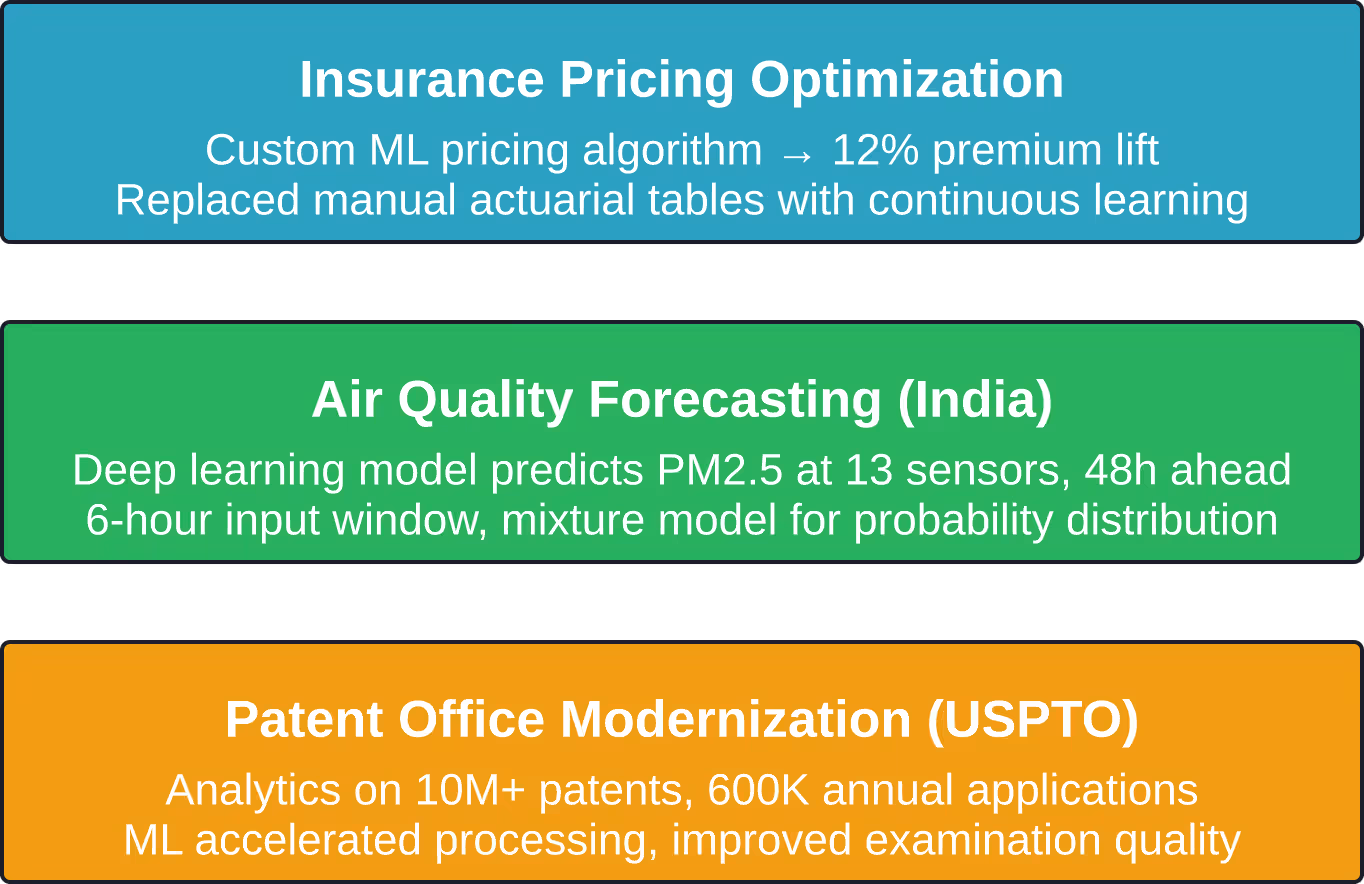
Pricing optimization is a classic ML application. One insurance company working with Tribe AI implemented a custom pricing algorithm that optimized premiums based on customer data, resulting in a 12% premium lift across policies. The model replaced manual actuarial tables with continuous learning from claim outcomes.
Beyond pricing, insurers use ML for fraud detection, underwriting automation, and claims triage. Consultants in this space need domain knowledge—understanding loss ratios, regulatory capital requirements, and compliance constraints—not just technical chops.
Healthcare and Life Sciences
Clinical decision support systems are a frontier application. Researchers have deployed convolutional neural networks to identify skin cancer from photographs, training on datasets exceeding 1.28 million images. However, bias remains a critical concern: less than 5% of these images are of dark-skinned individuals, leading to performance disparities across patient populations.
ML consultants working in healthcare must navigate HIPAA compliance, clinical validation protocols, and ethical considerations around algorithmic fairness. Research highlights that genetics data collected as of 2016 came predominantly from individuals of European ancestry, underscoring the need for representative training datasets.
Environmental and Public Sector
The IIT Kanpur Consulting Group partnered with India’s Ministry of Environment National Clean Air Program to develop a deep learning mixture model for forecasting PM2.5 pollution levels. The system predicts concentrations at 13 sensor locations using a 6-hour historical input window, with forecasts extending 48 hours ahead. For an agricultural organization in the same program, a 2% reduction in temperature forecasting error (measured by MAPE) enabled better irrigation scheduling and crop protection.
Public sector ML projects often prioritize interpretability and social impact over raw predictive performance. Consultants need to balance technical sophistication with stakeholder communication—explaining model outputs to policymakers who lack data science backgrounds.
Retail and E-Commerce
Demand forecasting, personalized recommendations, and dynamic pricing are table stakes. Retailers increasingly use computer vision for inventory management and store layout optimization. ML consultants help integrate these systems with legacy point-of-sale and warehouse management platforms.
The Machine Learning Consulting Process
Successful engagements follow a structured path, even though every project has unique wrinkles. Here’s a framework that reflects current best practices.
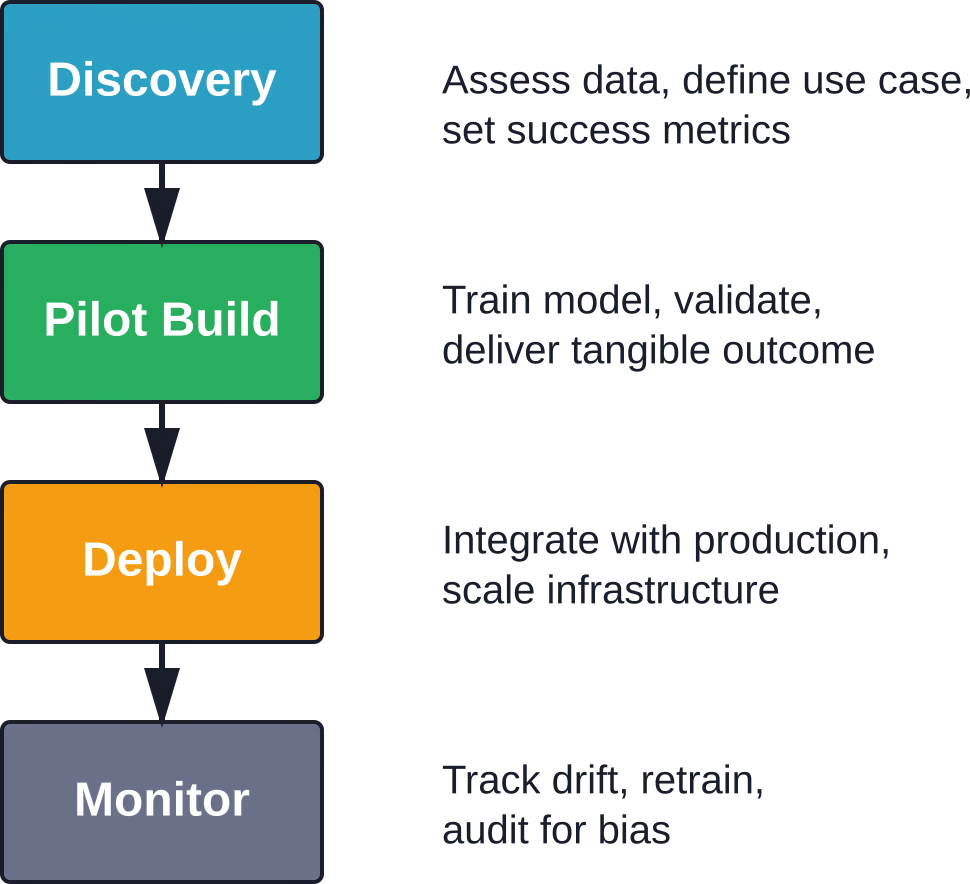
Phase 1: Discovery and Scoping
The first phase answers: Should we do this, and if so, what exactly?
Consultants interview stakeholders, audit existing data infrastructure, and evaluate technical feasibility. Key questions include:
- What business outcome would move the needle? Revenue lift, cost reduction, faster cycle time?
- What data exists today, and in what condition? Missing values, labeling consistency, and sampling bias all matter.
- Who owns the problem internally? Is there executive sponsorship and budget?
- What regulatory or ethical constraints apply? Healthcare, finance, and hiring use cases face heightened scrutiny.
At the end of discovery, the consultant delivers a scoping document: a proposed use case, success metrics, rough timeline, and cost estimate. Smart consultants avoid overpromising. If the data isn’t ready or the problem doesn’t suit ML, they say so.
Phase 2: Pilot Development
This is where the technical work begins. Typical activities include:
- Data pipeline construction. Raw data rarely arrives in model-ready format. Consultants build ETL pipelines to clean, normalize, and feature-engineer inputs. For time-series forecasting, they’ll construct lagged variables and rolling averages. For NLP, they’ll tokenize text and handle rare words.
- Algorithm selection and training. There’s no universal best algorithm. Gradient boosting machines excel on tabular data. Transformers dominate language tasks. Consultants experiment with multiple approaches, splitting data into training and test sets.
- Validation and calibration. A model that achieves high accuracy on test data can still fail in production if it’s poorly calibrated. For a well-calibrated classifier, when the model predicts a 90% confidence threshold, roughly 90% of those predictions should be correct. Consultants check calibration curves and adjust decision thresholds to match business risk tolerance.
The goal is to deliver one tangible outcome by week six: a working prototype, validated proof of concept, or completed migration phase. Early wins build stakeholder confidence and unlock budget for the next phase.
Phase 3: Production Deployment
Moving from a Jupyter notebook to a production API is where many projects stall. Deployment challenges include:
- Infrastructure scaling. Models trained on a laptop may need GPU clusters or distributed inference when serving millions of requests per day. Consultants configure autoscaling, load balancing, and failover.
- Integration with existing systems. The ML model is one component in a larger workflow. Consultants write APIs, handle authentication, and coordinate with internal engineering teams to embed predictions into dashboards, CRM tools, or transaction processing pipelines.
- Monitoring and alerting. Production models degrade over time as data distributions shift. Consultants set up dashboards to track prediction latency, error rates, and statistical properties of incoming data. If execution falls more than 10% behind schedule after the pilot, smart teams reassess scope, resources, or timeline rather than pushing forward blindly.
Phase 4: Ongoing Monitoring and Governance
Deployment isn’t the finish line. Models require ongoing care:
- Retraining schedules. As new data accumulates, models need periodic retraining to maintain accuracy.
- Drift detection. Input distributions can shift due to seasonality, competitor actions, or macroeconomic changes. Monitoring tools flag when current data diverges from training distributions.
- Bias audits. Fairness isn’t a one-time check. Consultants implement regular audits to ensure models don’t develop disparate impact on protected groups as they retrain on new data.
MIT Sloan research emphasizes that successful generative AI implementations focus on small and medium-sized wins while ensuring powerful tools are used appropriately. The same principle applies to traditional ML: incremental, measured progress beats moonshot swings.
Build vs. Buy: When to Bring in External Consultants
Not every organization needs external ML help. Here’s a decision framework.
| Scenario | Build Internally | Use External Consultants |
|---|---|---|
| Skills available in-house | Yes: data scientists, ML engineers on staff | Limited or none |
| Timeline | Flexible (6+ months) | Urgent (under 3 months) |
| Risk tolerance | Low: can afford to iterate and learn | High: need proven approach quickly |
| Problem complexity | Well-defined, standard use case | Novel, requires specialized expertise |
| Budget | Prefers ongoing salaries to project fees | Prefers project-based spend, no long-term headcount |
Many organizations pursue a hybrid model: consultants handle the initial build and knowledge transfer, then internal teams take over maintenance and iteration. This approach balances speed with long-term capability building.
Evaluating Machine Learning Consulting Firms
The ML consulting market is crowded. Firms range from solo practitioners to global consultancies with thousands of data scientists. How do you separate signal from noise?
Technical Depth
Ask candidates to walk through a past project in detail. Probe on:
- How did they handle class imbalance or missing data?
- What validation strategy did they use, and why?
- How did they measure model performance beyond standard accuracy metrics?
Strong consultants explain trade-offs clearly. Weak ones cite buzzwords without substance.
Domain Expertise
ML expertise alone isn’t enough. Healthcare projects require understanding clinical workflows and regulatory pathways. Financial services demand knowledge of risk models and compliance frameworks. Look for consultants who’ve solved similar problems in your industry.
Itransition highlights 25+ years in IT consulting and software, with ML expertise applied across industries. Firms with deep portfolios—collaborations with organizations like ESPN, Shell, 3M, Siemens, and NASCAR—demonstrate cross-domain pattern recognition.
Communication and Change Management
Technical brilliance means little if stakeholders don’t trust the outputs. Consultants need to explain model behavior to non-technical executives, document decisions for compliance teams, and train end users.
Ask how they’ve handled pushback or skepticism in past engagements. The best consultants treat organizational change as part of the project scope, not an afterthought.
Ethical Guardrails
Algorithmic bias is a reputational and legal risk. 2025-2026 audits show that leading facial recognition systems have reduced the error rate for darker-skinned women to below 2% due to the mandatory implementation of the EU AI Act and NIST bias mitigation standards, compared to 0.8% for lighter-skinned men. Skin cancer detection models trained predominantly on light-skinned patients—60% of images scraped from Google—perform poorly on darker skin tones.
Serious consultants proactively address bias. They audit training data for representation gaps, test models across demographic subgroups, and implement fairness constraints when necessary. NIST’s AI Risk Management Framework provides a structured approach to identifying and mitigating these risks.
Common Pain Points and How Consultants Address Them
Organizations encounter predictable obstacles when adopting ML. Experienced consultants have playbooks for each.
Insufficient or Dirty Data
The most common blocker: organizations overestimate data readiness. Labels are inconsistent. Historical records are incomplete. Systems don’t talk to each other.
Consultants help by:
- Conducting data audits early to set realistic expectations
- Building data cleaning pipelines with automated quality checks
- Identifying external datasets that can augment internal sources
- Advising on data collection strategies to improve future projects
Sometimes the answer is: collect more data before building a model. That’s an uncomfortable message, but it beats deploying a system doomed to fail.
Misaligned Expectations
Executives expect ML to solve problems it can’t. Stakeholders want 99% accuracy when 80% is realistic. Business units assume deployment will be instantaneous.
Consultants bridge this gap by setting clear success criteria upfront. What accuracy threshold makes the model useful? What’s the minimum viable product? How will we measure ROI?
MIT Sloan research on machine learning success emphasizes starting with a strong data strategy, selecting the right business use cases, and maintaining patience. Quick wins matter, but sustainable impact requires realistic timelines.
Model Drift and Maintenance
Models that perform well at launch can degrade silently. Customer behavior shifts. Competitors change pricing. Regulations evolve.
Consultants implement monitoring infrastructure: dashboards tracking prediction distributions, automated alerts when performance dips, and retraining schedules tied to data volume or calendar intervals. They also document retraining procedures so internal teams can sustain the system after handoff.
Emerging Trends in Machine Learning Consulting
The field continues to evolve rapidly. Here are shifts shaping engagements in 2026.
Generative AI Integration
Large language models and diffusion models have moved from research novelties to production tools. Consulting engagements increasingly involve fine-tuning foundation models for domain-specific tasks: contract analysis, customer support automation, synthetic data generation.
Companies like Sanofi are deploying generative AI for small-scale transformations—targeted use cases that deliver measurable value without requiring enterprise-wide overhauls. Consultants help scope these projects, select appropriate models, and implement guardrails to prevent hallucination or off-brand outputs.
Quantum-Inspired Methods
Tensor network algorithms offer a quantum-inspired approach to machine learning problems, particularly in quantum reservoir computing. Research from Deloitte Consulting explores scaling analysis of simulation methods for quantum embeddings, with experiments conducted on a normal laptop comparing time complexity with increasing number of qubits.
While still emerging, these methods show promise for specific optimization and simulation tasks where classical approaches struggle.
Responsible AI and Governance
Regulatory pressure is mounting. The EU AI Act, NIST’s AI Risk Management Framework, and state-level privacy laws create compliance obligations. Consulting engagements now routinely include governance workstreams: model cards documenting training data and limitations, bias impact assessments, and audit trails for high-stakes decisions.
This isn’t just legal box-checking. Organizations that proactively address fairness and transparency build user trust and avoid costly remediation down the line.
Edge Deployment and Federated Learning
Privacy regulations and latency requirements are pushing inference to the edge: smartphones, IoT devices, and on-premises servers. Consultants help organizations deploy lightweight models that run locally, implement federated learning where models train across decentralized data without centralizing sensitive information, and optimize for resource-constrained environments.
Real-World Case Studies
Concrete examples clarify what successful ML consulting looks like in practice.
Case Study: Insurance Pricing
A leading insurance MGA partnered with Tribe AI to overhaul pricing. Manual actuarial tables couldn’t adapt quickly to emerging risk patterns. The consulting team built a gradient boosting model that ingested customer demographics, claims history, and external risk factors.
The model ran in production for six months, dynamically adjusting premiums. Result: a 12% lift in premium revenue without sacrificing loss ratios. The client retained the infrastructure and now iterates internally, retraining quarterly as new claims data arrives.
Case Study: Environmental Forecasting
IIT Kanpur’s consulting group collaborated with India’s Ministry of Environment to predict air pollution. The challenge: PM2.5 levels spike unpredictably, making public health interventions difficult to time.
The team deployed a deep learning mixture model trained on 6 hours of historical sensor data, forecasting 48 hours ahead across 13 locations. By modeling probability distributions rather than point estimates, the system gave policymakers uncertainty bounds—critical for resource allocation decisions.
A parallel agriculture project showed how small improvements compound: a 2% reduction in temperature forecasting error (measured by MAPE) enabled better irrigation scheduling and crop protection.
Case Study: Patent Office Transformation
When Michelle K. Lee became director of the U.S. Patent and Trademark Office in 2015, the agency sat on a goldmine: over 10 million issued patents and 600,000 annual applications. But legacy systems made searching and examination slow.
A consulting engagement brought ML to bear on prior art search and application classification. Natural language processing models learned to identify similar patents, accelerating examiner workflows. The project required careful validation—errors in patent examination have legal consequences—but delivered measurable efficiency gains.
Technology Stack and Tools
ML consultants work with a broad toolkit. Here’s what shows up frequently in 2026 engagements.
| Category | Common Tools | Use Case |
|---|---|---|
| Programming languages | Python, R, SQL, Julia | Model development, data manipulation, statistical analysis |
| ML frameworks | TensorFlow, PyTorch, scikit-learn, XGBoost | Training neural networks, gradient boosting, classical ML |
| Data pipelines | Apache Spark, Airflow, Kafka, dbt | ETL, orchestration, streaming data |
| Cloud platforms | AWS SageMaker, Google Vertex AI, Azure ML | Managed training, deployment, scaling |
| Monitoring | MLflow, Weights & Biases, Evidently AI | Experiment tracking, drift detection, performance dashboards |
| Version control | Git, DVC (Data Version Control) | Code and dataset versioning |
Tool selection depends on client infrastructure, team skills, and project requirements. Consultants often inherit existing tech stacks and work within those constraints rather than imposing their preferences.
Cost and ROI Considerations
ML consulting isn’t cheap, but neither is building the wrong system. Pricing models vary:
- Time and materials. Consultants bill hourly or daily rates. This works for open-ended exploration or ongoing support. Rates vary widely based on consultant experience and geographic location.
- Fixed-price projects. For well-scoped engagements (e.g., “build a demand forecasting model for SKU-level inventory”), firms quote a total cost. Risk shifts to the consultant, so expect a premium over time-and-materials for equivalent work.
- Retainer arrangements. Clients pay a monthly fee for a reserved allocation of consulting time. This suits organizations that need ongoing strategic guidance and ad-hoc technical support.
ROI is highly use-case dependent. A 12% premium lift in insurance pricing pays back consulting fees quickly. A 2% forecasting improvement for a small agricultural cooperative may not. Smart consultants help quantify expected impact upfront so clients can make informed investment decisions.
Challenges and Limitations
Machine learning isn’t a panacea. Consultants who oversell capabilities do long-term damage to client trust and industry credibility.
When ML Isn’t the Answer
Some problems don’t need learning algorithms:
- Rules-based logic may be simpler, more transparent, and easier to maintain.
- If data volume is tiny (hundreds of examples, not thousands), classical statistics often outperform ML.
- High-stakes decisions with zero tolerance for error (e.g., safety-critical systems) may require deterministic approaches with formal verification.
Good consultants recommend simpler alternatives when appropriate.
Interpretability vs. Performance Trade-Offs
Deep neural networks often achieve the highest predictive accuracy. But they’re black boxes. Linear models and decision trees are interpretable but may sacrifice performance.
Regulated industries—healthcare, credit, hiring—increasingly demand explainability. Consultants navigate this trade-off by using techniques like SHAP values or LIME to interpret complex models, or by accepting slightly lower accuracy in exchange for transparency.
Data Privacy and Security
ML models can leak training data. Adversarial machine learning research (documented by NIST) explores attacks that extract sensitive information from deployed models or manipulate predictions.
Consultants working with personally identifiable information, health records, or financial data must implement privacy-preserving techniques: differential privacy, secure multi-party computation, or federated learning architectures that never centralize raw data.
Future Outlook for Machine Learning Consulting
Demand for ML consulting shows no sign of slowing. Several forces will shape the next few years.
- Commoditization of infrastructure. Cloud platforms continue to abstract complexity. AutoML tools democratize model building. This shifts consultant value from routine implementation toward strategic advisory, custom algorithm development for novel problems, and integration with messy real-world systems.
- Specialization by vertical. Generic “we do ML” positioning becomes less viable. Clients want consultants who speak their language—whether that’s clinical trials, supply chain logistics, or credit risk modeling. Expect continued fragmentation into boutique firms with deep domain expertise.
- Hybrid human-AI workflows. The most successful deployments don’t replace humans; they augment them. Consultants increasingly design systems where ML handles high-volume routine decisions and routes edge cases to human experts. This requires understanding not just algorithms but also organizational psychology and change management.
- Regulatory compliance as a service. As AI regulation tightens, compliance becomes a consulting differentiator. Firms that can navigate GDPR, the EU AI Act, sector-specific rules, and emerging frameworks will command premium rates.
Frequently Asked Questions
What’s the typical timeline for a machine learning consulting project?
Timelines vary by scope. A focused pilot—like building a single predictive model—might run 8-12 weeks. A comprehensive platform deployment with multiple models, data infrastructure overhaul, and integration work can take 6-12 months. Discovery and scoping typically consume 2-4 weeks upfront. Smart engagements target tangible deliverables by week six to validate direction before committing to larger phases.
How do I know if my data is good enough for machine learning?
Key indicators include volume (generally thousands of examples minimum, though transfer learning can work with less), labeling quality (consistent, accurate annotations), and relevance (features that plausibly correlate with the outcome you’re predicting). Many consulting engagements begin with a data audit to assess readiness. If gaps exist, consultants recommend data collection strategies or alternative approaches while infrastructure matures.
What’s the difference between ML consulting and hiring data scientists?
Consultants offer speed, specialized expertise, and no long-term headcount commitment. They’re ideal for projects with tight deadlines, novel technical challenges, or uncertainty about ongoing needs. Full-time hires make sense when ML becomes a core competency, you have sustained workload to justify headcount, and you want to build internal capability. Many organizations use consultants for initial builds, then transition to internal teams for maintenance and iteration.
Can machine learning models be biased, and how do consultants address this?
Yes. Models learn patterns from training data, including historical biases. Research shows facial recognition systems misclassify gender for darker-skinned women at a 35% error rate versus 0.8% for lighter-skinned men. Skin cancer detection trained predominantly on light skin performs poorly on darker tones. Reputable consultants audit training data for demographic representation, test model performance across subgroups, and implement fairness constraints when stakes are high. NIST’s AI Risk Management Framework provides structured guidance for identifying and mitigating these risks.
What happens after a consulting engagement ends?
Sustainable projects include knowledge transfer. Consultants document code, write runbooks for retraining and troubleshooting, and train internal teams. Some engagements transition to ongoing support retainers where consultants remain available for questions, performance reviews, or new feature development. The best outcomes occur when clients take ownership of deployed systems while retaining access to consultant expertise for complex edge cases.
How much does machine learning consulting cost?
Pricing varies widely by consultant experience, project complexity, and geographic location. Hourly rates for senior ML consultants can range significantly. Fixed-price projects for well-defined scopes might span different budget ranges depending on deliverables. Large-scale enterprise deployments command higher fees. ROI is use-case dependent—a model delivering measurable revenue lift or cost savings can pay back consulting fees quickly, while exploratory projects represent longer-term investments in capability building.
What industries benefit most from machine learning consulting?
Nearly every sector finds applications, but some see particularly high adoption. Financial services use ML for fraud detection, credit scoring, and algorithmic trading. Healthcare applies it to diagnostic support, drug discovery, and patient risk stratification. Retail leverages ML for demand forecasting, personalization, and inventory optimization. Manufacturing deploys predictive maintenance and quality control. The common thread: industries with large datasets, measurable business outcomes, and tolerance for iterative improvement benefit most.
Conclusion
Machine learning consulting bridges the gap between algorithmic potential and business reality. As organizations race to harness predictive models, natural language processing, and computer vision, consultants provide the specialized expertise, cross-industry experience, and risk mitigation frameworks that turn prototypes into production systems.
The field has matured significantly. Early consulting engagements often delivered one-off proofs of concept that never scaled. In 2026, successful projects are end-to-end: from strategic scoping through deployment and governance. Consultants don’t just train models—they build data pipelines, integrate with legacy systems, implement monitoring dashboards, and audit for bias.
Choosing the right partner requires evaluating technical depth, domain expertise, communication skills, and ethical guardrails. The best consultants say no when ML isn’t the answer, set realistic expectations, and design systems that clients can sustain after handoff.
Real talk: machine learning isn’t magic. It won’t fix bad data, misaligned incentives, or unclear business objectives. But when applied thoughtfully to well-scoped problems with sufficient data and stakeholder buy-in, ML delivers measurable impact. Consultants accelerate that journey, helping organizations avoid costly missteps and reach production faster.
Whether you’re exploring a first pilot or scaling an enterprise platform, the right consulting partner brings more than code. They bring judgment, pattern recognition across dozens of prior engagements, and the hard-won knowledge of what actually works when algorithms meet messy reality.
 English
  German
  Arabic
  French
  Dutch
Dutch  Spanish