
Quick Summary: Machine learning in genomics applies computational algorithms to analyze vast genetic datasets, identifying patterns invisible to traditional methods. From predicting disease risk to personalizing treatments, ML tools like convolutional neural networks and supervised learning models transform raw genomic data into clinical insights, achieving performance improvements of 7–29% over conventional approaches in critical applications.
The genomics field generates more data than ever before. A single whole-genome sequencing run produces hundreds of gigabytes. Traditional statistical methods can’t keep pace.
Machine learning changes that equation. Algorithms trained on millions of genetic variants can spot patterns humans would miss, predict disease risk from DNA sequences, and guide treatment decisions with unprecedented precision.
According to the National Human Genome Research Institute (NHGRI), researchers increasingly turn to artificial intelligence and machine learning to identify meaningful patterns in complex genomics datasets for healthcare and research purposes. The shift isn’t theoretical—it’s happening in clinics and labs right now.
Why Machine Learning Matters for Genomics
Genomic data is high-dimensional, noisy, and structured in ways that challenge conventional analysis. A typical exome contains variants in thousands of genes. Whole exome sequencing (WES) targets approximately 3% of the whole genome, which forms the basis for protein-coding genes—yet even that 3% generates enormous datasets with big data characteristics.
Machine learning thrives in exactly these conditions. Where traditional statistical tests struggle with thousands of correlated variables, ML algorithms excel at:
- Identifying non-linear relationships between genetic variants and phenotypes
- Handling missing data and technical noise inherent in sequencing
- Integrating heterogeneous data sources (genomic, transcriptomic, clinical)
- Scaling to datasets containing millions of samples
The field continues to expand the use of computational methods to improve understanding of hidden patterns in large, complex genomics data sets—from basic research to clinical translation.
Core Machine Learning Approaches in Genomics
Not all machine learning is created equal. Different genomic questions demand different algorithmic strategies.
Supervised Learning for Variant Classification
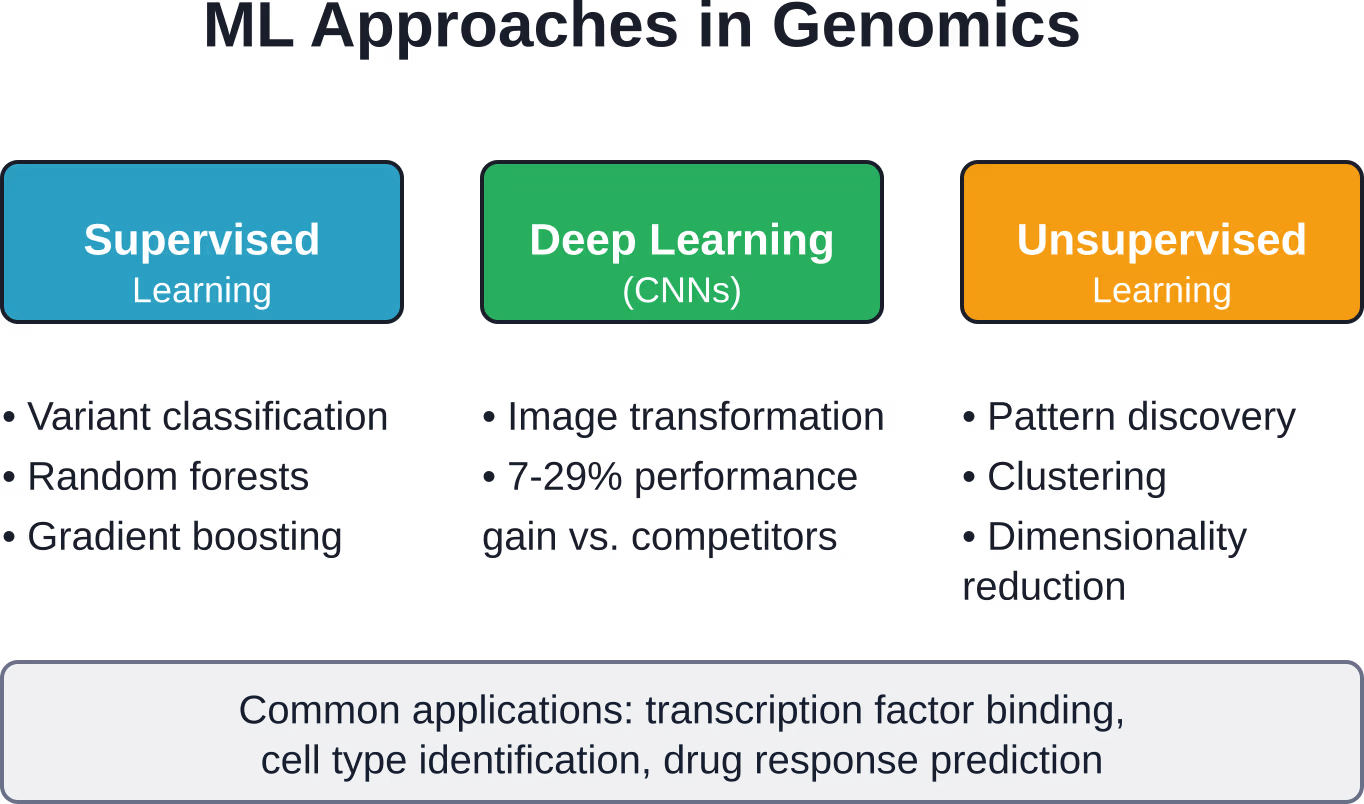
Supervised learning uses labeled training data to build predictive models. In genomics, this translates to training algorithms on known pathogenic and benign variants to classify new, uncertain variants.
Common supervised techniques include:
- Random forests that combine decision trees to predict variant pathogenicity
- Support vector machines that find optimal boundaries between variant classes
- Gradient boosting methods that iteratively refine predictions
These methods power clinical variant databases and prediction tools used daily in diagnostic labs. Genomic medicine, which provides diagnosis and treatment decisions based on genomic variations, has been implemented in clinical practice and has become more accessible. The clinical interpretation of genomic variations detected through genome analysis is crucial in genomic medicine.
Deep Learning and Convolutional Neural Networks
Deep learning represents a revolutionary shift in predictive modeling through the application of multi-layered neural networks, specifically convolutional neural networks (CNNs).
Here’s the thing though—CNNs were originally designed for image analysis. Researchers developed transformation methods like DeepInsight that convert genomics data from tabular form into image-like representations, enabling CNNs to capture latent features effectively.
The results speak for themselves. DeepInsight-3D showed a 7–29% improvement in performance, as measured by model AUC-ROC, across all these methods, according to Nature-published research. DeepInsight-3D achieved an average AUC of 0.72 (Area Under the Curve) for drug response prediction.
Transfer learning further reduces computational time and improves performance. Models pre-trained on large genomic datasets can be fine-tuned for specific tasks with smaller datasets, improving performance in tasks such as transcription factor binding prediction.
Unsupervised Learning for Pattern Discovery
When labeled training data doesn’t exist, unsupervised learning discovers structure in genomic data without predefined categories.
Techniques include clustering algorithms that group similar samples and dimensionality reduction methods that visualize high-dimensional genomic data in two or three dimensions. These approaches reveal hidden population structure, identify disease subtypes, and suggest novel biological hypotheses.

Apply Machine Learning to Genomics Research With AI Superior
Machine learning is reshaping genomics by helping researchers analyze vast genetic datasets and uncover meaningful patterns. AI Superior provides custom AI and ML solutions that can be applied to complex data challenges in genomics research.
Apply AI to Your Genomics Workflows
AI Superior offers machine learning capabilities that may support genomics initiatives, such as:
- Pattern recognition in large‑scale data
- Predictive models to assist in identifying trends
- Automation of data processing and analytical workflows
👉Contact AI Superior today to explore how their AI expertise can support your genomics research.
Real-World Applications Transforming Research and Care
Machine learning in genomics isn’t confined to academic papers. The applications are reshaping clinical practice and biological research.
Predicting Variant Pathogenicity
Clinical variant databases and machine learning prediction algorithms help clinicians interpret the thousands of variants discovered in patient genomes. Tools trained on databases like ClinVar and COSMIC predict whether newly discovered variants likely cause disease.
These predictions guide diagnostic decisions, family screening, and treatment selection in rare genetic diseases and cancer.
Drug Response and Precision Oncology
Cancer multi-omics databases paired with machine learning models predict how tumors will respond to specific therapies. By analyzing genomic, transcriptomic, and proteomic data together, algorithms identify patients most likely to benefit from targeted treatments.
The Cancer Cell Line Encyclopedia (CCLE), Genomics of Drug Sensitivity in Cancer (GDSC), and The Cancer Genome Atlas (TCGA) provide training data for these models. Researchers have achieved 72% accuracy predicting drug efficacy using deep learning approaches on these datasets.
Transcription Factor Binding and Gene Regulation
Understanding where transcription factors bind DNA is fundamental to decoding gene regulation. Machine learning models trained on ChIP-seq and DNase-seq data predict binding sites from DNA sequence alone.
The Kipoi repository accelerates community exchange and reuse of predictive models for genomics, hosting models for transcription factor binding, RNA splicing, and chromatin accessibility. This collaborative approach prevents redundant model development and enables systematic benchmarking.
Cell Type Identification from Single-Cell Data
Single-cell RNA sequencing generates expression profiles for thousands of individual cells. Machine learning automates cell type classification, replacing manual annotation with scalable, reproducible algorithms.
Methods applying deep learning approaches have shown performance improvements for cell type identification, according to published research.
| Application Area | ML Method | Performance Metric | Clinical Impact |
|---|---|---|---|
| Variant pathogenicity | Random forests, SVM | AUC 0.85-0.95 | Diagnostic classification |
| TF binding sites | CNNs | 15.1% AUPRC gain | Regulatory understanding |
| Cell type ID | scDeepInsight | 7% improvement | Disease subtyping |
Genomic Feature Engineering and Model Inputs
The success of machine learning models depends critically on how genomic data is represented and which features are extracted.
Large-scale genomic analyses have uncovered predictive patterns associated with organism traits and lifestyles. Research analyzing 387 fungal genomes used feature sets derived from carbohydrate-active enzymes (CAZymes), peptidases, secondary metabolite clusters, transporters, and transcription factors.
While phylogeny was an important component in most predictions, the inclusion of genomic data improved prediction performance for every lifestyle and trait tested. For obligate biotroph lifestyle prediction, phylogenetic data alone achieved an AUC of 0.899 ± 0.018, but adding genomic feature sets pushed performance to 1.000 ± 0.000, demonstrating substantial improvement from genomic feature integration.
Real talk: feature selection is often the difference between a mediocre model and a breakthrough one.
Key Feature Categories
- Sequence-based features: K-mer frequencies, GC content, motif occurrences
- Functional annotations: Gene ontology terms, pathway memberships, protein domains
- Evolutionary features: Conservation scores, phylogenetic signals, homology relationships
- Structural features: Secondary structure predictions, chromatin state, DNA shape
For necrotroph prediction in fungal genomes, the maximum AUC score increase was 0.395 using the CAZyme feature set—an 87% average AUC gain across the top three feature sets compared to parsimony methods.
Challenges Machine Learning Must Overcome
Despite impressive successes, machine learning in genomics faces real obstacles that limit current applications.
Imbalanced Class Sizes
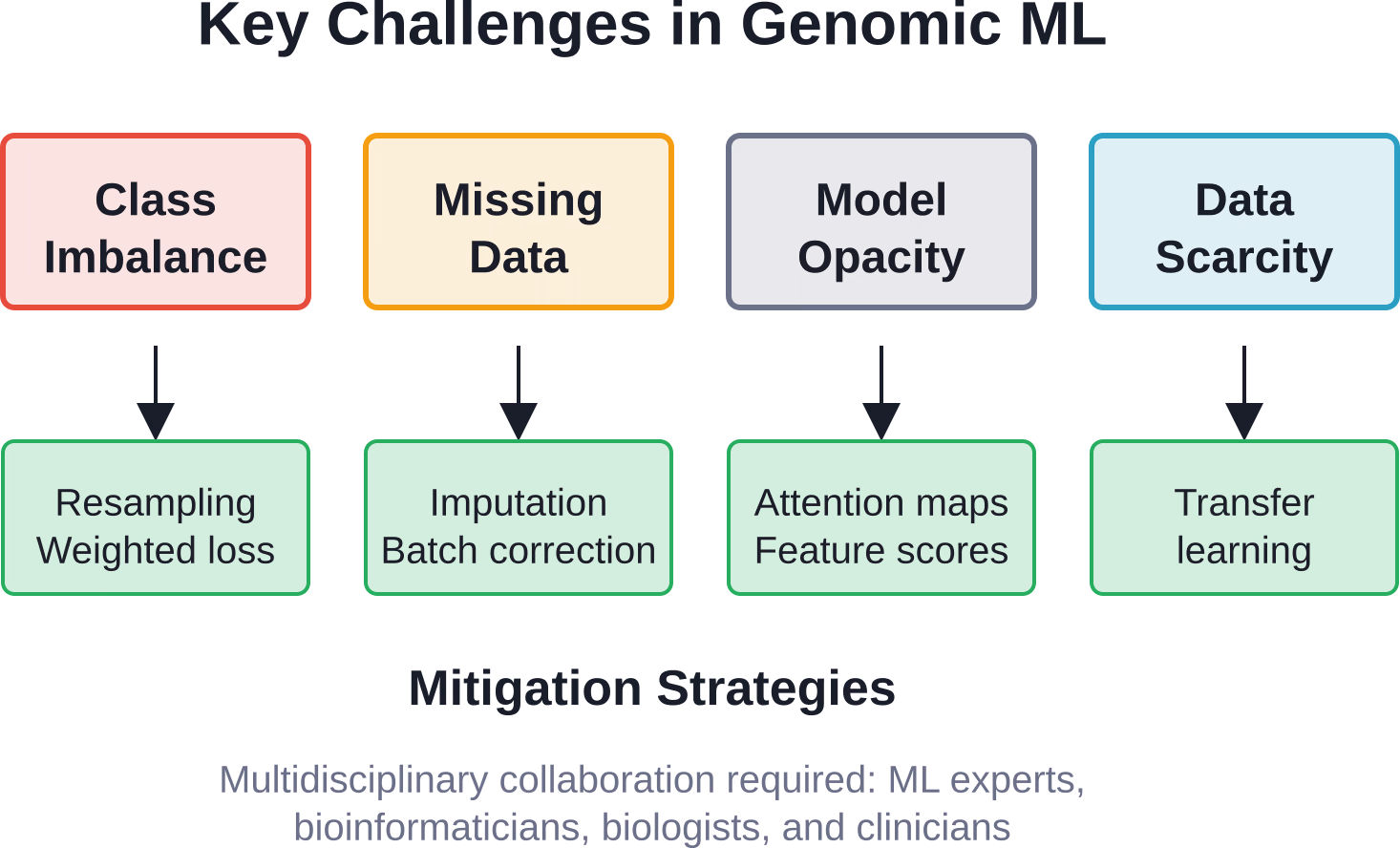
Pathogenic variants are rare compared to benign ones. Disease cases are outnumbered by controls. This class imbalance biases models toward the majority class, reducing sensitivity for rare events that matter most clinically.
Solutions include resampling techniques, weighted loss functions, and ensemble methods that explicitly address imbalance.
Missing and Heterogeneous Data
Genomic datasets frequently contain missing values from technical failures, biological absence, or incomplete databases. Different sequencing platforms, protocols, and processing pipelines introduce batch effects and heterogeneity.
Advanced imputation methods and domain adaptation techniques help, but handling heterogeneous data remains an active research area.
Model Interpretability
Deep learning models are often “black boxes.” A neural network might predict disease risk accurately but provide no mechanistic insight into why a variant is pathogenic.
For clinical adoption, interpretability is crucial. Techniques like attention mechanisms, saliency maps, and feature importance scores offer partial solutions, revealing which genomic regions drive predictions.
Data Size and Quality
Machine learning is data-hungry. Training robust models requires thousands to millions of labeled examples. For rare diseases or understudied populations, this data simply doesn’t exist yet.
Transfer learning and few-shot learning approaches aim to build useful models from limited data, but data scarcity remains a fundamental constraint.
Tools and Resources Accelerating Development
The machine learning genomics ecosystem includes repositories, databases, and collaborative frameworks that lower barriers to entry.
Model Repositories
The Kipoi repository hosts pre-trained models for genomics applications, enabling researchers to apply existing models without retraining. This accelerates community exchange and reuse of predictive models.
Other repositories include:
- MLOmics: Cancer multi-omics database specifically structured for machine learning applications
- GitHub collections: Community-maintained code repositories for genomics ML workflows
Government and Institutional Initiatives
The National Human Genome Research Institute (NHGRI) established the ML/AI Tools to Advance Genomic Translational Research (MAGen) consortium. This collaborative research effort explores the feasibility of machine learning and artificial intelligence tools that can enhance the accuracy and precision of predicting how individuals with pathogenic genetic variants manifest disease.
MAGen brings together the National Institute on Aging (NIA), Office of Data Science and Strategy (ODSS), and NHGRI to address critical questions in genomic translational research through coordinated ML development.
Educational Resources
Courses and tutorials help researchers acquire the computational skills needed to apply machine learning to genomics problems. Online platforms offer specialized genomics ML courses, while university programs increasingly incorporate computational genomics into curriculum.
The Future of Machine Learning in Genomics
Where does the field go from here? Several trends are emerging.
Multi-Modal Integration
The next generation of models will integrate genomic sequences with transcriptomic, proteomic, metabolomic, and clinical data. Multi-omics approaches capture biology’s complexity more completely than single data types.
Early results are promising. Models combining genomic and transcriptomic data outperform single-modality approaches across multiple prediction tasks.
Foundation Models for Genomics
Large language models transformed natural language processing. Genomic foundation models—massive neural networks pre-trained on billions of DNA and RNA sequences—are starting to show similar potential.
These models learn fundamental patterns of genome biology during pre-training, then adapt quickly to specific tasks with minimal fine-tuning data. The approach could democratize genomic ML by reducing the data requirements for developing functional models.
Privacy-Preserving Methods
Genomic data is inherently sensitive and identifiable. Federated learning enables model training across multiple institutions without centralizing raw data. Differential privacy adds mathematical guarantees that model outputs don’t leak individual-level information.
These techniques will be essential as genomic medicine scales to population-wide applications.
Clinical Decision Support
Machine learning tools are transitioning from research prototypes to FDA-cleared clinical decision support systems. Expect continued growth in regulatory pathways for genomic AI, standardized performance benchmarks, and integration with electronic health records.
But wait. Clinical adoption requires more than technical performance. Interpretability, bias mitigation, and equity considerations will determine whether these tools improve or worsen healthcare disparities.
Getting Started with Genomic Machine Learning
For researchers looking to apply machine learning to genomics problems, several practical steps help build foundational skills:
- Learn the biology: Effective genomic ML requires understanding the biological questions and data generation processes
- Master core ML techniques: Start with supervised learning fundamentals before advancing to deep learning
- Explore public datasets: TCGA, CCLE, GDSC, ClinVar, and gnomAD provide training data for diverse applications
- Use established frameworks: Python libraries like scikit-learn, TensorFlow, and PyTorch accelerate development
- Benchmark rigorously: Compare new methods against established baselines using held-out test sets
- Collaborate across disciplines: Partner with domain experts to ensure biological relevance and clinical utility
Community-maintained resources like GitHub repositories and online courses lower the learning curve. The field benefits from open-source culture and data sharing that enable rapid iteration.
Frequently Asked Questions
What is machine learning in genomics?
Machine learning in genomics applies computational algorithms to analyze genetic data, identify patterns, and make predictions about biological functions, disease risk, and treatment response. These methods handle the high-dimensional, complex nature of genomic datasets more effectively than traditional statistical approaches.
How accurate are machine learning models for genomic prediction?
Accuracy varies by application. Variant pathogenicity classifiers achieve AUC scores of 0.85-0.95. DeepInsight methods show 7–29% performance improvements over competing approaches. Performance depends on training data quality, feature engineering, and the specific prediction task.
What are the main challenges in applying ML to genomics?
Key challenges include class imbalance between rare and common variants, missing or heterogeneous data from different sequencing platforms, model interpretability for clinical decision-making, and limited training data for rare diseases or underrepresented populations. Addressing these requires multidisciplinary collaboration between ML experts, bioinformaticians, and clinicians.
Can machine learning predict disease from DNA sequences?
Machine learning models can estimate disease risk based on genomic variants, but predictions are probabilistic, not deterministic. Models trained on large databases like ClinVar predict variant pathogenicity to guide diagnosis. Polygenic risk scores combine effects of many variants to estimate disease susceptibility. However, environmental factors, gene-environment interactions, and incomplete biological knowledge limit prediction accuracy.
What’s the difference between supervised and unsupervised learning in genomics?
Supervised learning uses labeled training data—for example, variants marked as pathogenic or benign—to build predictive models. It’s used for classification and regression tasks. Unsupervised learning discovers patterns in unlabeled data through clustering and dimensionality reduction, revealing population structure or disease subtypes without predefined categories.
How does deep learning improve genomic analysis?
Deep learning, particularly convolutional neural networks, automatically learns hierarchical features from raw data. Methods like DeepInsight transform tabular genomic data into image-like representations, enabling CNNs to capture complex non-linear relationships. Transfer learning allows models pre-trained on large datasets to be fine-tuned for specific tasks, improving performance with less data and computation.
What resources exist for learning genomic machine learning?
The Kipoi repository hosts pre-trained models and code. NHGRI’s MAGen consortium develops collaborative ML tools. Online courses teach genomic ML fundamentals. Public databases (TCGA, CCLE, GDSC, ClinVar) provide training data. Python libraries (scikit-learn, TensorFlow, PyTorch) offer implementation frameworks. GitHub repositories share community-developed workflows and tutorials.
Conclusion
Machine learning fundamentally changes how researchers and clinicians extract meaning from genomic data. From predicting variant pathogenicity to personalizing cancer treatment, ML algorithms deliver insights impossible with traditional methods.
The performance gains are quantifiable—7–29% improvements in model accuracy and perfect AUC scores for certain classification tasks. These aren’t incremental advances. They represent step changes in capability.
Challenges remain. Data scarcity, model interpretability, and equitable access require ongoing attention. But the trajectory is clear: machine learning will become as fundamental to genomics as sequencing itself.
For researchers, the time to develop ML skills is now. For clinicians, understanding these tools is increasingly essential for evidence-based practice. The genomics field continues to expand computational methods to improve understanding of hidden patterns—and the patterns are just beginning to emerge.
Ready to explore machine learning in your genomics research? Start with public datasets, leverage pre-trained models from repositories like Kipoi, and collaborate with computational experts to ensure biological relevance and clinical impact.
 English
  German
  Arabic
  French
  Dutch
Dutch  Spanish