
Quick Summary: Machine learning in marketing automation combines intelligent algorithms with marketing platforms to predict customer behavior, personalize campaigns at scale, and optimize every touchpoint automatically. The technology enables real-time decision-making, advanced segmentation, and predictive analytics that drive higher conversion rates and ROI. By automating data analysis and campaign adjustments, marketers can focus on strategy while algorithms handle optimization.
Marketing automation has grown far beyond scheduled emails and basic workflow triggers. The integration of machine learning into these platforms represents a fundamental shift in how campaigns are conceived, executed, and optimized.
Traditional automation followed rigid rules. Modern systems learn from data, adapt to customer behavior, and make intelligent decisions without constant human intervention. That’s the difference between a system that sends an email at 9 AM and one that determines the optimal send time for each individual recipient based on their past engagement patterns.
The shift isn’t just technological—it’s strategic. Marketers who understand and implement machine learning gain competitive advantages that compound over time.
Understanding Machine Learning in Marketing Automation
Machine learning algorithms analyze patterns in marketing data to make predictions and decisions. Unlike traditional programming where developers write explicit rules, these systems learn from examples and improve through experience.
When applied to marketing automation, machine learning examines customer interactions, purchase history, engagement metrics, and behavioral signals. The algorithms identify patterns that humans might miss—subtle correlations between browsing behavior and conversion likelihood, or the sequence of touchpoints that leads to customer retention.
The practical impact shows up in everyday marketing operations. Segmentation becomes dynamic rather than static. Content recommendations adapt in real-time. Campaign performance improves automatically as the system learns what works.
The Technology Behind the Transformation
Several types of machine learning algorithms power modern marketing automation:
Supervised learning models train on labeled historical data—past campaigns with known outcomes. These models predict future results based on patterns found in successful campaigns. Lead scoring systems typically use supervised learning to identify which prospects are most likely to convert.
Unsupervised learning discovers hidden patterns in data without predefined labels. Customer segmentation often relies on unsupervised algorithms that group customers based on behavioral similarities the system identifies independently.
Reinforcement learning optimizes decisions through trial and feedback. These algorithms test different approaches, measure results, and adjust strategies to maximize specific outcomes like click-through rates or conversion rates.
The combination of these approaches creates marketing systems that are genuinely intelligent.
Key Applications of Machine Learning in Marketing Automation
The real value of machine learning emerges in specific marketing functions where automation and intelligence intersect.
Predictive Analytics and Customer Insights
Predictive analytics transforms historical data into forward-looking intelligence. Rather than simply reporting what happened last quarter, machine learning models forecast what will happen next month.
These predictions inform strategic decisions. Which customers are likely to churn in the next 60 days? Which prospects have the highest lifetime value potential? What products should be recommended to specific segments?
The accuracy of these predictions improves continuously as models process more data. Early implementations might achieve 60-70% accuracy; mature systems often exceed 85% for well-defined prediction tasks.
Advanced Customer Segmentation
Traditional segmentation divided customers into predetermined categories based on demographics or simple behavioral rules. Machine learning enables dynamic segmentation that evolves with customer behavior.
Algorithms identify micro-segments—small groups with highly specific characteristics and preferences. A fashion retailer might discover a segment of customers who browse during lunch hours, prefer sustainable materials, and respond to Instagram ads but ignore email. That level of granularity enables precisely targeted campaigns.
One leading e-commerce brand using machine learning-based segmentation saw a 25% increase in conversion rates and a 30% reduction in customer acquisition costs, according to a 2025 case study.
The segmentation updates automatically as customer behavior changes. Someone who shifts from casual browsing to active research moves into a different segment without manual intervention.
Personalization at Scale
Personalization has become table stakes in digital marketing. But genuine personalization—tailoring content, offers, timing, and channels to individual preferences—requires processing power and intelligence that humans can’t provide at scale.
Machine learning makes real personalization feasible for audiences of thousands or millions. The algorithms determine which product images resonate with specific customers, which subject lines drive opens, and which content topics maintain engagement.
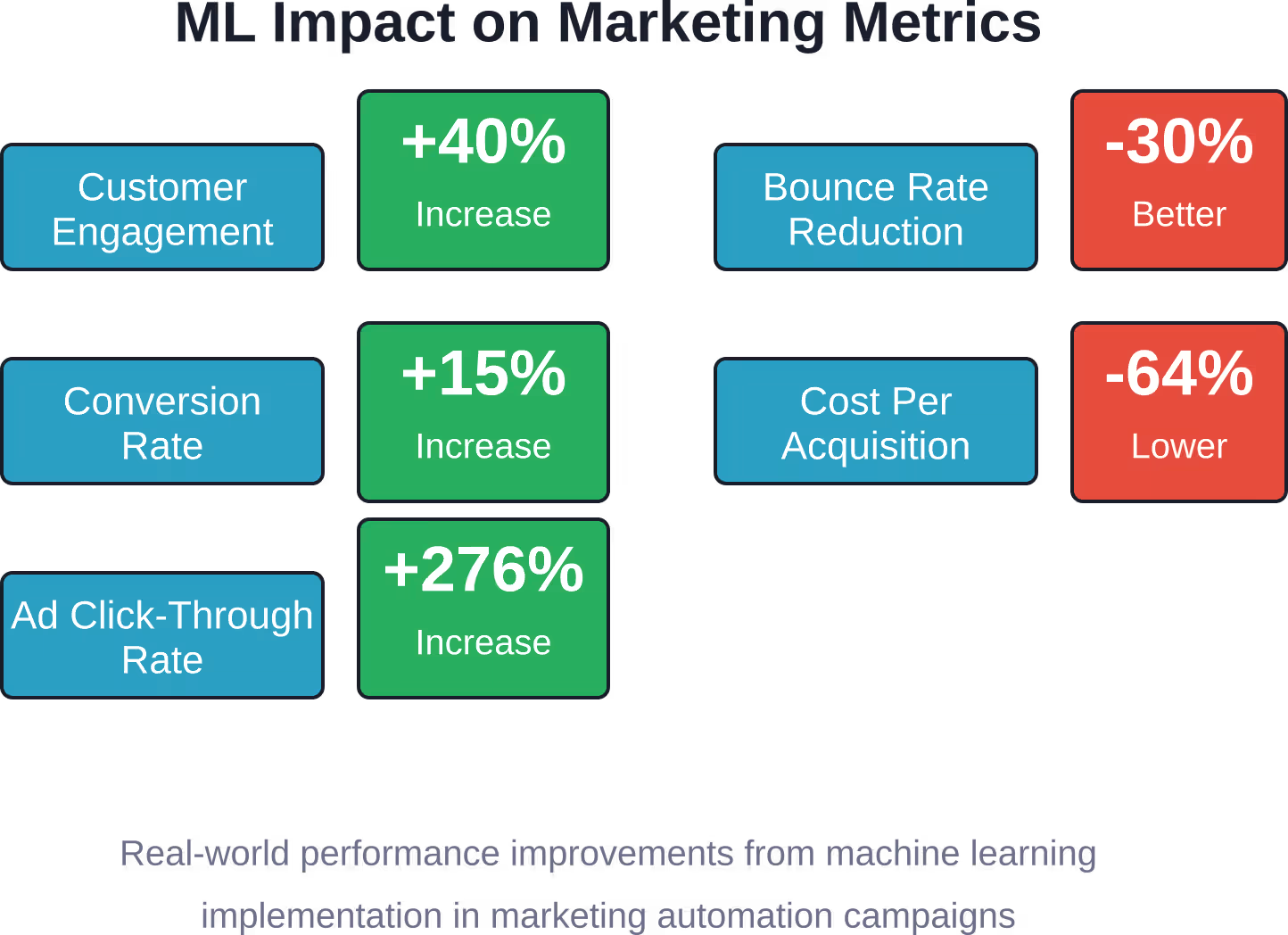
Turtle Bay Resort implemented Salesforce’s machine learning capabilities to personalize guest experiences. Website visitors who booked specific activities received tailored content promoting complementary experiences based on their preferences. The resort achieved a 40% increase in customer engagement.
The system doesn’t just personalize what customers see—it personalizes when they see it. Send-time optimization analyzes individual engagement patterns to determine the optimal moment for each recipient.
Dynamic Content Optimization
Content performance varies by audience, context, and timing. Machine learning continuously tests and optimizes content elements to maximize engagement and conversion.
This goes beyond simple A/B testing. Machine learning systems can test dozens of variations simultaneously, identify winning combinations, and automatically allocate traffic to high-performing variants. The optimization happens in real-time rather than waiting for statistical significance.
Walgreens used machine learning to generate 160 ad variations based on location. The campaign saw a 276% increase in CTR and a 64% decrease in cost per acquisition.
Persado’s machine learning platform helped Vanguard increase conversion rates by 15% through language optimization. The system analyzed which emotional tones, word choices, and message structures resonated most with different audience segments.
Lead Scoring and Nurturing Intelligence
Not all leads are created equal. Machine learning transforms lead scoring from a crude point system into a sophisticated predictive model.
Traditional lead scoring assigned arbitrary points to actions—5 points for opening an email, 10 points for visiting the pricing page. These systems required constant manual tuning and often missed crucial behavioral signals.
Machine learning models analyze hundreds of variables to predict conversion probability. The models identify which combination of behaviors actually correlates with closed deals based on historical data. A prospect who reads three blog posts might be more valuable than one who downloads a whitepaper, depending on patterns the algorithm discovers.
AI-assisted account-based marketing increases corporate revenue by up to 40% annually, according to Salesforce research, compared to 10% for traditional ABM approaches. The machine learning systems identify high-value accounts more accurately and predict optimal engagement strategies.
Lead nurturing becomes similarly intelligent. Rather than following predetermined drip sequences, machine learning adjusts the cadence, content, and channel based on individual prospect behavior. Someone who engages heavily receives more frequent touchpoints; disengaged prospects get different messaging designed to re-activate interest.
Real-Time Decision Making
Marketing has shifted from batch processing to real-time interaction. Machine learning enables split-second decisions that optimize customer experiences in the moment.
When a visitor lands on a website, machine learning algorithms instantly analyze dozens of signals—referral source, browsing history, device type, time of day, current session behavior. Based on this analysis, the system determines which content to display, which offers to present, and which calls-to-action are most likely to convert.
The same real-time intelligence powers chatbots and conversational interfaces. Natural language processing—a branch of machine learning—enables these systems to understand customer intent and provide relevant responses without human intervention.
Real-time bidding for programmatic advertising relies entirely on machine learning. Algorithms evaluate ad inventory, assess audience fit, predict conversion likelihood, and place bids—all in the milliseconds between a page loading and ads rendering.
Marketing Analytics and Attribution
Understanding which marketing activities drive results has always been challenging. Customer journeys span multiple touchpoints across channels and devices. Attribution models attempt to assign credit for conversions, but traditional models use simplistic rules.
Machine learning approaches attribution as a prediction problem. Rather than applying predetermined rules (first-touch, last-touch, linear), algorithms analyze patterns across thousands of customer journeys to determine which touchpoints actually influence outcomes.
The models account for complex interactions. Perhaps email alone doesn’t drive conversions, but email followed by a social ad within 48 hours shows strong correlation with purchases. Machine learning identifies these patterns automatically.
Analytics powered by machine learning also surface unexpected insights. The algorithms might discover that certain blog content correlates with higher lifetime value, or that customers who interact with support before purchasing have better retention rates.

Connect Marketing Automation and ML With AI Superior
Marketing automation works better when decisions are based on useful data rather than fixed rules alone. AI Superior can help teams add machine learning to automation workflows in a structured way, from early use case planning to model development and software integration.
Their work covers AI consulting, machine learning, data science, NLP, AI software development, proof of concept development, and model evaluation. This fits projects where teams want to test prediction, personalization, classification, or automated recommendations inside existing marketing systems.
AI Superior can help teams with:
- Defining where ML should fit inside automation workflows
- Reviewing CRM, campaign, customer journey, and engagement data
- Building proof of concept models
- Developing models for scoring, prediction, or personalization
- Evaluating model performance before implementation
- Planning integration with internal platforms or marketing software
- Supporting AI product development through deployment
For marketing automation, this can apply to lead scoring, customer journey triggers, automated segmentation, content recommendations, lifecycle campaigns, and predictive customer actions.
Contact AI Superior to discuss the project.
Implementation Challenges and Considerations
The benefits of machine learning in marketing automation are substantial, but implementation isn’t trivial. Several challenges commonly emerge.
Data Quality and Quantity
Machine learning models are only as good as their training data. Algorithms trained on incomplete, biased, or inaccurate data produce unreliable predictions.
Most organizations discover that their data needs significant cleanup before machine learning becomes effective. Customer records must be deduplicated and normalized. Interaction histories need to be complete and properly tagged. Integration across systems is essential to create a unified customer view.
Data quantity matters too. Small datasets limit what machine learning can achieve. A company with 500 customers won’t gain much from sophisticated segmentation algorithms—there’s simply not enough data to identify meaningful patterns. The technology delivers maximum value for organizations with substantial customer bases and interaction volumes.
Privacy and Compliance Requirements
Machine learning in marketing relies on customer data, which raises privacy concerns and regulatory requirements. The FTC has increased scrutiny of AI and automated decision-making systems in recent years.
The FTC has taken enforcement actions against companies for mishandling customer data in marketing contexts. In another case, the FTC filed suit against FBA Machine and Bratislav Rozenfeld (also known as Steven Rozenfeld and Steven Rozen) for a business opportunity scheme involving allegedly AI-powered software. The defendants allegedly defrauded consumers.
Organizations implementing machine learning in marketing must ensure compliance with data protection regulations. That means obtaining proper consent for data collection and use, providing transparency about automated decision-making, and implementing data security measures.
The FTC’s 2024 Operation AI Comply initiative targeted deceptive AI claims, signaling increased regulatory attention to how companies market and deploy AI technologies.
Technical Infrastructure Requirements
Effective machine learning requires robust technical infrastructure. Data must be collected, stored, and processed at scale. Models need computational resources for training and inference. Integration between marketing automation platforms and machine learning systems must be seamless.
Many organizations address this through marketing automation platforms with built-in machine learning capabilities rather than building custom solutions. This approach reduces technical complexity but may limit customization options.
Skill Gaps and Resource Needs
Machine learning systems don’t run themselves. Teams need data scientists or machine learning engineers who understand both the technology and marketing context. Marketers need training to interpret model outputs and translate insights into strategy.
The skills gap is real. Organizations often struggle to hire qualified talent or upskill existing teams quickly enough to keep pace with technology adoption.
The Current State of Adoption
Industry reports suggest that 75% of companies are using marketing automation to some degree. Machine learning integration within these platforms has accelerated rapidly over the past three years.
According to industry projections, the global machine learning market is expected to experience significant growth through 2032, reflecting massive investment across industries including marketing.
But adoption quality varies. Some organizations deploy sophisticated machine learning systems that drive measurable ROI improvements. Others implement basic automation with minimal intelligence and call it machine learning. The gap between leaders and laggards is widening.
Early adopters focused on individual use cases—predictive lead scoring or email send-time optimization. The trend now moves toward integrated systems where machine learning powers multiple functions across the marketing operation.
Choosing the Right Approach
Organizations implementing machine learning in marketing automation face several strategic choices.
| Approach | Best For | Advantages | Limitations |
|---|---|---|---|
| Platform-Integrated ML | Mid-size companies, generalists | Easy implementation, lower cost, vendor support | Limited customization, dependent on vendor roadmap |
| Custom ML Development | Large enterprises, unique requirements | Full control, tailored to specific needs, competitive advantage | High cost, requires specialized talent, longer timeline |
| Hybrid Approach | Growing companies, evolving needs | Balance flexibility and ease, incremental investment | Integration complexity, multiple vendor relationships |
| Third-Party ML Tools | Specific use cases, supplementing existing stack | Best-of-breed capabilities, rapid deployment | Integration requirements, data sharing concerns |
The right choice depends on organizational size, technical capabilities, budget, and strategic priorities. Most companies find that platform-integrated machine learning provides the best starting point, with custom development or specialized tools added as specific needs emerge.
Evaluating Marketing Automation Platforms
When evaluating platforms, look beyond marketing claims to understand actual machine learning capabilities. Key questions include:
- What specific machine learning models are implemented, and for which functions?
- How does the platform handle model training and retraining? Is it automatic or manual?
- What data requirements exist for machine learning features to work effectively?
- How transparent are the model predictions? Can marketers see why certain decisions were made?
- What level of control do users have over machine learning parameters and thresholds?
Vendor demonstrations should include concrete examples with real data rather than generic scenarios. Request case studies from similar organizations and ask about typical timelines for seeing measurable results.
Best Practices for Implementation
Successful machine learning implementations in marketing automation follow common patterns.
Start with Clear Objectives
Define specific, measurable goals before selecting technology. “Implementing machine learning” isn’t an objective—”reduce customer acquisition cost by 20%” or “increase email engagement rates by 30%” are objectives that machine learning might help achieve.
The objectives should align with broader business goals and have executive support. Machine learning projects require investment and organizational change. Without clear purpose and backing, they often stall.
Establish Data Foundations
Before deploying machine learning, ensure data infrastructure is solid. This includes:
- Customer data integrated from all relevant sources
- Consistent tagging and tracking across channels
- Historical data sufficient for model training (typically 6-12 months minimum)
- Data governance policies and quality standards
- Compliance frameworks for data privacy
Organizations that skip this foundational work inevitably encounter problems later when models produce unreliable predictions due to data issues.
Pilot Before Scaling
Start with contained pilot projects that deliver quick wins. Email send-time optimization or basic content recommendations make good starting points—they’re valuable but not mission-critical if something goes wrong.
Pilots provide learning opportunities. Teams develop skills, discover integration challenges, and refine processes before deploying machine learning to high-stakes use cases.
Measure and Iterate
Establish baseline metrics before implementation so improvements can be quantified. Track both leading indicators (engagement rates, click-through rates) and business outcomes (conversions, revenue, customer lifetime value).
Machine learning systems improve over time, but they need guidance. Regular review of model performance, identification of edge cases or failures, and refinement of training data all contribute to better results.
Future Directions
Machine learning in marketing automation continues evolving rapidly. Several trends are shaping the next phase.
Generative AI Integration
Large language models and generative AI systems are being integrated into marketing automation platforms. These tools generate content variations, write subject lines, create ad copy, and produce product descriptions at scale.
The combination of generative AI (for content creation) and machine learning (for optimization and targeting) creates powerful automation capabilities. Marketers can generate hundreds of content variations and let algorithms determine which performs best for each audience segment.
Privacy-Preserving Machine Learning
As privacy regulations tighten and third-party data becomes less available, privacy-preserving machine learning techniques gain importance. Federated learning, differential privacy, and on-device machine learning enable personalization without centralized data collection.
These approaches will become standard as regulations continue evolving and consumer privacy expectations rise.
Unified Customer Intelligence
Machine learning systems increasingly integrate data across the entire customer lifecycle—from awareness through purchase, usage, support, and retention. This unified intelligence enables more sophisticated predictions and orchestration.
The goal is a single intelligent system that understands each customer holistically and coordinates all interactions across channels and touchpoints automatically.
Autonomous Campaign Management
Current machine learning systems assist human marketers. The trajectory moves toward systems that autonomously plan, execute, and optimize campaigns with minimal human intervention.
These systems won’t replace marketers—they’ll handle tactical execution while humans focus on strategy, creativity, and brand stewardship. But the shift represents a fundamental change in what marketing work looks like.
Frequently Asked Questions
What’s the difference between marketing automation and machine learning in marketing automation?
Marketing automation executes predefined workflows based on rules set by marketers—send this email when someone downloads a whitepaper, move leads to this segment when they reach 50 points. Machine learning adds intelligence that adapts based on data patterns rather than following fixed rules. The system learns which email subject lines work best, when each individual customer is most likely to engage, and which leads are genuinely sales-ready. Traditional automation is rigid; machine learning-enhanced automation is adaptive.
How much data do I need before machine learning becomes effective?
The data requirements vary by use case, but generally organizations need at least several thousand customers and 6-12 months of interaction history for meaningful results. Simple applications like send-time optimization work with smaller datasets. Complex applications like predictive lifetime value modeling need larger volumes. Data quality matters more than quantity—10,000 clean, complete customer records are more valuable than 100,000 records with gaps and errors. Start by auditing current data rather than waiting to collect more.
Will machine learning replace marketing jobs?
Machine learning automates tactical execution and data analysis, not strategic thinking or creative work. The technology handles repetitive optimization tasks that previously consumed significant time—A/B test management, bid adjustments, segment updates, performance monitoring. This frees marketers to focus on strategy, positioning, creative direction, and customer understanding. Jobs change rather than disappear. Successful marketers develop skills in interpreting machine learning outputs, setting strategic parameters, and translating insights into business decisions.
How do I measure ROI from machine learning investments?
Establish baseline metrics before implementation across key performance indicators—conversion rates, customer acquisition cost, engagement rates, campaign ROI, customer lifetime value. After deployment, track these same metrics to quantify improvement. Most organizations see measurable impact within 60-90 days for tactical applications like email optimization. Strategic applications like predictive segmentation may take 6-12 months to show full impact. Calculate ROI by comparing incremental revenue or cost savings against total investment including software, implementation, and ongoing management costs.
What are the biggest mistakes companies make when implementing machine learning in marketing?
The most common failure is expecting immediate results from poor data. Organizations deploy sophisticated algorithms on incomplete, inconsistent data and wonder why predictions are unreliable. Other frequent mistakes include: implementing technology without clear business objectives, choosing overly complex solutions when simpler approaches would work, neglecting change management and team training, failing to establish feedback loops for continuous improvement, and treating implementation as a one-time project rather than an ongoing capability.
How do I know if my marketing automation platform’s machine learning features are actually working?
Look for transparency in how predictions are made and results are measured. Quality platforms show which signals drive predictions, provide confidence scores, and track prediction accuracy over time. Run controlled experiments—use machine learning for one segment while maintaining traditional approaches for a control group, then compare results. Request detailed reporting on model performance, not just overall campaign metrics. Ask the vendor to explain their algorithms in business terms. If explanations are vague or claims seem too good to be true, dig deeper.
What privacy considerations apply to machine learning in marketing?
Machine learning systems process customer data to make predictions and decisions, which triggers privacy regulations like GDPR, CCPA, and sector-specific rules. Organizations must obtain proper consent for data collection and use, provide transparency about automated decision-making, allow customers to access their data and understand how it’s used, and implement technical safeguards to prevent unauthorized access or misuse. The FTC has increased scrutiny of AI systems, particularly around deceptive practices and discriminatory outcomes. Work with legal counsel to ensure compliance before deploying machine learning systems that process customer data.
Conclusion
Machine learning has moved from experimental technology to essential infrastructure in marketing automation. The capability to analyze patterns at scale, predict customer behavior, and optimize campaigns automatically delivers competitive advantages that compound over time.
But technology alone doesn’t create success. Organizations that thrive combine machine learning capabilities with clear strategy, quality data, skilled teams, and commitment to continuous improvement. They start with specific objectives, establish solid data foundations, pilot carefully, and scale what works.
The gap between companies that effectively leverage machine learning and those that don’t continues widening. Leaders don’t just collect more data—they turn data into intelligence that drives better decisions at every touchpoint. They automate not just for efficiency but for improved customer experiences and measurable business outcomes.
The question isn’t whether to adopt machine learning in marketing automation. The question is how quickly and effectively your organization can build this capability before competitors pull too far ahead. Start with clear goals, invest in data quality, choose appropriate technology, and commit to the ongoing work of optimization and refinement.
The marketers who master this combination of technology and strategy will define what success looks like in the next era of digital marketing.
 English
  German
  Arabic
  French
  Dutch
Dutch  Spanish