
Quick Summary: Machine learning in marketing analytics transforms how organizations understand customer behavior, optimize campaigns, and drive revenue growth. By processing vast datasets in real time, ML algorithms enable predictive segmentation, personalized content delivery, and automated decision-making that was impossible with traditional analytics. Research shows implementations achieve up to 40% increases in engagement, while academic studies demonstrate growing adoption across enterprise marketing operations.
The marketing analytics landscape shifted dramatically over the past five years. What used to take weeks of manual analysis now happens in milliseconds.
Machine learning changed the game. Not through hype, but through measurable improvements in how organizations understand customers, predict behavior, and allocate resources.
Academic research in this domain has grown substantially—studies focused on machine learning applications in marketing analytics have accumulated substantial citations, with research showing growing academic interest in the field, reflecting the field’s rapid maturation. The practical impact is equally striking: implementations report engagement increases of 40% when ML-driven personalization replaces traditional segmentation approaches.
But here’s the thing—adoption isn’t automatic. The gap between theoretical capability and operational reality remains wide for most organizations.
This guide explores how machine learning actually works within marketing analytics frameworks, which use cases deliver tangible returns, and what challenges teams face during implementation.
What Machine Learning Brings to Marketing Analytics
Traditional marketing analytics relies on historical reporting and rule-based segmentation. Analysts query databases, build dashboards, and derive insights from what already happened.
Machine learning flips this model. Instead of describing the past, algorithms identify patterns humans miss and generate predictions about future behavior.
The difference matters because marketing decisions require forward-looking intelligence. Which customers will churn next quarter? What content will resonate with emerging segments? How should the budget shift across channels to maximize ROI?
Static analytics can’t answer these questions with precision. Machine learning can—and does.
Core Capabilities That Change the Analytics Workflow
ML introduces several fundamental capabilities that traditional analytics lacks. Pattern recognition operates at scale, processing millions of customer interactions to surface behavioral clusters that manual analysis would never detect.
Predictive modeling estimates probabilities for future events—purchase likelihood, churn risk, lifetime value—enabling proactive strategy rather than reactive response. Real-time processing evaluates incoming data streams and adjusts recommendations instantly, a requirement for modern digital experiences.
Automation handles repetitive analytical tasks—data cleaning, feature engineering, model retraining—freeing analysts to focus on strategic interpretation rather than technical execution.
These capabilities compound. Real-time pattern recognition enables immediate personalization. Predictive models improve as more data flows through the system. Automation scales analytics operations without linear headcount growth.

Turn Marketing Analytics Data Into ML Models With AI Superior
Marketing analytics often has enough data to support machine learning, but the value depends on choosing the right problem. AI Superior can help teams move from dashboards and reports to models that predict outcomes, explain patterns, or support better decisions.
Their work covers AI consulting, data science, machine learning, AI software development, proof of concept development, and model evaluation. This fits analytics projects where teams need to test whether existing data can support reliable ML before building a full solution.
AI Superior can support teams with:
- Reviewing marketing, CRM, sales, and web analytics data
- Defining prediction or classification tasks
- Building proof of concept models
- Developing models for forecasting, segmentation, or attribution support
- Testing model accuracy and business relevance
- Planning integration with dashboards or internal tools
- Supporting AI development after validation
For marketing analytics, this may apply to campaign forecasting, customer segmentation, revenue prediction, churn analysis, attribution modeling, and performance monitoring.
Contact AI Superior to discuss the project.
Primary Use Cases Delivering Measurable Impact
Not all machine learning applications in marketing analytics produce equal value. Some deliver rapid ROI. Others require extensive infrastructure before showing returns.
Research on marketing strategy enhancement through predictive and prescriptive analytics demonstrates growing validation of specific use case categories, indicating growing validation of specific use case categories.
Customer Segmentation and Behavioral Clustering
Traditional segmentation divides customers using predetermined rules—demographics, purchase history, geographic location. This approach produces static groups that miss nuanced behavioral patterns.
ML-driven segmentation discovers natural clusters within customer data without predefined categories. Algorithms analyze hundreds of features simultaneously—browsing patterns, engagement timing, content preferences, purchase sequences—to identify groups sharing subtle similarities.
The results are more granular and actionable. Instead of “customers aged 25-34,” segmentation might identify “mobile-first browsers who engage with video content on weekends and prefer eco-friendly products.”
Personalized messaging to these precise segments drives conversion. Industry analyses indicate that According to industry analyses, 65% of customers cite targeted promotions as a top factor in purchase decisions, explaining why ML-driven segmentation produces measurably higher engagement than demographic approaches.
Predictive Analytics for Customer Lifetime Value
Customer lifetime value (CLV) estimates the total revenue a customer generates throughout their relationship with a brand. Accurate CLV predictions inform acquisition spending, retention prioritization, and personalization depth.
Traditional CLV calculations use simple formulas—average purchase value × purchase frequency × customer lifespan. This approach assumes stable behavior and ignores individual variation.
Machine learning models ingest behavioral history, engagement patterns, demographic signals, and external factors to generate individualized CLV predictions. These models account for purchase acceleration, category expansion, and seasonal fluctuations that formula-based approaches miss.
The practical impact is resource allocation precision. Marketing teams can justify higher acquisition costs for high-CLV segments and design retention campaigns that prioritize customers with elevated churn risk and strong value potential.
Academic work on predicting customer lifetime value using behavioral segmentation frameworks demonstrates the feasibility of these approaches at scale, with models processing transaction histories, browsing data, and engagement signals to generate actionable predictions.
Content Optimization and Personalization
Content performance varies dramatically across audience segments. A headline that drives clicks for one group falls flat with another. Images, tone, length, and topic all influence engagement—but manual testing can’t explore the combinatorial space efficiently.
Machine learning automates content optimization through multivariate testing and personalization engines. Algorithms serve variations to different user segments, measure performance, and adjust distribution dynamically.
The result is adaptive content delivery. Each visitor sees versions predicted to maximize their engagement based on behavioral similarity to previous high-converting users.
Real-world implementations validate this approach. Turtle Bay Resort implemented ML-driven personalization through Salesforce, serving activity recommendations based on guest console interactions. Visitors booking certain activities received personalized content promoting snorkeling or excursions based on preference patterns. The adoption achieved a 40% increase in customer engagement (as referenced in case studies from marketing analytics implementations)—a measurable lift attributable to algorithmic content matching.
Campaign Performance Prediction and Budget Allocation
Marketing budgets flow across channels—search, social, display, email, content. Optimal allocation shifts constantly as audience attention migrates and channel costs fluctuate.
Traditional budget planning relies on historical performance and incremental testing. Teams allocate based on last quarter’s results and adjust slowly as data accumulates.
Machine learning models predict campaign performance before launch. By analyzing creative elements, targeting parameters, historical channel effectiveness, and competitive dynamics, algorithms estimate ROI for proposed campaigns.
This enables proactive budget optimization. Teams can model scenarios—”What if we shift 20% from search to social?”—and receive probabilistic forecasts before committing resources.
Continuous learning improves these predictions. As campaigns execute, models incorporate actual results and refine future estimates, creating a feedback loop that compounds accuracy over time.
Churn Prediction and Retention Intervention
Customer churn erodes revenue and increases acquisition burden. Identifying at-risk customers early enables targeted retention efforts before disengagement becomes irreversible.
Machine learning churn models analyze engagement decline, support interactions, payment issues, and behavioral shifts to calculate individual churn probability. Unlike rule-based alerts that trigger on single events, ML models weigh dozens of signals simultaneously.
High-risk customers receive proactive outreach—special offers, support check-ins, feature education—calibrated to their specific disengagement patterns. Research on AI and predictive analytics demonstrates cross-industry validation of predictive frameworks that extend to customer retention contexts, reflecting cross-industry validation of predictive frameworks that extend to customer retention contexts.
The economic logic is compelling. Retention costs substantially less than acquisition, and early intervention succeeds more often than last-minute recovery attempts.
Implementation Requirements and Technical Infrastructure
Machine learning doesn’t run on spreadsheets. Effective marketing analytics implementations require specific technical foundations.
Data infrastructure forms the first requirement. ML models need clean, structured data feeds from all customer touchpoints—web analytics, CRM, email platforms, transaction systems, support tools. Fragmented data creates blind spots that limit model accuracy.
Real-time processing capability matters for applications like personalization and campaign optimization. Batch processing that updates nightly can’t support dynamic content delivery or immediate bid adjustments.
Model deployment infrastructure bridges the gap between data science experimentation and operational marketing systems. Models trained in analytical environments must integrate with email platforms, ad servers, and content management systems to influence actual customer experiences.
Monitoring and retraining workflows ensure model performance doesn’t degrade. Customer behavior shifts over time—what predicted churn six months ago may not predict it today. Automated retraining pipelines keep models current without manual intervention.
Common Adoption Challenges and Mitigation Strategies
Implementation rarely proceeds smoothly. Organizations encounter predictable obstacles when introducing machine learning into marketing analytics workflows.
Data Quality and Integration Complexity
Most marketing organizations store customer data across disconnected systems. CRM holds contact information. Web analytics tracks browsing. Email platforms maintain engagement history. Transaction systems record purchases.
Machine learning models require unified customer views—single records that consolidate all touchpoints. Creating these views demands data engineering work: identity resolution, deduplication, schema harmonization, historical backfill.
Organizations often underestimate this effort. Data preparation consumes 60-80% of initial ML project timelines, a reality that surprises teams expecting to focus on algorithm selection.
Mitigation starts with incremental integration. Rather than attempting complete unification, teams can begin with high-value data sources—web analytics plus CRM—and expand coverage progressively.
Model Interpretability and Stakeholder Trust
Marketing executives make decisions that affect revenue. When an ML model recommends budget reallocation or audience targeting changes, stakeholders want to understand why.
But many effective machine learning algorithms—neural networks, ensemble methods—operate as black boxes. They generate accurate predictions without transparent reasoning.
This opacity creates trust barriers. Marketers hesitate to act on recommendations they can’t explain, especially when intuition suggests different approaches.
Interpretability techniques help. SHAP values, LIME, and partial dependence plots reveal which features drive specific predictions. Model documentation that explains training data, performance metrics, and validation procedures builds confidence.
Starting with interpretable algorithms—decision trees, linear models—can establish credibility before introducing complex approaches.
Skill Gaps and Organizational Capability
Effective ML adoption requires capabilities most marketing teams lack: data engineering, statistical modeling, algorithm tuning, production deployment.
Hiring data scientists addresses part of this gap but introduces collaboration challenges. Data scientists and marketers speak different languages, prioritize different outcomes, and work on different timelines.
Cross-functional team structures—data scientists embedded within marketing rather than isolated in analytics groups—improve outcomes. Regular communication, shared success metrics, and collaborative problem definition align technical work with business objectives.
External partnerships with ML implementation specialists can accelerate capability development while internal expertise grows.
Measurement and Attribution Complexity
Proving that machine learning improvements caused observed results is harder than it sounds. Marketing performance fluctuates due to seasonality, competitive actions, economic conditions, and product changes.
When engagement increases after ML adoption, isolating the algorithmic contribution from confounding factors requires rigorous experimental design—control groups, A/B testing, incrementality studies.
Organizations sometimes skip this rigor, attributing all positive movement to their new ML systems. This creates false confidence and misallocates credit.
Proper measurement design precedes implementation. Teams should establish baseline metrics, define success criteria, and plan controlled experiments before deploying models.
The Role of Marketing Automation Platforms
Marketing automation platforms increasingly embed machine learning capabilities, lowering the implementation barrier for organizations without data science teams.
Salesforce, HubSpot, Marketo, and similar platforms now offer built-in predictive lead scoring, send-time optimization, content recommendations, and audience segmentation powered by ML algorithms.
These embedded capabilities deliver value without requiring custom model development. Marketing teams configure parameters, connect data sources, and activate features through visual interfaces rather than writing code.
The tradeoff is reduced customization. Platform-embedded ML uses general-purpose algorithms trained on broad datasets. Custom models can incorporate proprietary data and business logic that generic approaches miss.
For many organizations, platform-embedded ML represents the optimal entry point. Teams gain experience with algorithmic decision-making, establish data workflows, and demonstrate value before investing in custom development.
Real-Time Processing and Infrastructure Considerations
Marketing applications increasingly demand real-time ML inference—predictions generated in milliseconds as customers interact with digital properties.
Personalized content selection, dynamic pricing, real-time bidding, and fraud detection all require sub-second model responses. Batch processing that updates overnight can’t support these use cases.
Real-time ML introduces infrastructure complexity. Models must be deployed to edge locations, API response times must be monitored, fallback logic must handle service degradation, and throughput must scale with traffic spikes.
Analyses suggest that 75% of marketing organizations have already implemented or are experimenting with AI solutions, reflecting the industry’s recognition that real-time capabilities increasingly separate competitive performers from laggards.
Cloud providers offer managed ML inference services that handle scaling automatically, reducing operational burden. However, latency-sensitive applications may require dedicated infrastructure or edge deployment strategies.
Ethical Considerations and Privacy Compliance
Machine learning marketing analytics processes personal data at scale, raising privacy and ethical concerns that organizations must address proactively.
Regulatory frameworks—GDPR in Europe, CCPA in California, emerging legislation elsewhere—impose requirements on data collection, storage, and algorithmic processing. Non-compliance carries substantial penalties and reputational risk.
Beyond legal compliance, ethical questions arise around algorithmic fairness, transparency, and manipulation. ML models can perpetuate biases present in training data or optimize for engagement in ways that harm user wellbeing.
Responsible ML practices include bias testing, fairness audits, transparency disclosures, and consent management. Organizations should establish ethical guidelines that constrain algorithmic optimization—defining not just what models can optimize for, but what they shouldn’t.
Privacy-preserving techniques like federated learning and differential privacy enable ML applications while limiting individual data exposure, though implementation complexity currently restricts adoption to sophisticated organizations.
Evaluating Vendor Solutions vs. Custom Development
Organizations face a build-versus-buy decision when adopting ML capabilities. Vendor platforms offer packaged solutions. Custom development provides tailored functionality.
| Consideration | Vendor Platforms | Custom Development |
|---|---|---|
| Time to Value | Weeks to months | Months to years |
| Customization | Limited to platform features | Unlimited flexibility |
| Ongoing Maintenance | Vendor handles updates | Internal team responsibility |
| Cost Structure | Subscription fees scale with usage | Upfront development + ongoing operations |
| Data Control | Varies by vendor; may involve external processing | Complete internal control |
| Integration | Pre-built connectors for common tools | Custom integration required |
The optimal path depends on organizational context. Smaller teams with limited data science capability benefit from vendor platforms. Larger organizations with unique requirements and internal expertise can justify custom development.
Hybrid approaches are common—using vendor platforms for standard use cases while custom-building for differentiated applications that drive competitive advantage.
Measuring Success and Defining KPIs
Machine learning marketing analytics initiatives require clear success metrics established before implementation.
Model performance metrics—accuracy, precision, recall, AUC—measure technical effectiveness but don’t directly translate to business impact. A churn model with 85% accuracy is meaningless if retention campaigns don’t improve.
Business metrics connect ML performance to organizational objectives. Relevant KPIs include conversion rate lift, customer acquisition cost reduction, retention rate improvement, revenue per customer increase, and campaign ROI enhancement.
Attribution methodology matters. Organizations should use controlled experiments—holdout groups, A/B tests, incrementality studies—to isolate ML contributions from confounding factors.
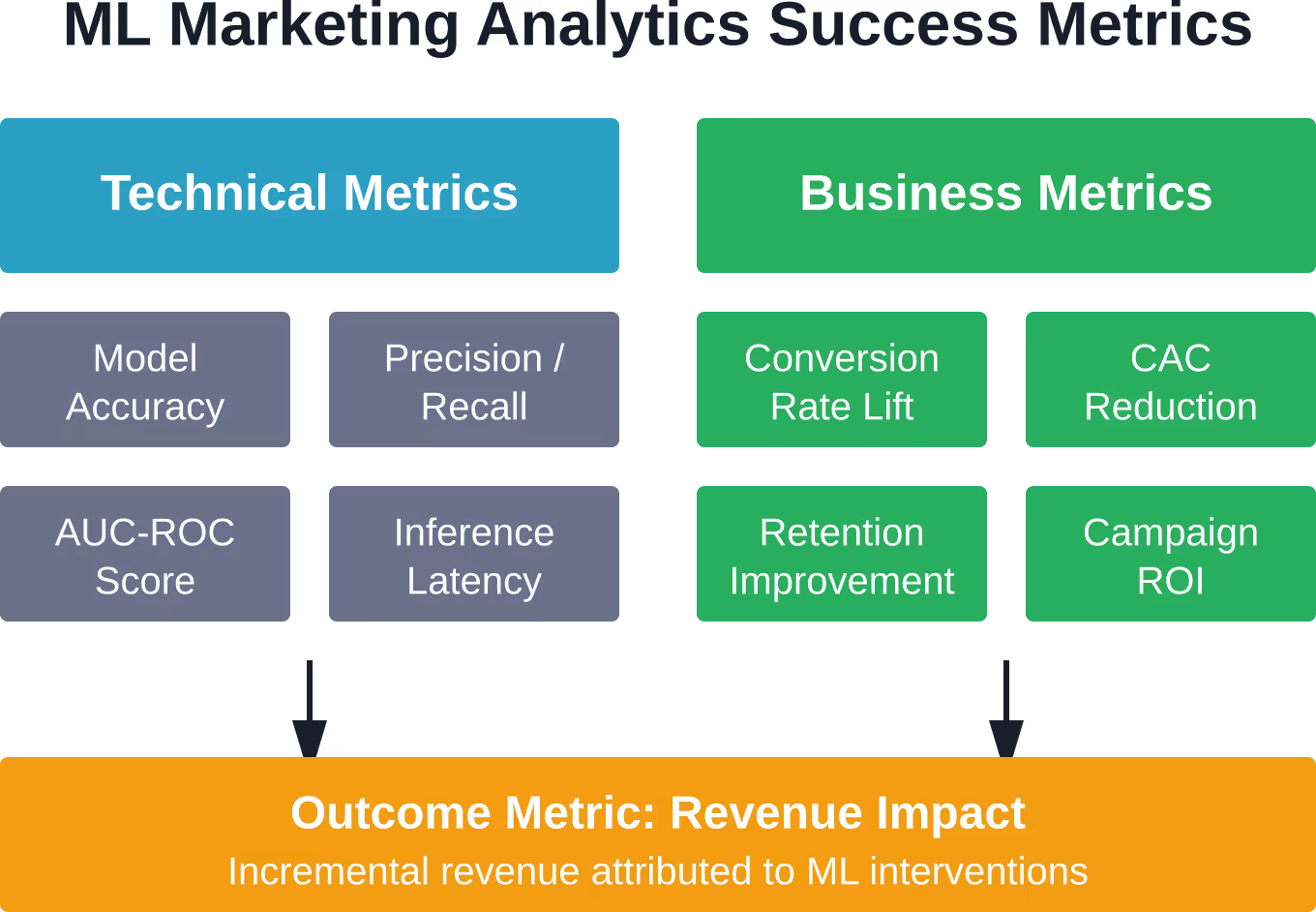
Leading organizations establish baseline periods before ML deployment, measuring performance under traditional approaches. Post-deployment, they compare treatment groups receiving ML-powered experiences against control groups receiving traditional experiences.
This rigorous measurement quantifies incremental impact and builds organizational confidence in continued ML investment.
Future Trajectories and Emerging Capabilities
Machine learning capabilities in marketing analytics continue evolving rapidly. Several trajectories will likely shape the field over the next few years.
Multimodal learning—algorithms that process text, images, video, and audio simultaneously—will enable richer customer understanding. Current models typically analyze single data types. Future systems will synthesize signals across modalities for more nuanced insights.
Automated machine learning (AutoML) will democratize access by handling algorithm selection, hyperparameter tuning, and feature engineering automatically. Marketing teams without data science expertise will deploy sophisticated models through low-code interfaces.
Causal inference methods will move beyond correlation to estimate true causal effects of marketing interventions. This addresses a persistent limitation of predictive models, which identify patterns without confirming causation.
Privacy-preserving techniques will advance, enabling collaborative learning across organizations without raw data sharing. This could unlock network effects in ML performance while maintaining competitive data protection.
Research on machine learning adoption in enterprise performance optimization indicates sustained academic interest in organizational implementation patterns, indicating sustained academic interest in organizational implementation patterns that will inform best practices as capabilities mature.
Frequently Asked Questions
What’s the difference between marketing analytics and machine learning in marketing?
Marketing analytics describes the broader discipline of measuring and interpreting marketing performance using data. It includes descriptive statistics, reporting dashboards, and manual analysis. Machine learning is a specific analytical technique within marketing analytics that uses algorithms to identify patterns, generate predictions, and automate decisions. Traditional marketing analytics tells what happened; machine learning predicts what will happen and recommends actions.
How much data is needed to start using machine learning for marketing?
The minimum viable dataset depends on the specific use case. Simple applications like email send-time optimization can work with thousands of customer records. Complex applications like lifetime value prediction typically require tens of thousands to millions of customer interactions for accurate modeling. Data quality matters more than quantity—clean, well-structured data from 10,000 customers often produces better results than messy data from 100,000.
Can small marketing teams benefit from machine learning, or is it only for enterprises?
Small teams can absolutely benefit, though the approach differs from enterprise implementations. Rather than building custom ML systems, smaller organizations typically leverage machine learning embedded in marketing automation platforms like HubSpot, Mailchimp, or Salesforce. These platforms provide predictive lead scoring, content optimization, and segmentation powered by ML without requiring data science expertise or infrastructure investment.
What roles are needed to implement machine learning in marketing analytics?
Successful implementations typically involve several roles working collaboratively: marketing analysts who understand business objectives and customer behavior, data engineers who build data pipelines and ensure quality, data scientists who develop and train models, ML engineers who deploy models to production systems, and marketing operations specialists who integrate ML outputs into campaign execution workflows. Smaller organizations might consolidate these roles or rely on external partners.
How long does it take to see results from machine learning marketing initiatives?
Timeline varies substantially by scope and organizational readiness. Organizations with mature data infrastructure and clear use cases can see initial results from platform-embedded ML features within weeks. Custom ML development typically requires 3-6 months for initial deployment plus additional time for optimization. Meaningful business impact often takes 6-12 months as models learn from production data and teams refine implementation based on results.
What’s the typical ROI of implementing machine learning in marketing analytics?
ROI varies widely based on use case, implementation quality, and organizational context, making industry-wide averages misleading. Documented case studies show outcomes ranging from 15% to 40% improvements in engagement, conversion, or retention metrics. Organizations should establish baseline performance, define specific success metrics, and use controlled experiments to measure incremental impact rather than relying on generic benchmarks.
How do privacy regulations like GDPR affect machine learning marketing applications?
Privacy regulations impose constraints on data collection, storage, processing, and algorithmic decision-making that ML implementations must respect. GDPR requires explicit consent for data processing, grants users rights to explanation of automated decisions, and mandates data minimization. Practically, this means ML systems must incorporate consent management, provide model interpretability for user requests, limit data retention, and implement technical safeguards. Compliance adds complexity but doesn’t prevent ML adoption—it requires thoughtful design that balances algorithmic performance with regulatory requirements.
Moving Forward with Machine Learning in Marketing
The competitive advantages of machine learning in marketing analytics are no longer theoretical. Organizations across industries demonstrate measurable improvements in customer understanding, campaign performance, and resource efficiency.
But advantage accrues to teams that implement thoughtfully. Random ML experimentation without clear objectives, quality data, or rigorous measurement wastes resources and creates organizational skepticism.
Start with high-value use cases where ML addresses specific business problems and measurable data exists. Customer segmentation, churn prediction, and content personalization represent proven entry points with clear success metrics.
Invest in data infrastructure before algorithms. Clean, integrated customer data determines ML success more than algorithm sophistication. Organizations with fragmented data should prioritize unification over model complexity.
Build cross-functional teams that combine marketing domain expertise with technical ML capabilities. Neither group succeeds in isolation—collaboration produces implementations that are both technically sound and strategically aligned.
Measure rigorously using controlled experiments that isolate ML contributions from confounding factors. Organizational confidence in continued ML investment depends on demonstrated incremental impact.
The gap between ML leaders and laggards in marketing will widen over coming years. Algorithms improve continuously as more data flows through systems, creating compounding advantages for early adopters.
The question isn’t whether machine learning will reshape marketing analytics—that transformation is already underway. The question is whether your organization will lead the shift or struggle to catch up.
 English
  German
  Arabic
  French
  Dutch
Dutch  Spanish