
Quick Summary: Machine learning in marketing research transforms how businesses understand consumers, predict behavior, and optimize campaigns. Through predictive analytics, sentiment analysis, and automated segmentation, ML processes vast datasets to uncover patterns humans would miss. According to the American Marketing Association, 62% of marketers now use AI-powered chatbots for content generation, while nearly 90% have adopted generative AI tools to improve productivity and creative outputs. Marketing research has shifted dramatically from intuition-based guesswork to precision-driven science. The catalyst? Machine learning algorithms that process customer data at scales previously unimaginable. As of September 2024, nearly 90% of marketers have embraced generative AI technologies, according to research from the American Marketing Association in collaboration with Lightricks. But the adoption of machine learning in marketing research extends far beyond content creation—it’s reshaping how organizations predict customer behavior, segment audiences, and allocate resources. Here’s the thing though—machine learning isn’t just a buzzword anymore. It’s the competitive advantage separating industry leaders from those struggling to keep pace with consumer expectations.
What Machine Learning Brings to Marketing Research
Machine learning represents a fundamental shift in how marketing research operates. Rather than relying on static models and manual analysis, ML systems learn from data continuously, identifying patterns and making predictions that improve over time. At its core, machine learning in marketing research addresses three critical challenges:
- Processing massive volumes of consumer data from multiple touchpoints
- Identifying non-obvious patterns in customer behavior
- Predicting future actions with quantifiable confidence levels
Stanford’s Human-Centered Artificial Intelligence research defines predictive analytics as “the practice of using data, statistical methods, and machine learning models to forecast future outcomes or trends.” In marketing research contexts, this translates to estimating customer lifetime value, churn probability, purchase intent, and response likelihood. Real talk: traditional market research methods simply can’t match the speed and accuracy ML delivers when analyzing consumer sentiment across millions of social media posts, product reviews, and support interactions.
Current State of ML Adoption in Marketing
The numbers tell a compelling story. Based on the American Marketing Association’s September 2024 survey, marketing professionals have rapidly integrated AI tools into their workflows:
| Tool Type | Adoption Rate | Primary Use Case |
|---|---|---|
| Chatbots (ChatGPT) | 62% | Content generation |
| AI-powered writing tools (Grammarly) | 58% | Content refinement |
| Embedded AI tools (Microsoft Co-Pilot, Canva) | 52% | Workflow integration |
| Specialized generators (Midjourney) | 45% | Visual content creation |
This widespread adoption didn’t happen overnight. Back in June 2016, a Weber Shandwick report found that 68% of CMOs reported their companies were “planning for business in the AI era,” with 55% expecting AI to have a greater impact on marketing than social media did. The gap between planning and implementation has now closed. Marketing teams aren’t just experimenting—they’re deploying ML systems for mission-critical research functions.
Core Applications in Marketing Research
Predictive Customer Analytics
Understanding customer behavior before it happens represents machine learning’s most valuable contribution to marketing research. The Journal of Marketing Research highlights how ML approaches enable firms to predict prospective relationships with first-time customers—something traditional statistical methods struggled to accomplish accurately. Predictive models analyze historical purchase data, browsing patterns, demographic information, and engagement metrics to forecast:
- Which customers will make repeat purchases
- Optimal timing for promotional outreach
- Product recommendations likely to convert
- Churn risk before customers disengage
Organizations using ML for customer prediction can allocate marketing budgets more efficiently, focusing resources on high-probability opportunities rather than broad, unfocused campaigns.
Consumer Sentiment Analysis
Machine learning excels at processing unstructured text data—product reviews, social media comments, survey responses, and support tickets—to extract sentiment and emotional tone at scale. According to research published in the Journal of Marketing, machine learning and natural language processing techniques measure how consumer attributes translate to perceived benefits. For tablet computers, technical specifications like RAM, CPU, weight, and screen resolution combine to create meta-attributes that consumers actually care about—portability, performance, usability. This understanding helps marketing researchers connect engineering decisions to customer perception, bridging the gap between what companies build and what consumers value. 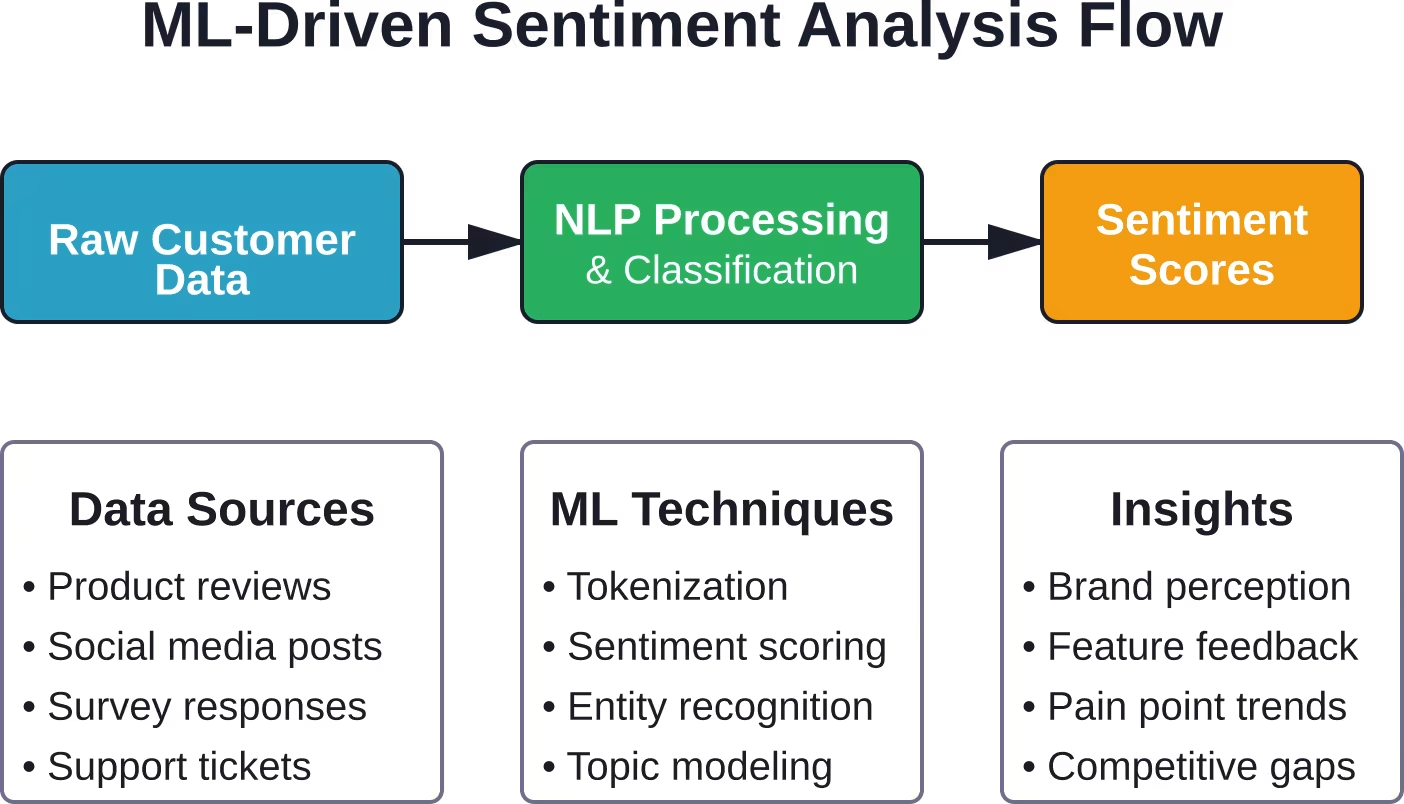
Automated Customer Segmentation
Traditional demographic segmentation—age, income, geography—misses behavioral nuances that drive purchase decisions. Machine learning identifies customer segments based on actual behavior patterns, not assumed characteristics. Clustering algorithms analyze hundreds of variables simultaneously to group customers who exhibit similar:
- Purchase frequency and basket composition
- Channel preferences and engagement patterns
- Price sensitivity and promotional response
- Product category affinities
These ML-derived segments often reveal counterintuitive groupings that outperform manual segmentation for targeting and personalization.
Campaign Optimization and Testing
A/B testing remains valuable, but machine learning enables multivariate optimization at scales impossible with manual management. ML algorithms can test dozens of variables simultaneously—messaging, imagery, timing, channel, offer structure—identifying winning combinations faster than traditional methods. Keyword optimization can significantly improve click-through rates and reduce bounce rates across various applications. 
Structure Your Marketing Research ML Project With AI Superior
Marketing research often combines survey data, customer feedback, market signals, text responses, and behavioral data. AI Superior can help teams use machine learning and data science to analyze this information in a more structured way. Their services include AI consulting, machine learning, data science, NLP, AI software development, proof of concept development, and model evaluation. This is relevant when research teams want to test models for classification, pattern detection, sentiment analysis, or prediction. AI Superior can help with:
- Turning research questions into clear ML use cases
- Reviewing survey, feedback, customer, or market datasets
- Creating proof of concept models
- Developing NLP models for text analysis
- Testing model outputs against research goals
- Planning software or dashboard integration
- Supporting development from concept to deployment
For marketing research, this can be useful for sentiment analysis, audience clustering, survey response classification, trend detection, and customer insight tools. Contact AI Superior to discuss the project.
Real-World Implementation Examples
Theory means little without execution. Several organizations have deployed machine learning in marketing research with measurable results.
Salesforce Einstein
Salesforce’s Einstein platform integrates ML directly into marketing workflows, enabling companies to analyze customer data without building custom models. The system predicts optimal send times, tailors content recommendations, and adapts campaign frequency based on individual engagement likelihood. One hospitality client, Turtle Bay Resort, achieved a 40% increase in customer engagement by implementing Salesforce’s ML-powered personalization. Website visitors booking specific activities received personalized content promoting snorkeling sessions or excursions matching their demonstrated preferences.
Braze ML Capabilities
Marketing platform Braze reports significant performance improvements from ML-driven personalization:
| Metric | Improvement |
|---|---|
| Average user sessions | 21% increase |
| Conversions | 31% increase |
| Revenue per user | 24% uplift |
| Repeat purchases | 13% improvement |
Another case study demonstrated even more dramatic results: 250% lift in conversion rates and 49% increase in repeat engagement through ML-optimized messaging. These aren’t incremental improvements—they represent step-function changes in marketing effectiveness.
Key Machine Learning Techniques for Research
Supervised Learning Models
Supervised learning trains algorithms on labeled historical data to predict outcomes for new inputs. In marketing research, this powers:
- Customer lifetime value prediction
- Churn probability scoring
- Lead quality assessment
- Response rate forecasting
The model learns relationships between input variables (customer attributes, behaviors) and known outcomes (purchases, churn, conversions), then applies those patterns to new customers.
Unsupervised Learning
Without predefined labels, unsupervised algorithms discover hidden patterns in data. Clustering identifies natural customer groupings, while dimensionality reduction techniques reveal which variables matter most for segmentation. Unsupervised methods excel at exploratory research—finding segments or patterns researchers didn’t know to look for.
Natural Language Processing
NLP techniques extract meaning from unstructured text. Sentiment analysis determines emotional tone. Topic modeling identifies themes across document collections. Named entity recognition pulls out products, brands, and features mentioned in customer feedback. According to research published in the Journal of Marketing, machine learning and natural language processing techniques measure how consumer attributes translate to perceived benefits, revealing how engineered attributes translate to perceived meta-attributes.
Deep Learning Networks
Neural networks with multiple layers can model complex, non-linear relationships in marketing data. Deep learning powers:
- Image recognition for visual content analysis
- Advanced recommendation engines
- Predictive models with hundreds of input variables
- Natural language generation for content creation
The trade-off? Deep learning requires substantial data volumes and computational resources compared to simpler ML approaches.
Implementation Challenges and Solutions
Data Quality and Integration
Machine learning models are only as good as their training data. Marketing organizations typically store customer information across fragmented systems—CRM platforms, email tools, web analytics, transaction databases, support systems. Integrating these sources while maintaining data quality requires:
- Establishing single customer identifiers across platforms
- Cleaning duplicate and conflicting records
- Standardizing data formats and definitions
- Implementing ongoing data validation processes
Poor data quality doesn’t just reduce model accuracy—it can introduce systematic biases that lead to flawed research conclusions.
Privacy and Compliance
The Federal Trade Commission has taken enforcement actions against companies for improper data sharing in marketing contexts. Marketing researchers deploying ML must navigate:
- Consent requirements for data collection and processing
- Restrictions on sensitive data categories
- Transparency obligations about automated decision-making
- Data retention and deletion requirements
The FTC has warned about AI harms including inaccuracy, bias, discrimination, and what it calls “commercial surveillance creep”—the expansion of data collection beyond original stated purposes.
Model Interpretability
Complex ML models often operate as “black boxes”—they produce accurate predictions without explaining why. For marketing research, this creates problems when stakeholders need to understand what drives customer behavior, not just predict it. Techniques like SHAP values and LIME help explain individual predictions, showing which variables most influenced a specific outcome. For strategic decisions, interpretability often matters more than marginal accuracy gains from more complex models.
Skill Gaps and Resource Requirements
Implementing ML in marketing research requires cross-functional expertise combining marketing domain knowledge, statistical understanding, and technical implementation skills. Most organizations face talent shortages in one or more areas. Options for bridging the gap include:
- Training existing marketing researchers in ML fundamentals
- Hiring data scientists with marketing context
- Partnering with specialized ML consultancies
- Adopting no-code ML platforms that handle technical complexity
The rise of platforms embedding ML capabilities directly into marketing tools—Salesforce Einstein, Adobe Sensei, HubSpot AI—lowers technical barriers, though at the cost of customization flexibility.
Best Practices for Adoption
Start with High-Impact Use Cases
Don’t try to transform everything simultaneously. Identify marketing research applications where:
- Sufficient quality data already exists
- Current manual processes create bottlenecks
- Prediction accuracy directly impacts business outcomes
- Success can be measured clearly
Customer churn prediction often makes a strong starting point—it uses readily available data, addresses a costly problem, and delivers measurable ROI when predictions inform retention campaigns.
Establish Baseline Metrics
Before deploying ML models, measure current performance with existing methods. This baseline enables quantifying improvement and calculating return on investment. Track both model performance metrics (accuracy, precision, recall) and business impact metrics (conversion rates, revenue per customer, cost per acquisition).
Iterate and Refine Continuously
Machine learning models degrade over time as customer behavior and market conditions shift. Model performance monitoring should trigger retraining when accuracy drops below thresholds. But wait—continuous improvement also means expanding from initial use cases to adjacent applications once teams develop ML capabilities and confidence.
Combine ML with Human Expertise
Machine learning augments marketing research; it doesn’t replace human judgment. Models identify patterns and generate predictions, while researchers interpret findings, develop strategy, and make decisions accounting for context algorithms can’t capture. The most effective implementations treat ML as a tool that extends human capability rather than an autonomous system.
The Future: Where ML in Marketing Research Is Heading
Generative AI represents the most visible recent advancement, but several trends will shape machine learning’s role in marketing research through the next several years.
Real-Time Personalization at Scale
Current personalization often relies on batch processing—models run overnight, generating recommendations applied the next day. Emerging systems process behavioral signals in real-time, adapting content and offers within milliseconds based on immediate context. This enables truly individualized experiences that respond to current intent rather than historical patterns.
Predictive Market Modeling
Beyond individual customer prediction, ML will increasingly model market-level dynamics—competitive response, category evolution, demand elasticity, channel effectiveness. These models help researchers understand how markets behave systemically, not just how individual consumers act.
Automated Insight Generation
Rather than just producing predictions, ML systems will generate explanatory insights in natural language—“conversion rates dropped 15% because competitor pricing decreased” or “segment C responds better to educational content than promotional offers.” This reduces the analytical burden on researchers, letting them focus on strategic implications rather than pattern identification.
Privacy-Preserving ML
Techniques like federated learning and differential privacy enable training ML models on distributed data without centralizing sensitive information. As privacy regulations tighten, these approaches will become essential for marketing research applications.
Frequently Asked Questions
What’s the difference between machine learning and AI in marketing?
Machine learning is a subset of artificial intelligence focused specifically on systems that learn from data and improve performance without explicit programming. AI is the broader category encompassing ML plus other techniques like rule-based systems and knowledge graphs. In marketing contexts, most “AI” applications actually use machine learning algorithms for prediction, classification, and pattern recognition.
How much data do I need to implement machine learning for marketing research?
Requirements vary by technique and application. Simple supervised learning models might work with thousands of labeled examples, while deep learning typically needs hundreds of thousands or millions of records. For most marketing applications, tens of thousands of customer records with relevant attributes and outcomes provide sufficient training data. Quality matters more than pure volume—clean, representative data with properly labeled outcomes beats massive datasets with errors and gaps.
Can small businesses benefit from ML in marketing research?
Absolutely. While large enterprises have advantages in data volume and resources, small businesses can leverage ML through several approaches. Cloud-based platforms embed ML capabilities without requiring in-house data scientists. Many marketing tools now include built-in AI features for segmentation, send-time optimization, and content recommendations. Third-party data providers offer ML-powered insights accessible to businesses of any size. The key is starting with focused applications that address specific pain points rather than attempting comprehensive transformations.
How accurate are ML predictions for customer behavior?
Accuracy depends on the prediction type, data quality, and model sophistication. Customer churn models typically achieve 70-85% accuracy. Purchase prediction accuracy varies widely based on product category and purchase frequency. Sentiment analysis accuracy ranges from 60-90% depending on context and language complexity. Important: even imperfect predictions provide value if they outperform existing methods and inform better decisions. A churn model that’s 75% accurate still identifies at-risk customers far better than random selection.
What skills does a marketing team need to implement ML?
Successful ML adoption requires combining three skill areas. Marketing domain expertise to identify valuable use cases, interpret results, and translate insights into strategy. Statistical and analytical skills to understand model assumptions, evaluate performance, and avoid common pitfalls. Technical capabilities to implement models, integrate data sources, and maintain systems. Teams don’t need all skills in one person—cross-functional collaboration between marketers, analysts, and data scientists works well. For organizations without technical resources, managed ML platforms and consultancies can fill gaps.
How do I measure ROI from machine learning in marketing research?
ROI measurement should compare business outcomes before and after ML implementation. Identify metrics tied to the specific use case—if predicting churn, measure retention rates and customer lifetime value for those targeted by ML-informed campaigns versus control groups. If optimizing ad targeting, compare cost per acquisition and conversion rates. Calculate implementation costs including data infrastructure, tools, and personnel time. Track both direct financial impact and indirect benefits like faster decision-making or improved customer satisfaction. Establish baseline measurements before deployment to enable valid comparisons.
What are the biggest mistakes companies make with ML in marketing?
Common pitfalls include starting with overly ambitious scope rather than focused pilots, neglecting data quality issues that undermine model accuracy, deploying models without ongoing monitoring and retraining, ignoring privacy and compliance requirements, expecting ML to work autonomously without human oversight, and measuring technical metrics (model accuracy) without tracking business impact. Organizations also frequently underestimate change management—ML changes workflows and decision processes, requiring stakeholder buy-in and training beyond just technical implementation.
Conclusion
Machine learning has moved from experimental technology to essential infrastructure for marketing research. The data is clear: organizations adopting ML for customer prediction, sentiment analysis, segmentation, and campaign optimization achieve measurable improvements in engagement, conversion, and revenue. But here’s the thing—successful implementation requires more than just deploying algorithms. It demands quality data, cross-functional expertise, continuous refinement, and strategic thinking about which problems ML solves best. The organizations winning with machine learning in marketing research share common traits: they start with focused, high-impact use cases; they measure results rigorously; they combine ML predictions with human judgment; and they treat implementation as an ongoing capability-building process rather than a one-time project. Now is the time to develop ML capabilities in marketing research. As tools become more accessible and adoption spreads, competitive advantage will increasingly depend on how effectively organizations leverage these technologies to understand customers and optimize marketing investments. Ready to explore machine learning for marketing research? Start by assessing current data infrastructure, identifying high-value prediction opportunities, and piloting a focused application where success can be measured clearly. The technology is mature, the tools are available, and the competitive stakes have never been higher.