
Quick Summary: Machine learning has transformed online advertising by enabling real-time optimization, precise audience targeting, and automated bidding strategies. These AI-driven systems analyze massive datasets to predict user behavior, personalize ad content, and maximize ROI while reducing manual effort. However, regulatory scrutiny from agencies like the FTC emphasizes the importance of transparency and ethical implementation in AI-powered advertising practices. Online advertising has shifted from gut instinct to algorithmic precision. Machine learning now powers the targeting, bidding, and optimization decisions that once required entire teams of analysts. The technology processes millions of data points in milliseconds. It predicts which users will click, what creative will resonate, and how much each impression is worth. For advertisers competing in programmatic ecosystems, machine learning isn’t optional anymore—it’s the baseline. But here’s the thing: the same algorithms that drive performance also raise regulatory red flags. The FTC has announced multiple enforcement actions against companies making deceptive AI claims in advertising and marketing. Understanding both the capabilities and the compliance requirements is essential for anyone running digital campaigns.
What Machine Learning Does in Digital Advertising
Machine learning refers to algorithms that improve their performance through exposure to data, without explicit programming for every scenario. In advertising, these systems learn patterns from historical campaign data, user behavior signals, and conversion outcomes. The technology handles several core functions. Predictive targeting identifies which audience segments are most likely to engage or convert. Real-time bidding algorithms determine optimal bid prices across thousands of auction events per second. Creative optimization tests variations and surfaces the combinations that drive results. About 49% of companies use artificial intelligence and machine learning to improve their marketing and sales efforts, according to industry analyses. These tools support better targeting, faster decisions, and less manual work across campaigns. Three categories of machine learning appear most frequently in advertising infrastructure:
- Supervised learning: Algorithms trained on labeled data sets (known conversions, click events, demographic matches) to predict outcomes for new users
- Unsupervised learning: Systems that discover hidden patterns in unlabeled data, useful for audience segmentation and anomaly detection
- Reinforcement learning: Models that learn optimal strategies through trial, reward, and iterative improvement, particularly valuable for bidding optimization
The practical impact shows up in campaign metrics. Real-time insights allow adjustments before budget waste accumulates. Personalization happens at scale, matching ad content to individual user contexts. Manual tasks—bid adjustments, budget allocation, A/B test analysis—run automatically. 
Build Smarter Online Advertising Models With AI Superior
Online advertising depends on fast signals — clicks, conversions, impressions, spend, audiences, and user behavior. AI Superior can support teams that want to use machine learning to analyze this data and build models for better campaign decisions. Their work includes AI consulting, machine learning, data science, AI software development, proof of concept development, and model evaluation. This fits cases where ad teams need to check model feasibility before adding AI into campaign systems or reporting workflows. AI Superior can support online advertising projects with:
- Defining the advertising ML use case
- Reviewing campaign, conversion, audience, and cost data
- Building proof of concept models
- Developing models for prediction, scoring, or optimization support
- Evaluating model reliability before rollout
- Planning integration with ad platforms or internal tools
- Supporting AI product development through deployment
For online advertising, this may apply to conversion prediction, budget allocation support, click-through rate modeling, campaign scoring, and audience analysis. Contact AI Superior to discuss the project.
Predictive Targeting and Audience Segmentation
Traditional audience targeting relied on demographic checkboxes and broad interest categories. Machine learning replaces those static segments with dynamic predictions based on behavioral signals. The algorithms analyze clickstream data, purchase history, time-on-site metrics, device patterns, and engagement sequences. They identify which combination of attributes correlates with desired outcomes—not just who matches a profile, but who exhibits behaviors that precede conversion. This approach uncovers non-obvious patterns. A user who browses product pages on mobile during lunch hours, abandons carts on weekends, but completes purchases on Tuesday evenings represents a behavioral signature. Machine learning spots those signatures across millions of users and adjusts targeting accordingly. Lookalike modeling extends this principle. The system analyzes characteristics of existing high-value customers, then scans broader audiences for similar patterns. Instead of manually guessing which demographics might work, the algorithm surfaces statistically similar prospects. Real-time adjustments matter here. As user behavior shifts—seasonality, trending topics, market changes—the models retrain continuously. Targeting criteria from three months ago might no longer reflect current patterns. Automated retraining keeps predictions current without manual intervention.
Privacy and Compliance Considerations
The same data that enables targeting also attracts regulatory scrutiny. The FTC has taken enforcement action against companies that mishandle consumer data in advertising contexts. The regulatory message is clear: machine learning capabilities don’t override privacy obligations. Advertisers using predictive targeting need transparent data practices, clear user consent mechanisms, and compliance protocols that match the sophistication of their algorithms.
Programmatic Advertising and Real-Time Bidding
Programmatic advertising runs on machine learning. Every time a webpage loads, dozens of advertisers bid for the impression in an automated auction that completes in milliseconds. Bidding algorithms determine the optimal price based on the user, context, and campaign goals. These systems process enormous volumes. A single campaign might participate in millions of auctions daily across multiple ad exchanges. Manual bidding is impossible at that scale—machine learning handles the volume while optimizing for performance targets. The algorithms learn bid landscapes. They identify which inventory sources deliver quality traffic, which placements generate conversions, and what price points win auctions without overpaying. Over time, the models improve their estimation of true impression value. Second-price auction dynamics add complexity. Bidding too high wastes the budget. Bidding too low loses valuable impressions. Machine learning navigates that tradeoff by predicting both win probability and conversion likelihood for each auction opportunity. Google’s production advertising infrastructure demonstrates the scale involved. According to research published on arXiv from Google, their Ads recommendation and auction scoring models achieved a 116% performance improvement in training efficiency and an 18% reduction in training costs across representative Ads models while maintaining a cache hit rate consistently above 95%. The system supports approximately 50% of representative recommendation models in Google datacenters, with an average of 22 different Ads models reusing cached data blocks. Training batch sampling at just 3% helps reduce computational overheads while maintaining model quality.
Creative Optimization and Dynamic Content
Machine learning doesn’t just decide who sees ads and how much to bid—it also determines what creative content performs best. Dynamic creative optimization tests variations automatically and serves the combinations that drive results. The system might test dozens of headline variations, multiple images, different call-to-action buttons, and various layout arrangements. Instead of running manual A/B tests that take weeks, machine learning allocates traffic dynamically, shifting impressions toward winning combinations while continuing to explore new options. Personalization adds another layer. The same product can be presented differently based on user context—showing price discounts to bargain shoppers, emphasizing quality to premium buyers, or highlighting convenience for time-constrained users. The algorithm matches creative elements to predict user preferences. This works particularly well in e-commerce contexts. Product recommendation systems analyze browsing patterns, purchase history, and collaborative filtering signals to surface relevant items. The advertising creative then dynamically inserts those recommended products into ad templates. Performance feedback loops close quickly. If a creative variation underperforms, the algorithm reduces its traffic allocation within hours. Winning combinations scale immediately. The entire optimization process runs continuously without manual oversight.
Click Fraud Detection
Machine learning also defends against invalid traffic. Click fraud—bots, click farms, and other artificial engagement—wastes advertising budgets. Detection algorithms analyze patterns that distinguish legitimate users from fraudulent sources. The systems examine click timing patterns, mouse movement trajectories, device fingerprints, and engagement sequences. Legitimate users exhibit natural variation and context-appropriate behavior. Fraudulent sources often show repetitive patterns, impossible click speeds, or device characteristics that don’t match declared attributes. IEEE research on click fraud detection using machine learning algorithms demonstrates various approaches to identifying invalid traffic. These systems improve continuously as fraudsters adapt tactics, creating an ongoing arms race between detection algorithms and fraud techniques. 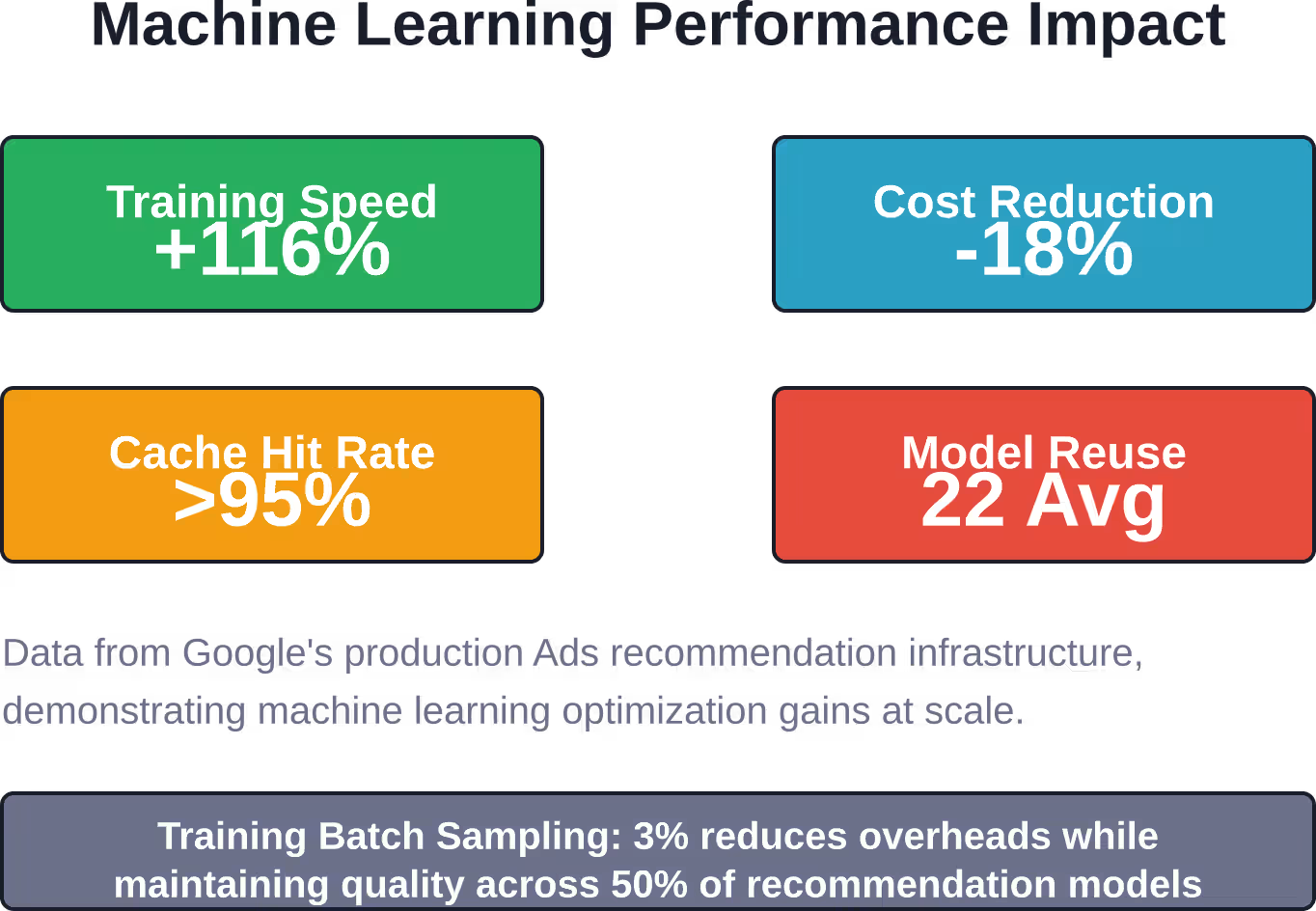
Attribution Modeling and Conversion Tracking
Understanding which ads actually drive conversions requires sophisticated attribution analysis. Users interact with multiple touchpoints before converting—search ads, display impressions, social media, email, retargeting. Machine learning helps determine which interactions deserve credit. Traditional last-click attribution assigns all credit to the final touchpoint before conversion. That approach ignores the influence of earlier interactions. Multi-touch attribution models distribute credit across the customer journey based on statistical contribution. Machine learning brings data-driven attribution. Instead of assuming equal credit or position-based weighting, the algorithms analyze thousands of conversion paths to identify which touchpoints correlate with successful outcomes. IEEE research on performance analysis of machine learning algorithms applied to multi-touch attribution demonstrates various approaches to this problem. Recent research presented at academic conferences shows how real-time systems can capture advertising interactions and apply causal analysis to determine true incremental impact. These systems go beyond correlation to estimate actual causation—separating ads that influenced conversions from those that merely appeared in the path. The practical value is budget allocation. If display ads consistently appear in converting paths but show low direct conversion rates, last-click attribution would undervalue them. Data-driven attribution reveals their true contribution, leading to better investment decisions.
Challenges and Limitations
Machine learning isn’t a silver bullet. The technology introduces specific challenges that advertisers need to address. Data quality determines model quality. Algorithms trained on incomplete, biased, or inaccurate data produce flawed predictions. Garbage in, garbage out applies especially to machine learning systems that scale those errors across millions of decisions. The FTC warned about AI harms in a June 2022 report on using artificial intelligence to combat online problems. The agency expressed concerns about inaccuracy, bias, discrimination, and commercial surveillance creep in automated systems. Bias manifests in several forms. Training data that overrepresents certain demographics leads to models that perform poorly for underrepresented groups. Historical optimization toward majority populations can create feedback loops that exclude valuable audiences. Explainability presents another hurdle. Complex neural networks make decisions based on patterns that aren’t easily interpretable. When a model denies an ad impression or adjusts a bid, understanding why becomes difficult. That opacity creates compliance risks and debugging challenges. Over-optimization can backfire. Models that aggressively pursue short-term metrics might sacrifice long-term brand building. An algorithm optimizing purely for immediate conversions might neglect upper-funnel awareness that drives future demand. And then there’s the regulatory landscape. The FTC launched Operation AI Comply in September 2024 (announced September 25, 2024), announcing five enforcement actions against operations using AI hype or selling AI technology that can be used in deceptive and unfair ways. In March 2024 (released March 28, 2024), the agency released its Privacy and Data Security Update highlighting actions related to AI and health privacy. In March 2026, Air AI and its owners agreed to a settlement with the FTC that includes a permanent ban on marketing business opportunities to resolve charges of misleading entrepreneurs and small businesses.
Implementation Best Practices
Successfully deploying machine learning in advertising requires more than just enabling algorithmic features. A few operational practices separate effective implementations from disappointing ones:
- Start with clean conversion tracking: Machine learning optimizes toward whatever goal is measured—if conversion tracking misses purchases or double-counts events, the algorithm optimizes toward flawed targets. Audit tracking infrastructure before enabling automated optimization.
- Allow sufficient learning periods: Algorithms need data volume before predictions stabilize. Launching a campaign and judging performance after 24 hours doesn’t give the system time to learn. Most platforms recommend at least 50 conversions before trusting automated bidding.
- Set appropriate guardrails: Automated systems should operate within defined boundaries—maximum bids, budget caps, excluded placements, brand safety filters. Algorithms optimize within constraints, not in spite of them.
- Monitor for drift: Model performance degrades over time as market conditions change. What worked six months ago might not work today. Regular performance reviews catch degradation before it significantly impacts results.
- Test incrementally: Don’t migrate entire budgets to machine learning overnight. Run controlled experiments comparing automated strategies against manual baselines. Scale what works, abandon what doesn’t.
The Interactive Advertising Bureau (IAB) focused its AI Standards Working Group in March 2021 to develop artificial intelligence standards, best practices, use cases, and terminologies for the industry. Following industry standards helps ensure implementations align with evolving norms.
| Implementation Phase | Key Actions | Success Metrics |
|---|---|---|
| Foundation Setup | Audit conversion tracking, establish baseline performance, set budget guardrails | Tracking accuracy >98%, clear baseline metrics documented |
| Initial Learning | Enable automated features on 20-30% of budget, collect 50+ conversions | Model confidence scores improving, no tracking errors |
| Optimization Phase | Compare automated vs. manual performance, adjust constraints based on results | CPA within 10% of baseline, conversion volume stable or increasing |
| Scaling | Gradually increase automated budget allocation, expand to additional campaigns | Sustained performance improvement, ROI gains vs. manual management |
| Maintenance | Monthly performance reviews, quarterly model retraining checks, ongoing compliance audits | Performance stability, no regulatory flags, model accuracy maintained |
The Future Trajectory
Machine learning in advertising continues evolving rapidly. Several trends are shaping the next phase. Privacy-preserving techniques are gaining priority. As third-party cookies disappear and privacy regulations expand, advertisers need machine learning approaches that work with less granular data. Federated learning, differential privacy, and on-device processing represent technical responses to that constraint. Multimodal models that process text, images, video, and audio simultaneously open new creative possibilities. An algorithm that understands both visual composition and linguistic messaging can optimize creative elements more holistically than systems that treat them separately. Causal inference methods are moving from academic research into production systems. Rather than just identifying correlation patterns, these approaches estimate actual cause-and-effect relationships between advertising exposures and outcomes. That distinction matters for accurate attribution and budget allocation. Real-time personalization is becoming more sophisticated. Instead of segmenting audiences into predefined buckets, emerging systems treat each user as a unique prediction problem. Dynamic creative assembly, personalized landing pages, and individualized offer optimization all benefit from per-user modeling. But technical capability alone won’t determine adoption. Regulatory frameworks, consumer sentiment, and industry standards all influence how machine learning gets deployed. The FTC’s ongoing enforcement actions signal that compliance requirements will keep pace with technological advancement.
Frequently Asked Questions
How does machine learning differ from traditional advertising targeting?
Traditional targeting uses predefined demographic and interest categories set manually by advertisers. Machine learning analyzes actual user behavior patterns to predict outcomes, continuously adjusting targeting criteria based on performance data rather than static assumptions. The algorithms identify non-obvious correlations that manual analysis would miss and adapt automatically as user behavior changes.
What data do machine learning advertising systems require?
These systems need conversion tracking data, user interaction signals (clicks, time on site, scroll depth), demographic attributes where available, device information, and historical campaign performance. More data generally improves model accuracy, but quality matters more than quantity—clean, accurate data from 1,000 users produces better results than messy data from 100,000.
Can small businesses benefit from machine learning in advertising?
Yes, though with some caveats. Major advertising platforms like Google and Meta embed machine learning into their standard offerings, making the technology accessible regardless of advertiser size. However, algorithms need sufficient conversion volume to learn effectively—campaigns generating fewer than 30-50 conversions monthly may not provide enough signal for automated optimization to outperform manual management.
How long does it take for machine learning advertising systems to show results?
Initial learning periods typically span 1-2 weeks, during which algorithms collect data and stabilize predictions. Meaningful performance comparisons usually require 30-45 days of runtime and at least 50 conversion events. Performance often dips slightly during early learning before improving as models refine their predictions. Patience during this ramp period is essential—judging results too quickly leads to premature abandonment of systems that would eventually perform well.
What are the main risks of using machine learning in advertising?
Key risks include algorithmic bias that excludes valuable audiences, over-optimization toward short-term metrics at the expense of brand building, privacy compliance failures if data handling doesn’t meet regulatory standards, and performance degradation when models aren’t retrained as market conditions change. The FTC has taken enforcement action against companies making deceptive AI claims and mishandling consumer data, highlighting compliance risks alongside technical challenges.
How do machine learning systems prevent click fraud?
Detection algorithms analyze behavioral patterns to distinguish legitimate users from bots and click farms. They examine click timing, mouse movement trajectories, device fingerprints, IP addresses, and engagement sequences. Legitimate traffic shows natural variation and context-appropriate behavior, while fraudulent sources exhibit repetitive patterns, impossible speeds, or device characteristics inconsistent with declared attributes. These systems continuously adapt as fraud tactics evolve.
Do machine learning algorithms replace human advertising expertise?
No. Algorithms handle data-intensive optimization tasks—bid adjustments, audience refinement, creative testing—but humans set strategy, define goals, establish guardrails, interpret results, and make decisions the data doesn’t clearly answer. Effective implementations combine algorithmic efficiency with human judgment about brand positioning, creative direction, and strategic priorities. The technology augments expertise rather than replacing it.
Conclusion
Machine learning has fundamentally changed how online advertising works. The technology enables precision, scale, and automation that manual approaches can’t match. Predictive targeting finds high-value audiences. Real-time bidding optimizes auction decisions. Dynamic creative serves personalized content. Attribution models reveal true conversion drivers. But capabilities come with responsibilities. Regulatory scrutiny from the FTC and other agencies makes clear that algorithmic sophistication doesn’t exempt advertisers from privacy obligations, transparency requirements, or truthful claims. The same data that powers targeting also creates compliance risks if mishandled. The advertisers who succeed with machine learning combine technical implementation with operational discipline. They audit data quality. They set appropriate guardrails. They monitor for bias and drift. They test incrementally rather than migrating everything at once. And they stay current with both technological advances and regulatory requirements. As privacy frameworks evolve and third-party data diminishes, machine learning approaches will need to adapt. Privacy-preserving techniques, causal inference methods, and multimodal models represent the next wave of advancement. The technology will keep improving—the question is whether implementations will keep pace with both capability and compliance demands. For anyone running digital campaigns, understanding machine learning isn’t optional anymore. The algorithms are already making decisions that affect performance and budget allocation. The choice is whether to leverage them strategically or let them operate as black boxes. Start with clean tracking, set clear goals, establish boundaries, and monitor results. The technology works—when implemented properly.