
Quick Summary: Machine learning has fundamentally transformed digital advertising by enabling real-time optimization, hyper-personalized targeting, and predictive campaign performance. As of 2025, 86% of advertisers are using or planning to use GenAI for video ad creative, while advanced ML algorithms have demonstrated improvements of +5.2% in CTR and +13.6% in RPM according to cluster-attention based advertising research. Despite rapid adoption, only 30% of agencies, brands, and publishers have fully integrated AI across the media campaign lifecycle as of 2025, highlighting both the technology’s transformative potential and the implementation challenges that remain. The advertising industry has reached an inflection point. Machine learning isn’t just optimizing campaigns anymore—it’s fundamentally rewriting how advertising works at its core. From programmatic bidding systems that make split-second decisions to generative AI creating entire video campaigns, ML has moved from experimental technology to mission-critical infrastructure. But the transformation is far from complete. According to the Interactive Advertising Bureau’s State of Data 2025 report, AI is on the brink of transforming how advertising works at its core. The keyword here? Brink. We’re not fully there yet, and the gap between early adopters and laggards is widening.
Understanding Machine Learning in Digital Advertising
Machine learning refers to algorithms that improve automatically through experience and data analysis. In advertising, this means systems that learn from campaign performance, user behavior, and conversion patterns to make increasingly better decisions without explicit programming for every scenario. The distinction matters because traditional advertising automation follows rigid rules. ML advertising systems adapt. When a campaign underperforms, rule-based systems wait for human intervention. ML systems identify the pattern, test alternatives, and adjust—often within minutes. That’s the fundamental shift: from reactive to predictive, from manual to autonomous.
The Three Pillars of ML Advertising
Modern ML advertising rests on three interconnected capabilities:
- Predictive analytics: Forecasting which users will convert, what creative will resonate, and when engagement peaks
- Real-time optimization: Adjusting bids, placements, and targeting as campaign data flows in
- Personalization at scale: Delivering individualized ad experiences across millions of users simultaneously
These aren’t separate features. They work together. Predictive models identify high-value audiences, real-time systems bid competitively for their attention, and personalization engines serve the most relevant creative variant.
The Current State of ML Adoption in Advertising
Here’s the reality: adoption is accelerating, but integration remains incomplete. Only 30% of agencies, brands, and publishers have fully integrated AI across the media campaign lifecycle as of 2025, according to IAB research conducted with BWG Global and Transparent Partner. That means 70% are still experimenting, implementing piecemeal, or struggling with the technical and organizational challenges. The adoption gap creates real anxiety. Data from IAB shows 37% of industry professionals express concern about job security with AI adoption, while 50% of brands worry about transparency in how agencies and publishers use AI. On the flip side, 50% of agencies fear brands will bring AI capabilities in-house, cutting them out entirely. 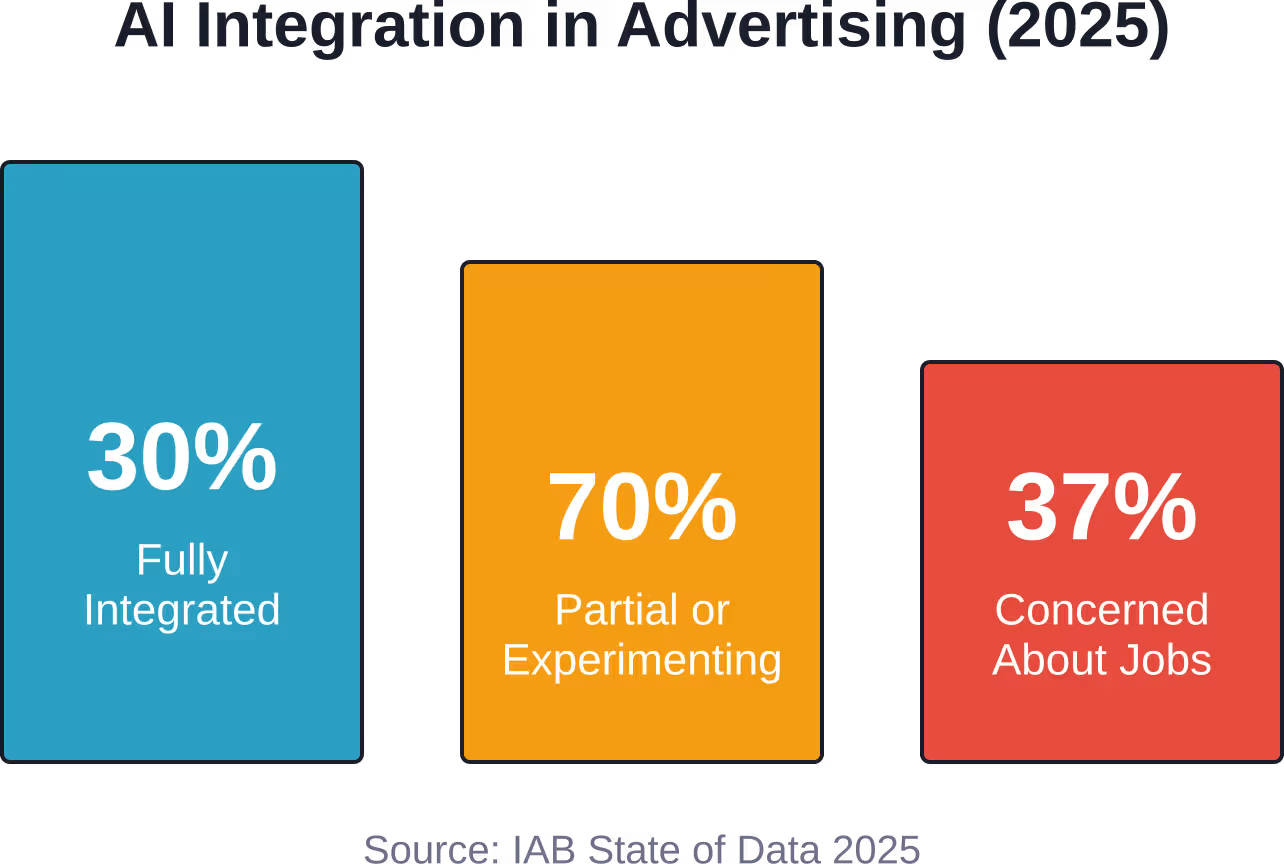 But wait—there’s a twist. While overall integration lags, specific ML applications are seeing explosive growth. The IAB’s 2025 Video Ad Spend & Strategy report reveals that 86% of buyers are using or planning to use GenAI for video ad creative. Half are already using it actively. According to industry projections, a significant percentage of ads will feature GenAI-created creative. That’s the pattern: tactical adoption is racing ahead of strategic integration.
Core ML Applications Transforming Digital Advertising
Programmatic Bidding and Real-Time Optimization
Real-time bidding (RTB) represents ML’s most mature application in advertising. Every time a web page loads, an auction occurs in milliseconds. ML algorithms analyze the user, context, inventory quality, and competitive landscape to determine the optimal bid. The sophistication has grown exponentially. Early programmatic systems used simple rules—bid X for audience Y. Modern ML bidding incorporates hundreds of signals: device type, time of day, browsing history, weather, nearby competitors, inventory scarcity, predicted conversion probability, and lifetime value forecasts. Research published on arXiv demonstrates the impact. A cluster-attention based advertising algorithm achieved a +5.2% improvement in click-through rate (CTR), a +13.6% increase in revenue per mille (RPM), and a +3.1% boost in advertiser return on investment (ROI) compared to baseline systems. Those numbers might seem modest. They’re not. In a multi-billion-dollar industry operating on thin margins, a 3% ROI improvement translates to hundreds of millions in value.
Audience Targeting and Segmentation
Traditional audience targeting relied on demographic proxies and explicit user data. Machine learning enables behavioral prediction at scale. ML models analyze patterns across millions of users to identify statistical twins—people who don’t share obvious demographic traits but exhibit similar online behaviors and conversion propensities. This matters especially as third-party cookies disappear and explicit user data becomes scarcer. According to research using Gemini 2.0 Flash for attribute prediction from web advertising exposure, ML models achieved 59.13% accuracy for gender prediction, 48.38% for employment status, and 42.70% for education level—substantially above random baseline performance. These predictions work even when users provide no explicit demographic information. The privacy implications are significant and we’ll address them shortly. But the capability is clear: ML can infer audience attributes from behavioral signals, enabling targeting even in privacy-constrained environments.
Creative Optimization and GenAI Content
This is where the recent explosion is happening. Generative AI has moved creative development from a human bottleneck to a scalable system. IAB data from 2025 shows how advertisers are deploying GenAI for creative work:
- 42% use it for creating audience-specific versions of ads
- 38% apply it for visual style changes
- 36% leverage it for contextual relevance adaptation
Furthermore, 58% of marketers plan to increase AI use for creative generation in the next year. The workflow has changed fundamentally. Previously, creating 20 ad variations for different audience segments meant 20 separate production cycles. Now, marketers create a base asset and GenAI systems generate variations—adjusting messaging, visual style, tone, and calls-to-action for each segment. Real talk: this isn’t replacing human creativity. It’s scaling it. Humans still define strategy, brand guidelines, and core messaging. AI handles the multiplication.
| Creative Task | Traditional Approach | ML-Powered Approach | Impact |
|---|---|---|---|
| Audience Variations | Manual production per segment | Automated generation from master | 10x faster deployment |
| A/B Testing | 2-4 variants tested | Hundreds of variants tested simultaneously | Better performance discovery |
| Contextual Adaptation | Limited or none | Real-time creative adjustment | Higher relevance, better CTR |
| Production Time | Days to weeks | Hours | Faster campaign launches |
Predictive Analytics and Attribution
Attribution—determining which touchpoints drove conversion—has plagued advertisers for decades. Users interact with brands across multiple channels, devices, and time periods. Which ad actually caused the purchase? Machine learning doesn’t solve attribution perfectly (nothing does), but it provides probabilistic models far superior to simplistic last-click or first-click attribution. ML attribution models analyze the complete user journey, assigning fractional credit based on each touchpoint’s statistical contribution to conversion probability. These models incorporate position effects (first and last interactions typically matter more), time decay (recent interactions weigh heavier), and channel interactions (some channel combinations work synergistically). The result? More accurate ROI measurement and better budget allocation decisions. Predictive analytics extends beyond attribution. ML models forecast campaign performance before launch, predict customer lifetime value to inform acquisition spending, and identify which leads are most likely to convert—enabling sales teams to prioritize effectively. 
Plan Digital Advertising ML Development With AI Superior
Digital advertising machine learning can be useful when teams need more than standard platform reporting. AI Superior can help define where ML fits, whether the data is strong enough, and how a model should be tested before wider use. Their services cover AI consulting, data science, machine learning, AI software development, proof of concept development, and model evaluation. This makes them relevant for teams building internal tools around campaign performance, user behavior, or automated recommendations. AI Superior can help teams with:
- Clarifying the digital advertising problem
- Reviewing ad performance, audience, and conversion data
- Creating ML prototypes for testing
- Developing models for forecasting or recommendation support
- Measuring model quality against campaign goals
- Planning integration into analytics or campaign systems
- Moving validated models into working software
For digital advertising, this can support campaign forecasting, audience segmentation, creative performance analysis, bid-related insights, and conversion modeling. Contact AI Superior to discuss the project.
Real-World Performance: What the Data Shows
Theory is great. Results matter more. Industry reports suggest that marketers implementing ML-driven personalization have observed conversion rate improvements ranging from 20-40% compared to non-personalized campaigns. In the travel industry, an airline leveraged machine learning to target users with similar online behaviors and achieved a 35% increase in conversion rates. In hospitality, Turtle Bay Resort achieved a 40% increase in customer engagement by implementing ML-powered personalization through Salesforce. The system analyzed booking behavior and served personalized content—promoting snorkeling sessions to some guests and excursions to others based on their preferences. Look, these aren’t guaranteed outcomes. Results vary wildly based on implementation quality, data availability, and industry context. But the pattern is consistent: well-executed ML advertising outperforms static approaches. 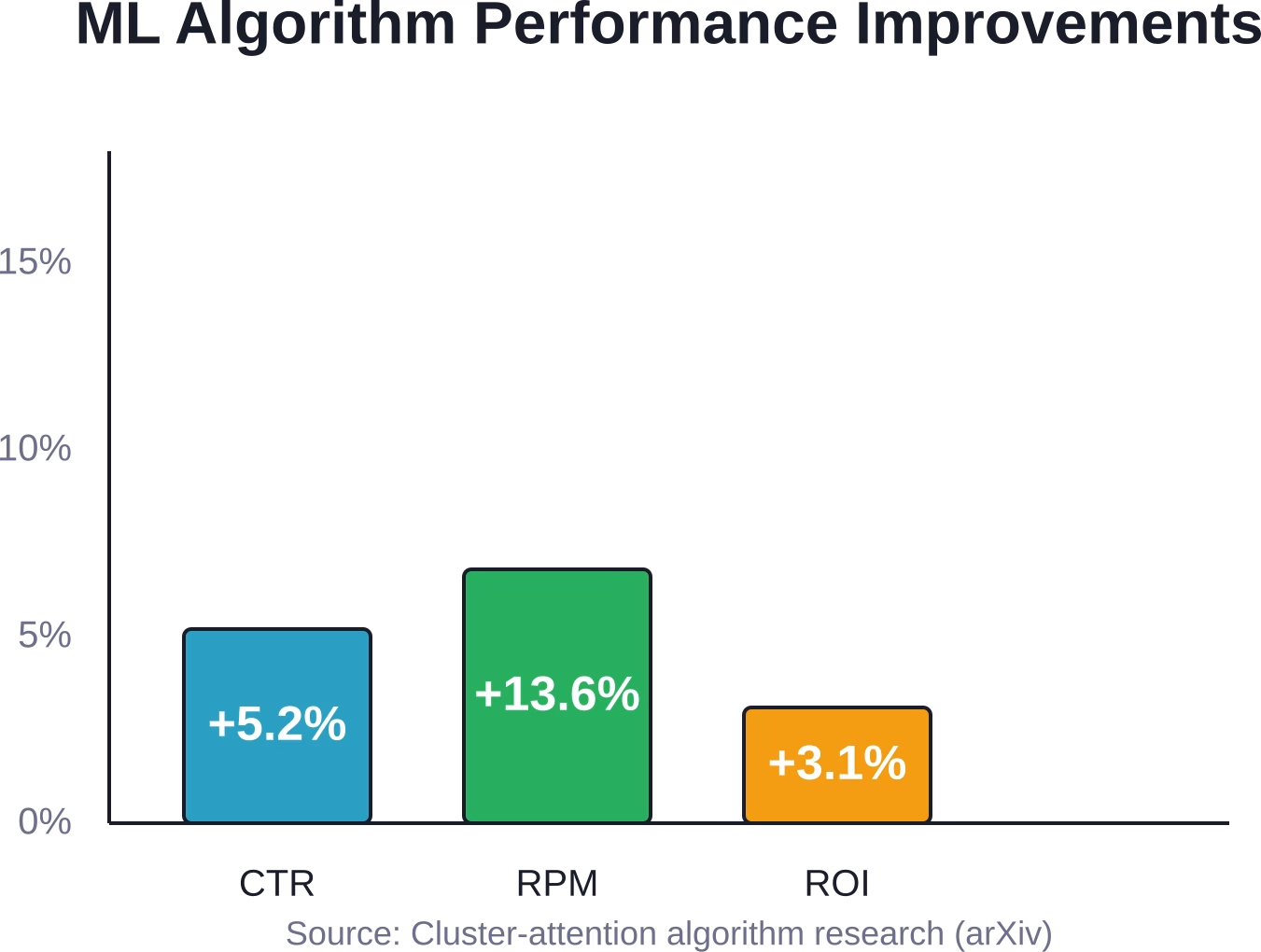
Implementation Challenges and Barriers
If ML is so powerful, why isn’t everyone using it? Because implementation is hard.
Data Quality and Availability
Machine learning is only as good as its training data. Garbage in, garbage out isn’t just a saying—it’s the fundamental constraint. Many advertisers lack the data infrastructure to support ML effectively. They have data, sure—scattered across platforms, inconsistently formatted, incomplete, and siloed. ML models need clean, integrated, substantial datasets to learn meaningful patterns. The minimum viable data threshold varies by application, but industry analyses suggest that effective ML personalization typically requires behavioral data from at least several thousand users, and preferably tens of thousands, before patterns become reliable.
Privacy Regulations and User Consent
Data privacy has reshaped digital marketing fundamentally. Northwestern University’s Spiegel Research Center noted in September 2025 that overarching federal and state regulations, combined with changing technology like third-party cookie deprecation and the rise of global ad blockers, make it increasingly important for marketers to stay ahead of the curve. ML models that rely on cross-site tracking face an existential challenge. Privacy regulations restrict data collection, storage, and usage. Consent requirements limit available data pools. And users are increasingly opting out. The solution isn’t to abandon ML—it’s to adapt. First-party data strategies, contextual targeting, and privacy-preserving ML techniques (like federated learning and differential privacy) are emerging as paths forward. But they require technical sophistication and strategic rethinking.
Transparency and Trust
Here’s the uncomfortable truth: most marketers don’t understand how their ML systems work. Neural networks are black boxes. They optimize for objectives, but the internal logic is opaque. IAB data shows 50% of brands worry about transparency in how agencies and publishers use AI. That’s not paranoia—it’s a rational response to opacity. The Federal Trade Commission has taken action against companies making false AI claims in advertising. In June 2024, the FTC filed suit against FBA Machine and its operator, alleging they falsely guaranteed consumers could make money operating online storefronts using AI-powered software. In March 2026, Air AI was banned from marketing business opportunities as part of an FTC settlement over similar misleading claims to entrepreneurs and small businesses. These cases highlight regulatory scrutiny around AI advertising claims and the importance of transparency.
Skills Gap and Organizational Readiness
Implementing ML isn’t just a technology problem—it’s an organizational transformation. Teams need new skills: data science, ML engineering, and AI governance. Workflows must change to accommodate iterative testing and continuous optimization. Decision-making shifts from intuition to data-driven experimentation. Many organizations underestimate this change management challenge. They buy ML tools, expecting plug-and-play solutions. Instead, they find themselves needing to restructure teams, hire new talent, and fundamentally rethink processes. The 37% of professionals concerned about job security with AI adoption reflect this tension. ML doesn’t eliminate marketing jobs—it transforms them. But that transformation requires adaptation, and not everyone is prepared.
Privacy-Preserving ML: The Path Forward
The tension between ML performance and user privacy isn’t going away. But new techniques are emerging to balance both.
Contextual Targeting 2.0
Old-school contextual targeting was crude—show car ads on automotive websites. ML-powered contextual targeting is sophisticated. Deep learning models analyze page content, semantic meaning, sentiment, and even visual context to understand the environment surrounding an ad placement. No user tracking required. The model evaluates the content itself. Research exploring online ad images using deep convolutional neural networks demonstrates how ML can extract rich contextual signals from the advertising environment without tracking individual users.
Federated Learning
Federated learning trains ML models across decentralized devices without centralizing user data. The model goes to the data, not the other way around. Each device trains a local model on its data. Only model updates (not raw data) are sent to a central server where they’re aggregated. The result: a globally trained model that never accessed any individual’s data directly. This approach is computationally expensive and technically complex, but it enables personalization without privacy compromise.
Differential Privacy
Differential privacy adds mathematical noise to datasets, ensuring individual records can’t be reverse-engineered while preserving aggregate patterns for ML training. The tradeoff is accuracy. More privacy means more noise, which degrades model performance. But for many applications, the privacy gain justifies the accuracy cost.
Platform-Specific ML Implementations
Meta Ads and Advantage+ Campaigns
Meta’s advertising platform represents one of the most sophisticated ML implementations in digital advertising. The Advantage+ suite uses ML to automate targeting, placement, creative, and budget allocation across Facebook, Instagram, and Messenger. The system works by analyzing billions of user interactions to identify patterns that predict conversion. Rather than advertisers manually defining audiences, the ML system explores the user base to find individuals statistically similar to past converters. Analyses suggest campaigns using Meta’s ML-driven targeting often achieve 20-30% better cost-per-acquisition than manual targeting, though results vary significantly based on vertical and creative quality.
Google Ads Smart Bidding
Google’s Smart Bidding uses auction-time bidding to optimize for specific conversion goals. The system considers an extensive range of signals—device, location, time of day, remarketing lists, ad characteristics, and more—to set the optimal bid for each auction. The key advantage is granularity. Traditional bidding sets rules at the campaign or ad group level. Smart Bidding optimizes at the individual auction level, adjusting for the unique combination of signals present in each moment.
Amazon Advertising ML
Amazon’s ML advantage is purchase data. The platform knows not just who clicked, but who bought—and what else they’ve purchased historically. This enables product recommendation algorithms that drive significant revenue. The “customers who bought X also bought Y” feature isn’t just convenience—it’s a sophisticated collaborative filtering algorithm analyzing millions of purchase patterns. For advertisers, Amazon’s ML systems can identify high-intent users with remarkable precision because they’re optimizing on actual purchase behavior, not proxy metrics like clicks.
Fraud Detection and Ad Verification
Not all ML applications in advertising are about optimization. Some are defensive. Click fraud—bots and malicious actors generating fake clicks to drain advertising budgets—costs the industry billions annually. ML fraud detection systems analyze click patterns, device fingerprints, behavioral signals, and network relationships to identify non-human traffic in real-time. Research on ad click fraud detection using machine learning and deep learning techniques demonstrates that ensemble models combining multiple ML approaches achieve detection accuracy above 95% on test datasets, substantially better than rule-based systems. The arms race continues. As fraud detection improves, fraudsters adapt their techniques. ML helps by identifying novel fraud patterns that haven’t been explicitly programmed as rules.
Measuring ML Advertising Success
How do you know if ML is working? The answer depends on your goals, but certain patterns emerge.
Key Performance Indicators
According to IAB’s 2025 Video Ad Spend & Strategy report, store visits and sales are now the most important KPIs for video buyers. The shift reflects ML’s ability to connect advertising exposure to real-world outcomes. Traditional metrics—impressions, clicks, viewability—remain important for operational monitoring. But they’re lagging indicators. ML enables prediction of leading indicators: conversion probability, customer lifetime value, and long-term revenue impact.
| Metric Type | Traditional Metrics | ML-Enhanced Metrics |
|---|---|---|
| Engagement | CTR, time on site | Predicted conversion probability, engagement quality score |
| Conversion | Conversion rate, CPA | Incremental conversions, multi-touch attribution scores |
| Value | Revenue, ROAS | Predicted LTV, profit-optimized ROAS |
| Audience | Demographics, interests | Behavioral cohorts, propensity segments |
Testing and Experimentation
The beauty of ML is its compatibility with rigorous testing. A/B tests, multivariate tests, and holdout groups enable measurement of incremental impact. Best practice: always maintain a control group using non-ML approaches. This isolates ML’s contribution from other factors (creative quality, seasonal effects, market trends).
The Future: What’s Coming Next
The pace of ML advancement in advertising shows no signs of slowing. Several trends are shaping the next evolution.
Multimodal AI and Rich Media
Current ML advertising primarily analyzes text and structured data. Next-generation systems process images, video, audio, and text simultaneously—understanding not just what an ad says, but how it looks, sounds, and feels. This enables creative analysis at scale. Instead of humans reviewing thousands of ad variants, ML systems evaluate visual composition, color psychology, emotional tone, and brand consistency automatically.
Conversational AI and Interactive Ads
Large language models are enabling a new ad format: conversational experiences. Instead of static messages, ads become interactive assistants that answer questions, provide recommendations, and guide purchase decisions in real-time. Early experiments show promise, but measurement challenges remain. How do you attribute value to a conversation that doesn’t immediately convert but influences future purchase decisions?
Autonomous Campaign Management
The end state of ML advertising is full autonomy. Humans set strategic goals and brand guidelines. AI handles everything else: audience identification, creative generation, placement optimization, budget allocation, and performance reporting. We’re not there yet. But the pieces are assembling. As IAB notes, AI is on the brink of transforming how advertising works at its core. The shift from tactical tool to strategic platform is underway.
Regulatory Evolution
Expect continued regulatory attention. The FTC’s actions against Air AI and FBA Machine signal scrutiny around AI advertising claims and business practices. Privacy regulations will continue evolving, potentially requiring technical adaptation of ML systems. Organizations investing in ML advertising must balance innovation with compliance—building systems that perform well while respecting privacy and regulatory boundaries.
Practical Implementation: Getting Started with ML Advertising
Theory is great. But how does a marketer actually implement ML advertising effectively?
Start with Platform-Native ML Tools
Don’t build from scratch. Major advertising platforms—Google, Meta, Amazon, Microsoft—offer sophisticated ML capabilities built-in. Start there. These tools require minimal technical expertise. Enable Smart Bidding in Google Ads. Use Advantage+ campaigns in Meta. Let the platform ML do the heavy lifting while your team learns what works.
Build First-Party Data Infrastructure
ML needs data. With third-party data disappearing, first-party data becomes the strategic asset. Implement proper tracking: consolidated customer data platforms, clean event tracking, unified user identifiers across touchpoints. This isn’t sexy infrastructure work, but it’s foundational.
Test, Measure, Iterate
ML isn’t magic. It’s probability. Some tests will fail. The key is learning fast and iterating. Establish clear KPIs, run controlled experiments, measure incremental impact, and scale what works. This requires discipline and patience—ML performance compounds over time as models learn.
Invest in Skills Development
Your team needs ML literacy. Not everyone needs to be a data scientist, but everyone should understand how ML works, what it can and can’t do, and how to interpret its outputs. Training, workshops, and hiring for ML fluency are investments that pay dividends as the technology becomes more central to advertising operations.
Addressing Audience Concerns About AI-Generated Ads
Here’s an uncomfortable question: do audiences trust AI-generated advertising? IAB data shows 37% of marketers fear audiences will distrust AI-generated ads. That concern isn’t unfounded. Consumers are becoming more aware of AI’s role in content creation, and some react negatively to the perception of inauthenticity. The solution isn’t to hide AI usage—it’s to ensure quality and relevance. Audiences don’t object to AI per se; they object to bad ads. If GenAI creates more relevant, engaging, useful ads, trust follows. Transparency also matters. Some brands are experimenting with disclosure—labeling AI-generated content. Early data on consumer response is mixed, but honesty generally builds trust over time.
Industry Collaboration and Standardization
ML advertising doesn’t exist in isolation. It requires ecosystem coordination. Industry organizations like IAB are developing standards, best practices, and benchmarks to enable interoperability and measurement consistency. The State of Data 2025 report represents the first-ever industry benchmark measuring AI transformation readiness. Standardization matters because ML systems need to communicate across platforms. Attribution models need consistent data formats. Privacy-preserving techniques require coordinated implementation. As Harvard’s Division of Continuing Education notes, AI presents marketers with opportunities to personalize customer experiences and build technological skills—but realizing those opportunities requires industry-wide cooperation, not just individual innovation.
Frequently Asked Questions
What is machine learning in digital advertising?
Machine learning in digital advertising refers to algorithms that automatically improve advertising performance by analyzing data patterns. These systems learn from campaign results, user behavior, and conversion data to make better targeting, bidding, and creative decisions without explicit programming for every scenario. ML enables real-time optimization, predictive analytics, and personalization at scale across programmatic advertising platforms.
How does machine learning improve ad targeting?
ML improves ad targeting by analyzing behavioral patterns across millions of users to identify statistical similarities beyond basic demographics. Instead of relying on explicit user-provided data, ML models predict conversion probability based on browsing behavior, contextual signals, and interaction patterns. Research shows ML attribute prediction can achieve 59.13% accuracy for gender, 48.38% for employment, and 42.70% for education—enabling effective targeting even in privacy-constrained environments.
What percentage of advertisers are using AI for creative development?
According to IAB’s 2025 research, 86% of advertisers are using or planning to use generative AI for video ad creative, with 50% already actively using it. Additionally, 42% use GenAI for creating audience-specific ad versions, 38% for visual style changes, and 36% for contextual relevance. Projections suggest a significant percentage of ads will feature GenAI-created creative by 2026, demonstrating rapid adoption for content generation.
What are the main challenges in implementing ML advertising?
The primary challenges include data quality and availability (ML requires clean, integrated datasets from thousands of users), privacy regulations restricting data collection and usage, transparency concerns (50% of brands worry about how agencies use AI), and organizational readiness gaps in skills and processes. Only 30% of agencies, brands, and publishers have fully integrated AI across the media campaign lifecycle as of 2025, indicating significant implementation barriers despite widespread interest.
How does machine learning handle privacy regulations?
ML adapts to privacy constraints through techniques like contextual targeting (analyzing page content rather than user behavior), federated learning (training models on decentralized devices without centralizing data), and differential privacy (adding mathematical noise to protect individual records). These approaches enable personalization and optimization while respecting user privacy and regulatory requirements, though they often require technical sophistication and may sacrifice some accuracy for privacy gains.
What ROI improvements can ML advertising deliver?
Research demonstrates that advanced ML algorithms achieve measurable improvements: +5.2% in click-through rate, +13.6% in revenue per mille, and +3.1% in advertiser ROI compared to baseline systems according to cluster-attention based advertising research. Industry reports suggest ML-driven personalization can improve conversion rates by 20-40%, with specific examples showing 35% conversion increases in travel and 40% engagement gains in hospitality. However, results vary significantly based on implementation quality, data availability, and industry context.
Is machine learning replacing human marketers?
ML is transforming marketing roles rather than eliminating them. While 37% of industry professionals express job security concerns, ML automates tactical execution—bidding, placement optimization, variant testing—freeing humans to focus on strategy, creative direction, and brand stewardship. The shift requires new skills in data analysis, ML system management, and AI governance. Organizations that view ML as augmentation rather than replacement tend to achieve better outcomes and smoother adoption.
Conclusion: Navigating the ML Advertising Transformation
Machine learning has moved from experimental technology to core infrastructure in digital advertising. The data is clear: ML systems deliver measurable performance improvements, enable personalization at unprecedented scale, and unlock capabilities impossible through manual optimization. But we’re still in the early innings. Only 30% of organizations have achieved full AI integration across campaign lifecycles. Privacy regulations continue reshaping what’s possible. Skills gaps and organizational readiness remain significant barriers. The winners in this transformation won’t be those with the most sophisticated algorithms—they’ll be organizations that balance technological capability with strategic clarity, user privacy, and workforce development. So what’s the next step? Start with platform-native ML tools to build familiarity. Invest in first-party data infrastructure to fuel future capabilities. Test rigorously, measure incrementally, and scale what works. And most importantly, invest in your team’s ML literacy—the technology will keep evolving, but human judgment remains the differentiator. The advertising industry is being rewritten by machine learning. The question isn’t whether to participate—it’s how quickly you can adapt and how effectively you can harness these capabilities for competitive advantage. The transformation is happening now. Position accordingly.