
Quick Summary: Machine learning in ad targeting uses AI algorithms to analyze user data, predict behavior, and automatically optimize ad delivery to the most relevant audiences. This technology has transformed digital advertising by improving targeting precision, reducing costs, and enabling real-time campaign adjustments—all while adapting to privacy regulations and cookie deprecation.
Digital advertising has undergone a radical transformation. Gone are the days when marketers manually selected audience segments and hoped for the best. Machine learning now powers ad targeting decisions at a scale and speed humans simply can’t match.
The technology analyzes millions of data points in milliseconds, identifies patterns invisible to the human eye, and automatically adjusts campaigns based on what’s actually working. And it’s not just about efficiency—it’s about relevance.
With online advertising accounting for 64.4% of total advertising spend as of 2021, and e-commerce expected to reach 23% of total retail by 2027 with 14.4% annual growth, the stakes have never been higher. Advertisers need every advantage they can get.
What Machine Learning Actually Does in Ad Targeting
At its core, machine learning in advertising is pattern recognition on steroids. These algorithms consume vast amounts of user behavior data—browsing history, purchase patterns, engagement signals, demographic information—and learn which combinations predict desired outcomes.
But here’s the thing: it doesn’t just find correlations. The system continuously tests, learns, and refines its predictions based on real results. Every ad impression, click, and conversion feeds back into the model, making it smarter over time.
The practical result? Ads reach people who are genuinely likely to care about them, at the exact moment they’re most receptive. Not because a marketer guessed right, but because the algorithm identified predictive signals across thousands of variables.
Key Functions of ML-Powered Targeting
Machine learning systems handle several critical tasks simultaneously. They predict which users will convert, determine optimal bid prices for each auction, identify new audience segments based on behavior patterns, and adjust creative elements based on engagement data.
These systems also detect ad fatigue before performance drops, allocate budget across channels dynamically, and recognize fraud patterns that would slip past manual review. The automation isn’t replacing strategy—it’s executing it at a scale manual management can’t approach.
How Machine Learning Models Process Targeting Decisions
The technical process behind machine learning targeting involves multiple layers of data processing and decision-making. Understanding this helps marketers work with these systems more effectively rather than treating them as black boxes.
Data collection happens across multiple touchpoints—website visits, app interactions, ad engagements, purchase history, and contextual signals like time, device, and location. This raw data then undergoes feature engineering, where the system transforms basic data points into meaningful predictive variables.
The model training phase is where the actual learning occurs. Algorithms analyze historical data to identify which feature combinations correlate with desired outcomes. In practice, systems often train multiple specialized models—one for click prediction, another for conversion likelihood, a third for lifetime value estimation.
Real-Time Prediction and Optimization
When an ad auction occurs, the trained model evaluates the user in milliseconds. It doesn’t just predict whether they’ll click—it estimates the probability of conversion, expected revenue, and optimal bid amount that balances cost against value.
Here’s where it gets interesting: the system doesn’t treat all conversions equally. A user likely to make a single small purchase gets different treatment than one showing signals of high lifetime value. The algorithm learns these nuances from historical patterns without explicit programming.

Develop Ad Targeting Models With AI Superior
Ad targeting needs careful data work because weak inputs can lead to poor audience decisions. AI Superior can help teams build machine learning models for audience scoring, segmentation, recommendation, or response prediction while keeping the project grounded in available data.
Their work includes AI consulting, machine learning, data science, AI software development, proof of concept development, and model evaluation. This is useful when a team needs to validate a targeting model before connecting it to campaign workflows.
AI Superior can support ad targeting projects with:
- Defining the targeting logic and ML task
- Reviewing customer, behavioral, campaign, and conversion data
- Building proof of concept targeting models
- Developing models for audience scoring or segmentation
- Testing model performance and stability
- Planning integration with internal platforms or ad tools
- Supporting the project from prototype to deployment
For ad targeting, this may apply to lookalike audience modeling, response prediction, customer scoring, personalization, and campaign list optimization.
Contact AI Superior to discuss the project.
Predictive Targeting: From Historical Data to Future Behavior
Predictive targeting represents the most sophisticated application of machine learning in advertising. Rather than targeting users based on what they’ve already done, these systems predict what they’re likely to do next.
The approach analyzes behavior sequences and temporal patterns. Someone browsing product reviews on Monday, checking prices on Wednesday, and reading buying guides on Friday isn’t just showing interest—they’re following a predictable path toward purchase. Machine learning models recognize these sequences and time the ad delivery accordingly.
Testing data shows the impact clearly. A 45-day A/B test comparing manual targeting to machine learning optimization showed a 17% jump in conversions and a 16% drop in cost per conversion. The algorithm identified predictive signals human analysts missed entirely.
| Targeting Approach | Conversion Rate Change | Cost per Conversion | Implementation Time |
|---|---|---|---|
| Manual Segmentation | Baseline | Baseline | 2-3 weeks |
| Rule-Based Automation | +5-8% | -3-5% | 1 week |
| Machine Learning | +15-20% | -12-18% | Initial setup only |
| Advanced ML + Lookalike | +25-35% | -20-25% | Ongoing optimization |
Lookalike Audiences and Similarity Modeling
Lookalike audience generation demonstrates machine learning’s pattern recognition power. The system analyzes characteristics of existing customers—not just demographics, but behavioral patterns, engagement signals, and content preferences—then finds users with similar profiles.
The challenge is ensuring these models don’t introduce bias. Research from Brookings revealed concerning patterns: a Lookalike audience based on 10,000 African American voters showed an 89% overlap with an African American sample. This highlights a critical issue: machine learning amplifies patterns in training data, including problematic ones. When historical data reflects existing biases, the algorithm learns and perpetuates them at scale.
Bias, Fairness, and Algorithmic Accountability
The power of machine learning in ad targeting comes with significant responsibility. These systems can inadvertently discriminate, create filter bubbles, or exploit vulnerable populations if not carefully designed and monitored.
IEEE has developed standards for algorithmic bias considerations, recognizing that technical solutions require proactive design. The challenge isn’t just detecting bias after the fact—it’s building systems that consider fairness from the ground up.
Real-world examples illustrate the stakes. Amazon’s experimental recruiting tool, used by a company with a 60 percent male global workforce and where men hold 74 percent of the company’s managerial positions, learned to penalize resumes containing words associated with women. The system wasn’t programmed to discriminate—it learned from historical hiring patterns that reflected existing bias.
Regulatory Response and Industry Standards
Regulators are taking notice. The FTC announced Operation AI Comply in September 2024, launching enforcement actions against operations using AI hype deceptively or selling AI technology that enables unfair practices. The message is clear: algorithmic targeting doesn’t exempt companies from discrimination laws.
IEEE standards and academic research from institutions like Brookings provide frameworks for detecting and mitigating bias. These approaches include fairness constraints during model training, regular audits comparing outcomes across demographic groups, and transparency documentation that makes algorithmic decisions explainable.
The technical challenge is substantial. Research from IEEE Spectrum notes that deep learning systems make it particularly hard to identify when decision-making is biased. The complexity that makes these models powerful also makes them opaque.
Privacy-Preserving Targeting in a Cookie-Less World
Third-party cookie deprecation has forced machine learning systems to evolve rapidly. The traditional approach—tracking users across the web via cookies—is disappearing, and algorithms must find new ways to deliver relevant ads without invasive surveillance.
Several privacy-preserving techniques are emerging. Federated learning allows models to train on user data without that data leaving the device. Differential privacy adds mathematical noise that protects individual privacy while preserving aggregate patterns. Contextual targeting has returned with machine learning enhancements that understand page content at a deeper level.
Research on blind targeting demonstrates that strategic approaches can recover significant targeting value while respecting privacy constraints. One study using the Criteo AI Labs dataset with 14M users found that intuitive benchmark strategies only achieved 33% of non-privacy-preserving targeting potential, while strategic querying methods recovered 97-101% of the value.
User Awareness and Control
Consumer awareness of ad targeting mechanisms remains limited. Pew Research Center found that 74% of Facebook users said they did not know that the “Your ad preferences” list existed before the study. When directed to it, users could find their listed ad preference categories, but research showed mixed alignment with user self-perception regarding these categories, and approximately half of Facebook users say they are not comfortable when they see how the platform categorizes them.
This gap between algorithmic inference and user perception matters. Even accurate targeting can feel invasive when users don’t understand or consent to how their data is used. Transparency mechanisms help, but only if users know they exist and can realistically exercise control.
| Privacy Approach | Targeting Accuracy | Implementation Complexity | User Control |
|---|---|---|---|
| Third-Party Cookies | High (legacy baseline) | Low | Minimal |
| Contextual + ML | Moderate to High | Medium | Implicit |
| First-Party Data | High (known users) | Medium | Account-based |
| Federated Learning | Moderate | Very High | Device-level |
| Cohort-Based (FLoC/Topics) | Moderate | Medium | Limited |
AI-Generated Ad Creative and Personalization
Machine learning has expanded beyond audience targeting into the creative generation itself. Large language models now create ad copy and visuals, often outperforming human-created content in testing.
Recent research found that LLM-generated ads achieved statistical parity with human-written ads (51.1% vs. 48.9%, p>0.05) in controlled studies. The quality advantage proved robust—even after applying a 21.2 percentage point detection penalty when participants correctly identified AI-origin, 29.4% of participants chose AI content.
What explains this performance equivalence? Qualitative analysis revealed that AI crafts more sophisticated, aspirational messaging and achieves superior visual-narrative coherence. The systems don’t just write decent copy—they optimize for engagement patterns learned from vast training data.
But this raises new ethical questions. When ads are individually personalized using AI that knows which psychological triggers work on each person, where’s the line between persuasion and manipulation? The technology’s effectiveness makes these questions urgent, not theoretical.
Implementation Challenges and Best Practices
Organizations implementing machine learning targeting face several practical challenges. Data quality and quantity top the list—models need substantial training data to learn effectively. Typical experimental setups in financial services use datasets with customer behavior tracked over 6-month observation windows, split 70% training, 15% validation, 15% test.
Integration complexity is another hurdle. Machine learning systems must connect with ad platforms, customer data platforms, analytics tools, and creative management systems. Each integration point introduces potential failure modes and data synchronization challenges.
Measurement and Attribution
Measuring machine learning impact requires careful experimental design. Simple before-and-after comparisons can be misleading because external factors—seasonality, market conditions, competitor actions—change constantly. Proper A/B testing with holdout groups provides cleaner attribution.
The measurement challenge extends to understanding why the algorithm makes specific decisions. Model interpretability tools help explain predictions, but complex ensemble models or deep learning systems resist simple explanation. Balancing performance with explainability becomes a practical trade-off.
Platform-Specific Implementation
Different advertising platforms implement machine learning targeting with varying approaches and capabilities. Understanding these differences helps advertisers choose appropriate platforms and set realistic expectations.
Major platforms like Facebook, Google, and Pinterest each use proprietary machine learning systems trained on massive datasets. Pinterest Engineering published details on their approach to delivering relevant ads, including sample weighting techniques that improved revenue, number of impressions, and eCPM by 0.82%, 0.38%, and 0.4% respectively through min-max scaling normalization.
Smaller platforms and independent ad tech companies often lack the data scale and engineering resources to build comparable systems. They may license third-party machine learning tools or rely on simpler rule-based optimization. Performance differences can be significant.
Programmatic Advertising and Real-Time Bidding
Programmatic advertising represents machine learning’s natural habitat. Real-time bidding auctions happen in milliseconds—far too fast for human decision-making. Algorithms evaluate each impression opportunity, predict its value, and determine optimal bid amounts automatically.
The sophistication varies widely. Basic programmatic systems use relatively simple rules and historical averages. Advanced implementations employ reinforcement learning that treats each auction as a sequential decision problem, learning optimal bidding strategies through trial and error while accounting for delayed conversion signals.
Research on learning personalized ad impact via contextual reinforcement learning addresses the delayed reward problem directly. Conversions often occur days or weeks after the initial ad exposure, making it difficult for algorithms to attribute value correctly. Techniques that model these delayed rewards improve bid optimization substantially.
Future Directions and Emerging Techniques
Machine learning in ad targeting continues to evolve rapidly. Several emerging trends are reshaping the landscape beyond what’s commonly deployed in 2026.
Hybrid intent-aware personalization combines conventional machine learning with retrieval-augmented generation from large language models. This approach models customer behavior through traditional ML while using LLMs to generate personalized messaging that adapts to rapidly evolving intent signals and regulatory constraints specific to financial services and other highly regulated industries.
Cross-device and cross-platform identity resolution is improving through privacy-preserving techniques. Rather than tracking individuals directly, systems recognize behavior patterns and probabilistically link interactions across devices without requiring persistent identifiers.
Causal inference methods are supplementing correlation-based prediction. Understanding causal relationships—what actually drives conversions versus what merely correlates—helps advertisers avoid wasted spend on users who would convert anyway and focus on persuadable audiences.
Multimodal Learning
Systems that process multiple data types simultaneously—text, images, video, audio, user behavior—are becoming more sophisticated. Multimodal models understand how visual elements, messaging, and context interact, enabling more nuanced creative optimization and better contextual targeting.
The challenge is computational cost. Multimodal models require substantially more processing power than single-modality systems, making real-time inference expensive. Optimization techniques that balance accuracy against latency and cost are active research areas.
Frequently Asked Questions
How does machine learning differ from traditional ad targeting?
Traditional targeting uses fixed rules and manual audience segments defined by marketers. Machine learning targeting automatically discovers patterns in user behavior data and continuously optimizes decisions based on actual performance. The algorithm identifies which combinations of signals predict conversions without explicit programming, and it adapts as conditions change. This enables scale and precision that manual targeting can’t match—testing showed 17% conversion improvements and 16% cost reductions compared to manual approaches.
Does machine learning targeting violate user privacy?
Machine learning itself is a technique, not inherently privacy-violating. Implementation matters enormously. Systems can use privacy-preserving methods like federated learning, differential privacy, and on-device processing. However, many implementations historically relied on invasive tracking. With third-party cookie deprecation and regulations like GDPR, the industry is shifting toward privacy-conscious approaches. Users should check platform privacy policies and use available controls, though research shows 74% of Facebook users weren’t aware preference controls existed.
Can machine learning ad targeting be biased?
Absolutely. Machine learning systems learn from historical data, and when that data reflects existing biases, algorithms amplify them at scale. Research documented cases where Facebook lookalike audiences showed demographic skew—with significantly higher overlap rates among African American samples compared to other demographics. Amazon’s experimental recruiting tool learned to penalize resumes associated with women because training data reflected a male-dominated workforce. Addressing bias requires careful data curation, fairness constraints, regular auditing, and transparency.
How much data is needed for effective machine learning targeting?
Requirements vary by approach complexity. Simple models might work with a few thousand conversions, while sophisticated deep learning systems need millions of examples. Typical experimental setups in financial services use datasets with customer behavior tracked over 6-month observation windows, split 70% training, 15% validation, 15% test. Cold start situations with limited data can use transfer learning—applying models trained on broader datasets and fine-tuning with limited specific data. First-party data from existing customers provides the richest signal, making it more valuable per record than third-party data.
Will AI completely automate ad targeting?
Automation handles execution and optimization but not strategy. Algorithms excel at processing vast data and making rapid decisions within defined parameters. They can’t set business objectives, understand brand positioning, or make judgment calls about ethical boundaries. Effective implementation requires human oversight for strategy, creative direction, budget allocation across channels, ethical guardrails, and interpreting results in business context. The trend is toward augmentation—AI handles what it does best while humans focus on strategic decisions machines can’t make.
How do I get started with machine learning ad targeting?
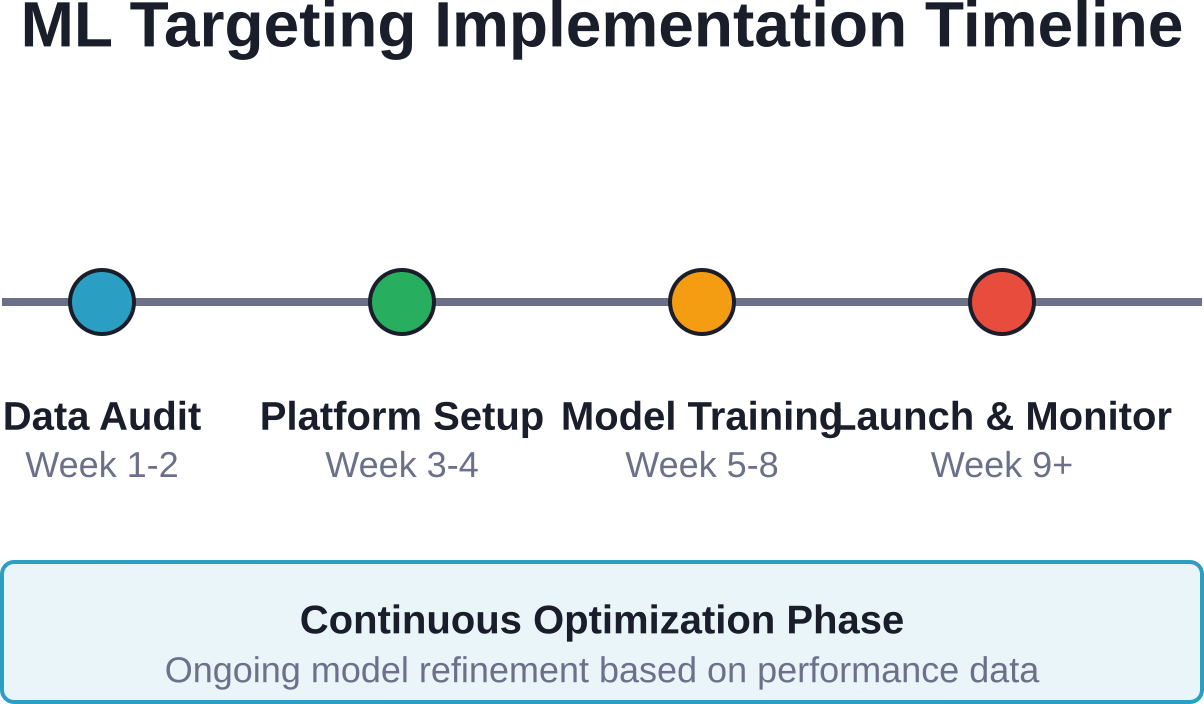
Start with platform-provided automated tools rather than building custom systems. Google’s Smart Bidding, Facebook’s Advantage+ campaigns, and similar offerings use sophisticated machine learning without requiring technical expertise. Begin by enabling automated bid optimization for a portion of budget while maintaining manual control on others for comparison. Audit data quality—machine learning is only as good as its training data. Ensure conversion tracking is accurate and comprehensive. Set clear success metrics before launch so results can be evaluated objectively rather than subjectively.
What’s the difference between machine learning and AI in advertising?
Artificial intelligence is the broad concept of machines performing tasks that typically require human intelligence. Machine learning is a specific subset of AI focused on systems that learn from data without explicit programming. In advertising context, machine learning specifically refers to algorithms that improve targeting, bidding, and optimization through pattern recognition. AI more broadly might include natural language processing for ad copy generation, computer vision for creative analysis, or recommendation systems. Practically, the terms are often used interchangeably in marketing contexts, though machine learning is more technically precise for targeting algorithms.
Conclusion
Machine learning has fundamentally transformed ad targeting from a manual, intuition-driven process to an automated, data-driven system that operates at scales humans can’t match. The technology delivers measurable improvements—higher conversion rates, lower costs, better relevance—when implemented thoughtfully.
But power comes with responsibility. Bias, privacy, transparency, and fairness aren’t just ethical concerns—they’re regulatory requirements and consumer expectations. The industry is navigating a transition from invasive tracking to privacy-preserving techniques, from opaque black boxes to explainable systems, from pure performance optimization to fairness-constrained models.
For advertisers, the path forward combines leveraging machine learning capabilities while maintaining strategic oversight. Let algorithms handle the execution complexity they excel at. Focus human attention on strategy, creative quality, ethical boundaries, and interpreting results in business context.
The technology will continue evolving. New techniques for privacy preservation, bias mitigation, creative generation, and causal inference are emerging from research labs. Staying informed and adaptable matters more than mastering any specific current implementation.
Ready to optimize ad targeting? Start by auditing current performance data, enabling automated optimization on one campaign as a test, and measuring results rigorously against control groups. Machine learning works, but only when grounded in solid data and clear objectives.
 English
  German
  Arabic
  French
  Dutch
Dutch  Spanish