
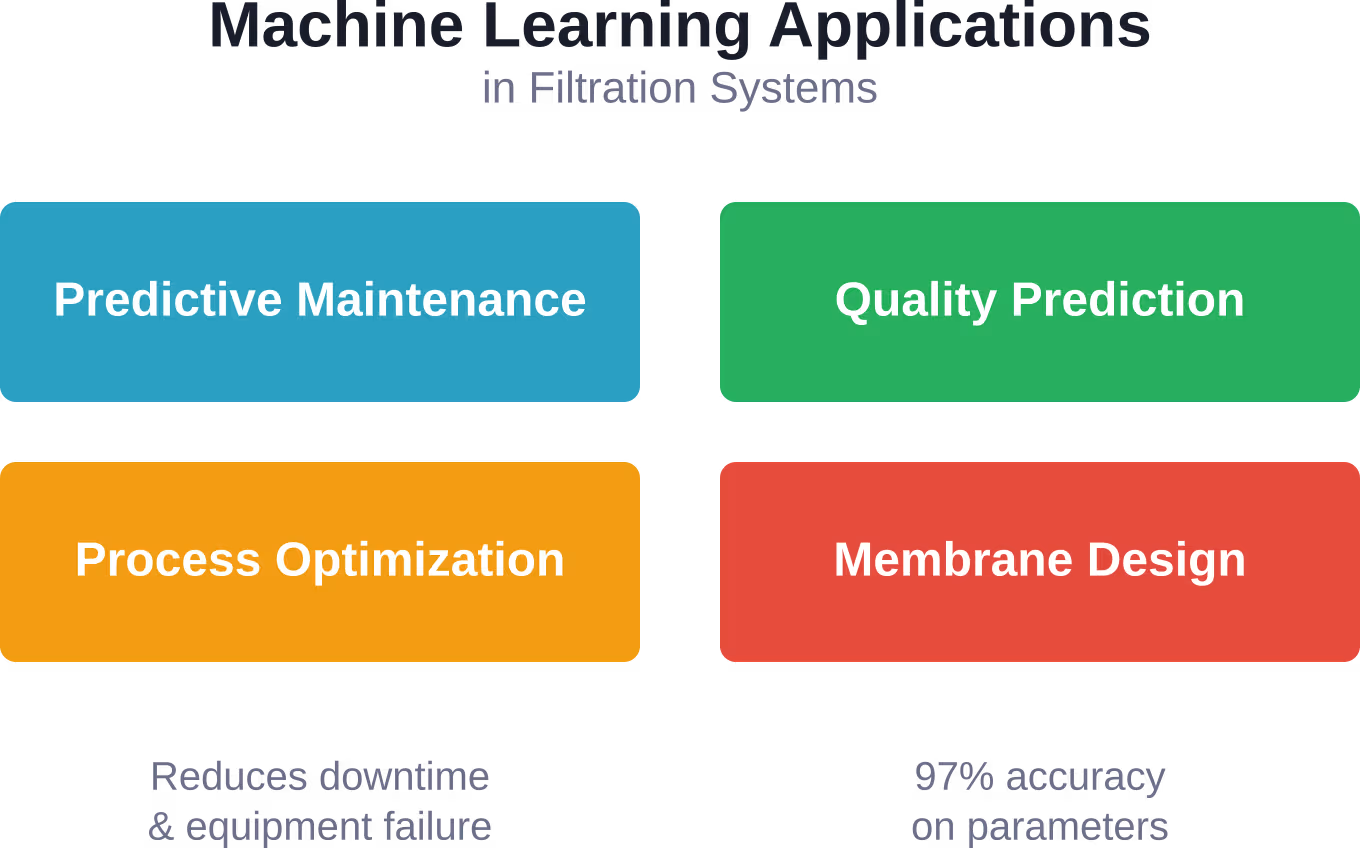
Quick Summary: Machine learning is revolutionizing filtration by enabling predictive maintenance, optimizing water treatment efficiency, and enhancing membrane design through AI-driven models. These technologies achieve up to 97% accuracy in forecasting wastewater quality parameters while reducing operational costs and improving system performance across industrial and municipal applications.
Filtration systems have evolved dramatically over the past decade. What started as mechanical separation processes now integrate sophisticated algorithms that predict failures, optimize performance, and reduce waste.
The intersection of artificial intelligence and filtration technology addresses one of humanity’s most pressing challenges: clean water access. The World Bank estimates global economic losses of USD 260 billion annually due to inadequate water supply and sanitation. Unsafe Water, Sanitation, and Hygiene (WASH) services were linked to approximately 1.4 million deaths globally in 2019.
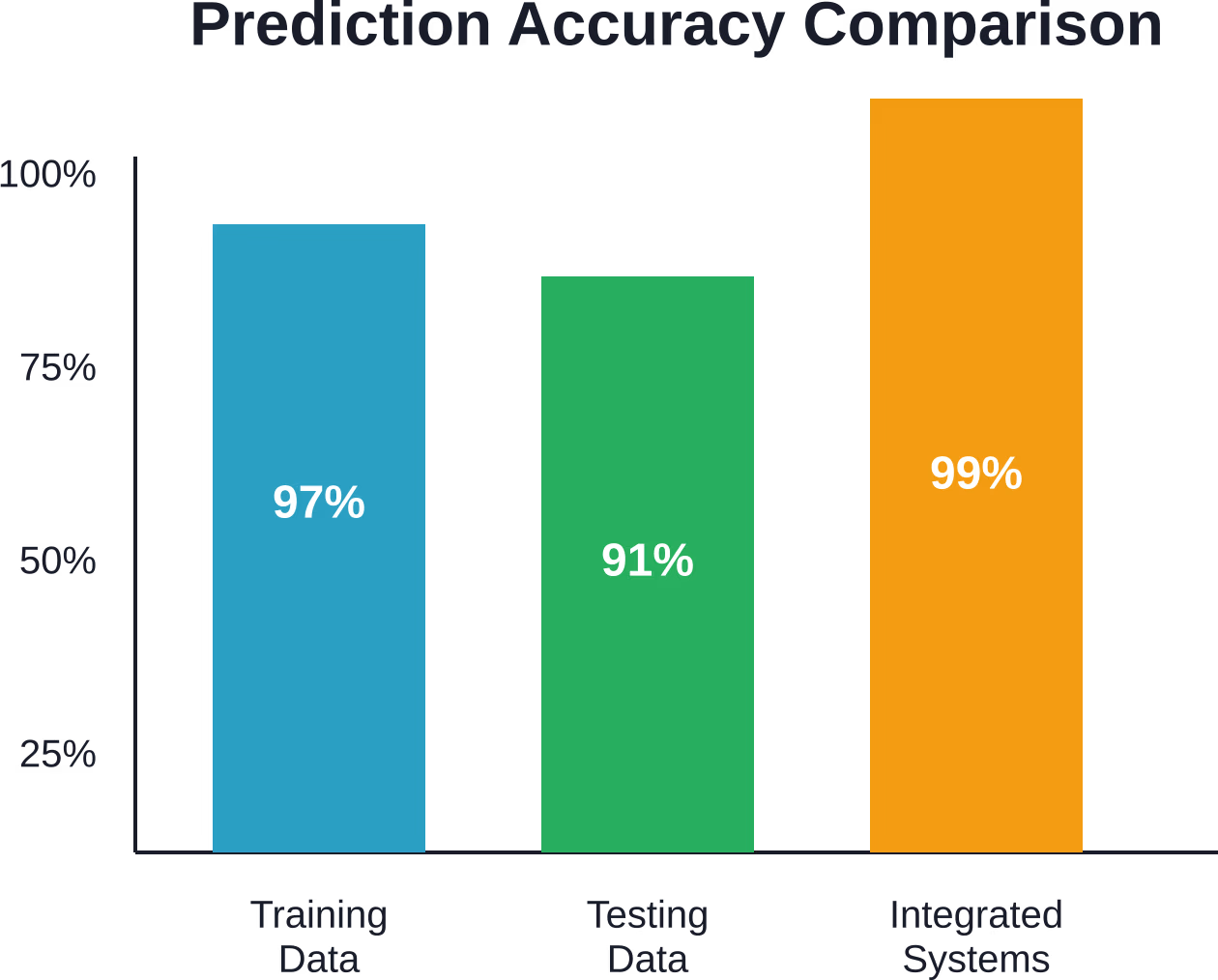
But machine learning offers tangible solutions. Recent studies show AI models forecasting wastewater quality parameters achieve up to 97% accuracy. The AVOA-RNN framework achieved 97% classification accuracy on river water quality prediction, while CNN-WWO models demonstrated approximately 2% accuracy improvements over standalone CNN approaches.
The Critical Role of AI in Modern Filtration
Traditional filtration monitoring relies on periodic sampling and manual inspection. That approach misses real-time changes and creates reactive rather than proactive maintenance cycles.
Machine learning changes this paradigm entirely. Neural networks continuously analyze sensor data, identifying patterns invisible to human operators.
The technology spans multiple domains. Water treatment plants use Convolutional Neural Networks to predict treatment efficacy. Industrial facilities deploy Random Forest classifiers for equipment health monitoring. Pharmaceutical manufacturers apply optimization algorithms to complex wastewater streams.
Real talk: the impact goes beyond technical improvements. Water quality degradation creates significant economic impacts on downstream regions through reduced productivity and increased health costs. AI-driven filtration systems directly address this economic burden.

Improve Filtration Analysis With AI Superior
Filtration systems often depend on operational efficiency, sensor monitoring, and environmental measurements that generate large amounts of technical data. AI Superior can help organizations build machine learning workflows that support monitoring, diagnostics, and performance evaluation in filtration-related systems. Their services include AI consulting, machine learning, data analytics, AI software development, and proof of concept implementation.
AI Superior can help filtration projects with:
- Structuring and preparing operational datasets
- Building ML models for performance analysis
- Identifying anomalies in filtration processes
- Developing predictive monitoring workflows
- Evaluating model stability in operational conditions
- Supporting software integration and deployment planning
For filtration projects, this may apply to contamination analysis, maintenance forecasting, operational diagnostics, and efficiency monitoring.
👉Reach out to AI Superior to discuss the technical requirements.
Predictive Maintenance Transforms Filter Management
Filter replacement schedules traditionally follow fixed intervals. Replace every three months. Change quarterly. These rigid timelines waste resources.
Machine learning enables condition-based maintenance. The MOMENT system, applied to automotive engine air filters, demonstrates this approach. Using data from OBD-II systems, researchers tested Support Vector Machines, Random Forest classifiers, and k-Nearest Neighbors algorithms.
The MOMENT system tested multiple algorithms including k-Nearest Neighbors, Support Vector Machines, and Random Forest classifiers for automotive air filter condition assessment. That level of accuracy means filters get replaced when actually needed, not on arbitrary schedules.
The implications extend beyond cars. Industrial filtration systems face similar challenges. Premature replacement increases costs. Delayed replacement risks contamination breakthroughs.
Neural networks trained on pressure differential, flow rate, and particle counts predict filter saturation with remarkable precision. IoT sensors provide continuous data streams. Algorithms process these inputs and flag maintenance windows days before performance degradation.
Water Treatment Gets Smarter With Neural Networks
Wastewater treatment plants manage incredibly complex processes. Biological systems fluctuate. Chemical inputs vary. Traditional control strategies struggle with this variability.
Convolutional Neural Networks combined with Water Wave Optimization improve predictive modeling in water treatment operations. These hybrid approaches capture non-linear relationships that conventional models miss.
Here’s what makes this significant: integrated photocatalytic-biological wastewater treatment systems are noted as effective alternative processes for removal of emerging contaminants. But optimizing these systems requires understanding hundreds of interacting variables.
Machine learning models digest historical performance data, real-time sensor inputs, and environmental conditions. They recommend adjustments to aeration rates, chemical dosing, and retention times.
The AVOA-RNN technique represents recent advances in this domain. Combining adaptive velocity-based optimization with recurrent neural networks, researchers developed models specifically for river water quality prediction.
| ML Technique | Application | Key Benefit |
|---|---|---|
| Convolutional Neural Networks | Treatment efficiency prediction | Captures spatial patterns in sensor data |
| Recurrent Neural Networks | Time-series water quality forecasting | Models temporal dependencies |
| Random Forest | Parameter importance ranking | Identifies critical control variables |
| Support Vector Machines | Classification of treatment states | Robust to outliers and noise |
Membrane Filtration Design Through AI
Membrane technology underpins modern filtration. Reverse osmosis, nanofiltration, and ultrafiltration all depend on carefully engineered polymer structures.
Designing optimal membranes traditionally involved extensive trial and error. Synthesize candidate material. Test permeability and selectivity. Iterate.
Machine learning accelerates this process dramatically. Molecular dynamics simulations generate training data about polymer behavior. Neural networks learn relationships between chemical structure and filtration performance.
The models predict key properties: water flux, salt rejection, fouling resistance. Researchers screen thousands of candidates computationally before synthesizing a single physical sample.
This approach applies equally to industrial applications. Pressure filtration in zinc leaching operations, for example, requires specific cake moisture properties. Artificial neural networks model the relationships between pressure, filtration time, and cake characteristics.
Real-Time Monitoring and Smart Water Infrastructure
Smart building systems integrate AI for optimizing HVAC, lighting, and increasingly, water management. Machine learning algorithms analyze occupancy patterns, weather forecasts, and usage trends.
Water sensors deployed throughout distribution networks generate massive datasets. Flow rates, pressure readings, turbidity measurements, and chemical composition all stream continuously.
The challenge isn’t collecting data. It’s extracting actionable insights from the deluge.
Machine learning models identify anomalies indicating leaks, contamination events, or equipment failures. The EPA’s Water Sensors Toolbox documents approaches for using advanced monitoring data to support decision making in real time.
WaterSense labeled fixtures, including showerheads, toilets, and faucet aerators, are independently certified to use 20 percent less water and perform as well or better than standard models. When coupled with AI monitoring, facilities can track performance deviations and optimize usage patterns further.
Feature Selection Methods in Filtration Models
Not all data points contribute equally to predictions. Filtering irrelevant features improves model performance and computational efficiency.
Correlation-based feature selection identifies variables strongly related to target outcomes. In water quality prediction, parameters like dissolved oxygen and pH might correlate strongly with bacterial counts.
Chi-square tests evaluate independence between categorical variables. This helps determine whether specific treatment conditions significantly affect filtration outcomes.
Information gain and mutual information quantify how much uncertainty about the target variable decreases when observing a particular feature. High information gain indicates valuable predictive features.
ANOVA (Analysis of Variance) assesses whether means of different groups differ significantly. For filtration systems, this might compare performance across different membrane types or operating conditions.
Variance thresholding removes features with minimal variation. If a sensor reading stays constant, it provides no useful information for prediction.
These filter methods run before model training. They reduce dimensionality, speed computation, and often improve generalization to new data.
Industrial Applications and Market Impact
The filtration industry encompasses diverse sectors: municipal water treatment, industrial process filtration, automotive air filters, pharmaceutical manufacturing, and food processing.
Each domain benefits from machine learning differently. But common themes emerge.
Computational fluid dynamics aids desalination by modeling flow patterns and optimizing membrane configurations. These simulations, informed by machine learning, reduce energy consumption in reverse osmosis systems.
Molecular dynamic simulation helps monitor water treatment plants by predicting how contaminants interact with treatment chemicals. Models trained on simulation data generalize to real-world operations.
Automated controls for water treatment plants adjust chemical dosing, aeration intensity, and sludge removal timing based on neural network recommendations. Operators still oversee the process, but AI handles minute-by-minute optimization.
The economic implications are substantial. Predictive maintenance reduces unplanned downtime. Optimized operations lower energy and chemical costs. Improved water quality supports public health and industrial productivity.
| Industry Sector | ML Application | Primary Benefit |
|---|---|---|
| Municipal Water | Quality forecasting | Public health protection |
| Industrial Process | Equipment monitoring | Reduced maintenance costs |
| Pharmaceutical | Wastewater optimization | Regulatory compliance |
| Automotive | Filter life prediction | Customer convenience |
| Desalination | Membrane performance | Energy efficiency |
Challenges and Limitations
Machine learning isn’t a panacea. Models require substantial training data. Initial deployment demands expertise.
Data quality issues plague real-world implementations. Sensors drift. Calibration lapses. Missing values introduce uncertainty.
Model interpretability presents challenges. Neural networks operate as black boxes. Operators may hesitate to trust recommendations they can’t explain.
Overfitting remains a constant risk. Models that memorize training data fail when conditions change. Regularization techniques and careful validation mitigate this but don’t eliminate it.
Integration with legacy systems creates practical barriers. Many filtration facilities operate decades-old equipment. Retrofitting sensors and control systems costs money and requires downtime.
Regulatory frameworks lag technological capabilities. Water quality standards specify testing protocols designed for manual sampling. Adapting these to continuous AI monitoring requires policy evolution.
Future Directions in Filtration AI
Edge computing enables real-time processing at sensor nodes. Rather than transmitting all data to central servers, lightweight models run locally. This reduces latency and bandwidth requirements.
Transfer learning allows models trained on one system to adapt quickly to another. A neural network developed for municipal treatment can fine-tune to industrial applications with minimal additional training.
Hybrid physics-informed machine learning combines mechanistic understanding with data-driven approaches. These models respect fundamental conservation laws while learning complex interactions from observations.
Explainable AI techniques provide transparency into model decisions. SHAP values and attention mechanisms reveal which features drive predictions, building operator confidence.
Federated learning enables collaboration without sharing sensitive data. Multiple facilities train a shared model while keeping their operational data private.
Digital twins create virtual replicas of filtration systems. These simulation environments test optimization strategies safely before deploying them to physical equipment.
Frequently Asked Questions
How accurate are machine learning models for predicting filter performance?
Machine learning models forecasting wastewater quality parameters achieve up to 97% accuracy. The AVOA-RNN framework achieved 97% classification accuracy on river water quality prediction, while CNN-WWO models demonstrated approximately 2% accuracy improvements over standalone CNN approaches. Specific accuracy depends on data quality, model architecture, and application context. Systems with consistent operating conditions typically achieve higher accuracy than those with high variability.
What types of sensors are needed for AI-powered filtration systems?
Most implementations use pressure transducers, flow meters, turbidity sensors, and chemical analyzers. Advanced systems add spectroscopic sensors for detailed contaminant characterization. The EPA’s Water Sensors Toolbox provides guidance on sensor selection and deployment for various applications. Sensor placement and calibration protocols significantly impact model performance.
Can machine learning reduce filtration costs?
Machine learning reduces costs through predictive maintenance, optimized chemical usage, and energy efficiency improvements. Condition-based maintenance prevents both premature filter replacement and performance degradation from delayed changes. Process optimization can deliver significant reductions in energy and chemical consumption through machine learning-driven adjustments, though exact savings depend on baseline efficiency and system complexity.
Do AI filtration systems require constant internet connectivity?
Not necessarily. Edge computing architectures run models locally on industrial controllers or dedicated computers. These systems process sensor data in real-time without cloud connectivity. Internet access enables remote monitoring, model updates, and aggregated analytics but isn’t required for basic predictive functionality.
What’s the difference between machine learning and traditional control systems?
Traditional control systems use fixed rules and setpoints defined by engineers. Machine learning systems learn optimal strategies from historical data and adapt to changing conditions. Traditional PID controllers maintain variables at target values. ML systems optimize multiple objectives simultaneously, balancing treatment quality, energy use, and chemical costs while accounting for complex interactions traditional controllers can’t capture.
How long does it take to train a filtration machine learning model?
Training duration varies widely. Simple models train on standard computers in minutes. Complex neural networks on large datasets may require hours or days on specialized hardware. More importantly, collecting sufficient training data typically takes 3-6 months to capture seasonal variations and diverse operating conditions. Transfer learning from pre-trained models can reduce data requirements substantially.
Are machine learning filtration systems reliable enough for critical applications?
Modern implementations use AI for optimization and advisory functions while maintaining traditional safety controls. This hybrid approach combines ML efficiency gains with proven fail-safe mechanisms. Integrated photocatalytic-biological wastewater treatment systems are noted as effective alternative processes for removal of emerging contaminants, demonstrating reliability for demanding pharmaceutical wastewater applications. Redundant sensors and model validation protocols ensure robust performance in safety-critical contexts.
Conclusion
Machine learning fundamentally transforms filtration from reactive maintenance to proactive optimization. Neural networks predict equipment failures before they occur. AI-driven controls adjust treatment processes in real-time for optimal efficiency.
The technology addresses urgent global challenges. With 1.4 million deaths annually linked to unsafe water services and USD 260 billion in economic losses from water-related issues, effective filtration has never been more critical.
Advances continue accelerating. Edge computing, explainable AI, and physics-informed models promise even more capable systems. Digital twins enable safe testing of optimization strategies.
But successful implementation requires careful planning. Data quality, sensor calibration, and operator training determine whether machine learning delivers its theoretical benefits. Organizations should start with pilot projects, demonstrate value, then scale gradually.
The filtration industry stands at an inflection point. Early adopters gain competitive advantages through reduced costs and improved performance. Those who delay risk falling behind as AI capabilities become standard expectations.
Ready to explore machine learning for your filtration systems? Start by auditing existing data collection infrastructure and identifying high-value prediction targets. The journey from traditional to intelligent filtration begins with that first step.
 English
  German
  Arabic
  French
  Dutch
Dutch  Spanish