
Quick Summary: Machine learning has become deeply integrated into everyday life, powering technologies from email spam filters and voice assistants to personalized recommendations and fraud detection. This technology learns from data patterns to make predictions and decisions that affect daily activities, often working invisibly in smartphones, apps, financial services, healthcare, and transportation systems. Understanding these real-world applications reveals how machine learning shapes modern experiences and why its adoption is accelerating across industries.
Machine learning surrounds us. Right now, it’s filtering spam from your inbox, suggesting the next song on your playlist, and deciding which social media posts appear in your feed.
Most people don’t notice it. The technology works quietly in the background, analyzing data and making predictions based on patterns it has learned from millions of examples.
But here’s the thing—machine learning has moved far beyond tech labs and research papers. A project undertaken by PriceWaterhouseCoopers estimated that “artificial intelligence technologies could increase global GDP by $15.7 trillion, a full 14%, by 2030. According to economic projections, North America is expected to see a $3.7 trillion economic boost from these technologies.
That massive economic impact comes from practical applications that touch daily life in dozens of ways. From the moment you wake up and check your phone to the security systems protecting your bank account, machine learning algorithms are working.
Let’s look at the real-world examples happening right now.
What Makes Machine Learning Different
Machine learning is a subset of artificial intelligence. The key distinction? Traditional software follows explicit instructions programmed by humans. Machine learning systems learn from data.
Feed a machine learning algorithm thousands of cat photos labeled “cat” and thousands of dog photos labeled “dog,” and it learns to distinguish between the two. No programmer writes specific rules like “if it has pointy ears and whiskers, it’s a cat.” The algorithm identifies patterns on its own.
According to MIT Sloan, generative AI has captured recent attention, but traditional machine learning remains a pervasive and powerful form of AI that continues changing every industry. The two technologies serve different purposes, and businesses need to know when to deploy each tool.
Three main types power most applications:
- Supervised learning: Algorithms train on labeled data (like spam vs. non-spam emails)
- Unsupervised learning: Algorithms find hidden patterns in unlabeled data (like customer segmentation)
- Reinforcement learning: Algorithms learn through trial and error, receiving rewards for correct actions (like game-playing AI)
Each type tackles different problems. The supervised approach handles most everyday applications people encounter.
Email Spam Filters: The Classic Example
Open your email inbox. Chances are, the spam folder caught dozens of unwanted messages overnight.
That’s machine learning at work. Email providers train algorithms on millions of messages—some marked as spam, others as legitimate. The system learns patterns: certain phrases, sender characteristics, link structures, and timing patterns that distinguish junk from real correspondence.
Sound familiar? It should. This technology has protected inboxes for years, constantly adapting as spammers change tactics.
The algorithm doesn’t follow a fixed list of spam indicators. It evolves based on user behavior. When you mark a message as spam (or rescue one from the spam folder), that feedback trains the system to make better predictions for your specific preferences.
Voice Assistants and Smart Speakers
“Hey Siri, what’s the weather today?”
Voice assistants like Siri, Alexa, and Google Assistant rely heavily on machine learning. Two key technologies power these systems: speech recognition and natural language processing.
Speech recognition converts your spoken words into text. Natural language processing interprets what those words mean and determines the appropriate response.
Both processes depend on algorithms trained on massive datasets of human speech. The systems learn to handle different accents, background noise, speech patterns, and contextual meanings. When you ask about “the weather,” the assistant understands you want a forecast, not a definition of the word “weather.”
These assistants get smarter over time. Every interaction provides training data that helps the system handle similar requests better in the future.
Personalized Recommendations Across Platforms
Netflix suggests shows you might enjoy. Spotify creates personalized playlists. Amazon recommends products based on browsing history. Social media platforms curate your feed.
All powered by machine learning recommendation systems.
These algorithms analyze patterns in user behavior: what you’ve watched, listened to, purchased, or clicked. They compare your behavior to millions of other users to find patterns—”people who liked A and B also enjoyed C.”
The technology goes deeper than simple similarity matching. Advanced algorithms consider factors like:
- Time of day and viewing context
- Seasonal trends and current events
- How long you watched before clicking away
- Which recommendations you ignored versus explored
Real talk: this is why your social media feed shows different content than your friend’s feed, even when you follow the same accounts. The algorithm predicts which posts will keep you engaged based on your past behavior.
Navigation and Traffic Prediction
Google Maps doesn’t just show the shortest route. It predicts travel time based on current traffic conditions, suggests alternate routes, and warns about delays.
Machine learning makes these predictions possible. The system analyzes real-time location data from millions of users (anonymized and aggregated), historical traffic patterns, road conditions, time of day, and special events.
The algorithm learns that certain roads slow down during rush hour, that accidents create specific backup patterns, and that construction zones affect traffic flow in predictable ways.
But wait—there’s more. The same technology helps ride-sharing services like Uber and Lyft predict demand, calculate surge pricing, and match drivers with riders efficiently.
Fraud Detection in Financial Services
Your credit card company monitors every transaction for suspicious activity. When you make an unusual purchase—say, buying expensive electronics in a foreign country—the system might flag it or temporarily block the card.
That’s machine learning analyzing transaction patterns in real time.
According to the Brookings Institution, AI and machine learning technologies are increasingly deployed to reduce government and private sector fraud. These systems learn normal spending patterns for each customer: typical purchase amounts, preferred merchants, geographic locations, and transaction timing.
When a transaction deviates significantly from learned patterns, the algorithm assigns it a fraud risk score. High-risk transactions trigger additional verification or automatic blocking.
The system balances two competing goals: catch fraud without annoying legitimate customers with false positives. Machine learning algorithms continuously adjust this balance based on outcomes—which flagged transactions were actually fraudulent versus legitimate purchases.
Healthcare Diagnostics and Medical Imaging
Machine learning is transforming healthcare, particularly in medical imaging and diagnostics.
Algorithms trained on thousands of medical images can identify patterns that indicate diseases—sometimes spotting subtle indicators human doctors might miss. These systems assist radiologists in detecting cancers, analyzing X-rays, interpreting MRI scans, and identifying other conditions.
Machine learning helps identify which wildlife species face extinction risk by analyzing massive datasets—similar pattern-recognition techniques apply to medical imaging analysis.
Here’s the thing though—these systems don’t replace doctors. They augment human expertise by processing vast amounts of data quickly and flagging cases that need closer examination.
Wearable devices also use machine learning to monitor health metrics. Smartwatches detect irregular heart rhythms, predict potential health issues, and alert users to seek medical attention when patterns deviate from normal ranges.
Smartphone Features and Photography
Modern smartphones pack dozens of machine learning applications into a pocket-sized device.
Face recognition unlocks your phone by learning the unique features of your face. The camera app automatically adjusts settings based on scene detection—recognizing whether you’re photographing a sunset, a person, food, or a document.
Portrait mode uses machine learning to distinguish subjects from backgrounds, creating artificial depth-of-field effects. Night mode algorithms combine multiple exposures intelligently to produce clear photos in low light.
Predictive text and autocorrect learn from your typing patterns. The keyboard suggests words based on context and your personal writing style, getting more accurate over time as it learns your vocabulary and common phrases.
Battery management systems use machine learning to optimize charging patterns and predict when you’ll need more power based on usage history.
Customer Service Chatbots
Visit most company websites today, and a chat window pops up offering help. Many of these are AI-powered chatbots using machine learning.
According to IBM, one bank using a watsonx Assistant system for customer service found the chatbot answered 96% of customer questions. These systems ensure customers don’t wait, handling large numbers of simultaneous inquiries around the clock.
The chatbots learn from conversations. Natural language processing algorithms interpret customer questions, even when phrased differently than expected. Over time, the system builds a knowledge base of common issues and effective responses.
When a chatbot can’t handle a query, it escalates to human agents—and learns from how those agents resolved the issue for future reference.
Content Moderation on Social Platforms
Social media platforms face the enormous challenge of moderating billions of posts, comments, and images daily.
Machine learning systems automatically scan content for violations: hate speech, graphic violence, spam, misinformation, and other prohibited material. Computer vision algorithms analyze images and videos, while natural language processing examines text.
These systems work at a scale impossible for human moderators alone. But they’re not perfect—which is why most platforms combine automated filtering with human review for edge cases and appeals.
The algorithms learn from moderator decisions and user reports, continuously updating their understanding of what constitutes violating content across different contexts and languages.
Machine Learning in Cybersecurity
According to NIST, AI systems have been on a global expansion trajectory, with development and adoption accelerating across sectors. Cybersecurity represents a critical application area.
Machine learning algorithms monitor network traffic, user behavior, and system logs to detect potential security threats. The technology identifies anomalies that might indicate a breach, malware infection, or hacking attempt.
Traditional security tools rely on known threat signatures—specific patterns of malicious code. Machine learning systems can detect previously unknown threats by recognizing unusual behavior patterns, even when the specific attack vector is new.
These systems analyze:
- Login patterns and access times
- Data transfer volumes and destinations
- Application usage patterns
- Device and location anomalies
When something deviates from learned norms—like a user suddenly downloading massive amounts of data at 3 AM from an unfamiliar location—the system flags it for investigation.
Search Engine Results and Ad Targeting
Google processes billions of searches daily, and machine learning determines which results appear and in what order.
The search algorithm considers hundreds of factors: keyword relevance, page authority, user location, search history, click-through patterns, and content quality indicators. Machine learning systems learn which results satisfy user intent by analyzing behavior—did users click a result and stay on that page, or immediately return to search for something better?
Online advertising relies heavily on machine learning too. Platforms predict which ads are most likely to interest specific users based on browsing history, demographics, search queries, and past ad interactions. The system optimizes for both user relevance and advertiser goals.
Language Translation Services
Google Translate and similar services use neural machine learning models trained on vast amounts of text in multiple languages.
Early translation systems used rule-based approaches, applying grammar rules and word-for-word substitution. Modern systems learn translation patterns from millions of examples—often by analyzing professionally translated documents where the same content exists in multiple languages.
These systems understand context, idiomatic expressions, and nuanced meanings that rule-based systems missed. The technology continues improving as it processes more translations and receives user feedback on accuracy.

Discover Everyday ML Applications With AI Superior
Machine learning is increasingly used in everyday digital systems, from recommendation engines and automation tools to predictive analytics and personalization workflows. AI Superior works with organizations that want to develop practical AI solutions for operational, analytical, or customer-facing environments. Their services cover AI consulting, machine learning engineering, data science, AI software development, and proof of concept implementation.
AI Superior can support everyday ML applications through:
- Evaluating operational and user-generated datasets
- Developing predictive and classification systems
- Building AI prototypes for internal workflows
- Supporting automation and personalization projects
- Testing model reliability and scalability
- Planning integration into existing software environments
For everyday machine learning applications, this may support recommendation systems, workflow automation, customer analytics, predictive monitoring, and data-driven personalization.
👉Contact AI Superior to explore the project requirements and next steps.
The Economic Impact and Future Trajectory
The numbers tell the story of how deeply machine learning is embedding itself into economic structures.
| Region | Projected AI GDP Increase by 2030 |
|---|---|
| China | $7 trillion |
| North America | $3.7 trillion |
| Northern Europe | $1.8 trillion |
| Africa and Oceania | $1.2 trillion |
| Rest of Asia | $0.9 trillion |
| Southern Europe | $0.7 trillion |
| Latin America | $0.5 trillion |
According to Brookings Institution analysis, these projections reflect how AI and machine learning technologies are becoming fundamental to economic productivity across regions. China set a national goal to build a domestic core AI industry worth 1 trillion RMB (approximately $150 billion) by 2030.
Industry data suggests companies recognize this trajectory—according to available data, 83% of organizations have increased their machine learning budgets year over year as they expand deployments across operations.
Understanding the Challenges
Machine learning isn’t without problems. Researchers at Case Western Reserve University found troubling statistics about scientific reproducibility: more than 70% of researchers have tried and failed to reproduce another scientist’s experiments, and more than half have failed to reproduce experiments.
This reproducibility challenge extends to machine learning research and deployment. Models trained on one dataset might not perform well on another. Results can be difficult to replicate due to differences in data, training procedures, or random initialization.
Other challenges include:
- Bias in training data: Algorithms learn from historical data, which may contain societal biases
- Privacy concerns: Machine learning often requires large amounts of personal data
- Transparency issues: Complex algorithms can be “black boxes” where even developers don’t fully understand decision-making processes
- Energy consumption: Training large models requires significant computational resources
According to Brookings research on fairness in machine learning, calibration represents a key concern. Systems should produce accurate predicted probabilities for each demographic group—if an algorithm predicts a 70% chance of a positive outcome for a specific group, then 70% of cases in that group should actually have positive outcomes.
IEEE standards bodies are working on frameworks for platform-independent machine learning model execution and deployment best practices to address some of these challenges.
What This Means for Daily Life Going Forward
Machine learning technology will become even more integrated into everyday experiences. The line between “AI-powered” and “regular” applications is blurring.
Expect smarter home devices that learn preferences without explicit programming. Healthcare applications that predict health issues before symptoms appear. Transportation systems that optimize traffic flow across entire cities in real time. Financial tools that provide hyper-personalized advice based on spending patterns and life goals.
Education is adapting too. Learning platforms use machine learning to personalize curriculum, identify where students struggle, and adjust teaching methods accordingly.
Environmental applications are expanding. Machine learning helps predict energy demand, optimize renewable energy distribution, monitor wildlife populations, and assist in focusing conservation efforts on at-risk species.
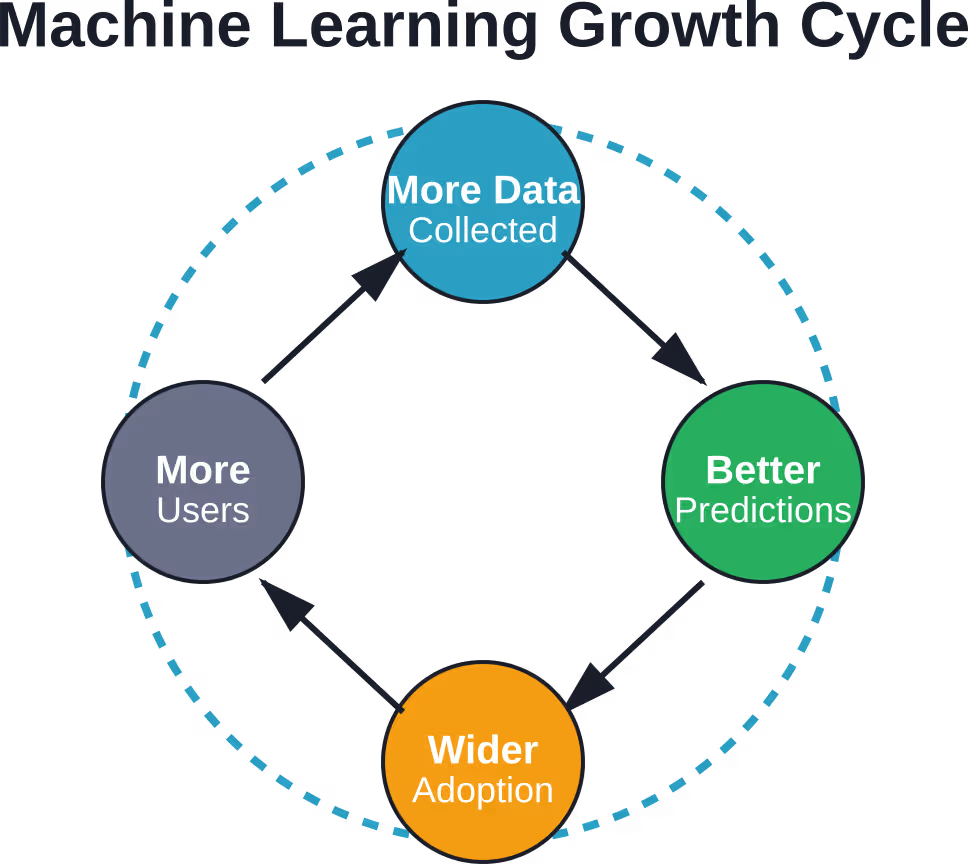
The technology becomes more powerful as it processes more data. Each interaction, transaction, and data point helps algorithms improve their predictions and become more useful.
Frequently Asked Questions
How does machine learning differ from traditional programming?
Traditional programming uses explicit instructions written by developers—if X happens, do Y. Machine learning algorithms learn patterns from data and make predictions without being explicitly programmed for every scenario. The system improves as it processes more examples rather than requiring a programmer to update code for each new situation.
Is machine learning the same as artificial intelligence?
Machine learning is a subset of artificial intelligence. AI is the broader concept of machines performing tasks that typically require human intelligence. Machine learning is a specific approach to achieving AI by training algorithms on data. Other AI approaches include rule-based expert systems and symbolic reasoning.
Does machine learning always require huge amounts of data?
It depends on the application. Complex tasks like image recognition or language translation require massive datasets—often millions of examples. Simpler prediction tasks might work well with smaller datasets. Techniques like transfer learning allow models trained on large datasets to be adapted to new tasks with less data.
Can machine learning algorithms be biased?
Yes. Machine learning systems learn from training data, and if that data reflects historical biases or isn’t representative of all populations, the algorithm will perpetuate those biases. According to Brookings Institution research on fairness, ensuring calibration across demographic groups remains an important challenge—predicted probabilities should be equally accurate for all groups.
How do companies protect privacy when using machine learning on personal data?
Organizations use several approaches: anonymizing data by removing identifying information, aggregating individual data points into statistical summaries, using encryption during processing, implementing access controls, and applying differential privacy techniques that add carefully calibrated noise to protect individual privacy while maintaining overall pattern accuracy. Regulations like GDPR and CCPA also impose legal requirements for data handling.
Will machine learning replace human workers?
Machine learning automates specific tasks rather than entire jobs. Most implementations augment human capabilities rather than replace them completely. In healthcare, algorithms help doctors make better diagnoses but don’t replace medical expertise. In customer service, chatbots handle routine questions while humans address complex issues. The technology shifts what types of work humans focus on rather than eliminating the need for human judgment, creativity, and oversight.
How can I tell when machine learning is being used in products I use?
Look for features that personalize experiences, make predictions, recognize patterns, or improve over time without explicit updates. Examples include personalized recommendations, spam filtering, voice recognition, facial recognition, autocorrect that learns your vocabulary, and systems that flag unusual activity. Most companies now disclose AI and machine learning usage in privacy policies and product documentation.
Conclusion: The Invisible Technology Shaping Modern Life
Machine learning has evolved from a research curiosity to a fundamental technology woven into the fabric of everyday life. Most people interact with machine learning systems dozens of times daily without noticing.
From the spam filter protecting your inbox to the navigation app guiding your commute, from the fraud detection securing your finances to the voice assistant answering questions, these algorithms work constantly in the background.
The technology isn’t perfect. Challenges around bias, privacy, transparency, and reproducibility require ongoing attention. But the trajectory is clear—machine learning applications will expand and improve as algorithms process more data and organizations develop better deployment practices.
Understanding how machine learning works and where it appears in daily life helps people make informed decisions about privacy, recognize when automated systems are making decisions, and appreciate both the capabilities and limitations of these powerful tools.
The next time you unlock your phone with face recognition, get a personalized recommendation, or receive an unusual transaction alert, you’ll know: machine learning is working behind the scenes, learning patterns and making predictions that shape modern digital experiences.
Want to learn more about how AI technologies are developing? Stay informed about machine learning applications in your industry and how these systems might affect your work, privacy, and daily routines in the years ahead.
 English
  German
  Arabic
  French
  Dutch
Dutch  Spanish