
Quick Summary: Cutting edge AI refers to the latest advances in artificial intelligence, particularly Edge AI—technology that processes data locally on devices rather than in the cloud. The market is projected to grow from USD 27.01 billion in 2024 to USD 269.82 billion by 2032, with a CAGR of 33.3%. These innovations enable faster decision-making, reduced latency, enhanced privacy, and real-world applications across fraud detection, natural language processing, and machine learning.
The landscape of artificial intelligence keeps shifting. What’s considered cutting edge today becomes standard practice tomorrow.
But right now, Edge AI represents something genuinely transformative—intelligence that lives on the devices around us, not somewhere in a distant data center. This shift changes everything about how businesses process data, make decisions, and protect privacy.
What Makes AI Cutting Edge Right Now
Cutting edge AI isn’t just about new algorithms. It’s about where and how that intelligence operates.
Edge artificial intelligence processes data locally on devices—smartphones, IoT sensors, cameras, industrial equipment. The concept emerged from a simple need: cloud computing creates latency. When decisions need to happen in milliseconds, sending data to a remote server and waiting for a response doesn’t cut it.
According to InData Labs, the market is projected to grow from USD 27.01 billion in 2024 to USD 269.82 billion by 2032, exhibiting a CAGR of 33.3% during the forecast period. That’s not hype. That’s businesses recognizing fundamental advantages.
Why Edge AI Outperforms Traditional Approaches
The advantages aren’t subtle. Edge AI delivers three core benefits that cloud-based systems can’t match.
Speed and Latency Reduction
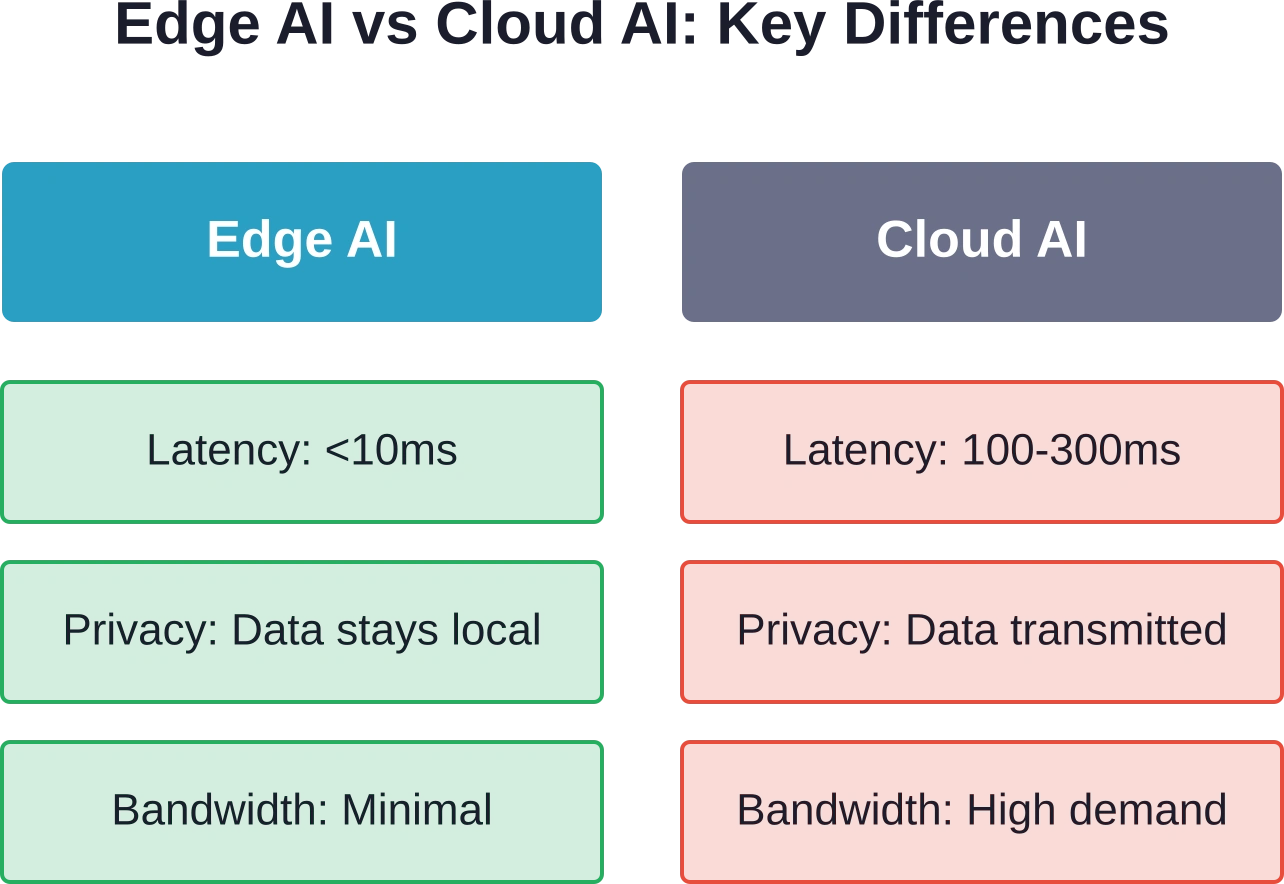
Processing happens where the data originates. No round trip to the cloud means response times drop from hundreds of milliseconds to single-digit milliseconds. For autonomous vehicles or industrial safety systems, that difference matters.
Privacy and Data Security
Sensitive data stays on the device. Medical records, financial transactions, personal conversations—they’re processed locally rather than transmitted across networks. This architecture reduces attack surfaces and simplifies compliance with regulations.
Bandwidth Efficiency
Only essential data gets sent to central systems. A security camera running edge AI might analyze thousands of video frames locally and only transmit clips when something noteworthy happens. This cuts bandwidth costs dramatically.

Develop AI Systems With AI Superior
AI Superior helps companies assess, build, and integrate AI solutions. Their services include AI consulting, AI software development, R&D, training, computer vision, NLP, predictive analytics, BI, and big data analytics.
For businesses exploring newer AI applications, this can help define which ideas are worth testing and how to turn them into working software.
Need AI Built Around a Real Use Case?
AI Superior can help with:
- assessing AI opportunities
- building custom AI and ML tools
- testing ideas through PoC or MVP work
- integrating AI into existing workflows
👉 Contact AI Superior to discuss your project.
Real-World Applications Transforming Industries
Theory sounds great. But what’s actually working in production environments?
Fraud Detection in Financial Services
According to Burnie Group, PayPal and other eCommerce companies have started to use deep-learning fraud-detection algorithms to monitor customers’ digital transactions and identify suspicious behaviors. A study by LexisNexis found that this deep-learning approach to security has reduced PayPal’s fraud rate to 0.32% of revenue.
That’s not a marginal improvement. Traditional rule-based systems miss sophisticated attack patterns. Machine learning models recognize subtle anomalies in transaction timing, device fingerprints, and user behavior that humans would never catch.
| Application Area | Technology Used | Key Benefit |
|---|---|---|
| Fraud Detection | Deep Learning Algorithms | 0.32% fraud rate at PayPal |
| Natural Language Processing | Transformer Models | Real-time language translation |
| Machine Perception | Computer Vision | Autonomous decision-making |
| Predictive Analytics | Time Series Models | Maintenance cost reduction |
Natural Language Processing Advances
Natural language processing has moved beyond simple keyword matching. Modern systems understand context, sentiment, and intent.
Customer service chatbots now handle complex queries that would have stumped earlier generations. Language translation happens in real time with accuracy that rivals human translators for common language pairs. Voice assistants process commands locally on smartphones, protecting privacy while delivering instant responses.
Machine Learning in Manufacturing
Predictive maintenance systems analyze sensor data from industrial equipment to forecast failures before they happen. Edge AI makes this practical by processing vibration patterns, temperature fluctuations, and acoustic signatures on-site.
Factories avoid expensive downtime. Maintenance teams focus resources where they’re actually needed rather than following rigid schedules.
Essential AI Tools for Business Teams
Cutting-edge doesn’t mean experimental. Several tools have matured enough for production deployment.
Natural language processing platforms enable automated content analysis, sentiment monitoring, and document classification. Machine learning frameworks let development teams build custom models without PhD-level expertise. Computer vision APIs add visual recognition capabilities to applications in days rather than months.
The key shift: these tools integrate into existing workflows. Teams don’t need to rebuild their entire tech stack to benefit from artificial intelligence.
When Edge AI Becomes Widespread
Adoption curves vary by industry. Healthcare and manufacturing lead because the benefits justify investment. Retail and logistics follow closely.
Consumer devices already embed edge AI—smartphones use it for photo processing, voice recognition, and facial authentication. That ubiquity creates familiarity. As chip manufacturers optimize processors for AI workloads and development tools mature, implementation barriers keep falling.
Market trends suggest the technology will reach mainstream adoption within the next three to five years. Not in research labs—in everyday business operations.
Frequently Asked Questions
What exactly is cutting edge AI?
Cutting edge AI refers to the latest advances in artificial intelligence technology, particularly Edge AI—systems that process data locally on devices rather than relying on cloud servers. This enables faster response times, better privacy, and reduced bandwidth requirements for real-time applications.
How does Edge AI differ from traditional cloud AI?
Edge AI processes data on local devices with latency under 10 milliseconds, while cloud AI requires transmitting data to remote servers with 100-300ms delays. Edge AI keeps sensitive data local for better privacy and uses minimal bandwidth, whereas cloud AI demands high bandwidth and exposes data during transmission.
What industries benefit most from cutting edge AI?
Financial services use AI for fraud detection with proven results like PayPal’s 0.32% fraud rate. Manufacturing deploys predictive maintenance to prevent equipment failures. Healthcare leverages AI for diagnostic imaging and patient monitoring. Retail applies it for inventory optimization and personalized customer experiences.
Is Edge AI expensive to implement?
Initial costs depend on scale and complexity, but Edge AI often reduces long-term expenses by cutting bandwidth usage, minimizing cloud computing fees, and preventing costly downtime through predictive capabilities. Check with solution providers for current pricing specific to business needs.
Can small businesses use cutting edge AI tools?
Absolutely. Many AI platforms offer tiered pricing and pre-built models that don’t require extensive technical expertise. Natural language processing APIs, fraud detection services, and computer vision tools integrate into existing systems without massive infrastructure investments.
How fast is the Edge AI market growing?
According to InData Labs, the Edge AI market is projected to grow from USD 27.01 billion in 2024 to USD 269.82 billion by 2032, with a compound annual growth rate of 33.3%. This represents nearly 10x growth over eight years.
What skills do teams need to work with cutting edge AI?
Basic understanding of machine learning concepts helps, but modern platforms abstract much of the complexity. Teams benefit from data analysis skills, programming knowledge in Python or similar languages, and domain expertise to identify appropriate use cases. Many tools provide visual interfaces that reduce coding requirements.
Moving Forward with AI Innovation
The transformation isn’t coming. It’s here.
Edge artificial intelligence delivers measurable advantages—proven fraud reduction, faster processing, stronger privacy protection. The market trajectory shows businesses recognize these benefits and commit resources accordingly.
What matters now isn’t whether to adopt cutting edge AI. It’s identifying which applications deliver the highest return for specific business contexts. Start with clear use cases where latency, privacy, or bandwidth creates tangible problems. Pilot implementations reveal integration challenges before full-scale deployment.
The technology keeps evolving. But the core principles—processing data where it originates, reducing latency, protecting privacy—these remain constant. Organizations that master these fundamentals position themselves to leverage whatever innovations emerge next.
Explore how Edge AI can address specific challenges in operations. The tools exist. The market momentum is undeniable. Implementation gets simpler each quarter as platforms mature and best practices spread.
 English
  German
  Arabic
  French
  Dutch
Dutch  Spanish