
Quick Summary: Natural language processing (NLP) solutions are transforming industries by automating documentation, detecting fraud, predicting equipment failures, and improving decision-making. Healthcare, finance, manufacturing, insurance, and legal sectors report 60-80% reductions in processing time, 40-60% decreases in error rates, and millions in cost savings through applications like clinical documentation, compliance monitoring, predictive maintenance, and contract analysis.
Natural language processing has moved from research labs into the operational core of major industries. It’s not about futuristic promises anymore—it’s about measurable results happening right now.
The NLP market reached $34.83 billion in 2026, with projections pointing toward $93.76 billion by 2032. But those numbers tell only part of the story.
What matters more? Organizations report 60-80% reductions in processing time for routine transactions and 40-60% decreases in human error rates for data-intensive tasks. That’s the real transformation.
This article examines how NLP solutions are reshaping healthcare, finance, manufacturing, insurance, and legal industries—with real-world applications, verified statistics, and emerging trends that matter in 2026.
Understanding Natural Language Processing in Industrial Context
Natural language processing enables machines to understand, interpret, and generate human language. That’s the technical definition.
Here’s what it actually means for industries: systems that read thousands of insurance claims in minutes, medical records that write themselves, compliance monitoring that happens in real-time across 100 million daily transactions.
The technology combines several components working together:
- Text analysis and extraction: Pulling structured data from unstructured documents
- Sentiment analysis: Understanding tone, urgency, and emotional context
- Named entity recognition: Identifying people, places, organizations, and specialized terms
- Machine translation: Converting between languages while preserving meaning
- Text generation: Creating human-quality documentation and reports
Modern NLP models leverage transformer architectures and large language models trained on domain-specific data. The latest systems understand context across entire documents, not just individual sentences.
What changed recently? Training methods evolved to handle specialized vocabularies—medical terminology, legal language, financial jargon—without losing general comprehension capabilities.

Build NLP Tools With AI Superior
AI Superior develops NLP and machine learning solutions for text analysis, question answering, semantic search, sentiment analysis, speech recognition, machine translation, and related workflows. Their team can also build custom AI software around company data and existing systems.
For teams considering NLP solutions, this can support customer support, document search, internal knowledge tools, content analysis, and text-heavy business processes.
Need NLP Built Around Your Text Data?
AI Superior can help with:
- building custom NLP solutions
- analyzing documents, messages, and support data
- testing chatbot or search ideas through PoC work
- connecting NLP tools with existing platforms
👉 Contact AI Superior to discuss your project.
Healthcare: Clinical Documentation Without the Paperwork
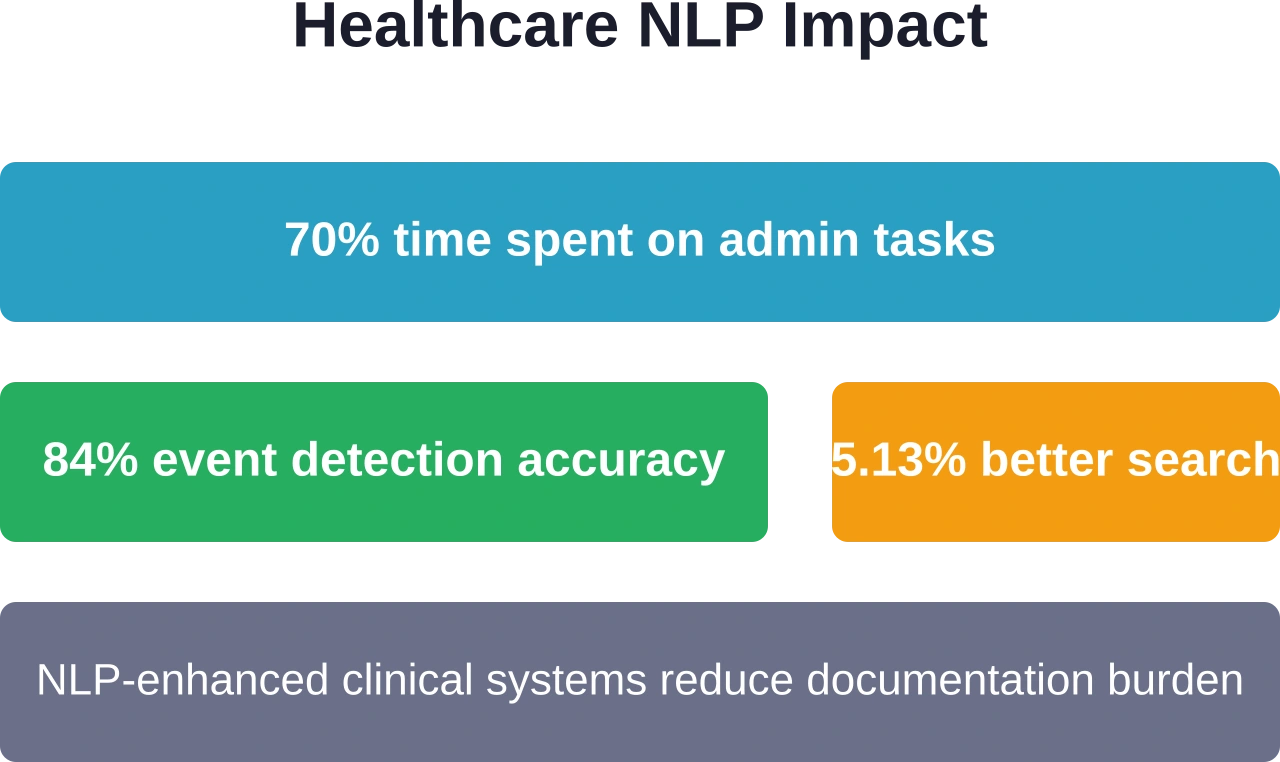
Healthcare workers currently spend up to 70% of their time on administrative tasks rather than patient care. NLP is changing that equation dramatically.
Medical event detection systems using electronic health record (EHR) data achieve 84% accuracy, according to research published in Frontiers in Artificial Intelligence in February 2026. But accuracy numbers don’t capture the operational impact.
Clinical documentation systems now transcribe physician notes, extract relevant symptoms and diagnoses, and populate structured fields automatically. The technology recognizes medical terminology, understands abbreviations, and maintains HIPAA compliance throughout the process.
Search functionality improved by 5.13% when enhanced with NLP versus traditional keyword approaches—a seemingly small number that translates to finding critical information faster when seconds matter.
Real-world deployment? A leading biotech company combines protein structure prediction with domain-specific medical analysis, reducing drug development timelines by 40%. That’s years compressed into months for potentially life-saving treatments.
Healthcare adoption of AI happens at twice the rate of the broader economy. NLP drives much of that acceleration, particularly in:
- Automated coding for billing and insurance claims
- Clinical decision support that surfaces relevant patient history
- Adverse event detection from unstructured notes
- Patient communication through intelligent chatbots
- Literature review and research synthesis
The technology handles multiple languages too. Analysis of legal and medical NLP systems shows 54% of corpus data in English, but with growing representation in Chinese (10%), German, French, Portuguese, Japanese, and Italian (3-5% each).
Financial Services: Fraud Detection and Compliance at Scale
Financial institutions process enormous transaction volumes daily. Manual review doesn’t scale. NLP solutions analyze patterns, detect anomalies, and flag suspicious activity in real-time.
The numbers tell the story. During the first nine months of 2023, over 83,000 Americans fell victim to credit card fraud, with financial losses exceeding $183 million. Traditional detection methods catch some of this—but not enough.
Modern NLP systems for fraud detection examine transaction descriptions, communication patterns, and behavioral signals simultaneously. They understand context: a large purchase at an electronics store might be normal for one customer but suspicious for another.
Banks using NLP for compliance monitoring process over 100 million transactions daily, achieving a 20% reduction in false positives. That means fewer legitimate transactions flagged incorrectly and more actual fraud caught early.
Risk Assessment and Credit Analysis
Beyond fraud, NLP transforms how financial institutions assess risk. Traditional credit scoring relies on structured data—income, debt ratios, payment history.
NLP adds another dimension by analyzing unstructured data: business reviews, news articles, social media sentiment, earnings call transcripts. The technology identifies early warning signs that numeric data misses.
One insurance company used NLP to automate claims processing, which dropped processing time from 58 minutes to 5 minutes. Accuracy improved 25%.
Regulatory compliance represents another massive application. Financial regulations span thousands of pages, with frequent updates. NLP systems monitor regulatory changes, identify relevant sections, and flag areas requiring policy updates.
Customer Service and Support
Chatbots save businesses $8 billion annually according to Juniper Research, when implemented effectively. The difference between frustrating and helpful chatbots? NLP sophistication.
Advanced conversational AI systems handle thousands of concurrent interactions, maintaining context across multi-turn conversations. They escalate complex issues to human agents and learn from each interaction.
Voice recognition technology reached $22.49 billion in 2026, projected to reach $61.71 billion by 2031. Financial services drive significant adoption, deploying voice-enabled systems for account inquiries, transaction disputes, and authentication.
Manufacturing: Predictive Maintenance and Quality Control
Manufacturing generates vast amounts of unstructured data: maintenance logs, quality inspection reports, operator notes, supplier communications. NLP extracts actionable insights from this information ocean.
According to NIST research published in 2026, 72% of manufacturers prioritize cost reduction and operational efficiency with AI. Predictive maintenance leads those initiatives.
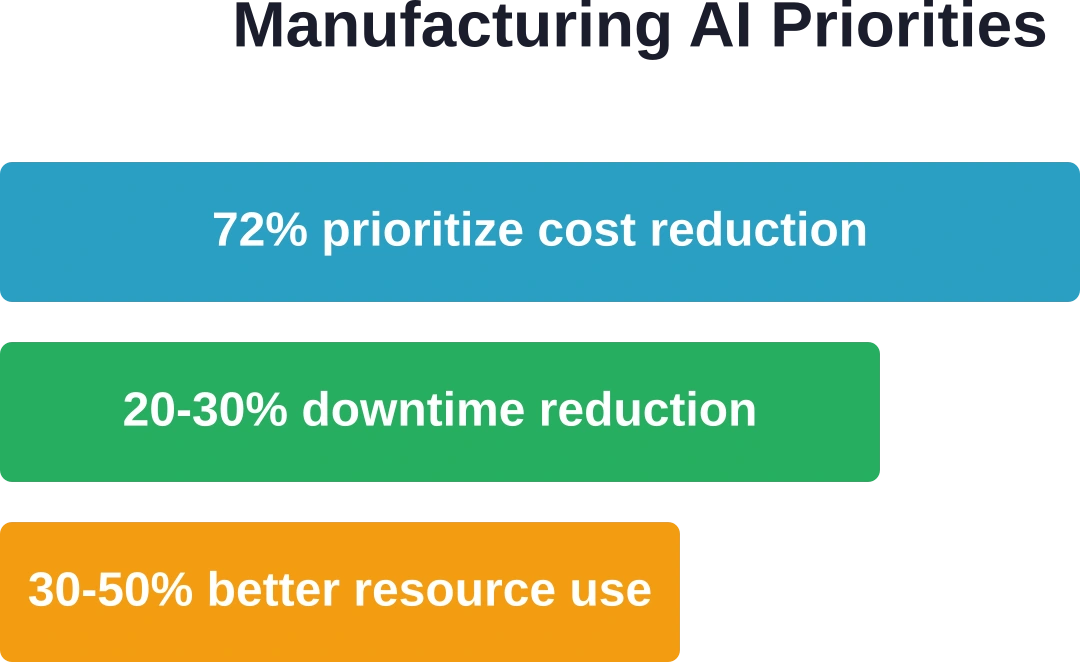
Manufacturing facilities using AI for predictive maintenance report 20-30% reductions in unplanned downtime. NLP contributes by analyzing maintenance logs and operator reports to identify failure patterns before they become critical.
The systems parse free-text maintenance notes, recognizing descriptions like “unusual noise from bearing” or “intermittent vibration” and correlating them with sensor data. This multi-modal approach catches problems that purely numeric monitoring misses.
Organizations implementing operational AI report 30-50% improvements in resource utilization across automated processes. That efficiency comes partly from better understanding of how equipment actually performs versus manufacturer specifications.
Quality Control and Defect Analysis
Quality inspection generates enormous documentation: defect descriptions, inspector comments, rework instructions. NLP systems categorize defects automatically, identify recurring issues, and trace problems to root causes.
One manufacturing operation deployed NLP to analyze quality reports across multiple facilities. The system identified a supplier material variation causing intermittent defects—something that took months to detect manually.
Product design benefits too. NLP analyzes customer feedback, warranty claims, and service reports to identify design improvements. Engineers get structured insights rather than reading through thousands of individual comments.
Insurance: Claims Processing and Risk Assessment
Insurance operations revolve around documents: policy applications, claims submissions, medical records, damage assessments, legal filings. NLP transforms how insurers handle this information.
InsurTech innovation using natural language processing enables automated claims triage, fraud detection, and policy customization at scale. The technology reads claim descriptions, extracts relevant details, and routes cases appropriately.
Processing time improvements are dramatic. One insurer reduced claims processing from several days to hours by deploying NLP systems that extract structured data from photographs, repair estimates, and adjuster notes.
Underwriting and Policy Customization
Traditional underwriting relies on questionnaires with standardized responses. NLP enables more nuanced risk assessment by analyzing free-form responses, supplementary documents, and external data sources.
The technology identifies risk factors in applicant submissions, flags inconsistencies, and suggests appropriate policy terms. Underwriters review recommendations rather than starting from scratch for each application.
Policy documents themselves become more accessible. NLP-powered search helps customers understand coverage details without reading entire policy documents. Questions like “Am I covered for water damage from a burst pipe?” get accurate answers instantly.
Claims Fraud Detection
Fraudulent claims cost the insurance industry billions annually. NLP helps identify suspicious patterns in claim descriptions, communication timing, and supporting documentation.
The systems analyze linguistic cues: overly detailed explanations, inconsistent descriptions across multiple submissions, vocabulary matches with known fraudulent claims. Combined with traditional fraud indicators, NLP improves detection rates while reducing false positives that frustrate legitimate claimants.
Legal Industry: Contract Analysis and Research
Legal work involves massive document review, research, and analysis. NLP solutions handle routine legal tasks, allowing attorneys to focus on strategy and client counseling.
Research analyzing natural language processing in the legal domain found 54% of legal text NLP corpus data in English, with substantial representation in multiple languages. That multilingual capability matters for international legal work.
Contract review systems extract key terms, identify standard versus non-standard clauses, and flag potential risks. What took junior attorneys hours now happens in minutes.
Legal Research and Precedent Analysis
Legal research traditionally meant reading through hundreds of case opinions searching for relevant precedents. NLP systems search based on legal concepts, not just keywords.
The GAMECHANGER program at the Department of Defense developed NLP tools documented in a December 2025 Brookings case study. Similar systems deployed in law firms analyze case law, identify relevant precedents, and suggest legal arguments based on successful past cases. The technology understands legal reasoning patterns and citation relationships.
Due Diligence and Compliance
Mergers, acquisitions, and compliance audits generate enormous document review requirements. NLP systems review contracts, emails, financial records, and other documents to identify risks and compliance issues.
Construction code extraction using fine-tuned BERT models has been demonstrated when analyzing building regulations. Similar approaches work for other regulatory frameworks and specialized legal domains.
Emerging NLP Capabilities and Trends
NLP technology continues evolving rapidly. Several trends are reshaping what’s possible in 2026 and beyond.
Multi-Modal Understanding
Modern NLP systems don’t just process text—they understand relationships between text, images, audio, and structured data. A healthcare system might analyze both a physician’s dictated notes and associated medical imaging, understanding how descriptions relate to visual findings.
This multi-modal capability appears in manufacturing quality control (correlating defect descriptions with photos), insurance claims (analyzing damage descriptions alongside images), and financial services (combining transaction data with communication patterns).
Domain-Specific Fine-Tuning
General-purpose language models provide strong baseline capabilities, but domain-specific fine-tuning delivers the accuracy needed for production systems. Medical NLP models trained on clinical texts understand disease relationships and treatment protocols that general models miss.
Fine-tuning approaches have become more efficient. Organizations achieve strong performance with smaller, specialized models rather than always deploying the largest available systems.
Quantum Natural Language Processing
Quantum computing approaches to NLP remain mostly experimental but show promising results. Research demonstrates sentiment analysis accuracy reaching up to 81.67% using quantum-enhanced classifiers with support vector machines and SPSA optimization.
Complex-valued neural networks for sentiment analysis show 10% accuracy improvements over traditional TextCNN and GRU architectures. While quantum NLP hasn’t reached mainstream deployment, it represents a potential future direction as quantum computing hardware matures.
Real-Time Processing and Edge Deployment
NLP systems increasingly run in real-time at the edge rather than relying on cloud processing. Manufacturing equipment performs on-device analysis of maintenance logs, while mobile healthcare applications process clinical notes without sending data to external servers.
This edge deployment improves latency, reduces bandwidth requirements, and addresses privacy concerns by keeping sensitive data local.
Implementation Considerations and Challenges
Deploying NLP solutions isn’t without challenges. Organizations encounter several common obstacles.
Data Quality and Availability
NLP systems require substantial training data reflecting actual use cases. Healthcare organizations need de-identified clinical notes, financial institutions need labeled transaction data, manufacturers need maintenance logs with known outcomes.
Data quality matters more than quantity. A thousand well-labeled examples often outperform ten thousand noisy ones. Organizations must invest in data curation, annotation, and quality control.
Privacy and Security Requirements
NLP systems process sensitive information: medical records, financial transactions, proprietary business documents. Security frameworks must protect data throughout the processing pipeline.
Regulatory compliance adds complexity. HIPAA requirements for healthcare data, GDPR for European personal information, financial regulations for transaction records—each imposes specific controls.
Edge deployment and on-premises processing address some concerns by keeping data local, but introduce operational complexity.
Integration with Existing Systems
NLP solutions rarely operate in isolation. They must integrate with electronic health record systems, financial transaction platforms, manufacturing execution systems, claims management software, and document management systems.
API design, data format compatibility, and workflow integration require careful planning. The most sophisticated NLP model delivers little value if it can’t exchange data with surrounding systems.
Model Bias and Fairness
NLP models learn from training data that may contain biases. Healthcare models might perform differently across demographic groups, financial models might reflect historical lending discrimination, hiring systems might perpetuate existing biases.
Addressing bias requires diverse training data, careful evaluation across population segments, and ongoing monitoring in production. Organizations must test for fairness systematically, not assume models are neutral.
Selecting NLP Solutions for Your Industry
Choosing the right NLP approach depends on specific requirements, constraints, and objectives. Several factors guide the decision.
| Factor | Considerations | Impact on Selection |
|---|---|---|
| Data Volume | Processing throughput requirements, storage capacity | Cloud vs. edge deployment, model size constraints |
| Latency Requirements | Real-time vs. batch processing acceptable delay | Model architecture, hardware acceleration needs |
| Domain Specificity | General language vs. specialized terminology | Pre-trained vs. fine-tuned vs. domain-specific models |
| Privacy Constraints | Data sensitivity, regulatory requirements | On-premises vs. cloud, encryption requirements |
| Language Support | Single vs. multiple languages, dialect variations | Multilingual models, language-specific training |
| Integration Needs | Existing systems, data formats, workflows | API design, compatibility requirements |
Build Versus Buy Decisions
Organizations face a fundamental choice: build custom NLP solutions or deploy commercial platforms.
Building custom solutions offers maximum flexibility and control. Organizations train models on proprietary data, optimize for specific use cases, and maintain complete ownership. But custom development requires specialized expertise, substantial data science resources, and ongoing maintenance.
Commercial NLP platforms provide faster deployment and lower initial costs. Vendors handle model training, updates, and infrastructure management. Trade-offs include less customization, potential vendor lock-in, and recurring subscription costs.
Many organizations adopt hybrid approaches: commercial platforms for standard tasks, custom models for proprietary applications. A healthcare system might use commercial transcription services while building custom models for specialized clinical workflows.
Proof of Concept and Pilot Programs
Starting with limited-scope pilots reduces risk and demonstrates value before full deployment. Successful pilots identify integration challenges, quantify benefits, and build organizational support.
Effective pilots focus on specific, measurable outcomes: reduce claims processing time by 50%, improve contract review accuracy to 95%, decrease maintenance-related downtime by 20%. Clear success metrics enable objective evaluation.
Pilots should involve end users early. The most technically sophisticated solution fails if users don’t trust it or workflows don’t accommodate it.
The Future of NLP in Industry
Several developments will shape NLP’s industrial impact over the next few years.
Increased Model Accessibility
NLP capabilities once available only to large technology companies are becoming accessible to smaller organizations. Open-source models, cloud-based APIs, and low-code platforms lower barriers to entry.
This democratization accelerates adoption across industries and company sizes. Small manufacturers can deploy predictive maintenance, regional banks can implement fraud detection, and local healthcare providers can automate documentation.
Regulatory Frameworks and Standards
As NLP systems handle increasingly critical functions, regulatory frameworks are emerging. NIST and other standards bodies are developing guidelines for AI system evaluation, documentation, and deployment.
Industry-specific regulations are following. Healthcare AI systems face FDA oversight, financial AI systems must satisfy banking regulators, and autonomous systems across industries encounter safety certification requirements.
These frameworks provide needed safeguards while potentially slowing innovation and increasing compliance costs.
Integration with Other AI Technologies
NLP rarely operates alone. Integration with computer vision, predictive analytics, robotics, and other AI technologies creates comprehensive solutions.
A manufacturing quality system might combine visual inspection with NLP analysis of operator comments. A healthcare diagnostic system might integrate medical imaging analysis with clinical note processing. A financial fraud system might combine transaction pattern detection with communication analysis.
These multi-technology approaches deliver more complete solutions than any single technology alone.
Frequently Asked Questions
What industries benefit most from NLP solutions?
Healthcare, financial services, manufacturing, insurance, and legal industries see the largest impact, reporting 60-80% reductions in processing time and 40-60% decreases in error rates. These sectors handle large volumes of unstructured text data—clinical notes, financial documents, maintenance logs, claims, contracts—making NLP particularly valuable. However, retail, telecommunications, and government sectors also achieve significant benefits in customer service, compliance, and operations.
How much does NLP implementation cost?
Costs vary dramatically based on scope, deployment model, and customization requirements. Cloud-based API services charge per transaction or monthly subscription, typically starting at hundreds to thousands of dollars monthly for moderate usage. Custom implementations require data science teams, computing infrastructure, and training data, with total costs ranging from tens of thousands to millions of dollars. Many organizations start with limited pilots costing $20,000-50,000 to prove value before larger investments.
How long does NLP deployment take?
Timeline depends on complexity and existing infrastructure. Using commercial NLP APIs for straightforward applications (sentiment analysis, basic extraction) can take weeks. Custom models for specialized domains (medical terminology, legal language) typically require 3-6 months for data preparation, training, and integration. Enterprise-wide deployments with multiple use cases and system integrations often span 12-18 months. Starting with focused pilots accelerates learning and demonstrates value faster.
What accuracy levels can NLP systems achieve?
Accuracy varies by task and domain. Medical event detection from electronic health records reaches 84% accuracy. Construction code extraction using fine-tuned BERT models has demonstrated strong performance when analyzing building regulations. Financial fraud detection systems process over 100 million transactions daily with 20% false positive reduction. Quantum-enhanced sentiment analysis reaches up to 81.67% accuracy. Task complexity, training data quality, and domain specificity all influence performance.
How do NLP systems handle multiple languages?
Modern multilingual NLP models process dozens of languages using shared representations. Analysis of legal NLP systems shows 54% English corpus data, 10% Chinese, and 3-5% each for German, French, Portuguese, Japanese, and Italian. Performance typically remains strong across major languages, though lower-resource languages may show reduced accuracy. Organizations operating globally can deploy single multilingual models rather than maintaining separate systems per language.
What data privacy concerns exist with NLP?
NLP systems process sensitive information including medical records, financial transactions, and personal communications. Privacy risks include unauthorized data access, unintended information disclosure, and regulatory non-compliance. Mitigation strategies include encryption, access controls, data anonymization, on-premises deployment, and federated learning that keeps data local. Healthcare NLP must satisfy HIPAA requirements, financial systems must meet banking regulations, and European deployments must comply with GDPR.
Can small organizations benefit from NLP technology?
Absolutely. Cloud-based NLP APIs and platforms make sophisticated capabilities accessible without large data science teams or infrastructure investments. Small manufacturers use NLP for maintenance log analysis, regional banks deploy fraud detection, local healthcare providers automate clinical documentation, and small law firms use contract analysis tools. Starting with commercial platforms for standard tasks provides immediate value while building expertise for potential custom development later.
Conclusion
Natural language processing solutions are delivering measurable transformation across industries right now. Healthcare organizations reduce administrative burden by 70%, financial institutions detect fraud across 100 million daily transactions, manufacturers cut unplanned downtime by 20-30%, and legal teams review contracts in minutes rather than hours.
These aren’t theoretical benefits—they’re operational realities backed by verified data from government agencies, academic research, and industry deployments.
The NLP market’s growth from $34.83 billion in 2026 toward $93.76 billion by 2032 reflects this proven value. Organizations that deploy NLP solutions strategically gain efficiency, reduce costs, improve accuracy, and enable employees to focus on higher-value work.
Success requires careful planning: understanding specific use cases, selecting appropriate technology approaches, addressing data quality and privacy requirements, and integrating with existing systems. But organizations across industries and sizes are achieving remarkable results.
The question isn’t whether NLP will transform your industry—it already is. The question is whether you’ll lead that transformation or follow others who moved first.
 English
  German
  Arabic
  French
  Dutch
Dutch  Spanish