Quick Summary: Artificial intelligence is fundamentally reshaping decision-making by enabling faster data analysis, reducing human biases, and automating routine choices. However, research shows AI amplifies existing inequalities—boosting high performers by 10-15% while lowering outcomes for struggling decision-makers by 8%. The future belongs to hybrid models where AI handles pattern recognition and humans provide judgment, context, and ethical oversight.
Decision-making has always been the ultimate test of human intelligence. From choosing markets to enter, to hiring the right people, to allocating capital—every major outcome traces back to someone making a call under uncertainty.
Now artificial intelligence is inserting itself into that process. And it’s not just offering recommendations anymore.
AI systems are analyzing millions of data points in milliseconds, spotting patterns humans can’t see, and in some cases making final decisions without human approval. Research analyzing 32 peer-reviewed studies (2016-2025) found that hybrid AI-human decision models achieve 38% faster response times while maintaining 89% prediction accuracy in behavioral assessments.
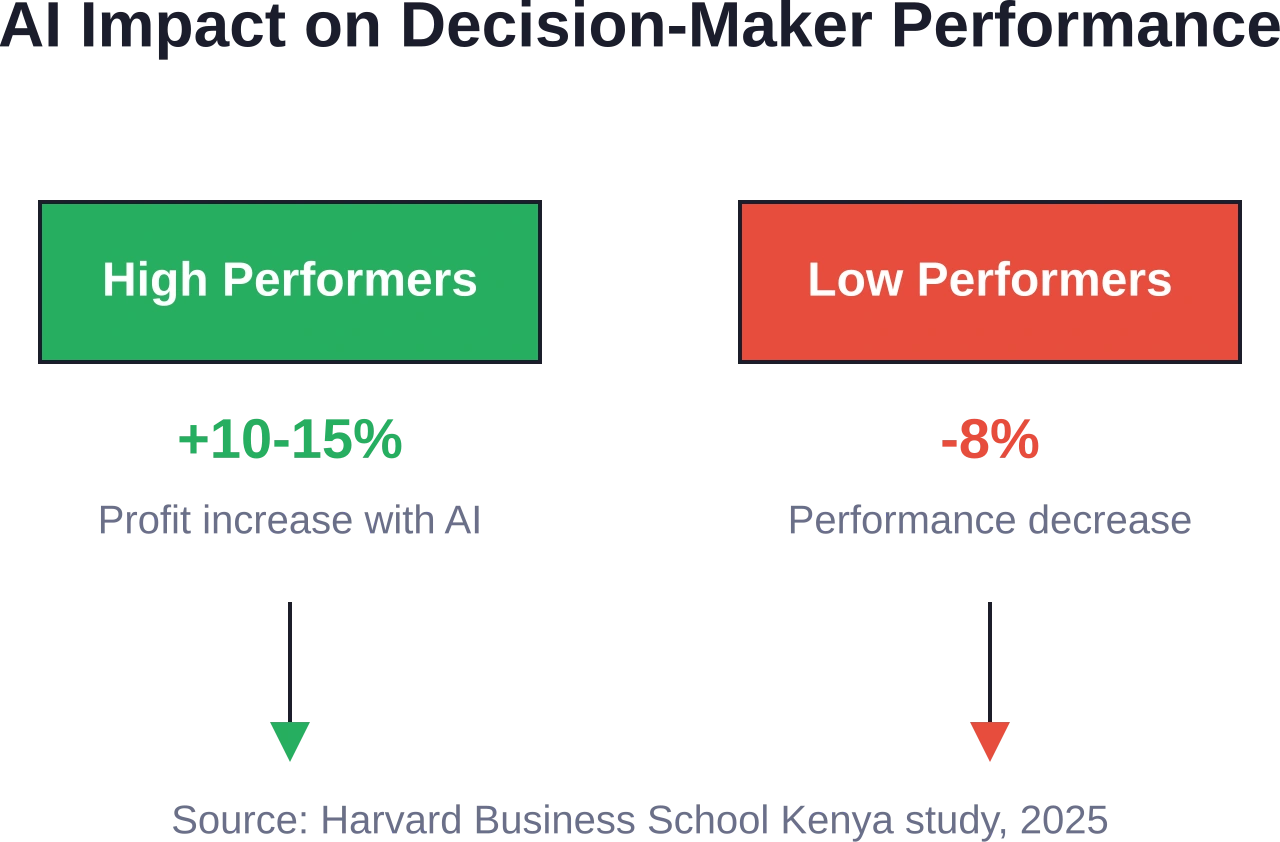
But here’s what most coverage misses: AI doesn’t improve decision-making equally for everyone. Studies from Harvard Business School reveal that AI assistants boost performance for already-successful entrepreneurs by 10-15%, while actually decreasing outcomes for struggling decision-makers by 8%.
The transformation isn’t just about speed or accuracy. It’s about who benefits, who gets left behind, and what happens when machines start making choices that used to require human judgment.
What AI Actually Does in Decision-Making Today
Strip away the hype and AI’s role in decisions comes down to three core functions: pattern recognition, prediction, and automation.
Pattern recognition means scanning massive datasets to find correlations humans would never spot manually. A financial services firm analyzing loan applications doesn’t just look at credit scores anymore—AI examines thousands of variables simultaneously, from transaction patterns to device metadata, flagging risks or opportunities a human analyst would take weeks to uncover.
Prediction builds on those patterns. Once the system identifies what factors correlate with outcomes, it forecasts what’s likely to happen next. Marketing teams use this to predict which customers will churn. Supply chain managers use it to anticipate disruptions before they cascade.
Automation is where AI moves from advisor to decision-maker. When confidence thresholds are met, the system acts without waiting for human approval. Fraud detection systems block suspicious transactions instantly. Inventory management AI reorders stock automatically.
The shift from human-only to hybrid decision-making is accelerating. Since 2019, the number of organizations embracing AI has more than doubled, though adoption has plateaued between 50-60% in recent years. Companies that effectively harness AI are experiencing higher financial returns than those still relying solely on traditional approaches.
Real-Time Data Analysis Changes Everything
Historically, business decisions happened in batch mode. Collect data, run reports, schedule meetings, debate options, make a call. By the time the decision landed, market conditions had often shifted.
AI collapses that timeline. Real-time data analysis means decisions happen in the same moment conditions change. Dynamic pricing algorithms adjust rates every few minutes based on demand signals. Trading systems execute buy or sell orders in microseconds when technical patterns emerge.
But speed creates new problems. Faster decisions mean less time for human oversight. When AI systems operate in real-time, humans often become rubber-stampers rather than thoughtful reviewers. The question becomes: are we making better decisions, or just making bad decisions faster?

Build AI Tools With AI Superior
AI Superior develops custom AI software, machine learning models, predictive analytics tools, and AI-based applications. Their team can help assess where AI fits, review available data, build a PoC or MVP, and integrate the final solution into existing systems.
For decision-making workflows, this can support forecasting, risk scoring, scenario analysis, recommendation tools, or data-driven systems that help teams work with clearer inputs.
Need AI Built Around Business Decisions?
AI Superior can help with:
- assessing AI use cases
- building custom AI and ML tools
- developing predictive analytics models
- integrating AI into existing workflows
👉 Contact AI Superior to discuss your project.
The Performance Paradox: AI Helps Those Who Need It Least
Here’s where the research gets uncomfortable.
A Harvard Business School study tracking entrepreneurs in Kenya found that AI assistants boosted profits and revenues by 10-15% for high-performing business owners. These were people already making good decisions—AI made them even better.
For low-performing entrepreneurs? Performance dropped by 8%.
The researchers were surprised enough to double-check the data. But the pattern held. AI amplified existing capabilities rather than equalizing outcomes. Decision-makers with strong fundamentals—clear problem framing, good judgment, ability to interpret context—used AI suggestions as high-quality inputs. Those lacking those foundations took AI recommendations at face value, often implementing ideas that sounded good but didn’t fit their specific circumstances.
This isn’t just an equity issue. It’s a strategic vulnerability. Organizations assuming AI will automatically improve everyone’s decision-making are setting themselves up for a nasty shock when performance diverges and the gap between strong and weak decision-makers widens.
The Gender Gap in AI Adoption
The same Harvard research uncovered another uncomfortable pattern: women entrepreneurs used AI tools 10-40% less than men, with an average gender gap of 25%.
Lower adoption means lower benefits. Which means existing inequalities in business outcomes get baked into the AI era rather than solved by it.
The reasons behind lower adoption are complex—ranging from tool design that doesn’t account for different work patterns, to confidence gaps in technical literacy, to time poverty among women balancing more unpaid care work. But the result is clear: AI decision-making tools risk widening gender disparities in business performance unless adoption barriers are actively addressed.
Hybrid Models: Where AI and Human Judgment Meet
The best results don’t come from replacing humans with AI. They come from designing systems where each does what it does best.
AI excels at:
- Processing massive datasets quickly
- Spotting statistical patterns and anomalies
- Maintaining consistency across thousands of similar decisions
- Operating without fatigue or emotional bias
- Handling high-frequency, time-sensitive choices
Humans excel at:
- Understanding context and nuance
- Applying ethical judgment to edge cases
- Recognizing when rules should be broken
- Incorporating values and long-term strategy
- Taking responsibility and being accountable
Research indicates that AI cognitive scaffolding systems improve team antifragility by 214% when combined with human emotional intelligence. The keyword is “combined”—neither element alone produced those results.
Here’s what that looks like in practice. A retail company uses AI to forecast demand and auto-generate purchase orders. The system handles 90% of decisions automatically, ordering standard inventory based on historical patterns and current trends. But when the AI flags unusual patterns—say, a sudden spike in demand for a specific product category—it routes the decision to a human buyer who investigates whether it’s a genuine trend, a data error, or a temporary blip that doesn’t warrant changing order volumes.
The human isn’t reviewing every decision. That would negate the speed advantage. But they’re handling the 10% where context matters most.
Designing Decision Rights
The tricky part is deciding which decisions AI can make autonomously and which require human approval.
Set the threshold too low and you lose the efficiency gains. Require human review on too many choices and you’re back to being a bottleneck. Set it too high and the system will eventually make a catastrophically bad call that a human would’ve caught.
Smart organizations map their decisions along two dimensions: impact and ambiguity. High-impact, low-ambiguity decisions—like fraud detection where the patterns are clear and the cost of missing fraud is high—can often be automated with confidence thresholds. Low-impact, high-ambiguity decisions might also be automated because the cost of being wrong occasionally is acceptable.
High-impact, high-ambiguity decisions? Those stay with humans, though AI can surface relevant data and options.
| Decision Type | Impact Level | Ambiguity | Recommended Approach |
|---|---|---|---|
| Fraud detection | High | Low | Automated with human review for borderline cases |
| Inventory reordering | Medium | Low | Fully automated with exception alerts |
| Hiring decisions | High | High | AI screens, humans decide |
| Content recommendations | Low | Medium | Fully automated with ongoing monitoring |
| Strategic market entry | High | High | Human decision with AI data support |
| Email routing | Low | Low | Fully automated |
Problem Framing: The Skill AI Can’t Replace
Here’s what most AI decision-making coverage misses: the quality of AI’s output depends entirely on the quality of the question you ask.
Ask an AI assistant “What should we build next quarter to improve customer retention?” and it’ll return a polished list of features, integrations, and product ideas. Implement them and watch retention stay flat or even drop.
Why? Because the question assumes the retention problem is about product features. Maybe it’s actually about onboarding friction, pricing confusion, or poor customer support. AI can’t reframe your problem for you—it optimizes for the question as stated.
Problem framing is the meta-skill that determines whether AI helps or misleads. It means:
- Defining what success actually looks like in measurable terms
- Distinguishing between symptoms and root causes
- Identifying constraints and trade-offs upfront
- Questioning whether you’re solving the right problem at all
Real talk: most organizations are terrible at this. They’re so eager to get to solutions that they skip the hard work of framing. AI makes this worse because it’s so good at generating plausible-sounding answers to poorly-framed questions.
How to Frame Decisions for AI Support
Start by defining success in plain language. If the decision is about market expansion, success might be “profitable entry within 24 months with at least 15% market share in two target cities.” That’s specific enough to measure and narrow enough to guide analysis.
Next, distinguish leading from lagging indicators. Leading indicators are early signals that the decision is working—maybe customer acquisition cost in the new market or partnership conversations with local distributors. Lagging indicators are final outcomes like profitability or market share. AI is excellent at tracking both, but you need to define them upfront.
Identify constraints explicitly. Budget limits, timeline requirements, resource availability, regulatory restrictions—whatever boundaries exist. AI can optimize within constraints, but only if it knows what they are.
Finally, test your problem framing by asking: “If we solve this perfectly, does it actually move the needle on what we care about?” If the answer is unclear, reframe before proceeding.
The Governance Challenge: Who’s Accountable When AI Decides?
As AI takes on more decision-making authority, a thorny question emerges: who’s responsible when things go wrong?
When a human loan officer denies credit, the officer can be asked to explain the reasoning. When an AI system denies credit based on patterns in historical data, accountability gets murky. Is it the data scientist who trained the model? The executive who approved deployment? The vendor who sold the software?
According to data from IEEE Standards Association, the AI governance market is already worth $227.6 million and estimated to grow 35.7% over the next five years. Companies are realizing that ethical AI isn’t optional—it’s a risk management necessity.
Real consequences are emerging. The EU AI Act now allows fines up to 6% of global yearly revenue for high-risk violations. That’s enough to get board-level attention.
Building Accountable AI Systems
Accountability starts with transparency. Decision-makers need to understand, at least in general terms, how the AI reached its conclusion. Black-box systems that can’t explain their reasoning are liability nightmares waiting to happen.
But transparency alone isn’t enough. Someone human needs to be designated as accountable for each AI system’s decisions. That person should have the authority to override the system, the responsibility to monitor its performance, and the consequences if it goes off the rails.
Documentation matters. Every significant AI-driven decision should leave an audit trail showing what data was used, what the system recommended, whether a human reviewed it, and what action was taken. When regulators or lawyers come asking questions, “the AI did it” won’t be an acceptable answer.
The National Institute of Standards and Technology (NIST) has developed an AI Risk Management Framework specifically to help organizations build trustworthy systems. Their guidance emphasizes that AI risk management isn’t just a technical problem—it requires input from legal, compliance, business, and ethics stakeholders.
Bias Amplification: When AI Learns Our Worst Patterns
AI systems trained on historical data will absorb and amplify any biases present in that data.
Hiring algorithms trained on past hiring decisions will favor candidates who look like past hires—which often means favoring demographic groups that were historically overrepresented. Lending algorithms trained on past loan approvals will replicate whatever patterns of discrimination existed in those decisions, whether intentional or not.
The problem is subtle. Nobody programs the AI to discriminate. But when the training data reflects a biased world, the AI learns to perpetuate those biases at scale.
And here’s the kicker: AI-driven decisions often feel more objective than human ones. They’re based on data and algorithms, not gut feelings or personal prejudices. That perceived objectivity can make biased AI systems more dangerous than biased humans, because people are less likely to question or override them.
Mitigating Bias in AI Decision Systems
Start by auditing training data for historical patterns that shouldn’t be perpetuated. If past promotion decisions favored one demographic group, don’t train an AI on those decisions without addressing the underlying bias.
Test for disparate impact. Run the AI’s recommendations through demographic analysis to see if outcomes differ systematically by race, gender, age, or other protected characteristics. If they do, investigate why.
Build in human review for high-stakes decisions. AI can surface candidates, flag risks, or recommend options, but final decisions about hiring, lending, healthcare, or criminal justice should involve human judgment that can account for context the data doesn’t capture.
The U.S. government has taken notice. Recent White House executive orders emphasize preventing ideological biases in federal AI systems, recognizing that when AI plays a critical role in how people learn, consume information, and navigate daily life, reliability and fairness become essential.
The Future of Human-AI Decision Making
So where does this head?
Over the next five years, expect AI to take over more routine, high-frequency decisions where patterns are clear and stakes are moderate. Inventory management, basic customer service routing, fraud screening, content moderation—these will become almost entirely automated.
For complex, high-stakes decisions, hybrid models will dominate. AI will surface insights, simulate scenarios, and recommend options. Humans will provide strategic judgment, ethical oversight, and final accountability.
The skills that matter will shift. Data analysis becomes less valuable when AI can do it faster and better. Problem framing becomes more valuable because AI can’t tell you what question to ask. Technical literacy becomes table stakes—leaders who can’t understand how AI systems work will struggle to govern them effectively.
Emotional intelligence stays critical. Research consistently shows that when AI cognitive scaffolding is combined with human emotional intelligence, team performance improves significantly. The organizations that figure out how to blend analytical AI capabilities with human soft skills will outperform those that treat it as a pure technology problem.
What Organizations Should Do Now
First, inventory your decisions. Map out which decisions happen regularly, who makes them, what data informs them, and what the consequences of errors are. You can’t design an AI decision strategy without knowing your decision landscape.
Second, start with low-risk automation. Pick decisions that are repetitive, data-rich, and have clear success metrics. Build the system, monitor closely, and learn before scaling to higher-stakes choices.
Third, invest in governance infrastructure. Designate who’s accountable for each AI system. Create review processes for high-stakes decisions. Build audit trails. Establish protocols for when humans should override AI recommendations.
Fourth, train your people. Not just in how to use AI tools, but in how to frame problems, interpret AI outputs critically, and recognize when AI recommendations don’t make sense. The goal isn’t to replace human judgment—it’s to augment it.
Finally, test for bias regularly. AI systems drift over time as new data comes in. What worked fairly six months ago might be producing disparate outcomes today. Ongoing monitoring isn’t optional.
Industry-Specific Transformations
The impact of AI on decision-making varies dramatically by industry. Each sector faces unique opportunities and constraints.
Healthcare: Clinical Decision Support
AI-based clinical decision support systems are already helping diagnose diseases, recommend treatment protocols, and predict patient outcomes. But research on these systems has returned mixed results—sometimes AI improves clinical decision-making, sometimes it doesn’t, and the reasons aren’t always clear.
The challenge is that medicine requires both pattern recognition and contextual judgment. AI excels at the former. A system trained on millions of radiology images can spot anomalies a human might miss. But it can’t assess whether the patient’s lifestyle, preferences, or comorbidities make a particular treatment unsuitable.
The best implementations use AI to flag potential issues and surface relevant research, while clinicians make final treatment decisions accounting for the full patient context.
Finance: Risk Assessment and Trading
Financial services have been early AI adopters, using it for credit scoring, fraud detection, algorithmic trading, and portfolio management.
The speed advantage matters enormously here. Trading algorithms make decisions in microseconds, capitalizing on price discrepancies before they disappear. Fraud systems block suspicious transactions before money leaves the account.
But financial AI also faces intense scrutiny. Lending algorithms that produce disparate outcomes by race or gender create legal liability. Trading algorithms that amplify market volatility raise systemic risk concerns. Accountability is a live issue—when an algorithm loses millions, who bears responsibility?
Manufacturing and Supply Chain
Manufacturing has embraced AI for predictive maintenance, quality control, and supply chain optimization. These are domains where AI shines—lots of sensor data, clear success metrics, and decisions that need to happen faster than human review allows.
A factory floor with hundreds of machines generates enormous amounts of operational data. AI can spot patterns indicating a machine is likely to fail soon, triggering maintenance before it breaks down and halts production. That’s a clear win with measurable ROI.
Supply chain decisions—when to order, how much inventory to hold, which suppliers to use—benefit from AI’s ability to process demand signals, transportation data, and risk factors simultaneously.
Customer Service and Marketing
AI now handles many first-line customer service decisions—routing inquiries, answering common questions, escalating complex issues to humans. Marketing teams use AI to decide which customers see which messages, when, and through what channels.
These are relatively low-stakes decisions made at high volume. Perfect fit for automation. But the cumulative effect shapes customer experience, which has long-term business impact.
The risk is over-automation. Customers tolerate AI handling simple requests, but when something goes wrong, they want a human who has authority to solve the problem. Companies that automate too aggressively end up with frustrated customers stuck in AI loops with no path to real resolution.
Frequently Asked Questions
Will AI completely replace human decision-making?
No. AI will automate many routine, data-driven decisions, but complex choices requiring judgment, ethics, strategy, and accountability will remain human responsibilities. Research shows the best outcomes come from hybrid models where AI handles pattern recognition and humans provide contextual judgment. High-stakes decisions in areas like healthcare, justice, and strategic business planning will continue requiring human oversight.
How accurate are AI decision-making systems compared to humans?
It depends entirely on the domain and how well the system is designed. Hybrid AI-human decision models maintain 89% prediction accuracy in behavioral assessments while achieving 38% faster response times. In narrow tasks with clear patterns and abundant data, AI often outperforms humans. But in ambiguous situations requiring context or ethical judgment, human decision-makers still have the edge. The key is matching the decision type to the appropriate level of AI involvement.
What are the biggest risks of using AI for important decisions?
The primary risks include bias amplification (when AI learns discriminatory patterns from historical data), lack of accountability (unclear who’s responsible when AI makes bad decisions), over-reliance on automation without human oversight, and performance inequality—research shows AI assistants boost high performers by 10-15% but decrease low performer outcomes by 8%. Organizations also face regulatory risk, with the EU AI Act allowing fines up to 6% of global revenue for violations.
How can organizations prevent bias in AI decision systems?
Start by auditing training data for historical biases that shouldn’t be perpetuated. Test AI outputs for disparate impact across demographic groups. Require human review for high-stakes decisions. Build audit trails showing how decisions were reached. Implement ongoing monitoring since AI systems drift over time. The National Institute of Standards and Technology provides an AI Risk Management Framework specifically designed to help organizations build trustworthy, fair systems.
What skills do employees need to work effectively with AI decision tools?
Problem framing becomes the critical skill—defining the right question before asking AI for analysis. Technical literacy to understand how AI systems work and their limitations is essential. Critical thinking to evaluate whether AI recommendations make sense in context. Emotional intelligence remains valuable, as team antifragility improves 214% when AI cognitive scaffolding combines with human emotional intelligence. Finally, ethical judgment to recognize when AI outputs conflict with organizational values.
How much does it cost to implement AI decision-making systems?
Costs vary enormously depending on scope and complexity. Off-the-shelf AI tools for standard use cases like customer service routing or basic analytics can run from thousands to tens of thousands annually. Custom AI systems for complex decision-making—like clinical decision support or advanced supply chain optimization—often require six or seven-figure investments in development, integration, and ongoing maintenance. The AI governance market alone is worth $227.6 million and growing 35.7% annually, indicating substantial investment in oversight infrastructure.
Can small businesses benefit from AI decision-making, or is it only for large enterprises?
Small businesses can definitely benefit, though the approach differs from enterprises. Start with accessible SaaS tools that embed AI—marketing platforms with automated segmentation, inventory systems with demand forecasting, accounting software with cash flow predictions. These provide AI capabilities without requiring technical expertise or large budgets. Research on small business resilience in Industry 5.0 contexts shows that appropriately scaled AI tools can enhance decision-making even in resource-constrained environments. The key is starting with narrow, high-value use cases rather than trying to implement comprehensive systems.
Conclusion: The Human-AI Decision Partnership
Artificial intelligence is fundamentally changing how decisions get made. It’s faster, can process more data, and spots patterns humans miss. Those capabilities are real and valuable.
But the transformation isn’t replacing human judgment with machine logic. It’s creating a partnership where each side contributes what it does best.
The organizations that thrive won’t be the ones that automate most aggressively. They’ll be the ones that thoughtfully design which decisions AI handles autonomously, which require human-AI collaboration, and which stay purely human.
They’ll invest in problem framing skills, because AI can only optimize for the question you ask. They’ll build governance infrastructure, because accountability matters more as stakes rise. They’ll test for bias relentlessly, because AI will amplify whatever patterns exist in training data.
And they’ll recognize that AI creates winners and losers. High performers see their capabilities amplified. Those struggling see gaps widen. That means organizations need to actively support skill development rather than assuming AI automatically raises all boats.
The future of decision-making isn’t human or AI. It’s human and AI, working in tandem, with clear roles and shared accountability.
The question for leaders isn’t whether to adopt AI for decisions. It’s how to design the partnership so both humans and machines contribute their strengths while compensating for each other’s weaknesses.
Get that balance right and decision-making can improve significantly—research indicates 214% gains in team antifragility, 38% faster response times, and maintained accuracy. Get it wrong and you’ve just automated bad decisions at scale.