Quick Summary: IoT and big data form a transformative partnership where billions of connected devices generate massive data streams that analytics platforms convert into actionable intelligence. This synergy enables real-time decision-making, predictive maintenance, operational efficiency, and personalized experiences across industries from smart cities to healthcare. Together, they’re reshaping how organizations operate, innovate, and compete.
The explosion of connected devices has fundamentally changed how organizations collect, process, and leverage information. Sensors embedded in everything from industrial equipment to wearable health monitors continuously stream data to centralized platforms.
But raw data alone doesn’t create value. That’s where analytics enters the picture.
When the Internet of Things meets big data processing, something remarkable happens. Organizations suddenly gain visibility into patterns, anomalies, and opportunities that were previously invisible. This relationship isn’t just complementary—it’s multiplicative.
How IoT and Big Data Create Value Together
The Internet of Things generates unprecedented volumes of data. Every sensor reading, every device interaction, every status update contributes to a massive information stream that traditional databases can’t handle efficiently.
Big data platforms solve this challenge through distributed processing architectures that scale horizontally. They ingest, store, and analyze information from millions of devices simultaneously, turning noise into signal.
According to NIST guidance on IoT cybersecurity, considerations become critical as IoT deployments scale. The sheer number of endpoints multiplies both opportunities and vulnerabilities, making robust architecture essential.
Real-Time Processing Enables Immediate Response
Traditional batch processing can’t keep pace with IoT data streams. Devices don’t wait for nightly ETL jobs—they generate information continuously.
Stream processing frameworks handle this challenge by analyzing data in motion. Events trigger alerts, models update continuously, and decisions happen in milliseconds rather than hours.
Scale Drives the Need for Specialized Architecture
IEEE technical standards emphasize that IoT architectures must accommodate massive scale from the outset. A smart city deployment might manage 61,000 daily trajectories across transportation systems, generating datasets measured in gigabytes per day.
Big data platforms distribute workloads across clusters, ensuring that adding more devices doesn’t break the system. Horizontal scaling means capacity grows with demand.

Develop IoT Data Tools With AI Superior
AI Superior builds AI and machine learning solutions for big data analytics, predictive analytics, BI, data analysis, and custom software development. Their work can help companies process data from different sources and turn it into tools for forecasting, monitoring, and operational insight.
For IoT and big data projects, this can support sensor analytics, device monitoring, anomaly detection, predictive maintenance, or reporting tools built around connected systems.
Need AI Connected to IoT Data?
AI Superior can help with:
- building machine learning models
- analyzing large and complex datasets
- creating predictive analytics tools
- integrating AI with existing platforms
👉 Contact AI Superior to discuss your project.
Industry Applications Proving the Partnership
The combination delivers tangible results across sectors. Let’s look at how different industries leverage this powerful duo.
Smart Cities Optimize Urban Life
Urban environments continuously generate data from traffic sensors, utility meters, surveillance systems, and environmental monitors. According to UN DESA computational and statistical data survey referenced in PMC sources, population projections indicate significant urban migration patterns by 2050, making intelligent infrastructure essential.
Big data analytics applied to urban mobility datasets enables traffic prediction. Research shows average MAPE (Mean Absolute Percentage Error) forecasting errors of 9.62% for the first year, 11.90% for the second year, and 18.66% for the third year. Cities can proactively manage congestion, optimize public transit routes, and respond to incidents faster.
Healthcare Transforms Patient Outcomes
Wearable devices and remote monitoring equipment continuously track vital signs, activity levels, and medication adherence. This constant stream feeds analytics platforms that detect anomalies and predict adverse events before they occur.
Contactless technologies accelerated adoption during the COVID-19 pandemic as enterprises turned to digital solutions. The result? Earlier interventions, reduced hospital readmissions, and personalized treatment protocols.
Industrial Operations Prevent Downtime
Manufacturing equipment embedded with sensors reports temperature, vibration, pressure, and performance metrics thousands of times per hour. Predictive maintenance algorithms analyze these patterns to forecast failures weeks in advance.
Consider UPS, which uses route optimization powered by IoT and analytics. Their ORION system eliminated one mile per driver per year, saving $50 million dollars annually and reducing CO2 emissions significantly. Field knowledge transforms into algorithmic intelligence that gets smarter over time.
Critical Success Factors for Implementation
Deploying this technology combination successfully requires attention to architecture, security, and scalability from day one.
Choose the Right Infrastructure
Edge computing reduces latency by processing data closer to devices. Cloud platforms provide unlimited scale. Hybrid approaches balance both needs, keeping time-sensitive processing local while sending aggregate data to centralized systems.
Storage solutions must handle both structured sensor readings and unstructured log files efficiently. Modern architectures separate hot data (recent, frequently accessed) from cold data (historical, archived).
Secure Every Endpoint
NIST guidance emphasizes that IoT cybersecurity demands attention throughout the development lifecycle. Every device represents a potential vulnerability. Encryption, authentication, and regular firmware updates aren’t optional—they’re fundamental.
Big data platforms must implement role-based access controls, audit logging, and data anonymization where privacy regulations require it.
Design for Scale From the Start
Pilot projects often handle dozens or hundreds of devices. Production deployments quickly reach thousands or millions. Architectures that don’t accommodate exponential growth create technical debt that becomes expensive to resolve later.
Plan data retention policies early. Not every sensor reading needs permanent storage. Aggregation, sampling, and time-based archiving keep costs manageable while preserving analytical value.
Overcoming Common Implementation Challenges
Organizations face predictable obstacles when combining these technologies. Here’s how to address them.
| Challenge | Impact | Solution Approach |
|---|---|---|
| Data Quality Issues | Faulty sensors generate misleading analytics | Implement validation rules, outlier detection, device health monitoring |
| Integration Complexity | Siloed systems prevent unified insights | Adopt open standards, API-first design, middleware platforms |
| Skill Gaps | Teams lack expertise in both domains | Cross-train staff, partner with specialists, use managed services |
| Cost Management | Storage and processing expenses escalate | Optimize data pipelines, implement tiered storage, monitor usage |
The Future: AI Amplifies the Partnership
Artificial intelligence represents the next evolution of this relationship. Machine learning models trained on historical IoT data become increasingly accurate at prediction and anomaly detection.
In practice, AI algorithms identify patterns human analysts would never spot. Research on data-driven predictive models shows MAPE (Mean Absolute Percentage Error) values of 9.62% for the first year, 11.90% for the second year, and 18.66% for the third year, according to research published in PMC.
As edge devices gain computational power, inference moves closer to sensors. Smart cameras identify defects instantly. Autonomous vehicles process sensor fusion locally. The cloud handles model training while edges execute decisions.
Getting Started: Practical First Steps
Organizations ready to leverage this powerful combination should begin with focused pilots that demonstrate clear ROI.
Start by identifying a specific business problem where real-time data would drive better decisions. Equipment downtime? Supply chain visibility? Energy waste? Choose one, instrument it thoroughly, and prove the concept works.
Select technology partners with proven track records in both domains. Integration expertise matters as much as individual product capabilities.
Measure results rigorously. Track not just technical metrics but business outcomes—cost savings, revenue growth, customer satisfaction improvements.
Frequently Asked Questions
What’s the difference between IoT and big data?
IoT refers to networks of connected physical devices that collect and exchange data through sensors and internet connectivity. Big data encompasses the technologies, platforms, and methodologies for storing, processing, and analyzing massive datasets that exceed traditional database capabilities. IoT devices generate the data that big data platforms analyze.
Why do IoT and big data work well together?
IoT devices generate continuous, high-volume data streams that traditional systems can’t process efficiently. Big data platforms are specifically designed to ingest, store, and analyze information at this scale in real-time. The combination turns raw sensor readings into actionable intelligence that drives automated decisions and strategic insights.
What industries benefit most from IoT big data integration?
Manufacturing leverages predictive maintenance and quality control. Healthcare uses remote monitoring and personalized treatment. Smart cities optimize traffic, utilities, and public safety. Retail personalizes customer experiences. Agriculture monitors crop health and automates irrigation. Transportation improves logistics and fleet management. The applications span virtually every sector.
How much data do IoT devices actually generate?
Volume varies dramatically by device type and sampling frequency. A single smart city deployment can generate 882 MB of trajectory data daily from 61,000 connected vehicles. Industrial facilities with thousands of sensors might produce terabytes monthly. Wearable health devices generate megabytes per user per day. Scale compounds quickly across device populations.
What are the biggest challenges in implementing IoT big data solutions?
Security tops the list—every device represents a potential vulnerability. Data quality issues from faulty sensors corrupt analytics. Integration complexity across heterogeneous systems creates bottlenecks. Skill gaps leave organizations short on expertise spanning both domains. Cost management requires careful architecture to avoid runaway storage and processing expenses.
Do you need cloud infrastructure for IoT big data?
Not exclusively, but cloud platforms offer advantages in scalability, managed services, and global reach. Edge computing handles time-sensitive processing locally, reducing latency for critical decisions. Hybrid architectures combining edge, on-premises, and cloud infrastructure often deliver optimal performance and economics. The right approach depends on latency requirements, data sovereignty concerns, and existing infrastructure investments.
How does AI fit into IoT and big data?
AI algorithms trained on historical IoT data enable predictive analytics, anomaly detection, and automated decision-making that surpass rule-based systems. Machine learning identifies complex patterns across millions of data points. As edge devices gain processing power, AI inference moves closer to sensors for real-time autonomous operation while cloud systems handle model training and refinement.
Conclusion
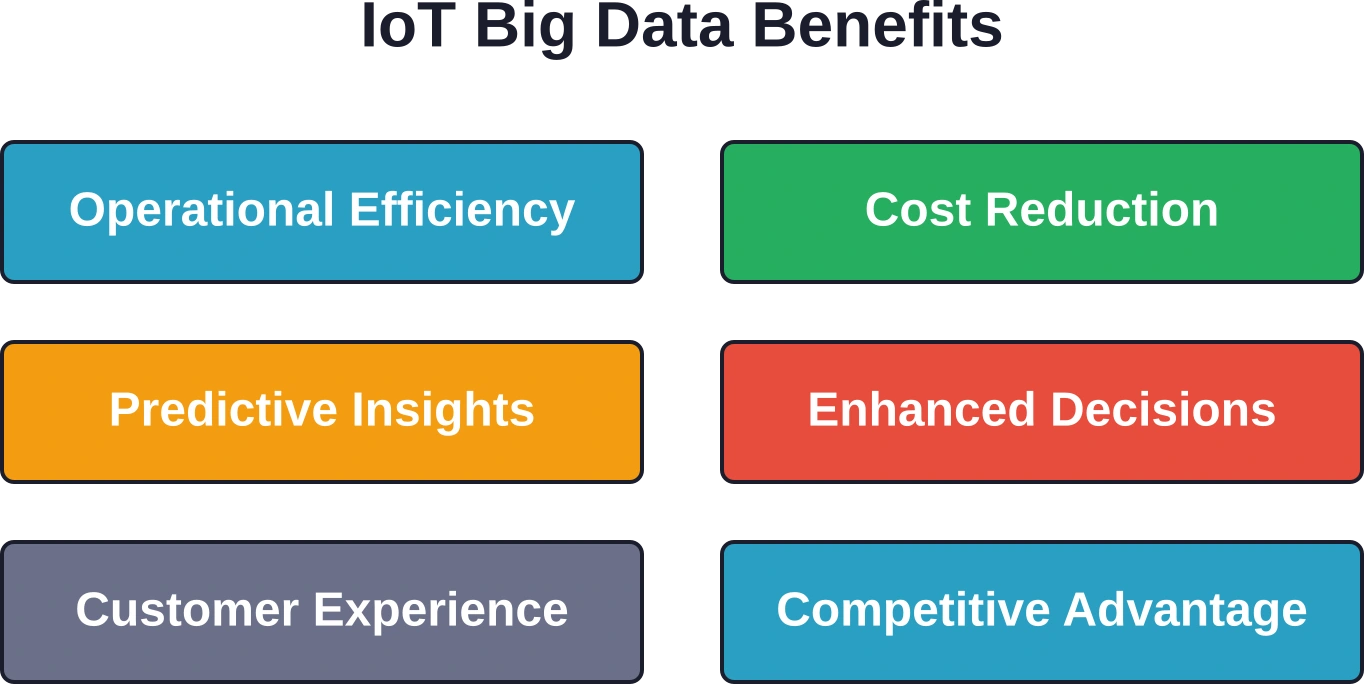
The partnership between IoT and big data isn’t just powerful—it’s transformative. Organizations that master this combination gain visibility, efficiency, and competitive advantages that weren’t possible a decade ago.
Success requires thoughtful architecture, robust security, and commitment to both domains. But the payoff—measured in cost savings, revenue growth, and operational excellence—justifies the investment.
Start small, prove value quickly, and scale deliberately. The future belongs to organizations that turn device data into intelligence and intelligence into action.