
Quick Summary: Generative AI is reshaping entrepreneurship by enabling startups and enterprises to automate content creation, streamline operations, and personalize customer experiences. From AI-powered content services and fraud detection systems to personalized education platforms and data preparation tools, generative AI business ideas span nearly every industry. Success requires moving beyond experimentation to strategic implementation, with only 4% of companies achieving full AI integration as of 2026.
The generative AI revolution isn’t coming. It’s here.
According to MIT Sloan research, a single entrepreneur can now create a complete product launch—including email campaigns, website content, and social media posts totaling 9,200 words—in just 30 minutes using generative AI tools. That kind of productivity shift isn’t just impressive. It’s transformative.
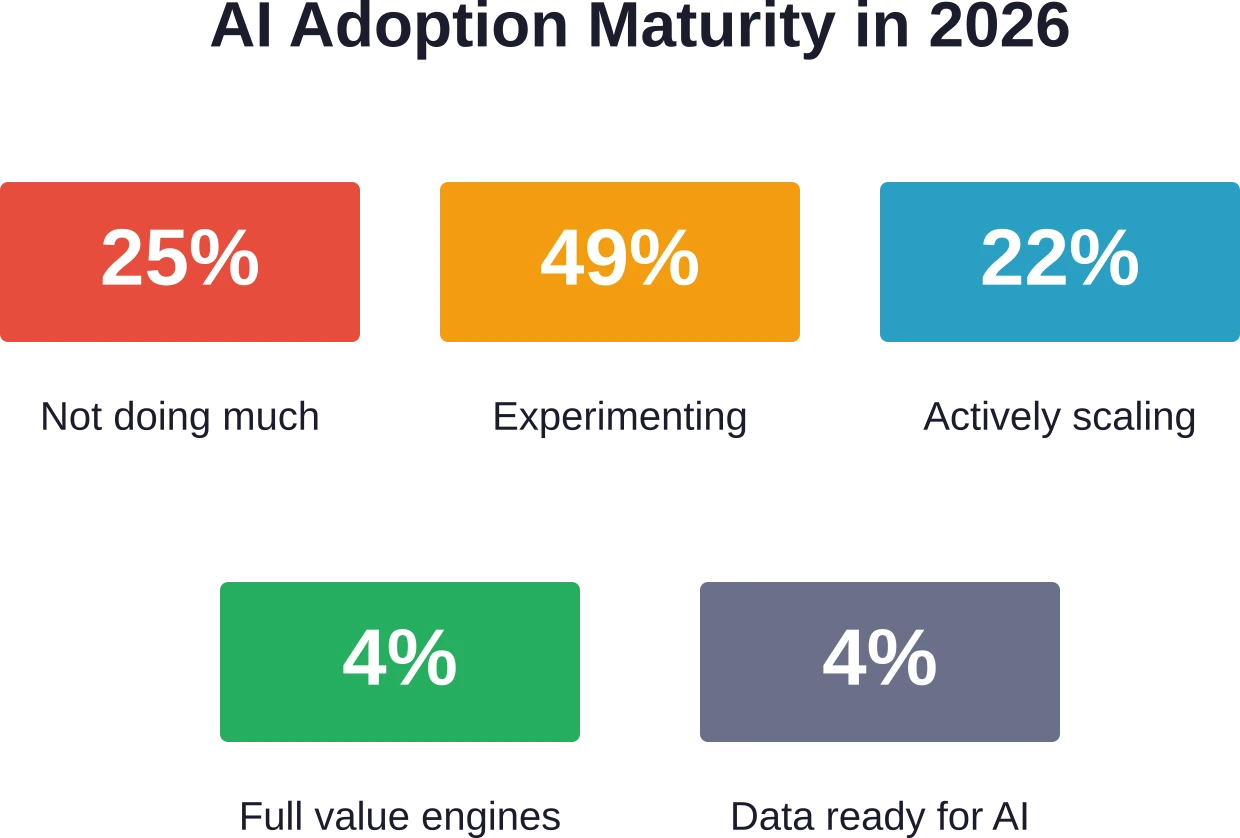
But here’s the thing: while 49% of companies remain stuck experimenting with AI proofs of concept, only 4% have become full AI “value engines” with deeply embedded operations. The gap between testing and scaling represents both the challenge and the opportunity in today’s market.
This guide explores generative AI business ideas that are delivering measurable results in 2026, backed by academic research and real-world implementation data.
The Current Landscape of Generative AI in Business
The state of AI adoption tells an interesting story. Research from MIT Sloan reveals that companies fall into distinct categories: 25% aren’t doing much with AI at all, 49% are still experimenting, 22% are actively scaling, and just 4% have achieved full integration.
What separates winners from the pack?
Data readiness, for one thing. Only 4% of enterprises have data structured and ready to be ingested by AI models. That’s a massive bottleneck—and a massive opportunity for businesses that can solve data preparation challenges.
A six-month study published in 2024 tracked GenAI integration across seven consumer-facing business workflows. The results? Sales increases ranging from 0% to 16.3%, depending on how much marginal value GenAI added compared to existing practices. The annual incremental value per consumer was noted in the research.
Those numbers might seem modest, but they’re real, measured, and repeatable. That’s what matters.

Turn AI Ideas Into Software With AI Superior
AI Superior helps companies assess AI opportunities, review available data, build PoC or MVP versions, and integrate AI solutions into existing workflows. Their services cover AI software development, consulting, R&D, training, and custom AI implementation.
Need Help Testing an AI Idea?
AI Superior can help with:
- assessing AI use cases
- building custom AI and ML tools
- creating PoC or MVP versions
- integrating AI into daily workflows
👉 Contact AI Superior to discuss your project.
High-Impact Generative AI Business Ideas
AI-Powered Content Creation Services
Content remains king, but generative AI has completely redefined the production economics.
A research study examining journalism found that LLM-generated content had a median ROUGE-L score of 0.62 when compared to published articles, with a prompt-to-publication span of just one day. Among LLM tasks analyzed, 83.1% involved article generation and 14.5% focused on headline creation.
The business opportunity here extends far beyond journalism. Companies need:
- Product description generators for e-commerce catalogs
- SEO content at scale for content marketing
- Social media caption services
- Email campaign copywriting
- Technical documentation automation
The key differentiator isn’t just speed—it’s consistency and customization. Generic AI outputs won’t cut it. Services that combine generative AI with industry-specific training data and human editorial oversight are commanding premium rates.
One particularly promising niche: content repurposing services that take long-form content and automatically generate multiple formats—blog posts into social threads, webinars into article series, podcasts into show notes and quotes.
Fraud Detection and Anomaly Identification Systems
In 2023, banks globally faced $442 billion in projected losses from payments, checks, and credit card fraud. Even capturing a fraction of that prevention market represents substantial opportunity.
Generative AI excels at pattern recognition and anomaly detection because it understands normal behavior well enough to generate it—which means it can also spot deviations.
Business applications include:
- Financial transaction monitoring for banks and fintechs
- Insurance claims fraud detection
- E-commerce account takeover prevention
- Healthcare billing anomaly identification
- Supply chain integrity verification
The strongest models here combine generative AI with traditional machine learning approaches. Generative models create synthetic fraud scenarios for training, while discriminative models handle real-time classification.
According to Savannah Thais from Columbia University’s Data Science Institute, enterprises need to avoid automating critical human judgment. The winning approach? AI flags anomalies; humans make final decisions on high-stakes cases.
AI-Enhanced Personalized Learning Platforms
Education technology is experiencing a generative AI renaissance. The technology enables true personalization at scale—something educators have wanted for decades but couldn’t deliver economically.
MIT Sloan research on AI for entrepreneurship highlights how GenAI tools save founders time and effort when developing business plans. That same principle applies across educational contexts.
Promising business models include:
- Adaptive learning systems that generate custom practice problems
- AI tutoring services with natural conversation interfaces
- Corporate training platforms with role-specific scenario generation
- Language learning apps with contextual conversation practice
- Technical skills platforms with personalized coding challenges
The key insight: generative AI doesn’t replace teachers or trainers. It handles the scaling problem—creating unlimited practice materials, providing immediate feedback, and adapting to individual learning pace—while humans focus on motivation, complex explanation, and relationship building.
Recent research published in 2025 on integrating generative AI in cybersecurity education emphasizes pedagogical strategies that promote critical thinking alongside AI use. That balance between automation and human guidance defines successful implementations.
Data Preparation and Transformation Services
Remember that statistic about only 4% of enterprises having AI-ready data? That’s your market.
Data preparation remains the unglamorous bottleneck preventing AI adoption. Companies have data spread across legacy systems, inconsistent formats, incomplete documentation, and quality issues.
Generative AI can:
- Automatically generate data schemas and documentation
- Clean and standardize datasets
- Create synthetic data for testing and training
- Generate data transformation pipelines
- Produce data quality reports with natural language summaries
This isn’t a consumer business—it’s B2B, often enterprise-focused. But the market is enormous and underserved.
MIT research emphasizes that modernizing data infrastructure is essential before enterprises can unlock generative AI’s potential. Services that bridge the gap between messy reality and AI-ready infrastructure solve a critical pain point.
AI-Powered Customer Service Automation
Customer service automation isn’t new. What’s new is the quality and flexibility of generative AI-powered interactions.
Earlier chatbots followed rigid decision trees and frustrated users with their limitations. Generative AI enables natural, contextual conversations that can handle edge cases and unexpected questions.
Business opportunities span multiple models:
- White-label customer service platforms for SMBs
- Industry-specific support bots (legal intake, medical triage, financial advisory)
- Internal help desk automation for enterprises
- Multilingual support services
- Voice-based customer service systems
The implementation sweet spot combines generative AI for initial interaction and context gathering with human handoff for complex issues. Research from Wharton’s Ethan Mollick emphasizes that cheap experimentation is key for entrepreneurs—testing different conversation flows, prompts, and handoff triggers until the system works reliably.
One often-overlooked niche: AI systems that help human customer service representatives by suggesting responses, pulling relevant knowledge base articles, and summarizing conversation history. That augmentation approach often delivers better ROI than full automation.
Generative Design and Prototyping Tools
Design has always involved iteration—lots of it. Generative AI compresses that cycle dramatically.
Applications range from visual design to engineering:
- Logo and brand identity generators
- UI/UX mockup creation tools
- Product packaging design services
- Architectural space planning systems
- Engineering component optimization
MIT Sloan research highlights how founders can experiment quickly with generative AI—creating multiple design variants, testing them, and refining based on feedback. That rapid iteration used to require expensive designer time. Now it’s available to startups from day one.
The business model here often combines software tools with service layers. A pure software play faces intense competition, but pairing AI-powered generation with expert design consulting creates defensible value.
Real talk: generative design tools won’t replace human designers. But they’ll eliminate the grunt work and let designers focus on strategy, brand alignment, and creative direction.
Industry-Specific Document Generation
Every industry has documents—contracts, reports, proposals, compliance filings, technical specs. Most are templated, repetitive, and time-consuming.
Generative AI thrives on exactly this kind of structured-yet-variable content creation.
High-value niches include:
- Legal document automation (contracts, briefs, discovery responses)
- Financial report generation (earnings summaries, risk assessments)
- Healthcare documentation (clinical notes, discharge summaries)
- Real estate listing descriptions and marketing materials
- Grant proposal writing for nonprofits and researchers
The key requirement: deep domain expertise. Generic document generation adds limited value. Services that understand industry regulations, standard terminology, and specific requirements command premium pricing.
According to NIST’s AI Risk Management Framework, cultivating trust in AI technologies requires transparency and risk mitigation. For document generation businesses, that means human review of AI outputs, clear disclosure about AI use, and accountability mechanisms.
Implementation Strategies That Actually Work
Having a great idea is one thing. Execution is another.
Research from MIT’s Center for Information Systems Research identifies common mistakes organizations make with AI projects. Most failures stem from treating AI as purely a technology problem rather than a business transformation challenge.
Start With Specific Use Cases
Broad “AI strategy” initiatives usually fail. Narrow, well-defined projects succeed.
Pick one workflow, one pain point, one measurable outcome. Solve that completely before expanding. MIT research emphasizes that experimentation is key—test quickly, learn from results, iterate.
The 30-minute product launch experiment that generated 9,200 words of content didn’t start with “let’s use AI for everything.” It started with a specific goal: create launch materials fast.
Prioritize Data Quality Over Model Sophistication
The fanciest generative AI model trained on garbage data produces garbage outputs.
According to MIT Sloan experts, only 4% of enterprises have data ready for AI ingestion. That data preparation work isn’t glamorous, but it’s essential.
For startup founders, this means:
- Investing in data collection infrastructure early
- Establishing data quality standards from day one
- Documenting data sources and transformations
- Building feedback loops to improve data over time
Design for Human-AI Collaboration
Savannah Thais from Columbia University stresses that enterprises need a culture shift in thinking about AI and the value of humans. The goal isn’t replacing people—it’s augmenting their capabilities.
Successful implementations maintain human judgment for:
- High-stakes decisions
- Creative direction and strategy
- Edge cases and exceptions
- Ethical considerations
- Customer relationship building
AI handles scale, speed, and consistency. Humans handle nuance, empathy, and wisdom.
| Business Idea | Technical Complexity | Market Size | Time to Revenue |
|---|---|---|---|
| Content Creation Services | Low | Large | 1-3 months |
| Fraud Detection Systems | High | Very Large | 6-12 months |
| Personalized Learning | Medium | Large | 3-6 months |
| Data Preparation Services | Medium | Very Large | 3-6 months |
| Customer Service Automation | Medium | Very Large | 2-4 months |
| Document Generation | Low-Medium | Medium | 2-4 months |
Market Trends Shaping Generative AI Opportunities
Understanding where the market is heading helps identify tomorrow’s opportunities today.
The Shift From Foundation Models to Application Layer
MIT Sloan research distinguishes between AI startups that build foundation models (“makers”), customize existing models (“shapers”), and use models as-is (“takers”). McKinsey uses similar categorization.
The trend is clear: foundation model development concentrates among well-funded players. The opportunity for most entrepreneurs sits in the application layer—solving specific industry problems with existing models.
That’s actually good news. Building applications requires less capital, reaches revenue faster, and focuses on customer problems rather than technical achievements.
Regulatory Environment and Trust Requirements
Government policy is catching up with AI innovation. White House executive orders in 2025 established frameworks for ensuring AI leadership while managing risk.
NIST’s AI Risk Management Framework provides guidance for cultivating trust and promoting innovation while mitigating risk. For businesses, this creates both requirements and competitive advantages.
Companies that build compliance, transparency, and accountability into their AI systems from the start will have significant advantages as regulations tighten.
The Integration Challenge
Standalone AI tools are giving way to integrated solutions. Customers don’t want another point solution—they want AI capabilities embedded in their existing workflows.
For entrepreneurs, this suggests several strategies:
- Build integrations with popular platforms from day one
- Design APIs that let customers embed your AI in their systems
- Partner with established software vendors
- Focus on specific workflow automation rather than general-purpose tools
The research showing sales increases of 0% to 16.3% across different workflows reinforces this point. Impact depends entirely on context—how well the AI integrates with existing processes and how much marginal value it adds.
Common Pitfalls to Avoid
Learning from others’ mistakes is cheaper than making your own.
Technology-First Thinking
“We’ll build an AI solution and then find customers” rarely works. Start with customer pain points, then apply technology to solve them.
MIT research on AI entrepreneurship emphasizes that the competitive landscape has shifted. Generative AI is a tool available to everyone—competitive advantage comes from understanding customer needs and business models, not from access to technology.
Underestimating Integration Complexity
Getting a demo working is easy. Integrating AI into production systems with proper error handling, monitoring, and fallback mechanisms is hard.
Plan for integration complexity from day one. That includes technical integration, but also workflow changes, training requirements, and change management.
Ignoring Ethical and Bias Concerns
Generative AI models can perpetuate biases present in training data. For business applications—especially in hiring, lending, healthcare, or legal contexts—bias can create legal liability and damage brand reputation.
According to NIST guidance, risk management should be built into AI systems from conception. That means:
- Testing for bias across demographic groups
- Maintaining human oversight for sensitive decisions
- Providing transparency about AI use
- Creating accountability mechanisms
- Establishing processes for handling errors
Scaling Before Product-Market Fit
The data showing that 49% of companies remain in experimentation mode while only 22% are actively scaling isn’t necessarily bad. Experimentation is appropriate before achieving product-market fit.
The mistake is scaling too early—investing heavily in infrastructure, hiring, and marketing before validating that customers will pay for the solution.
Use generative AI’s strength—rapid, cheap experimentation—to test multiple approaches, gather customer feedback, and refine the offering before committing to scale.
Building a Competitive Moat
If generative AI tools are available to everyone, how do you build defensible competitive advantages?
Proprietary Data
The most defensible moat is data nobody else has. As you serve customers, you collect data that improves your models in ways competitors can’t replicate.
This compounds over time. Better data leads to better outputs, which attracts more customers, which generates more data.
Domain Expertise and Workflow Integration
Deep understanding of specific industries creates moats that pure technology plays can’t overcome. A generative AI tool built by healthcare professionals who understand clinical workflows has advantages generic tools can’t match.
That expertise shows up in:
- Feature prioritization aligned with actual user needs
- Terminology and output formats matching industry standards
- Integration with industry-specific systems
- Compliance with sector regulations
Network Effects
Some generative AI business models can create network effects. Platforms where user-generated content trains models, marketplaces connecting AI service providers with customers, or systems that improve as more organizations share (anonymized) data all benefit from network effects.
These are harder to engineer than traditional software network effects, but when achieved, they’re equally powerful.
Brand and Trust
In domains where AI errors have serious consequences—legal, medical, financial—brand reputation and trust become significant moats.
Building that trust requires:
- Consistent quality over time
- Transparency about capabilities and limitations
- Responsive support when issues arise
- Clear accountability mechanisms
- Proactive communication about changes and updates
Funding and Resource Considerations
Different generative AI business ideas require vastly different resource levels.
Content creation services can bootstrap with minimal capital—API costs, basic infrastructure, and founder time. Fraud detection systems serving enterprise banks require significant engineering resources, regulatory expertise, and lengthy sales cycles.
Y Combinator’s database includes 232 of the top Generative AI startups, reflecting strong investor interest. But investor appetite concentrates in specific areas: application-layer solutions with clear ROI, vertical-specific tools with defensible moats, and infrastructure plays solving real bottlenecks.
For bootstrapped founders, focus on:
- Low technical complexity opportunities
- Fast time-to-revenue business models
- Service-based approaches before product-based
- Niches where expertise matters more than scale
The research showing founders can create comprehensive launch materials in 30 minutes demonstrates how generative AI itself lowers startup costs. Use that to your advantage.
FAQ
What generative AI business ideas are most profitable in 2026?
Content creation services, fraud detection systems, and data preparation tools show strong profitability. A six-month study found GenAI implementations increased sales by 0% to 16.3% depending on integration quality, with annual incremental value noted in the research per consumer. The most profitable opportunities combine low technical complexity with high market demand and integrate seamlessly into existing customer workflows.
How much capital do I need to start a generative AI business?
Capital requirements vary dramatically by business model. Service-based content creation businesses can start with under $5,000 for API costs and basic infrastructure. Enterprise fraud detection systems may require $500,000+ for development, compliance, and sales. According to MIT research, only 4% of enterprises have AI-ready data, creating opportunities for bootstrapped data preparation services that require modest capital but significant expertise.
Do I need technical expertise to launch a generative AI business?
Technical requirements depend on the specific opportunity. Content services, document generation, and design tools often require minimal coding—mainly API integration and workflow design. Fraud detection, custom model training, and infrastructure plays demand deep technical expertise. MIT Sloan research emphasizes that competitive advantage comes from understanding customer needs and business models as much as from technical capabilities.
What industries offer the best generative AI opportunities?
Financial services (fraud detection, risk assessment), healthcare (documentation, clinical decision support), education (personalized learning), and professional services (legal, accounting document automation) show strong opportunity. The key is identifying industries where generative AI adds marginal value beyond existing practices. Research indicates that 49% of companies are still experimenting with AI, representing substantial market opportunity for proven implementations.
How do I build trust in AI-powered services?
NIST’s AI Risk Management Framework emphasizes transparency, accountability, and risk mitigation. Successful strategies include maintaining human oversight for critical decisions, providing clear disclosure about AI use, testing for bias across demographic groups, and establishing responsive processes for handling errors. Research from Columbia University stresses avoiding the temptation to fully automate tasks requiring human judgment, creativity, and empathy.
What’s the typical timeline from idea to revenue for generative AI businesses?
Service-based models can reach initial revenue in 1-3 months. Product-based platforms typically require 3-6 months for MVP development and early customer acquisition. Enterprise solutions often need 6-12 months due to longer sales cycles and integration requirements. MIT research shows that cheap experimentation is key—founders should test concepts quickly rather than building extensively before market validation.
How do I differentiate my generative AI business from competitors?
Proprietary data, deep domain expertise, workflow integration, and brand trust create defensible moats. Generic AI implementations face intense competition, but vertical-specific solutions with industry knowledge command premium pricing. According to MIT Sloan, only 4% of companies have achieved full AI value engine status, suggesting that execution quality and operational excellence differentiate more than pure technology capabilities.
Moving From Idea to Implementation
The generative AI opportunity is real, measurable, and accessible. But opportunity alone doesn’t create successful businesses.
Start with specificity. Pick one business idea from this guide that aligns with your expertise, market access, and resource constraints. Define one narrow use case within that idea. Build the minimum viable implementation that solves a real problem for a specific customer segment.
Test quickly. The research showing founders can generate 9,200 words of launch content in 30 minutes illustrates generative AI’s core advantage—rapid, cheap experimentation. Use that capability to test different approaches, gather feedback, and iterate based on real user responses rather than assumptions.
Focus on the data. Remember that only 4% of enterprises have AI-ready data. Whether your business helps solve that problem directly or depends on quality data for its own operations, data infrastructure deserves as much attention as model selection.
Design for humans. AI augments human capabilities rather than replacing them. The implementations that deliver 16.3% sales increases rather than 0% are those that enhance what people already do well while automating repetitive, scalable tasks.
Build trust systematically. In an environment where White House policy emphasizes both innovation and risk management, businesses that incorporate transparency, accountability, and ethical considerations from day one will have lasting competitive advantages.
The generative AI revolution is creating unprecedented opportunities for entrepreneurs who combine technological tools with business acumen, domain expertise, and execution discipline. The question isn’t whether these opportunities exist—research and real-world implementations confirm they do. The question is whether you’ll move from reading about possibilities to building actual solutions.
 English
  German
  Arabic
  French
  Dutch
Dutch  Spanish