
Quick Summary: Generative AI transforms data analytics by automating code generation, streamlining workflows, and enabling natural language queries that make insights accessible to non-technical users. Organizations leverage tools like ChatGPT and custom LLMs to accelerate analysis, automate documentation, and build predictive models—with studies showing significantly reduced timeframes for complex tasks that previously took hours. The technology promises a 7% boost to global GDP while fundamentally changing how teams extract value from data.
The data analytics landscape has shifted dramatically. What once required specialized coding skills and hours of manual work now happens through conversational prompts and automated workflows.
Generative AI doesn’t just make analysts faster—it fundamentally changes who can extract insights from data. And that changes everything about how organizations operate.
Here’s the reality: less than 5% of collected data ever gets analyzed. Companies sitting on mountains of information rarely convert it into actionable intelligence. Generative AI aims to close that gap.
What Makes Generative AI Different for Analytics
Traditional analytics tools require users to learn specific syntax, understand data structures, and manually configure every transformation. Generative AI flips this model entirely.
Large language models trained on code repositories, statistical methods, and domain knowledge can now interpret natural language requests. Ask for a correlation analysis in plain English, and the system generates the appropriate Python or R code, executes it, and explains the results.
The implications ripple across organizations. Business stakeholders who previously waited days for analyst support can now prototype their own queries. Data teams shift from writing repetitive code to validating outputs and designing analytical frameworks.
Industry reports suggest that generative AI could raise global gross domestic product by 7%, with Goldman Sachs estimating potential impacts on 300 million knowledge worker jobs. Data analytics sits at the center of this transformation.

Build AI Analytics Tools With AI Superior
AI Superior develops AI-based applications and custom software products using machine learning and AI models. Their work also covers AI consulting, NLP, predictive analytics, BI, big data analytics, and software integration.
For analytics teams, this can support tools that summarize data, answer questions, generate reports, or help users explore business information faster.
Need Generative AI Built for Your Data?
AI Superior can help with:
- building custom AI and analytics tools
- developing NLP and machine learning features
- testing ideas through PoC or MVP work
- integrating AI into existing data systems
👉 Contact AI Superior to discuss your project.
Six Practical Use Cases Changing How Teams Work
The technology moves fast, but certain applications have proven their value across industries. These aren’t theoretical—they’re being deployed right now.
Code Generation That Actually Saves Time
Generative AI accelerates development cycles by producing data transformation scripts, statistical models, and visualization code from descriptions. Studies have documented building predictive models and testing performance in significantly reduced timeframes using ChatGPT with R.
That timeline represents a 60-80% reduction compared to manual coding. More importantly, the AI handles boilerplate setup, library imports, and syntax details that consume time without adding analytical value.
The models aren’t perfect. Code requires review, testing, and often modification. But the starting point arrives in seconds rather than hours.
Natural Language Queries for Non-Technical Users
Chatbots and virtual agents now serve as interfaces between business questions and data warehouses. Marketing teams query campaign performance, finance reviews budget variances, operations checks inventory levels—all through conversational prompts instead of SQL.
The democratization effect matters more than speed. When analysis becomes accessible without technical gatekeepers, organizations make faster decisions based on data rather than intuition or delayed reports.
Automated Data Governance and Documentation
Data governance traditionally involves tedious manual documentation—cataloging fields, tracking lineage, maintaining data dictionaries. Generative AI automates much of this burden.
Systems scan databases, generate field descriptions, identify relationships, and maintain updated documentation as schemas evolve. Trust in data improves when teams can quickly verify sources, understand transformations, and trace metrics to raw inputs.
AI-Generated Visualizations and Dashboards
Describing a desired visualization generates the corresponding chart configuration. Need a cohort retention curve broken down by acquisition channel? The prompt produces the appropriate parameters, color schemes, and aggregations.
Dashboard creation accelerates from hours to minutes. Analysts iterate through options by refining prompts rather than manually adjusting settings. The speed encourages exploration—teams try more visualization approaches and discover patterns they might have missed with slower tools.
Workflow Automation Across the Data Pipeline
ETL processes, data validation checks, anomaly detection routines—generative AI handles repetitive pipeline tasks that previously required custom scripts. The systems learn organizational patterns and propose automation opportunities.
A healthcare consultancy used generative AI models to extract insights from survey data, applying prompt engineering techniques to identify themes, segment respondents, and flag statistical anomalies. The approach scaled analysis that would have required multiple analysts working over weeks.
AI Agents Managing Complex Analytical Tasks
The newest frontier involves autonomous agents that break complex requests into sub-tasks, execute each step, validate results, and synthesize findings. Ask for a competitive market analysis, and the agent queries multiple data sources, performs statistical comparisons, identifies trends, and drafts an executive summary.
These systems represent a shift from tool to collaborator. The AI doesn’t just answer specific queries—it manages end-to-end analytical workflows with minimal human intervention.
How Organizations Implement Generative AI Analytics
Adoption patterns separate companies that capture value from those that pilot endlessly without production deployments.
Start With High-Impact, Low-Risk Applications
Code generation and documentation automation offer quick wins without exposing sensitive decisions to AI uncertainty. Teams build confidence with the technology before applying it to strategic analysis.
Establish Clear Validation Protocols
Generative AI produces output confidently, even when wrong. Every generated analysis needs human review. Organizations that succeed build validation checkpoints into workflows rather than trusting outputs blindly.
In a 2023 post-class survey, 63% of compulsory and 86% of MBAs reported at least a 5 out of 7 agreement with the statement, “This class has convinced me that it’s better to analyze data with code.” The combination of AI assistance and code-based workflows resonated because it provided transparency—users could verify the logic, not just trust a black box.
Invest in Prompt Engineering Skills
Quality outputs require quality inputs. Teams need training in crafting effective prompts, providing context, and iterating through refinements. The best results come from analysts who understand both the analytical question and how to communicate it to language models.
Integrate With Existing Data Infrastructure
Standalone AI tools deliver limited value. Real gains come from integrating generative capabilities into existing BI platforms, data warehouses, and workflow systems. Users access AI features within familiar interfaces rather than switching between disconnected applications.
| Implementation Approach | Time to Value | Risk Level | Best For |
|---|---|---|---|
| Code assistance plugins | 1-2 weeks | Low | Developer productivity |
| Natural language query layer | 1-3 months | Medium | Business user access |
| Automated documentation | 2-4 weeks | Low | Governance improvements |
| Full autonomous agents | 3-6 months | High | Complex analytical workflows |
Real-World Results and Performance Metrics
The hype cycle around generative AI makes skepticism healthy. What do actual deployments show?
Analyses indicate that prompt engineering strategies significantly influence output quality and user trust in AI-generated content. Organizations that invest in prompt design see measurably better results than those treating the AI as a magic oracle.
Speed improvements cluster around 40-70% for code-heavy tasks. The 45-minute model build mentioned earlier represented a specific case, but broader studies show consistent acceleration when generative AI handles boilerplate and syntax.
Accuracy remains variable. For well-defined analytical tasks with clear success criteria, generative AI performs reliably. For ambiguous questions requiring domain judgment, human oversight stays critical.
User satisfaction splits along interesting lines. Technical users appreciate time savings but often critique code quality. Non-technical users value access over perfection—getting an 80% solution immediately beats waiting days for a 95% solution.
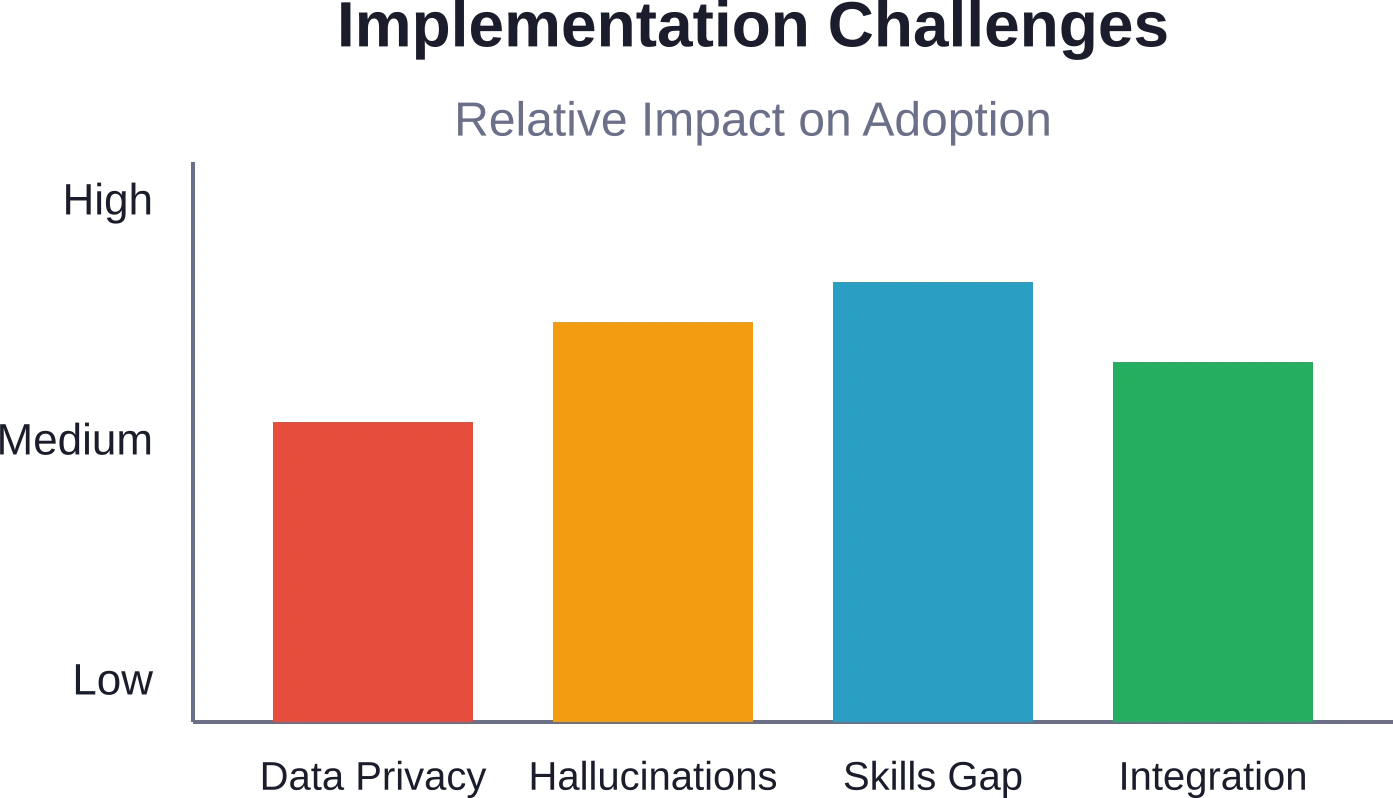
Critical Challenges and Limitations
No technology arrives without trade-offs. Generative AI for analytics introduces specific concerns that organizations must address.
Data Privacy and Security Risks
Sending proprietary data to external AI services creates exposure. Companies need on-premise or private cloud deployments, careful data masking, or contractual guarantees about how providers handle information.
The NIST GenAI evaluation program, with round-table discussions planned for April 2026, addresses some of these concerns by evaluating indistinguishability from human writing and believability of generated content. Standards development helps, but implementation responsibility falls on individual organizations.
The Hallucination Problem
Language models confidently generate plausible-sounding but factually incorrect outputs. In data analytics, this manifests as invented statistics, misinterpreted relationships, or logically flawed conclusions presented with authoritative tone.
Mitigation requires verification steps, cross-referencing with source data, and maintaining human judgment in the loop. Automation doesn’t mean abdication.
Skills Gap and Change Management
Deploying generative AI doesn’t eliminate the need for analytical expertise—it shifts what expertise matters. Teams need new skills in prompt engineering, output validation, and AI-augmented workflows while maintaining statistical literacy and domain knowledge.
The transition creates friction. Some team members embrace the technology enthusiastically while others resist, creating culture challenges that technical solutions alone can’t solve.
Cost and Resource Allocation
Enterprise-grade generative AI implementations require compute resources, API costs, or licensing fees. Small teams might find public tools like ChatGPT sufficient, but organizations processing millions of records need infrastructure investments.
ROI calculations should account for both direct costs and opportunity costs of delayed adoption while competitors move forward.
The Education Ecosystem Responds
Educational institutions and training platforms rapidly adapted curricula to address generative AI skills gaps. Specialized courses now teach data analytics specifically through the lens of AI assistance.
Programs emphasize practical hands-on experience—generating code, validating outputs, applying prompt engineering techniques to real datasets. The focus shifts from memorizing syntax to understanding analytical logic and effectively collaborating with AI tools.
This educational shift mirrors broader workforce changes. Future analysts will assume AI assistance as a baseline capability, much like current analysts assume spreadsheet proficiency.
Looking Forward: Where This Technology Goes Next
Multimodal capabilities will expand beyond text. Generative AI will interpret data visualizations, suggest improvements, and explain chart insights in natural language. Users will describe desired analyses verbally and receive comprehensive reports without typing prompts.
Integration with real-time data streams will enable continuous monitoring and automated alerting. AI agents will watch dashboards, identify anomalies, investigate root causes, and escalate findings—all without manual triggers.
Industry-specific fine-tuning will improve output quality. Healthcare analytics AI trained on medical terminology, financial models trained on accounting principles, supply chain systems trained on logistics patterns—specialization will reduce hallucinations and increase relevance.
But the fundamental shift has already occurred. Data analysis is no longer exclusively the domain of technical specialists. The barrier between questions and answers continues dropping.
Frequently Asked Questions
What’s the difference between generative AI and traditional analytics tools?
Traditional analytics tools require users to learn specific query languages, understand data structures, and manually configure analyses. Generative AI accepts natural language requests, generates appropriate code or queries automatically, and explains results conversationally. The technology makes analytics accessible to non-technical users while accelerating work for experienced analysts.
Can generative AI replace data analysts entirely?
No. Generative AI automates repetitive coding tasks and democratizes basic queries, but complex analytical projects still require human judgment, domain expertise, and strategic thinking. The technology shifts analyst work toward higher-value activities like framework design, validation, and insight interpretation rather than eliminating the role.
How accurate are AI-generated data analyses?
Accuracy varies by task complexity and prompt quality. For well-defined problems with clear specifications, generative AI performs reliably. For ambiguous questions requiring contextual judgment, outputs need human review. Organizations should implement validation protocols rather than trusting AI outputs blindly. Studies show prompt engineering significantly influences output quality.
What are the main security concerns with using generative AI for analytics?
Data privacy tops the list—sending proprietary information to external AI services creates exposure risks. Organizations need private deployments, data masking strategies, or contractual guarantees. Additional concerns include hallucinations producing confidently wrong conclusions, lack of audit trails for AI-generated insights, and potential bias in training data affecting analytical outputs.
Which industries benefit most from generative AI in analytics?
Healthcare, finance, retail, and technology sectors show particularly strong adoption. These industries combine large data volumes, regulatory documentation requirements, and need for rapid insights—all areas where generative AI delivers clear value. However, applications span virtually every sector that relies on data-driven decision making.
How long does it take to implement generative AI analytics tools?
Implementation timelines range from 1-2 weeks for simple code assistance plugins to 3-6 months for comprehensive autonomous agent deployments. Quick wins come from low-risk applications like automated documentation and code generation. Complex integrations with existing data infrastructure and custom model fine-tuning require longer timelines.
Do I need coding skills to use generative AI for data analysis?
Basic applications require no coding—natural language queries handle simple analyses. However, validating AI-generated outputs, refining complex requests, and handling edge cases benefit significantly from coding literacy. Educational programs now teach analytical thinking and AI collaboration skills together rather than treating them as separate domains.
Taking the Next Step
Generative AI for data analytics isn’t coming—it’s here. Organizations already deploying these capabilities capture competitive advantages through faster insights, democratized access to data, and analyst teams focused on strategic work rather than repetitive coding.
The question isn’t whether to adopt, but how quickly and intelligently. Start with low-risk, high-impact applications. Build validation protocols. Invest in prompt engineering skills. Integrate with existing infrastructure rather than creating disconnected tools.
Most importantly, maintain human judgment at the center. AI accelerates and democratizes analysis, but strategic decisions still require expertise, context, and wisdom that models can’t replicate.
The data you’ve already collected contains untapped value. Generative AI provides the key to unlock it.