
Quick Summary: Data warehouses centralize business data into a single source of truth, enabling faster decision-making, improved analytics, and enhanced security. They deliver measurable ROI by consolidating structured data from multiple sources, supporting AI-ready infrastructure, and providing historical insights that drive strategic planning.
Modern businesses drown in data. Customer records, transaction logs, inventory systems, marketing platforms—each generates streams of information every second. Yet having data and actually using it are two different things.
That’s where data warehouses come in. They transform scattered, siloed information into a centralized, queryable resource that powers everything from quarterly reports to machine learning models.
But do they actually deliver value worth the investment? Let’s look at what the numbers say.
What Makes Data Warehouses Essential for Business Intelligence
A data warehouse is a specialized repository designed to store structured data from multiple sources in a consistent, organized format. Unlike operational databases that handle day-to-day transactions, warehouses are optimized for analysis.
Think of it as the difference between a grocery store (operational database) and a recipe database (data warehouse). The store tracks what’s in stock right now. The recipe database tells you how ingredients combine over time to create specific outcomes.
Data warehouses provide a technical infrastructure to efficiently store structured data and analyze large-scale information across the enterprise. They sit at the heart of modern business intelligence, enabling organizations to manage large volumes of data while maintaining consistency and performance.
Centralized Single Source of Truth
Organizations typically pull data from dozens of systems—CRM platforms, ERP software, marketing automation tools, financial systems, and more. Each uses different formats, naming conventions, and update schedules.
Without centralization, finance might report revenue using one dataset while sales uses another. Marketing measures campaign success with metrics that don’t align with what product teams track. This fragmentation leads to conflicting reports and decision paralysis.
Data warehouses solve this by consolidating everything into one governed location. Teams across the organization query the same data, use the same definitions, and see the same numbers. When everyone works from identical information, debates shift from arguing about whose data is correct to discussing what the data actually means.

Turn Warehouse Data Into BI Tools With AI Superior
AI Superior builds BI solutions, big data analytics tools, predictive analytics systems, and custom AI software. Their team can help companies work with raw data from different sources and turn it into reporting, forecasting, and decision-support tools.
For data warehouse projects, this can help connect stored business data with clearer dashboards, analytics workflows, and tools that teams can actually use.
Need BI Built Around Your Data?
AI Superior can help with:
- building custom BI and analytics tools
- connecting data warehouses with reporting workflows
- developing predictive analytics models
- integrating AI tools into existing systems
👉 Contact AI Superior to discuss your project.
Measurable ROI and Business Value
Here’s where theory meets reality. Organizations implementing modern data warehousing solutions report substantial financial returns.
According to Forrester research on data lakehouse platforms, organizations deploying BigQuery and BigLake solutions achieved a 117% return on investment. Companies using data management solutions reported strong financial returns (specific ROI and NPV figures not independently verified).
Business intelligence platforms built on warehouse infrastructure delivered strong ROI. Organizations deploying AI-enabled data cloud solutions reported strong returns (specific ROI and NPV figures not independently verified).
These represent real savings from reduced infrastructure costs, faster time-to-insight, eliminated redundant systems, and improved decision accuracy.
| Solution Type | ROI | Net Present Value | Source |
|---|---|---|---|
| Data Lakehouse (BigQuery/BigLake) | 117% | Verified in study | Forrester TEI Study |
| Data Management Solutions | Strong returns | Not independently verified | Forrester TEI Study |
| BI Platform (Sigma) | Strong ROI | Not verified | Forrester TEI Study |
| AI Data Cloud (Snowflake) | Strong returns | Not independently verified | Forrester TEI Study |
Enhanced Analytics and Faster Decisions
Speed matters in business. The company that spots market shifts first can act while competitors are still sorting through reports.
Centralize Data for Easier Analysis
Data warehouses make analytics faster by organizing data into structures built for reporting and analysis. Instead of pulling information from several systems, joining datasets manually, and fixing inconsistencies, analysts can work from one prepared source.
This saves time and reduces the risk of different teams working from different numbers.
Scale Analytics With Cloud Warehousing
Cloud-based solutions such as Amazon Redshift and Google BigQuery help businesses handle large datasets without heavy upfront infrastructure costs.
They also make it easier to scale resources up or down as needs change. This shift to cloud warehousing has made real-time analytics more practical for many companies.
Keep Teams Working From the Same Data
A strong data warehouse gives teams a consistent foundation. Finance can reproduce last quarter’s analysis even if source systems change. Data science teams can retrain models using stable inputs. Marketing can measure campaign performance with the same customer definitions used by sales and support.
That consistency helps decisions move faster because teams spend less time arguing over the data and more time acting on it.
Historical Intelligence and Trend Analysis
Operational databases optimize for the present. They show current inventory, today’s orders, this week’s active customers. But business strategy requires historical context.
Data warehouses maintain versioned history through snapshots and slowly changing dimensions. This means organizations can analyze how customer behavior evolved over years, how product performance shifted across seasons, or how pricing changes impacted margins across different market segments.
When firmware updates change how devices report metrics, or when supplier attributes are modified, the warehouse preserves both old and new values. Teams can analyze historical data using the definitions that existed at the time, or reinterpret past events using current categorizations.
This temporal depth is impossible in operational systems where records are updated in place and history is overwritten.
AI-Ready Infrastructure
Machine learning models need three things: large volumes of clean data, consistent feature definitions, and reproducible training pipelines. Data warehouses provide all three.
Industry analyses indicate that organizations increasingly prioritize building AI-ready data infrastructure. Warehouses serve as the foundation for these initiatives by providing structured, governed datasets that feed directly into ML pipelines.
Instead of data scientists spending weeks assembling training datasets from disparate sources, they query the warehouse where data is already cleaned, joined, and formatted. Model features stay consistent across training and production environments because both draw from the same source.
When models need retraining, versioned historical data ensures reproducibility. Teams can debug performance issues by comparing current training data to past snapshots, identifying exactly when and why results diverged.
Improved Data Security and Governance
Scattered data creates scattered vulnerabilities. When sensitive information sits across dozens of systems, each with different access controls and security standards, the attack surface becomes harder to manage.
A data warehouse helps centralize security and governance by giving teams one controlled environment for analytics. Instead of managing permissions separately across every source system, administrators can define access rules at the warehouse level.
Key Benefits
- Centralized access control, so teams manage permissions from one place
- Role-based access, allowing each department to see only the data it needs
- Stronger protection for sensitive records, such as financial, customer, or operational data
- Audit trails that show who accessed which data and when
- Easier compliance reporting when teams need to prove how data is handled
- Consistent governance policies across reports, dashboards, and machine learning models
- Faster updates when privacy rules, masking requirements, or data classifications change
This makes security easier to enforce and governance easier to maintain. When rules are applied once at the warehouse level, they can carry through every report, dashboard, and model that uses that data.
Scalability That Grows With Business Needs
Small businesses might start with gigabytes of data. Enterprises process petabytes. Data warehouses scale across this entire spectrum.
Cloud-based warehouses in particular handle growth without manual intervention. When query volume spikes during quarter-end reporting, compute resources scale up automatically. When demand drops, resources scale down, keeping costs proportional to actual usage.
The global data warehousing market is expected to reach $51.18 billion by 2028, reflecting significant growth as companies rely on solutions and tools that make warehouses easier to use than ever before.
This scalability extends beyond storage. As organizations add new data sources—acquiring companies, launching products, entering markets—warehouses accommodate additional data without architectural rewrites. New tables integrate with existing structures, maintaining consistent query patterns and governance policies.
Cost Efficiency Versus Alternative Approaches
Data warehouse implementations vary widely in cost. Typical price ranges span from $30,000 up to $1,000,000, depending on deployment model, data volume, user count, and feature requirements.
But cost comparisons should account for the alternative: maintaining data across disconnected systems with redundant storage, duplicate ETL processes, and teams manually reconciling conflicting reports.
Cloud-based deployments reduce upfront infrastructure costs by eliminating the need to purchase servers, storage arrays, and networking equipment. Organizations pay for what they use, scaling spending with actual business needs rather than provisioning for peak capacity.
Reduced engineering overhead matters too. When data infrastructure is centralized and well-governed, teams spend less time building one-off integrations and more time generating insights.
Types of Data Warehouse Solutions
Not all warehouses are identical. Implementations vary based on architecture, deployment model, and use case.
| Type | Structure | Best For | Key Characteristic |
|---|---|---|---|
| Enterprise Data Warehouse (EDW) | Centralized, highly structured | Organization-wide BI | Comprehensive governance |
| Cloud Data Warehouse | Cloud-native architecture | Scalable analytics | Elastic compute and storage |
| Data Mart | Department-specific subset | Focused use cases | Optimized for specific teams |
| Data Lakehouse | Hybrid structured/unstructured | Advanced analytics and ML | Combines warehouse and lake benefits |
Enterprise data warehouses centralize all organizational data with rigorous modeling and governance. They serve as the authoritative source for company-wide reporting and compliance.
Cloud data warehouses leverage cloud infrastructure for elasticity and reduced maintenance. Teams can scale resources on demand without managing physical hardware.
Data marts subset warehouse data for specific departments or use cases, optimizing performance and access patterns for focused analytics needs.
Data lakehouses combine structured warehouse capabilities with support for unstructured data, enabling both traditional BI and advanced ML workloads from a single platform.
Implementation Considerations
Successful warehouse deployments require planning beyond technology selection. Research on data warehouse implementation rates showed variations across markets, with some studies indicating 35% adoption in certain regions, indicating that organizational readiness matters as much as technical capability.
Schema design determines query performance and analytical flexibility. Overly normalized schemas slow queries. Overly denormalized schemas create maintenance headaches. Finding the right balance requires understanding actual query patterns and business questions.
ETL (extract, transform, load) processes need monitoring and error handling. When source systems change formats or go offline, pipelines must detect issues and alert teams rather than loading corrupted data silently.
Governance frameworks should be established early. Waiting until the warehouse is populated to define data ownership, classification, and access policies creates technical debt that’s expensive to remediate.
Real-World Applications Across Industries
- Financial services firms use warehouses to consolidate transaction data, assess risk exposure, and meet regulatory reporting requirements. Historical data supports fraud detection models that identify anomalous patterns across millions of transactions.
- Retail organizations analyze point-of-sale data, inventory levels, and customer purchase histories to optimize pricing, forecast demand, and personalize marketing. Warehouse infrastructure supports recommendation engines that drive significant revenue growth.
- Healthcare providers integrate electronic health records, billing systems, and clinical research data to improve patient outcomes and operational efficiency. Versioned historical data enables retrospective studies while maintaining HIPAA compliance.
- Manufacturing companies monitor supply chain data, production metrics, and quality control measurements to reduce defects and optimize inventory. Real-time warehouse updates alert teams to issues before they cascade into larger problems.
Frequently Asked Questions
What’s the difference between a data warehouse and a regular database?
Operational databases optimize for transaction speed—inserting, updating, and deleting individual records quickly. Data warehouses optimize for analytical queries—scanning millions of records to calculate aggregates, identify trends, and generate reports. Warehouses store historical data with optimized structures for read-heavy workloads, while databases prioritize current data with structures for write-heavy operations.
How long does it take to implement a data warehouse?
Implementation timelines range from weeks to months depending on data volume, source system complexity, and organizational readiness. Cloud-based solutions can be operational in weeks since infrastructure provisioning is automated. On-premise deployments or complex enterprise warehouses with extensive governance requirements may take several months from planning through production deployment.
Can small businesses benefit from data warehouses?
Absolutely. Cloud data warehouses with pay-as-you-go pricing make enterprise-grade analytics accessible to businesses of all sizes. Small companies benefit from centralized data, faster reporting, and better decision-making without large upfront investments. Starting with a focused implementation addressing specific pain points often delivers immediate value that justifies expansion.
What’s the difference between a data warehouse and a data lake?
Data warehouses store structured data in defined schemas optimized for querying and reporting. Data lakes store raw data in native formats—structured, semi-structured, and unstructured—without requiring predefined schemas. Warehouses excel at business intelligence and reporting. Lakes excel at exploratory analysis and machine learning on diverse data types. Data lakehouses combine both approaches.
How do data warehouses support AI and machine learning?
Warehouses provide clean, consistent, versioned data that ML models require. They centralize feature engineering, ensuring training and production environments use identical definitions. Historical snapshots enable reproducible model training and debugging. Governed access ensures models comply with data privacy regulations. Infrastructure integration allows models to query warehouse data directly in production without separate data pipelines.
What are the main security risks with data warehouses?
Centralization creates a high-value target—compromising one system exposes all consolidated data. Poorly configured access controls might grant excessive permissions. Inadequate encryption for data at rest or in transit creates vulnerability. However, these risks are manageable through role-based access, encryption, audit logging, and regular security reviews. Centralized security controls are often more robust than scattered protections across multiple systems.
How much does a data warehouse cost?
Costs vary widely based on deployment model, data volume, query complexity, and user count. Cloud warehouses typically charge for storage (often $20–$40 per terabyte monthly) and compute (hourly rates for query processing). Annual costs range from tens of thousands for small implementations to hundreds of thousands for enterprise-scale deployments. On-premise solutions involve upfront hardware costs plus ongoing maintenance. Check vendor websites for current pricing since models and rates change frequently.
Conclusion: Strategic Infrastructure for Data-Driven Business
Data warehouses aren’t just storage systems. They’re strategic infrastructure that transforms how organizations use information.
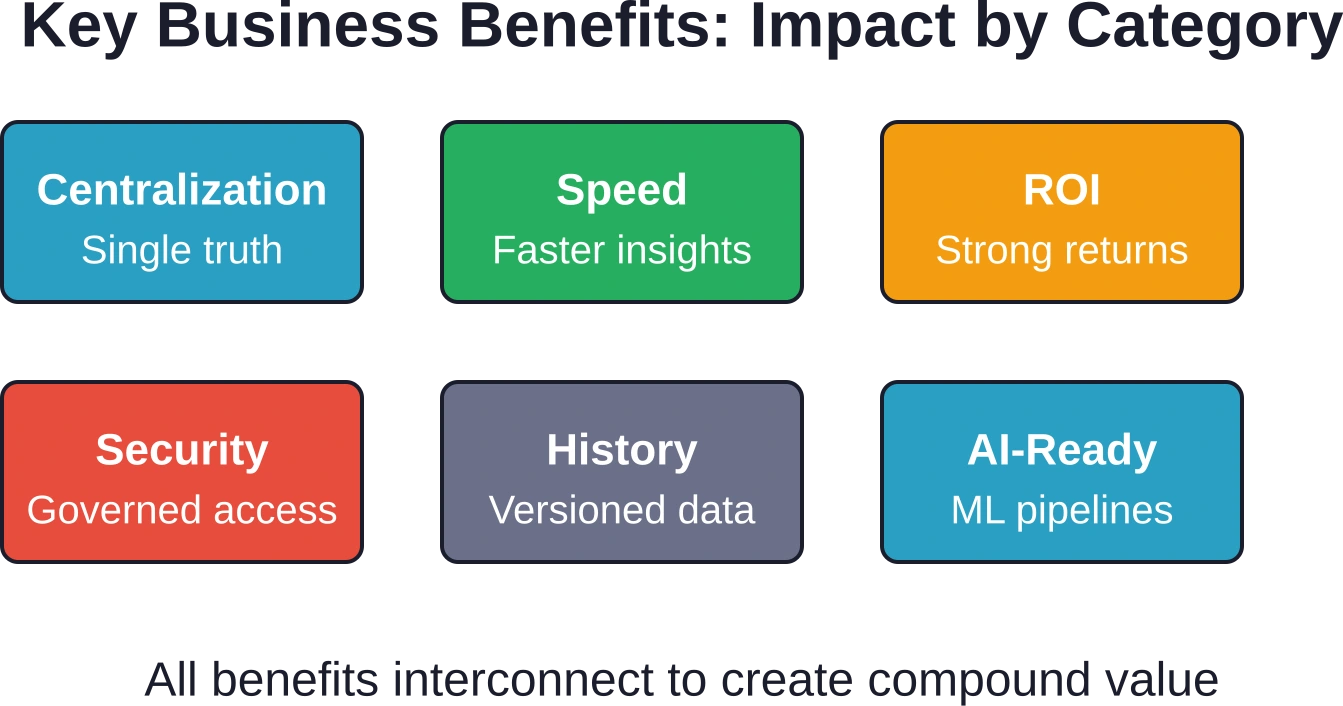
The benefits compound: centralized data enables faster analytics, which supports better decisions, which drive measurable ROI. Historical intelligence feeds AI models, which generate competitive advantages. Enhanced security and governance reduce risk while accelerating analytics.
Organizations reporting strong financial returns aren’t seeing those returns from storage alone. They’re capturing value from decisions made faster, risks avoided earlier, and opportunities spotted sooner than competitors.
The question isn’t whether to implement a data warehouse. It’s how quickly an organization can deploy infrastructure that turns scattered data into strategic advantage. In markets where insight velocity determines winners, that infrastructure isn’t optional—it’s essential.
Ready to centralize your data and accelerate analytics? Modern cloud warehouses make getting started easier and more affordable than ever. The companies pulling ahead aren’t debating whether to build data infrastructure. They’re already using it.