
Quick Summary: AI exploration represents humanity’s systematic journey to uncover artificial intelligence’s capabilities across scientific research, industry applications, and societal transformation. From NIST’s AI Risk Management Framework to NSF’s investment in National AI Research Institutes, organizations worldwide are discovering AI possibilities that range from 40% reductions in manufacturing defects to breakthroughs in climate forecasting and healthcare. Understanding these emerging capabilities—and the frameworks guiding responsible development—empowers businesses and researchers to navigate AI’s transformative potential.
Artificial intelligence has shifted from speculative technology to practical infrastructure. The exploration of AI possibilities now spans federal policy, academic research, industrial manufacturing, and daily consumer experiences. But what does AI exploration actually mean, and which possibilities deserve attention?
Here’s the thing though—AI exploration isn’t about chasing futuristic fantasies. It’s about systematically discovering what these systems can accomplish today, understanding their limitations, and building frameworks to deploy them responsibly.
This landscape has changed dramatically. As of March 2026, NSF announced a $100 million investment in National AI Research Institutes awards specifically to secure American leadership in AI. That’s just one data point in a much larger pattern of investment and discovery.
What AI Exploration Really Means
AI exploration encompasses both the technical process of discovering computational capabilities and the organizational journey of identifying practical applications. The concept operates at multiple levels simultaneously.
At the algorithmic level, researchers explore how different architectures process information, identify patterns, and generate outputs. Machine learning agents can now autonomously propose ideas and conduct experiments, fundamentally changing how scientific research progresses.
At the institutional level, exploration means identifying opportunities where AI creates measurable value. BMW reduced manufacturing flaws by 40% using machine learning systems. General Electric achieved a 40% reduction in unplanned downtime through similar implementations. These aren’t theoretical possibilities—they’re documented outcomes from systematic exploration.
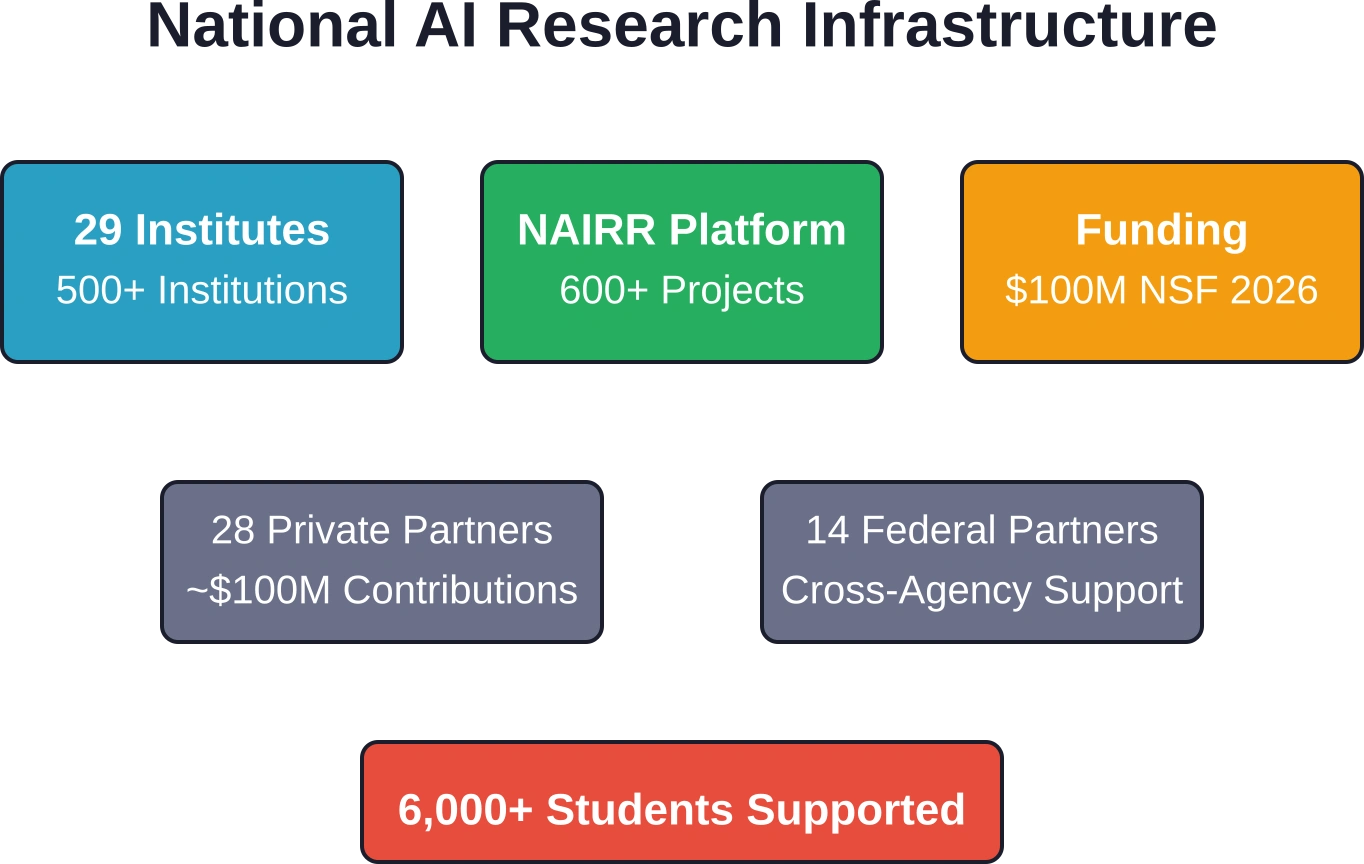
The National Artificial Intelligence Research Resource (NAIRR), led by NSF, exemplifies coordinated exploration at scale. This infrastructure provides research and education communities with access to computing, software, data, models, educational resources and expertise necessary for responsible AI advancement. Initially established as a pilot in 2024, NAIRR has supported more than 600 research projects and 6,000+ students, with approximately $100 million in private sector in-kind contributions from 28 private sector partners alongside 14 federal partners.
Real talk: exploration differs from deployment. Many organizations confuse the two, rushing to implement AI before understanding what they’re actually trying to accomplish.

Turn AI Ideas Into Working Solutions With AI Superior
AI Superior helps companies recognize, assess, prioritize, and define possible applications for data science, machine learning, and artificial intelligence. Their team can also help with AI consulting, R&D, training, software development, and implementation.
Need Help Finding the Right AI Solution?
AI Superior can help with:
- assessing possible AI opportunities
- reviewing data and technical feasibility
- planning PoC or MVP development
- preparing AI projects for integration
👉 Contact AI Superior to discuss your project.
Government Frameworks Shaping AI Discovery
Policy frameworks shape which AI opportunities organizations can explore safely. NIST’s AI Risk Management Framework gives companies a shared way to think about trust, risk, transparency, and responsible AI development.
The framework was created through broad collaboration with industry, academia, and other stakeholders. It is voluntary, but it gives teams useful criteria for assessing AI products, services, and systems without building their own governance approach from scratch.
Recent executive actions have also shifted the U.S. AI policy landscape, with more focus on innovation, industry growth, and national competitiveness. These efforts do not only add compliance pressure. They also create clearer definitions, risk categories, and evaluation methods.
Policy will always move slower than technology. Still, these frameworks give organizations practical reference points for exploring AI possibilities without running into the same governance questions every time.
The Ethics and Governance Dimension
Ethical considerations aren’t separate from AI exploration—they’re embedded within it. The IEEE Global Initiative 2.0 on Ethics of Autonomous and Intelligent Systems addresses the balance between potential benefits and risks as AI systems integrate into critical infrastructure and societal functions.
The AI governance market itself demonstrates this priority. The AI governance market is estimated to be worth $227.6 million with projected growth of 35.7% over the next five years. Companies worldwide recognize that ethical AI isn’t optional—regulatory frameworks impose significant penalties for high-risk violations.
IEEE CertifAIEd™ and related certification programs help organizations assess fairness, transparency, accountability, and privacy protection in their AI solutions. These aren’t abstract principles—they’re measurable characteristics that determine whether AI systems function as intended across diverse populations.
| Framework/Initiative | Organization | Primary Focus | Status |
|---|---|---|---|
| AI Risk Management Framework | NIST | Trustworthiness and risk mitigation | Active, voluntary adoption |
| National AI Legislative Framework | White House | Policy coordination and competitiveness | Released March 2026 |
| IEEE Ethics Initiative 2.0 | IEEE | Autonomous systems ethics | Ongoing development |
| IEEE CertifAIEd™ | IEEE | AI system certification | Available for implementation |
Scientific Discovery Through AI Systems
AI exploration has fundamentally altered how scientific research progresses. The traditional hypothesis-experiment-analysis cycle now incorporates AI-driven pattern recognition, simulation acceleration, and automated experimentation.
Climate science provides a compelling example. Running global climate simulations traditionally required weeks on supercomputers, limiting the number of scenarios scientists could explore. Researchers developed new models that project 100 years of climate data significantly faster, expanding the possibility space for climate research.
The transformation extends across disciplines. Physics researchers use AI as what one physicist describes as a muse—a source of inspiration and ideas that identifies patterns humans might overlook. Neurology benefits from AI’s ability to process vast datasets of brain imaging and neural activity. Meteorology leverages machine learning to improve forecast accuracy and extend prediction horizons.
But wait. These aren’t examples of AI replacing scientists. They’re examples of AI augmenting human capabilities, handling computational bottlenecks that previously constrained research velocity.
The National AI Research Institutes Network
The National AI Research Institutes, launched in 2020 and expanded significantly through 2026, represent strategic investments in foundational AI science and its application to critical economic sectors. These institutes, funded at approximately $20 million each over five years, connect over 500 funded and collaborative institutions across the U.S. and internationally.
NSF announced a $100 million investment in National AI Research Institutes awards expansion, alongside additional funding for test bed infrastructure and multimodal AI programs.
The 29 institutes focus on themes including astronomical sciences, materials research, and new methods for strengthening AI itself. They serve as hubs connecting universities, government agencies, industry partners, and nonprofits to advance AI research, build national infrastructure for AI education, and train the next generation of researchers and practitioners.
This distributed network model accelerates discovery by enabling specialized exploration within each institute while facilitating knowledge transfer across the entire network.
Industrial Applications and Measurable Outcomes
Industry exploration focuses on quantifiable business value. Manufacturing, in particular, has demonstrated AI’s transformative impact through documented case studies.
BMW’s 40% reduction in manufacturing flaws came from machine learning systems that identify defect patterns in production processes faster and more accurately than traditional quality control methods. General Electric’s 40% reduction in unplanned downtime resulted from predictive maintenance algorithms that anticipate equipment failures before they occur.
These outcomes share common characteristics: they address high-cost problems, they leverage existing data infrastructure, and they integrate into established workflows rather than requiring complete process redesign.
The short answer? Successful industrial AI exploration starts with expensive, repetitive problems where pattern recognition creates immediate value.
Machine Learning Adoption on Legacy Systems
One significant barrier to AI exploration is the perception that it requires entirely new technical infrastructure. Research on machine learning adoption for legacy systems challenges this assumption.
The integration of machine learning is critical for industrial competitiveness, yet adoption is frequently stalled by prohibitive costs and operational disruptions of upgrading legacy systems. The financial and logistical overhead required to support the full ML lifecycle presents a formidable barrier to widespread implementation.
However, frameworks now exist for integrating ML capabilities into existing systems without complete infrastructure replacement. This approach reduces financial barriers and allows organizations to explore AI possibilities incrementally, validating value before committing to larger transformations.
Sound familiar? Most organizations don’t need to rebuild everything. They need strategic entry points where AI creates measurable improvements within existing constraints.
Current Capabilities and Future Directions
Distinguishing between current AI capabilities and speculative future possibilities matters for effective exploration. Present-day AI excels at pattern recognition, optimization within defined parameters, and processing unstructured data at scale.
Machine learning agents have evolved considerably. Analysis of different AI systems shows distinct behavioral patterns: some systems favor algorithmic modifications with zero implementation errors, while others demonstrate implementation issues at varying rates.
These performance characteristics influence which exploration paths prove most productive. Systems that consistently deliver zero implementation errors enable faster iteration. Those with higher error rates require more validation overhead.
Now, this is where it gets interesting. The agents exploring AI possibilities themselves exhibit different exploration strategies, with variation in parameter configuration and algorithmic modification emphasis, creating a meta-layer of exploration—AI systems discovering better ways to discover AI capabilities.
Application-Driven Innovation
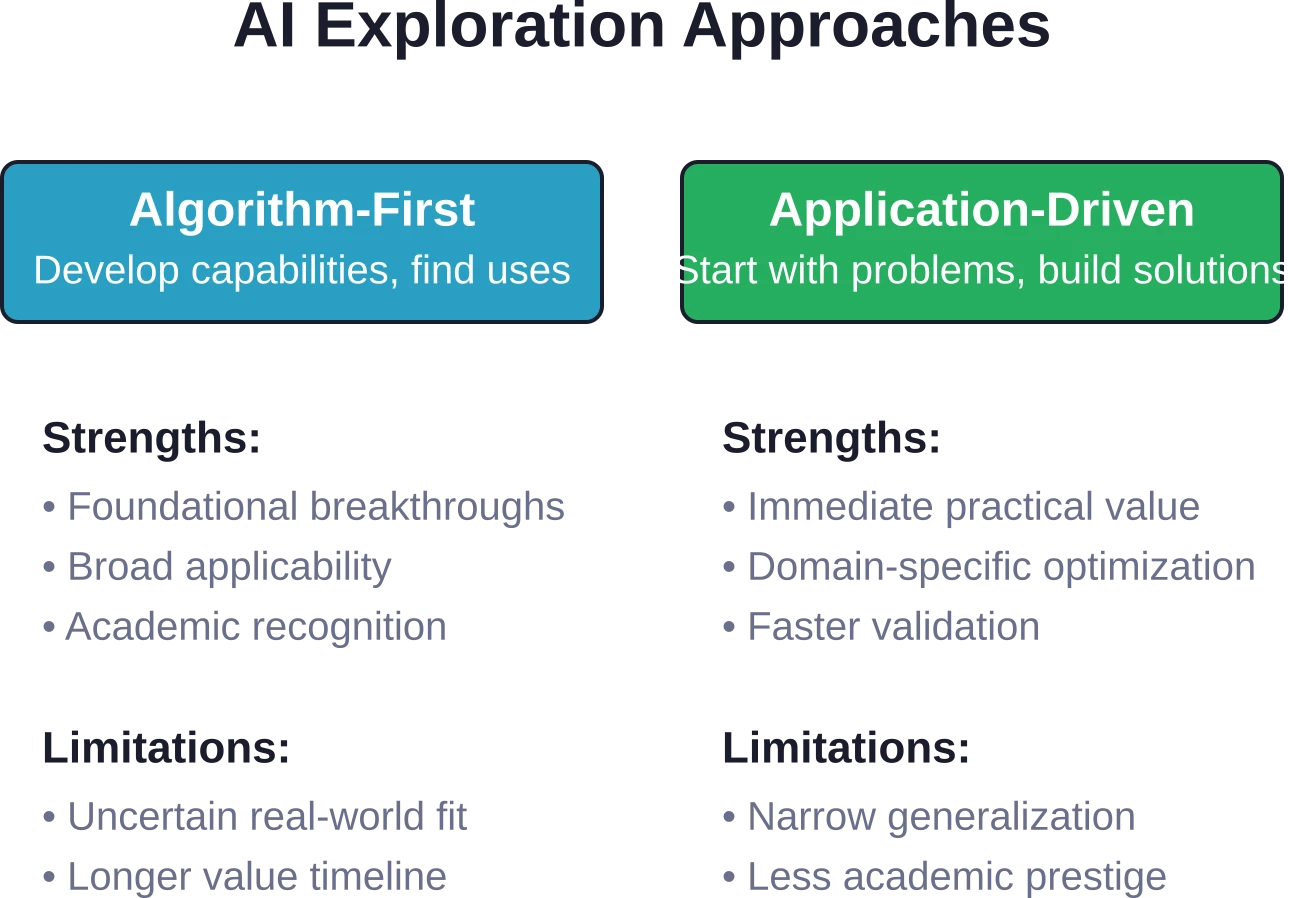
Application-driven research has been systematically undervalued in the machine learning community, according to position papers from leading researchers. As applications of machine learning proliferate, innovative algorithms inspired by specific real-world challenges have become increasingly important.
This approach flips traditional research priorities. Instead of developing algorithms and searching for applications, application-driven innovation starts with pressing real-world challenges and develops tailored solutions. Healthcare, climate science, materials discovery, and agricultural optimization exemplify domains where this approach accelerates progress.
The healthcare AI landscape particularly demonstrates this pattern. Recent research roundtables identified advances, applications, and open challenges across diagnostic imaging, drug discovery, clinical decision support, and patient outcome prediction. Each advance emerged from specific clinical needs rather than abstract algorithmic development.
That said, balancing application-driven research with foundational algorithmic work remains essential. Neither approach alone maximizes AI’s potential.
Challenges in AI Exploration and Development
AI exploration faces obstacles that slow discovery and limit adoption. Understanding these challenges helps organizations allocate resources more effectively.
- Data quality and availability constitute the most common barrier. AI systems require substantial training data that’s representative, labeled accurately, and free from systematic biases. Many domains lack this data infrastructure, making exploration impossible regardless of algorithmic sophistication.
- Computational resource requirements create access inequalities. Training large models demands hardware and energy budgets beyond most organizations’ reach. The NAIRR initiative specifically addresses this challenge by democratizing access to computational infrastructure.
- Interpretability remains problematic for high-stakes applications. When AI systems make recommendations affecting human health, legal outcomes, or financial access, stakeholders need to understand the reasoning. Many powerful AI architectures function as black boxes, producing accurate outputs without transparent decision pathways.
Open-World Machine Learning Challenges
Open-world machine learning addresses AI system behavior when encountering situations that differ from training conditions. Traditional machine learning assumes closed-world settings where training and deployment data follow similar distributions. Real-world applications violate this assumption constantly.
Research reviews identify key challenges: out-of-distribution detection (recognizing when inputs differ significantly from training data), novel class discovery (identifying categories not present during training), and continual learning (updating knowledge without forgetting previous learning).
These challenges directly impact exploration. An AI system that fails silently when encountering novel situations can’t be trusted to explore possibility spaces beyond its training distribution. Robust open-world capabilities are prerequisites for reliable AI-driven discovery.
Okay, so what about evaluation metrics? FPR95 (false positive rate at 95% true positive rate) and AUPR (area under the precision-recall curve) provide quantitative measures of open-world performance, enabling systematic comparison of different approaches.
The Workforce and Expertise Gap
Technical infrastructure alone doesn’t enable AI exploration—skilled practitioners are equally essential. The workforce gap in AI expertise constrains how quickly organizations can explore possibilities.
The NAIRR Classroom component specifically addresses this challenge by developing an AI-ready workforce through expanded education, training, user support, and outreach to new and nontraditional research and learning communities across all 50 U.S. states plus DC and Puerto Rico.
Training the next generation of AI researchers and practitioners requires more than technical skills. Domain expertise, ethical reasoning, interdisciplinary collaboration, and critical thinking about AI’s societal implications are equally important competencies.
Organizations exploring AI possibilities need team members who understand both the technology and the application domain. A healthcare AI project requires medical expertise alongside machine learning skills. Agricultural AI demands agronomic knowledge. This interdisciplinary requirement complicates talent acquisition and development.
| Challenge Category | Primary Impact | Current Mitigation Strategies |
|---|---|---|
| Data Quality and Availability | Limits training effectiveness | Data consortiums, synthetic data generation |
| Computational Resources | Creates access barriers | NAIRR infrastructure, cloud platforms |
| Interpretability | Reduces trust in high-stakes domains | Explainable AI research, hybrid systems |
| Open-World Robustness | Unreliable in novel situations | Out-of-distribution detection, continual learning |
| Workforce Expertise | Slows adoption velocity | NAIRR Classroom, university programs, certification |
Strategic Approaches to AI Opportunity Identification
Systematic exploration of AI possibilities requires structured methodologies. Organizations that succeed in AI adoption typically follow deliberate identification processes rather than pursuing opportunities randomly.
The process begins with inventory: cataloging existing data assets, computational infrastructure, domain expertise, and business processes. AI opportunities emerge at the intersection of these resources and high-value problems.
Prioritization frameworks help rank opportunities. Factors include potential impact magnitude, implementation feasibility, data availability, stakeholder alignment, and competitive advantage. Not all AI possibilities deserve pursuit—strategic focus matters more than comprehensive coverage.
Pilot projects validate assumptions before full-scale deployment. Small-scope implementations test whether AI capabilities match the problem characteristics, whether data quality suffices, whether stakeholders accept AI-generated outputs, and whether integration complexities remain manageable.
Here’s the thing though—many organizations skip the pilot phase, rushing from opportunity identification to production deployment. This approach maximizes risk and minimizes learning.
Benchmarking AI Research Agents
Recent benchmarking efforts evaluate machine learning agents’ ability to conduct scientific research autonomously. These assessments measure how effectively AI systems can propose ideas, design experiments, execute implementations, and analyze results.
Benchmark results reveal significant variation across different systems. Some exhibit strong algorithmic modification capabilities but struggle with parameter configuration. Others demonstrate balanced approaches but encounter higher implementation error rates. Understanding these performance profiles helps researchers select appropriate tools for different exploration tasks.
The FML-bench framework specifically evaluates AI agents for scientific research, emphasizing research-oriented perspectives rather than purely engineering-oriented task completion. This distinction matters because scientific discovery requires different capabilities than application development—creativity, hypothesis generation, and experimental design alongside implementation skills.
The Role of Trustworthy AI in Exploration
Trustworthiness determines which AI possibilities organizations can responsibly pursue. Systems that produce biased outputs, compromise privacy, or function unreliably in critical situations constrain exploration regardless of their technical capabilities.
NIST’s AI Risk Management Framework emphasizes trustworthiness as a multidimensional construct: validity and reliability (the system performs as intended), safety (it avoids unacceptable outcomes), security and resilience (it resists attacks and recovers from failures), accountability and transparency (decisions are explainable and attributable), explainability and interpretability (outputs can be understood by stakeholders), privacy enhancement (personal information is protected), and fairness with harmful bias managed (systematic discrimination is mitigated).
These dimensions aren’t binary properties—they exist on continuums and involve tradeoffs. Maximizing transparency might reduce performance. Enhancing privacy could limit personalization. Effective AI exploration navigates these tradeoffs deliberately rather than accidentally.
Executive guidance has specifically addressed ideological bias concerns, emphasizing that Americans require reliable outputs from AI systems. When ideological biases or social agendas are embedded in AI, the resulting systems can compromise the neutrality expected in government services and critical applications.
But wait. Fairness itself involves value judgments about which outcomes constitute fair treatment. Different fairness definitions can conflict mathematically—optimizing for one fairness metric can worsen another. This complexity means trustworthy AI exploration requires ongoing ethical deliberation, not just technical solutions.
Future Possibilities and Realistic Expectations
Distinguishing realistic near-term AI possibilities from speculative future capabilities helps organizations invest exploration resources wisely.
- Over the next 3-5 years, expect continued advances in multimodal AI systems that process text, images, audio, and video simultaneously. NSF support for multimodal AI programs specifically enables this direction. These systems will enable applications that require understanding multiple information types together—medical diagnosis combining imaging with patient history, environmental monitoring integrating satellite imagery with sensor data, educational tools that adapt to multiple learning modalities.
- Scientific discovery acceleration will intensify. AI systems that autonomously conduct experiments, propose hypotheses, and identify promising research directions will become standard research infrastructure rather than experimental novelties. Investment in test bed infrastructure for programmable cloud laboratories specifically enables this transition.
- Industry applications will shift from narrow optimization to broader operational intelligence. Rather than AI systems that solve single tasks, expect integrated platforms that coordinate multiple AI capabilities across entire workflows—supply chain management that anticipates disruptions, predicts demand, optimizes inventory, and reroutes logistics simultaneously.
That said, certain long-promised capabilities remain distant. Artificial general intelligence—AI systems with human-like reasoning across arbitrary domains—isn’t imminent despite recurring predictions. Common sense reasoning, robust transfer learning, and reliable creativity still challenge AI systems fundamentally.
The most productive exploration strategy focuses on achievable near-term possibilities rather than pursuing distant speculative capabilities.
Practical Next Steps for Organizations
Organizations ready to explore AI possibilities can begin with concrete actions rather than comprehensive strategies.
- Start by assessing current data assets. What structured and unstructured data does the organization generate, store, and control? What’s its quality, completeness, and accessibility? Many AI opportunities exist or fail based purely on data readiness.
- Identify expensive, repetitive problems where pattern recognition creates value. Customer service interactions, quality control processes, document processing, predictive maintenance, and demand forecasting represent common high-value targets.
- Engage with existing AI infrastructure initiatives. For educational institutions and researchers, NAIRR provides access to computational resources, datasets, and expertise. For industry organizations, partnerships with National AI Research Institutes offer collaboration opportunities.
- Prioritize ethical AI and governance frameworks early. Implementing IEEE CertifAIEd™ principles or NIST AI RMF guidelines from the beginning proves easier than retrofitting trustworthiness into deployed systems. The AI governance market’s projected growth reflects increasing recognition that responsible AI isn’t optional.
- Build interdisciplinary teams. AI exploration requires domain expertise alongside technical skills. A data scientist without manufacturing knowledge can’t effectively explore AI possibilities in production optimization. A healthcare administrator without machine learning understanding can’t evaluate AI diagnostic tools critically.
Real talk: many organizations overcomplicate AI exploration. The most effective approach often involves starting small, learning quickly, and scaling what works rather than attempting comprehensive AI transformation immediately.
Frequently Asked Questions
What does AI exploration actually mean?
AI exploration refers to the systematic process of discovering artificial intelligence capabilities, identifying practical applications, and understanding limitations. It operates at multiple levels: technical exploration of algorithmic capabilities, organizational exploration of business applications, and societal exploration of AI’s broader impacts. Exploration differs from deployment—it emphasizes learning and discovery rather than immediate implementation.
How much does it cost to explore AI possibilities for a business?
Costs vary dramatically based on scope and approach. Organizations can begin AI exploration with minimal investment by leveraging existing data assets, using open-source tools, and starting with pilot projects. The National Artificial Intelligence Research Resource (NAIRR) provides researchers and educators with access to computational infrastructure, reducing cost barriers. For industrial applications, initial exploration might require $50,000-$200,000 for data preparation, pilot implementations, and consulting expertise, though this varies significantly by industry and problem complexity.
What are the biggest challenges in AI exploration today?
Data quality and availability constitute the most common barrier—AI systems require substantial representative training data that many organizations lack. Computational resource requirements create access inequalities. The workforce expertise gap constrains how quickly organizations can explore possibilities. Interpretability remains problematic for high-stakes applications where stakeholders need to understand AI reasoning. Open-world robustness challenges—reliable performance when encountering novel situations—limit trust in AI-driven discovery.
Which industries benefit most from AI exploration?
Manufacturing has demonstrated measurable outcomes, with companies achieving 40% reductions in defects and unplanned downtime. Healthcare shows promise in diagnostic imaging, drug discovery, and clinical decision support. Scientific research across climate science, physics, materials discovery, and astronomy benefits from AI-accelerated discovery. Financial services, agriculture, transportation, and energy sectors all show significant AI application potential. The key factor isn’t industry type but rather the presence of expensive, repetitive problems where pattern recognition creates value.
How do government AI frameworks affect business exploration?
Government frameworks like NIST’s AI Risk Management Framework provide voluntary guidelines that help businesses explore AI responsibly without inventing assessment methods from scratch. These frameworks establish shared definitions, risk categories, and evaluation methods that make exploration more efficient. Policy initiatives like the National AI Legislative Framework balance innovation enablement with consumer protection. Rather than creating compliance burdens, well-designed frameworks reduce uncertainty about which AI possibilities organizations can safely pursue.
What’s the difference between AI exploration and AI implementation?
Exploration emphasizes discovery, learning, and validation—identifying what AI can accomplish and whether it fits specific problems. Implementation focuses on deploying validated AI capabilities into production systems at scale. Exploration involves experimentation, pilot projects, and deliberate failure as part of learning. Implementation requires reliability, integration with existing infrastructure, and ongoing maintenance. Many organizations struggle by rushing from opportunity identification to full implementation without adequate exploration phases to validate assumptions.
How can organizations access AI research infrastructure?
The National Artificial Intelligence Research Resource (NAIRR), led by NSF, provides researchers and educators with access to computational resources, datasets, models, and expertise. Initially established as a pilot in 2024, NAIRR has supported more than 600 research projects and engaged 6,000+ students across all 50 states plus DC and Puerto Rico. The 29 National AI Research Institutes connect over 500 institutions and offer collaboration opportunities. For industry organizations, partnerships with research institutes, cloud platform AI services, and open-source tools provide entry points without building complete infrastructure internally.
Conclusion: The Path Forward in AI Discovery
AI exploration has transitioned from speculative experimentation to systematic discovery supported by substantial infrastructure, policy frameworks, and documented outcomes. The $100 million NSF investment in National AI Research Institutes, NAIRR’s network supporting 600+ projects, and industry results like BMW’s 40% manufacturing defect reduction demonstrate that AI possibilities are concrete and measurable.
The most successful exploration approaches balance ambition with realism. They start with expensive, repetitive problems where pattern recognition creates immediate value. They build on existing data assets rather than requiring complete infrastructure replacement. They prioritize trustworthiness from the beginning, incorporating NIST AI RMF principles and ethical considerations throughout development.
Organizations need not explore every AI possibility—strategic focus matters more than comprehensive coverage. The key is identifying the intersection of organizational capabilities, high-value problems, and AI’s demonstrated strengths.
As AI capabilities continue advancing, exploration itself becomes more sophisticated. Machine learning agents that autonomously conduct experiments, government frameworks that clarify responsible development paths, and collaborative infrastructure like NAIRR all accelerate the discovery process.
The future of AI exploration belongs to organizations that combine technical capabilities with domain expertise, ethical frameworks, and systematic experimentation. Start with data assessment, identify high-value problems, engage with existing infrastructure initiatives, and build interdisciplinary teams. The possibilities are substantial—and the exploration process itself reveals which possibilities deserve pursuit.
 English
  German
  Arabic
  French
  Dutch
Dutch  Spanish