
Quick Summary: Enterprise AI development solutions help large organizations integrate advanced AI technologies—machine learning, agentic systems, and generative AI—into core business operations. These platforms provide infrastructure, governance, compliance frameworks, and turnkey applications that enable secure, scalable AI deployment across manufacturing, finance, healthcare, and government sectors. As of 2026, authoritative standards from NIST, IEEE, and the White House guide risk management, interoperability, and ethical AI implementation.
Enterprises across manufacturing, financial services, utilities, and government are racing to integrate AI systems that actually deliver business value. Yet most organizations struggle with fragmented tooling, compliance headaches, and deployment bottlenecks that slow innovation to a crawl.
Here’s the thing though—enterprise AI development isn’t just about spinning up a few machine learning models. It requires purpose-built infrastructure, governance frameworks that satisfy regulators, and architectural patterns that scale from proof-of-concept to production workloads handling millions of transactions.
This guide breaks down the platforms, standards, and strategies that global enterprises use to deploy AI securely and at scale.
What Enterprise AI Development Solutions Actually Are
Enterprise artificial intelligence refers to the integration of advanced AI-enabled technologies and techniques within large organizations to enhance business functions. These solutions encompass data collection, analysis, automation, customer service, risk management, and complex decision-making operations.
But what separates enterprise AI from consumer or startup AI tools? Scale, governance, and mission-critical reliability.
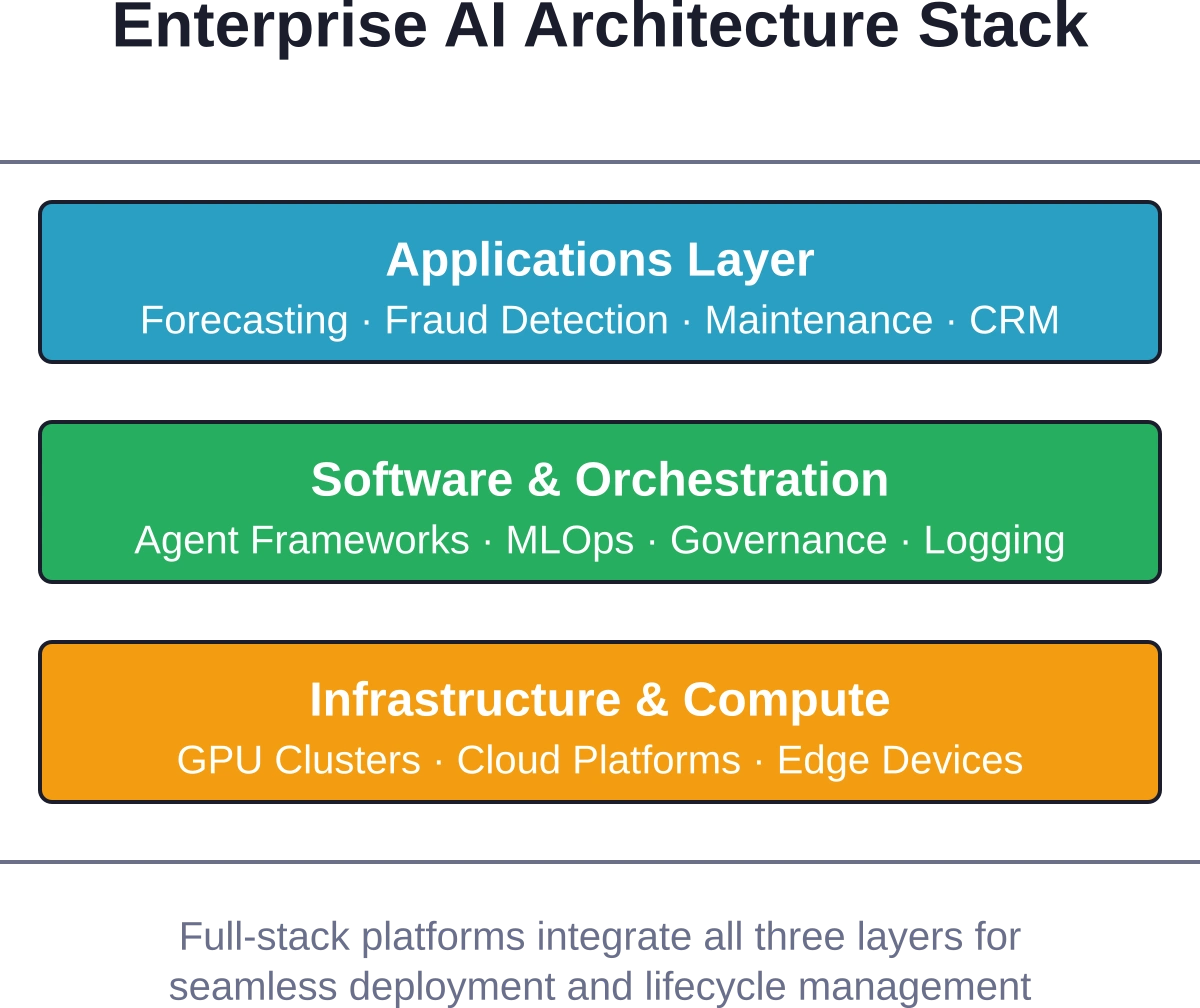
Enterprise AI platforms provide full-stack capabilities across three layers:
- Infrastructure: Accelerated compute resources, self-hosted or cloud environments, secure network policies
- Software: Development frameworks, agent orchestration, model lifecycle management, audit logging
- Applications: Turnkey solutions for forecasting, fraud detection, supply chain optimization, predictive maintenance
Companies deploy these systems to handle operations where downtime, bias, or security breaches carry severe financial and reputational consequences. That’s why enterprise solutions prioritize explainability, compliance, and human oversight mechanisms that consumer AI products often skip.

Develop Enterprise AI Systems With AI Superior
AI Superior develops AI-based applications and custom software products using machine learning models and algorithms. Their team can work through discovery, data assessment, MVP development, scaling, integration, and result evaluation, which is useful for larger systems that need to fit existing workflows.
For enterprise AI development, this can support internal tools, analytics systems, automation workflows, predictive models, or AI features added to existing platforms.
Need AI Built for Enterprise Workflows?
AI Superior can help with:
- building custom enterprise AI software
- developing machine learning and analytics models
- testing ideas through PoC or MVP work
- integrating AI into business systems
👉 Contact AI Superior to discuss your project.
Authoritative Governance Standards Shaping Enterprise AI in 2026
Real talk: compliance frameworks have matured rapidly over the past 24 months. Organizations can’t afford to treat AI governance as an afterthought anymore.
NIST AI Risk Management Framework
The National Institute of Standards and Technology released guidance designed to cultivate trust in AI technologies and promote AI innovation while mitigating risk. NIST’s AI Risk Management Framework addresses legal and regulatory requirements, ensuring policies, processes, and practices for mapping, measuring, and managing AI risks are transparent and effective.
On February 17, 2026, NIST announced the “AI Agent Standards Initiative” to ensure that the next generation of AI is widely adopted with confidence, can function securely on behalf of users, and can interoperate smoothly across the digital ecosystem.
White House National AI Legislative Framework
On March 20, 2026, the Trump Administration unveiled a national AI legislative framework committed to winning the AI race. The framework aims to enable American industry to innovate and thrive while ensuring all Americans benefit from technological advancement.
Executive orders issued between January 2025 and December 2025 removed barriers to American leadership in AI, emphasizing free markets, world-class research institutions, and entrepreneurial spirit. The framework explicitly prohibits ideological biases in federal government AI systems, mandating reliable outputs for Americans navigating education, information consumption, and daily tasks.
IEEE CertifAIEd Ethical AI Certification
The IEEE Standards Association offers CertifAIEd certification to help organizations demonstrate ethical AI practices. According to IEEE data published in January 2026, 39% of SMEs now use AI applications—up from 26% in 2024. That rapid adoption creates pressure to balance innovation with trust.
The AI governance market is worth $227.6 million and estimated to grow 35.7% in the next 5 years, according to Grand View Research. Companies worldwide recognize that ethical AI isn’t optional. Organizations face potential EU AI Act penalties including significant fines for non-compliance. The framework establishes tiered penalties based on violation severity and company size.
Enterprise AI Platform Architectures and Design Patterns
Organizations building reliable AI systems face architectural decisions that determine whether deployments succeed or collapse under production load. Research published on arXiv in 2025 identified strategic patterns enterprises use to structure AI transformation.
Agentic AI System Patterns
Agentic AI represents a transformative shift beyond traditional neural systems. These autonomous agents perceive environments, make decisions, and execute actions to achieve defined goals.
Academic research documented 18 governance and control patterns for agentic communities, including compliance monitoring, access control, and audit trail mechanisms. Organizations implement these patterns to maintain regulatory alignment while agents operate with meaningful autonomy.
Key workflow management patterns include:
- Workflow agent orchestration: Coordinating multiple specialized agents across complex business processes
- Batch processing: Handling large-scale data transformation jobs during off-peak hours
- Real-time streaming: Processing live data feeds for fraud detection, anomaly monitoring, and immediate response systems
Data processing patterns that enterprises rely on:
- Filtering and triage: Routing high-priority items to human reviewers while agents handle routine cases
- Structured extraction: Converting unstructured documents into database records
- Data transformation: Normalizing inputs from heterogeneous sources
- Summarization: Condensing reports, tickets, and communications for executive dashboards
Performance Optimization Strategies
Production AI systems require four core performance optimization patterns:
| Pattern | Purpose | Use Case |
|---|---|---|
| Progressive refinement | Iteratively improve outputs through multi-pass processing | Document generation, code review |
| Fallback and degradation | Switch to simpler models when primary systems fail | High-availability customer service |
| Caching and memoization | Store expensive computation results for reuse | Recommendation engines, search |
| Parallel processing | Distribute workload across multiple compute nodes | Large-scale forecasting, simulation |
These patterns prevent bottlenecks that plague AI deployments when traffic spikes or model latency degrades under load.
Leading Enterprise AI Development Companies and Platforms
Organizations evaluating enterprise AI solutions typically assess providers across infrastructure capabilities, software maturity, industry-specific applications, and compliance tooling.
Full-Stack Infrastructure Providers
NVIDIA delivers end-to-end solutions transforming organizations into AI enterprises. Their stack spans accelerated infrastructure (DGX systems, GPU clusters), enterprise-grade software (NIM microservices, AI Enterprise platform), and pre-trained foundation models optimized for inference performance.
Cloud hyperscalers AWS, Microsoft Azure, and Google Cloud Platform provide managed AI services including model training infrastructure, vector databases, agent orchestration frameworks, and compliance monitoring dashboards. These platforms integrate with existing enterprise authentication, networking, and data governance systems.
Turnkey Application Platforms
C3 AI operates as an enterprise AI application software company, delivering over 40 turnkey applications addressing business-critical needs across manufacturing, financial services, government, utilities, oil and gas, chemicals, agribusiness, and defense sectors. Organizations deploy and operate AI at scale using pre-built solutions rather than developing custom models from scratch.
Cohere offers private, secure, customizable enterprise AI platforms emphasizing data sovereignty. Companies retain control over training data, model weights, and inference environments—critical for regulated industries handling sensitive information.
Development Infrastructure and Governance
Coder provides enterprise AI development infrastructure giving developers secure, governed environments to run AI coding agents at scale. The platform offers self-hosted infrastructure with full control over agent permissions, audit logging, and compliance requirements.
This approach addresses the tension between developer velocity and security teams demanding observability. Developers and agents work in parallel inside secure environments where every action gets logged, role-based access controls prevent unauthorized operations, and compliance frameworks automatically validate changes.
Key Technology Considerations for Enterprise AI Implementation
Successful enterprise AI deployments balance technical requirements with organizational change management. Several critical factors determine whether implementations deliver ROI or stall in pilot purgatory.
Data Infrastructure and Quality
AI models are only as reliable as the data feeding them. Enterprises must establish data pipelines that guarantee:
- Consistent schema and formatting across source systems
- Data lineage tracking for audit and debugging
- Privacy-preserving transformations (anonymization, differential privacy)
- Version control for training datasets
Organizations often underestimate the engineering effort required to build production-grade data infrastructure. That’s where many AI initiatives falter—models perform well in controlled experiments but degrade rapidly when exposed to messy, inconsistent real-world data.
Model Lifecycle Management
Deploying a model once isn’t enough. Production AI systems require continuous monitoring, retraining, and versioning as data distributions shift and business requirements evolve.
Effective MLOps practices include:
- Automated retraining pipelines triggered by performance degradation
- A/B testing infrastructure comparing model versions in production
- Rollback mechanisms restoring previous versions when new deployments fail
- Performance dashboards tracking accuracy, latency, and resource consumption
Security and Access Control
Enterprise environments demand defense-in-depth security across multiple layers. AI systems must enforce:
- Network isolation preventing unauthorized access to model endpoints
- Encryption for data at rest and in transit
- Role-based permissions determining who can deploy models, access training data, or view inference results
- Audit logs capturing every interaction for compliance reviews
The NIST AI Risk Management Framework emphasizes that security requirements flow from understanding which AI systems are subject to specific legal and regulatory mandates. Nondiscrimination, data privacy, and security requirements often mandate documented processes proving compliance.
Explainability and Transparency
Enterprises deploying AI for credit decisions, medical diagnoses, or hiring processes face regulatory requirements to explain model reasoning. Black-box systems that can’t justify outputs create legal liability.
Techniques for improving explainability include:
- Feature importance analysis showing which inputs most influenced predictions
- Counterfactual explanations demonstrating what would change the output
- Model-agnostic interpretation methods working across different architectures
- Human-in-the-loop workflows requiring expert review for high-stakes decisions
Industry-Specific Use Cases Driving Enterprise AI Adoption
Different sectors prioritize distinct AI capabilities based on operational needs and regulatory environments.
| Industry | Primary Use Cases | Key Challenge |
|---|---|---|
| Manufacturing | Predictive maintenance, quality control, supply chain optimization | Integrating with legacy OT systems |
| Financial Services | Fraud detection, risk assessment, algorithmic trading, customer service | Meeting strict regulatory compliance |
| Healthcare | Diagnostic assistance, treatment planning, drug discovery, administrative automation | HIPAA compliance, liability concerns |
| Government | Citizen services, cybersecurity, infrastructure monitoring, policy analysis | Transparency and bias mitigation |
| Utilities | Demand forecasting, grid optimization, outage prediction, asset management | System reliability and safety |
According to industry reports, enterprise chatbot deployments have achieved high user engagement rates and 3X better conversion than the website within the first few months. That kind of performance demonstrates why customer service automation ranks among the highest-ROI enterprise AI applications.
Common Implementation Challenges and How to Overcome Them
Look, most enterprise AI projects don’t fail because of immature technology. They fail because of organizational friction, misaligned expectations, and poor change management.
Siloed Data and Legacy Systems
Enterprises operate dozens or hundreds of disconnected systems accumulated over decades. Customer data lives in CRM platforms, transaction records sit in mainframe databases, and operational telemetry flows through proprietary industrial protocols.
Breaking down these silos requires executive sponsorship, dedicated data engineering teams, and often significant infrastructure investment. Organizations that succeed establish data mesh architectures where domain teams own their data products while adhering to organization-wide governance standards.
Skills Gaps and Talent Shortages
Demand for AI engineers, data scientists, and ML specialists far exceeds supply. Enterprises compete with tech giants offering higher compensation and cutting-edge research opportunities.
Practical strategies include:
- Partnering with specialized AI development firms rather than building everything in-house
- Upskilling existing engineers through training programs and certifications
- Using low-code/no-code AI platforms that reduce the expertise required for deployment
- Focusing scarce talent on high-value custom models while using turnkey solutions for commodity use cases
Unrealistic Expectations and Scope Creep
Executives often expect AI systems to deliver magical results across every business function simultaneously. That approach guarantees failure.
Successful implementations start narrow—one high-value use case with clear success metrics, manageable scope, and committed stakeholders. Demonstrate ROI, refine processes, and then expand to adjacent problems. Iterative delivery beats big-bang transformations every time.
The Future of Enterprise AI Development: Trends to Watch
Now, this is where it gets interesting. Several emerging trends will reshape how enterprises build and deploy AI systems over the next 24 months.
Agentic AI and Multi-Agent Systems
The shift from passive AI models to autonomous agents that plan, execute, and learn represents a fundamental architectural change. Enterprises will deploy communities of specialized agents—each handling specific domains—that collaborate to accomplish complex objectives.
The NIST AI Agent Standards Initiative announced in February 2026 aims to establish interoperability standards ensuring agents from different vendors can communicate securely. That standardization will accelerate adoption by reducing vendor lock-in concerns.
Small Language Models and Edge Deployment
Not every enterprise AI workload requires massive foundation models running in cloud data centers. Organizations increasingly deploy smaller, specialized models at the edge—on factory equipment, retail point-of-sale systems, and mobile devices.
These models offer lower latency, reduced bandwidth costs, and improved data privacy since sensitive information never leaves the device. Expect continued research into model compression, quantization, and distillation techniques that maintain accuracy while shrinking model size.
AI-Assisted Software Development
Coding agents are transforming how enterprises build and maintain software. Developers use AI to generate boilerplate code, write unit tests, debug issues, and review pull requests.
But wait. These tools introduce new security and quality risks. That’s why platforms like Coder emphasize governed environments where coding agents operate within guardrails—scanning generated code for vulnerabilities, enforcing style guidelines, and requiring human approval for critical changes.
Federated Learning and Privacy-Preserving AI
Organizations collaborating on AI models often can’t share raw training data due to privacy regulations or competitive concerns. Federated learning enables training models across distributed datasets without centralizing the data.
Healthcare consortiums, financial industry groups, and supply chain partnerships will increasingly adopt federated approaches to build better models while respecting data sovereignty requirements.
Frequently Asked Questions
What makes enterprise AI different from consumer AI tools?
Enterprise AI prioritizes scalability, governance, compliance, explainability, and integration with existing business systems. These solutions handle mission-critical workloads where failures carry severe financial and reputational consequences, requiring robust monitoring, audit trails, and human oversight mechanisms that consumer tools typically lack.
How much does enterprise AI implementation typically cost?
Costs vary dramatically based on scope, industry, and infrastructure requirements. According to IEEE research, a typical 50-person SME operates on a $100,000 annual IT budget. Large enterprise implementations range from hundreds of thousands for turnkey applications to millions for custom platforms requiring data center infrastructure, specialized talent, and multi-year development cycles.
What are the biggest risks in enterprise AI deployments?
Key risks include model bias producing discriminatory outcomes, security vulnerabilities exposing sensitive data, compliance failures triggering regulatory penalties (EU AI Act fines reach €35 million or 7% of global revenue), over-reliance on AI without human oversight, and technical debt from poorly architected systems that can’t scale or adapt to changing requirements.
Which industries benefit most from enterprise AI solutions?
Manufacturing, financial services, healthcare, government, utilities, retail, and logistics see the highest ROI from enterprise AI. These sectors handle large-scale repetitive operations, complex decision-making under uncertainty, and massive data volumes where AI delivers measurable efficiency gains, cost reductions, and improved outcomes.
How do NIST AI standards affect enterprise implementations?
NIST provides voluntary frameworks helping organizations map, measure, and manage AI risks. The AI Risk Management Framework guides governance practices ensuring legal compliance, transparency, and effective risk mitigation. The AI Agent Standards Initiative announced February 2026 establishes interoperability standards enabling secure agent communication across platforms.
Can small and mid-sized enterprises realistically deploy AI?
Absolutely. Adoption among SMEs jumped from 26% in 2024 to 39% in 2026 according to IEEE data. Cloud-based platforms, turnkey applications, and low-code tools reduce barriers to entry. IEEE CertifAIEd certification offers SMEs practical, scalable approaches to responsible AI implementation balancing innovation with trust and compliance requirements.
What skills do teams need for successful enterprise AI projects?
Core capabilities include data engineering (pipeline construction, quality assurance), machine learning engineering (model training, optimization, deployment), MLOps (monitoring, versioning, retraining), software engineering (API design, integration, testing), and domain expertise translating business requirements into technical implementations. Cross-functional collaboration among IT, business units, legal, and compliance teams proves critical.
Conclusion: Building Enterprise AI That Delivers Real Business Value
Enterprise AI development solutions have matured significantly. Organizations now have access to robust platforms, clear governance frameworks from NIST and IEEE, and proven architectural patterns that scale reliably.
Success requires more than deploying cutting-edge technology. It demands thoughtful platform selection aligned with business objectives, data infrastructure investment, compliance integration from day one, and organizational change management ensuring stakeholders across IT, business units, and legal collaborate effectively.
The enterprises winning the AI race in 2026 start narrow with high-value use cases, demonstrate ROI quickly, and expand iteratively. They build on authoritative standards like the NIST AI Risk Management Framework rather than inventing governance from scratch. They balance innovation velocity with security, explainability, and ethical considerations.
Ready to transform AI from experimental project to production system driving measurable business outcomes? Start by assessing which use cases offer the clearest ROI, evaluate whether your data infrastructure can support reliable model training, and partner with proven platform providers offering the governance tools regulators increasingly demand.
The technology is ready. The standards exist. The question is whether organizations will commit the resources and leadership attention required to implement enterprise AI successfully.
 English
  German
  Arabic
  French
  Dutch
Dutch  Spanish