
Quick Summary: AI consulting for startups provides strategic guidance to integrate artificial intelligence into business operations, from feasibility assessments and use-case identification to deployment and ongoing optimization. Consultants help early-stage companies avoid costly mistakes, accelerate implementation timelines, and maximize ROI on AI investments without requiring in-house expertise.
The startup world doesn’t slow down for anyone. AI adoption keeps accelerating—in 2025, 88% of global organizations reported using AI in at least one business function, up from 78% the previous year. For early-stage companies, that pace creates pressure.
But here’s the thing though—most startups don’t have the bandwidth or depth of expertise to build AI capabilities from scratch. That’s exactly where AI consulting comes in.
AI consulting for startups isn’t about handing off your entire product vision to an external firm. It’s about getting expert eyes on your specific challenges, mapping realistic paths forward, and avoiding the rookie mistakes that burn through runway capital.
What AI Consulting Actually Covers
AI consulting services range from high-level strategy to hands-on implementation support. The scope depends entirely on where a startup sits in its development lifecycle and what problems need solving.
Most consulting engagements start with feasibility assessment. Consultants evaluate whether AI makes sense for the specific problem at hand, what data requirements exist, and what realistic timelines look like. This prevents teams from chasing shiny technology that doesn’t match business needs.
Then comes use-case identification. Not every business process benefits equally from AI, and consultants help prioritize based on impact potential and implementation complexity. The U.S. Small Business Administration notes that AI tools can help small businesses find solutions across various operational challenges, from customer service to inventory management.
Strategy Development
Strategic planning establishes the roadmap. Consultants map out which AI capabilities to build first, what infrastructure investments are necessary, and how to measure success. This includes defining key performance indicators that actually matter—not vanity metrics.
For startups working on AI-powered products, strategy work often extends to competitive positioning and go-to-market planning. How does the AI capability differentiate from existing solutions? What customer segments care most about the specific capabilities being developed?
Technical Implementation Support
Implementation is where strategy meets reality. Consultants either build AI systems directly or work alongside internal teams to accelerate development. This includes model selection, training pipeline setup, deployment architecture, and integration with existing systems.
Data from academic research shows that large language models decreased average time for mid-level professional writing tasks by 40%, with an 18% increase in output quality. Similar productivity gains appear across different AI applications when properly implemented—60% gains in code optimization, 26% in bug fixing, and 14% for customer support workers using AI assistance.
Real talk: those numbers don’t happen automatically. They require proper tool selection, workflow integration, and ongoing refinement—exactly what experienced consultants bring to the table.
Why Startups Choose External AI Consultants
The decision to bring in outside help usually boils down to three factors: speed, expertise gaps, and cost efficiency.
Speed to Market
Consultants compress learning curves. They’ve seen what works across multiple implementations and can steer teams away from dead ends. For startups racing to reach product-market fit or hit funding milestones, those saved months matter enormously.
A startup trying to build internal AI capabilities from zero often spends 6-12 months just assembling the right team and getting everyone up to speed. Consultants bring that expertise on day one.
Specialized Knowledge
AI encompasses a massive range of specializations—computer vision, natural language processing, recommendation systems, time-series forecasting, reinforcement learning. Very few startups need experts in all these areas, but they might need deep expertise in one.
Hiring full-time specialists for every potential AI use case doesn’t make economic sense at early stages. Consultants provide access to specialized knowledge exactly when needed, without permanent headcount costs.
Objective Perspective
Internal teams sometimes fall in love with particular technical approaches or struggle to prioritize objectively. External consultants bring fresh eyes and can deliver hard truths about what’s realistic given time and resource constraints.
That objectivity extends to vendor selection, build-versus-buy decisions, and honest assessments of whether AI is even the right solution for a given problem.
Common AI Use Cases for Startups
AI consulting engagements typically focus on a few high-impact areas where the technology delivers clear business value.
Customer Support Automation
Intelligent chatbots and automated ticket routing reduce support costs while maintaining service quality. Research shows productivity increases for customer support workers using AI assistance.
Implementation involves training models on historical support conversations, integrating with existing helpdesk systems, and establishing escalation paths for complex issues that need human attention.
Data Analysis and Insights
Many startups collect mountains of data but lack the analytical capacity to extract actionable insights. AI-powered analytics tools surface patterns, predict customer behavior, and identify optimization opportunities.
This includes everything from sales forecasting to user segmentation to anomaly detection in system logs.
Content Generation and Marketing
Generative AI tools assist with content creation, from marketing copy to product descriptions to social media posts. The key is using these tools to augment human creativity rather than replace it entirely.
Consultants help establish workflows that maintain brand voice and quality standards while accelerating content production.
Code Development Acceleration
AI-powered development tools like GitHub Copilot and similar assistants boost engineering productivity. Studies document significant productivity gains in code optimization, bug fixing, and documentation tasks when AI tools are properly implemented.
However, data from software development research notes that only 10-15% of development time involves actual coding. The broader engineering workflow—requirements gathering, design, testing, deployment—matters just as much.
| Use Case | Typical Impact | Implementation Complexity | Time to Value |
|---|---|---|---|
| Customer Support Bots | 30-40% ticket reduction | Medium | 6-10 weeks |
| Sales Forecasting | 20-30% accuracy improvement | Medium | 8-12 weeks |
| Content Generation | 40-50% time savings | Low | 2-4 weeks |
| Code Assistance | 15-25% productivity gain | Low | 1-2 weeks |
| Recommendation Engine | 10-20% conversion lift | High | 12-20 weeks |
| Fraud Detection | 50-70% false positive reduction | High | 10-16 weeks |
Selecting the Right AI Consultant
Not all consulting firms bring the same capabilities or work styles. Choosing the right partner requires evaluating several factors.
Domain Expertise
Look for consultants with experience in similar problem domains. Someone who’s built recommendation systems for e-commerce won’t necessarily excel at natural language processing for legal tech.
Ask for case studies and client references in related industries. The closer their past work aligns with current needs, the faster they’ll deliver value.
Technical Depth vs. Strategic Focus
Some consultants specialize in high-level strategy—they’ll map out what to build but won’t write code. Others focus on hands-on implementation. Many offer both, but their core strength typically leans one direction.
Match the consultant’s strength to current needs. Pre-product startups often need more strategic guidance. Companies with clear requirements but limited technical capacity need implementation support.
Engagement Models
Consulting engagements structure in different ways: fixed-scope projects, time-and-materials arrangements, or retainer relationships. Each model fits different situations.
Fixed-scope works well when requirements are crystal clear and unlikely to change. Time-and-materials provides flexibility for exploratory work. Retainers make sense for ongoing optimization and support.
Team Size and Availability
Large consulting firms bring extensive resources but may staff projects with junior team members while senior experts only appear occasionally. Smaller firms or independent consultants offer more direct access to experienced practitioners but have less bandwidth for large projects.
The U.S. Small Business Administration’s Regional Innovation Clusters program supports technology-focused small businesses with services including accelerators, market research, and customer discovery. These resources can supplement or complement private consulting relationships.

Shape Startup AI Ideas Into Working Systems With AI Superior
Startups often have AI ideas before they have a clear plan for what should be built first, what data is needed, or how the solution will fit into the product. AI Superior supports startups through AI consulting, AI and data strategy, use case discovery, machine learning, predictive analytics, and custom AI software development. This is especially relevant when a startup needs technical clarity before moving into full development.
AI Superior’s startup support can include:
- Defining realistic AI use cases
- Building AI MVPs and prototypes
- Preparing data for machine learning models
- Developing predictive analytics or automation tools
- Integrating AI features into startup products
Contact AI Superior to discuss how AI consulting can support your startup idea, product planning, or first AI-based solution.
Cost Structures and Budget Planning
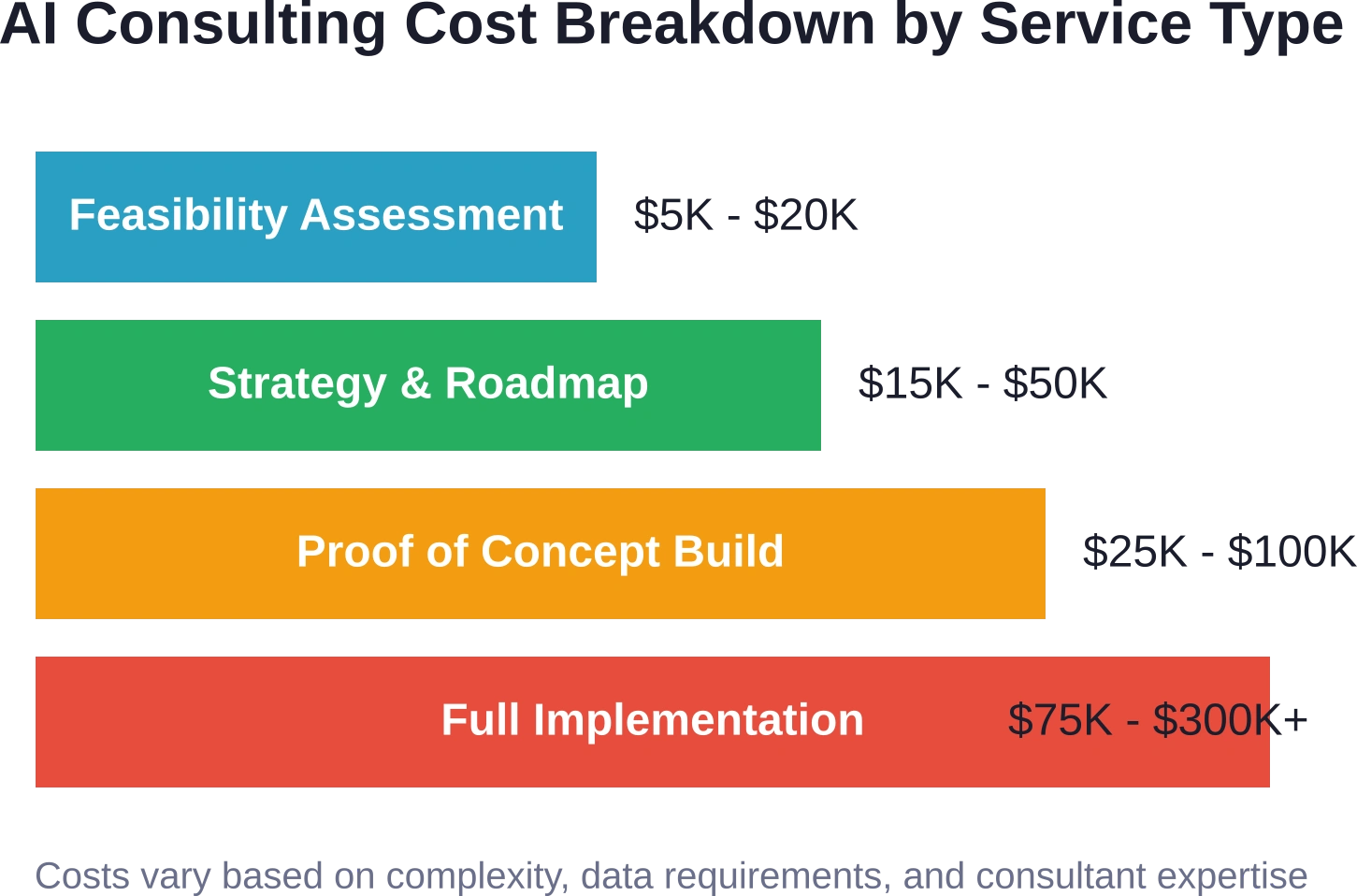
AI consulting costs vary dramatically based on scope, consultant expertise, and engagement length. Understanding typical pricing helps with budget planning.
Hourly Rates
Independent AI consultants and small firms typically charge between $150-$400 per hour, depending on specialization and experience level. Strategy-focused consultants often sit at the higher end of that range.
Large consulting firms charge $250-$600+ per hour, with premium firms commanding even higher rates for specialized AI expertise.
Project-Based Pricing
Fixed-price projects for discrete scopes typically range from a few thousand dollars for narrow assessments up to $50,000-$200,000+ for comprehensive strategy and implementation work.
For example, automation strategy consulting focused on optimizing tech stacks and resources starts around £3,200 according to available market pricing. More extensive implementations involving custom model development run substantially higher.
Value-Based Arrangements
Some consultants structure deals around outcomes rather than time invested. This might include equity stakes, success fees tied to performance metrics, or hybrid models combining base fees with performance bonuses.
Value-based pricing aligns incentives but requires clear, measurable success criteria and longer engagement timelines to prove results.
Maximizing ROI from AI Consulting
Getting value from consulting relationships requires active participation, not passive outsourcing. Several practices improve outcomes.
Define Clear Objectives
Vague goals like “explore AI opportunities” produce vague results. Specific objectives—”reduce customer support ticket volume by 30%” or “improve sales forecast accuracy by 20%”—focus consultant efforts and create measurable success criteria.
Document these objectives upfront and revisit them throughout the engagement to ensure work stays aligned with business priorities.
Ensure Data Readiness
AI systems require data. Consultants can’t build effective models if data is scattered across systems, poorly documented, or full of quality issues.
Invest time preparing data before consulting engagements begin. Clean, well-organized data accelerates every subsequent step and reduces consulting hours spent on data wrangling.
Allocate Internal Resources
Consultants need internal counterparts who understand the business context, have authority to make decisions, and can coordinate across teams. Engagements stall when consultants can’t get questions answered or access required systems.
Plan for internal team members to dedicate 10-20% of their time supporting consultant work, more for complex implementations.
Knowledge Transfer
The best consulting engagements leave internal teams capable of maintaining and extending the work after consultants depart. Build knowledge transfer into the engagement structure—documentation, training sessions, and hands-on collaboration.
Otherwise, companies become dependent on external support for every future modification or issue.
Government Support for AI-Powered Startups
Federal programs provide resources that complement private consulting relationships and reduce implementation costs.
The U.S. Small Business Administration notes that the federal government has adopted artificial intelligence to better serve the public, and small businesses can similarly use AI tools to do more with less.
Regional Innovation Clusters
SBA’s Regional Innovation Clusters deliver direct support to innovative small businesses and startups across the country. In October 2024, SBA announced 14 new awards expanding the RIC network, with awardees serving as hubs in sectors including biotech, cybersecurity, smart manufacturing, and agriculture.
RICs provide services like accelerators, market research, customer discovery, and government and commercial contracting assistance—all valuable complements to private AI consulting.
Research Infrastructure Access
The National Science Foundation’s National Artificial Intelligence Research Resource provides access to computing resources, data, models, and educational materials. Through the NAIRR Classroom initiative, NSF expands education and training to new research and learning communities.
Over its first two years, NAIRR attracted approximately $100 million in private sector in-kind contributions, engaged 28 private sector partners and 14 federal partners, supported 600+ research and education projects, and reached 6,000+ students.
NSF data shows that startups in its Convergence Accelerator and Innovation Corps programs numbered 531 in FY 2021, 398 in FY 2022, 378 in FY 2023, and 435 in FY 2024—demonstrating continued federal support for technology-focused new ventures.
Real-World Success Patterns
Looking at actual startup implementations reveals what separates successful AI consulting engagements from disappointing ones.
Start Small, Scale Fast
The most successful implementations begin with narrow, well-defined use cases rather than trying to transform entire business models overnight. Prove value in one area, then expand to others.
One example from SBA case studies: rockITdata, an IT consulting services company founded in 2019, saw a 280% increase in revenue after 2020, reaching over $6 million in 2021 revenue through focused technology expertise. The company provides IT consulting and mission support to government and commercial sectors, demonstrating how focused technology expertise drives growth.
Measure Continuously
Successful teams establish measurement frameworks before implementation begins and track metrics throughout. This creates feedback loops that guide optimization and prove business value.
Without measurement, it’s impossible to know whether AI investments deliver returns or just consume resources.
Balance Automation with Human Oversight
AI works best augmenting human capabilities rather than replacing them entirely. Research indicates that human-AI teams can outperform humans working alone when properly designed—but that collaboration requires thoughtful workflow design.
Consultants who understand this balance help startups automate appropriate tasks while preserving human judgment where it matters most.
Emerging Trends Reshaping AI Consulting
The AI consulting landscape keeps evolving as new capabilities emerge and market dynamics shift.
AI-Native Consulting Startups
A new wave of startups is reimagining consulting delivery using AI tools to dramatically reduce costs and accelerate timelines. These companies use AI to automate research, analysis, and even aspects of strategy development.
Community discussions note that while these AI-powered consulting services don’t yet match the quality of premium firms, they offer instant availability and significantly lower price points—appealing to startups with limited budgets.
Vertical Specialization
AI consulting increasingly splits along industry verticals as domain expertise becomes more critical. Healthcare AI consulting requires understanding HIPAA compliance and clinical workflows. Financial services AI consulting needs regulatory knowledge and risk management expertise.
Generalist AI consultants struggle to compete with specialists who understand both the technology and the specific business context.
Emphasis on Responsible AI
Concerns about bias, transparency, and ethical implications drive demand for consultants who can implement AI systems responsibly. This includes fairness testing, explainability methods, and governance frameworks.
Regulatory pressure amplifies this trend. Organizations need consultants who understand both technical implementation and compliance requirements.
When to Delay or Avoid AI Consulting
AI consulting isn’t always the right move. Several situations call for caution or delay.
Premature Optimization
Pre-product startups still validating problem-solution fit shouldn’t invest heavily in AI infrastructure. Focus on proving core value first, then optimize with AI once product-market fit exists.
AI can’t fix fundamental product or business model issues.
Insufficient Data
Machine learning requires substantial data to train effective models. If a startup hasn’t accumulated enough quality data yet, AI consulting delivers limited value. Wait until data assets justify the investment.
Unclear Business Case
If the expected ROI from AI implementation doesn’t clearly exceed consulting and development costs, delay the investment. Focus on lower-hanging fruit that delivers better returns.
Limited Implementation Capacity
Consultants can design beautiful AI systems, but someone needs to maintain them. Without internal technical capacity or budget for ongoing support, AI implementations decay rapidly after consultants depart.
Key Questions to Ask Prospective Consultants
Evaluating AI consultants requires probing beyond marketing materials. These questions surface important information:
- Can you share case studies from similar companies in our industry or with similar challenges?
- What specific AI tools, frameworks, and platforms do you typically recommend, and why?
- How do you approach data quality assessment and preparation?
- What does your typical engagement timeline look like from kickoff to production deployment?
- How do you structure knowledge transfer to ensure internal teams can maintain AI systems after your engagement ends?
- What metrics do you use to measure success, and how do you track them?
- Who will actually do the work—senior consultants or junior team members?
- What happens if the initial approach doesn’t deliver expected results?
Strong consultants answer these questions clearly and specifically. Vague responses or overreliance on buzzwords signal potential problems.
Building Internal AI Capabilities Long-Term
Even with excellent consulting support, startups eventually need internal AI capabilities as they scale. Planning this transition from the beginning prevents painful dependencies.
Hire Strategically
Initial AI hires should combine technical skills with business acumen. Data scientists who understand product strategy and customer needs deliver more value than pure researchers focused solely on model performance.
STEM employment data from federal sources indicates significant workforce participation in technical fields. The talent pool exists—accessing it requires competitive compensation and compelling problems to solve.
Document Everything
Consultant-built systems need comprehensive documentation for future internal teams to understand and maintain. Make documentation a formal deliverable in every consulting agreement.
Participate in Implementation
Internal team members who work alongside consultants during implementation learn faster and understand systems more deeply than those who just receive handoff documentation.
Structure consulting engagements as collaborative partnerships rather than outsourced projects.
Conclusion
AI consulting for startups bridges the gap between cutting-edge technology and practical business needs. The right consultants accelerate implementation timelines, help avoid costly mistakes, and deliver measurable results—without requiring companies to build extensive internal expertise before launching AI initiatives.
But success requires more than just hiring consultants. Startups need clear objectives, prepared data, dedicated internal resources, and realistic expectations about timelines and costs.
The AI consulting market keeps evolving as new tools emerge and best practices develop. What worked two years ago may not represent the optimal approach today. That’s actually an argument for consulting relationships—experienced consultants stay current with the rapidly shifting landscape so internal teams don’t have to.
Start with a narrow, high-impact use case. Measure results rigorously. Build internal capabilities gradually while leveraging external expertise strategically. That approach positions startups to capture AI’s benefits without betting the company on unproven technology.
Ready to explore AI consulting for your startup? Define specific business objectives, assess data readiness, and begin conversations with consultants who have relevant domain expertise. The sooner planning begins, the faster AI capabilities can drive real business value.
Frequently Asked Questions
How much does AI consulting typically cost for startups?
AI consulting costs range from $5,000-$20,000 for initial feasibility assessments up to $75,000-$300,000+ for full implementations. Hourly rates run $150-$600 depending on consultant expertise and firm size. Project scope, data complexity, and required customization drive total costs more than any single factor.
How long does a typical AI consulting engagement take?
Timelines vary by scope. Feasibility assessments take 2-4 weeks. Strategy development requires 3-6 weeks. Proof-of-concept builds span 6-12 weeks. Full production implementations run 12-24 weeks or longer for complex systems. Factor additional time for data preparation, which often reveals unexpected delays.
Should startups hire AI consultants or build internal teams?
Early-stage startups benefit more from consulting until AI use cases prove their value and scale justifies full-time hires. Consultants provide immediate expertise without long-term payroll commitments. As AI becomes central to the product or operations, transition to internal teams while using consultants for specialized expertise gaps.
What’s the difference between AI consulting and general technology consulting?
AI consulting requires specialized expertise in machine learning, data science, model deployment, and AI-specific infrastructure. General technology consultants understand software development and systems integration but may lack the depth needed for AI model training, optimization, and production deployment at scale.
How can startups measure ROI from AI consulting investments?
Establish baseline metrics before implementation begins—customer support ticket volume, sales forecast accuracy, content production time, or whatever the AI system aims to improve. Track those same metrics post-deployment. Calculate cost savings or revenue gains and compare against total consulting and implementation costs to determine ROI.
Do AI consultants require access to proprietary company data?
Most AI implementations require access to real data for training and testing models. Consultants should sign comprehensive non-disclosure agreements. Consider starting with synthetic or anonymized data for initial prototyping, then providing real data only for final model training. Verify consultants follow security best practices for data handling and storage.
What happens after the consulting engagement ends?
Strong consulting engagements include knowledge transfer, documentation, and training so internal teams can maintain AI systems independently. Many consultants offer ongoing support retainers for troubleshooting and optimization. Clarify post-engagement support options before signing agreements to avoid unexpected dependencies.
 English
  German
  Arabic
  French
  Dutch
Dutch  Spanish