
Quick Summary: Artificial intelligence is revolutionizing agriculture through precision farming, predictive analytics, and automated systems that optimize crop yields, reduce resource waste, and help farmers make data-driven decisions. From soil health monitoring to drone-assisted surveillance and disease detection, AI technologies are addressing critical challenges like climate change, labor shortages, and the need to feed 9.7 billion people by 2050. With AI-driven advisory costs dropping from $30 to around $3 per farmer, according to FAO data, these innovations are becoming accessible even to smallholders in low- and middle-income countries.
Agriculture stands at a crossroads. The sector already generates about one-third of global greenhouse gas emissions and withdraws roughly 70% of the world’s freshwater. Yet more than 638 million people remain chronically undernourished.
The challenge? Feeding an additional 2-3 billion people by mid-century while reducing environmental harm and coping with declining labor availability.
Enter artificial intelligence. AI technologies are transforming how farmers monitor soil, predict yields, detect diseases, and manage resources. And the numbers tell a compelling story.
The Economic Case: Why AI Adoption Is Accelerating
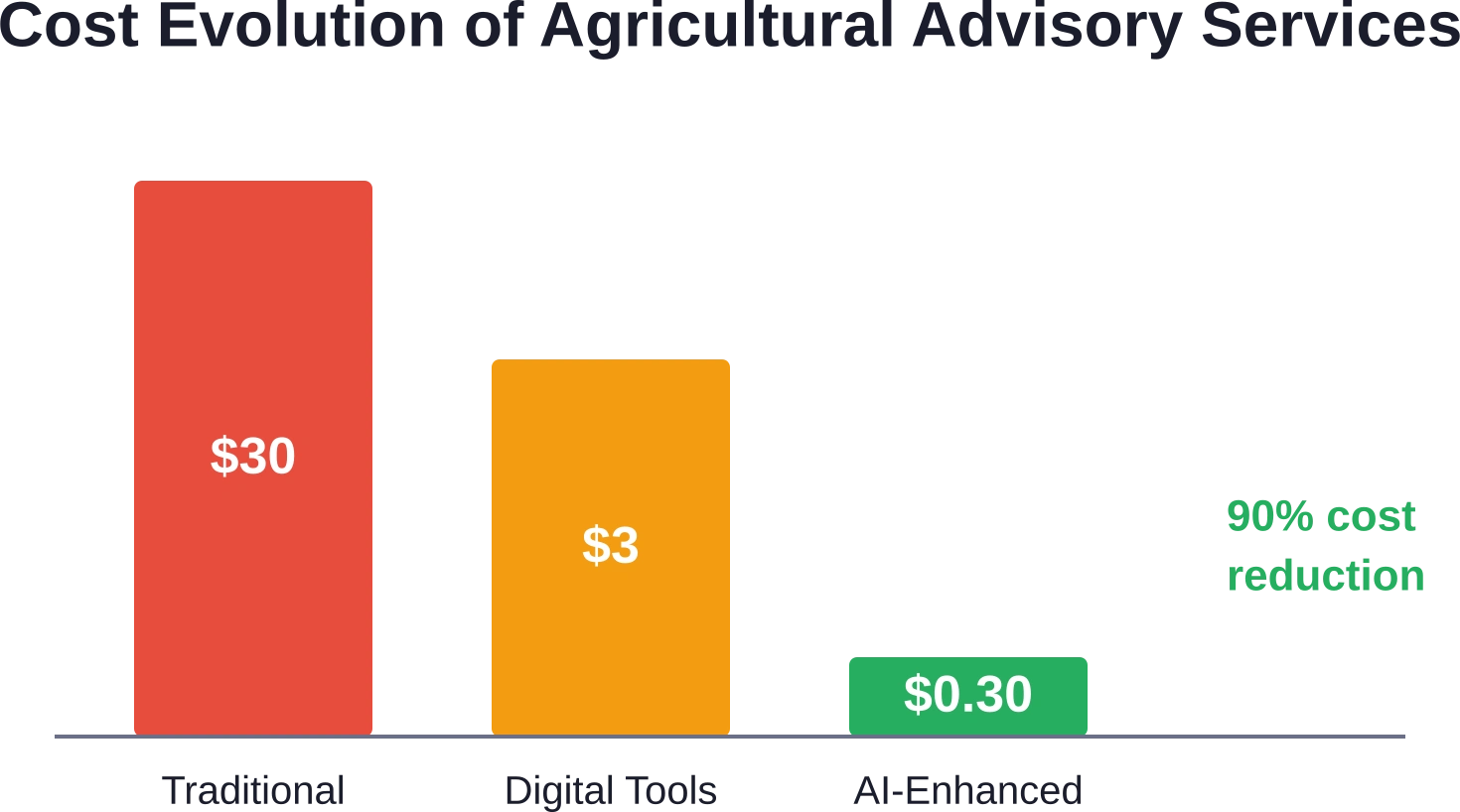
Traditional agricultural advisory services have long been prohibitively expensive. According to FAO data, conventional advisory support costs around $30 per farmer. Digital tools brought that down to roughly $3 per farmer.
AI-enhanced systems? According to FAO data, digital tools have reduced costs to around $3 per farmer, with further reductions anticipated.
That’s a 90% cost reduction from traditional methods ($30 to $3). For smallholders working on fewer than two hectares—who represent a significant portion of global agricultural producers and contribute substantially to food production—this accessibility shift changes everything.
The AI in Agriculture Market is projected to grow from $1.7 billion in 2023 to $4.7 billion by 2028. That growth reflects not just hype but measurable impact.
Seven Core Applications Transforming Farming
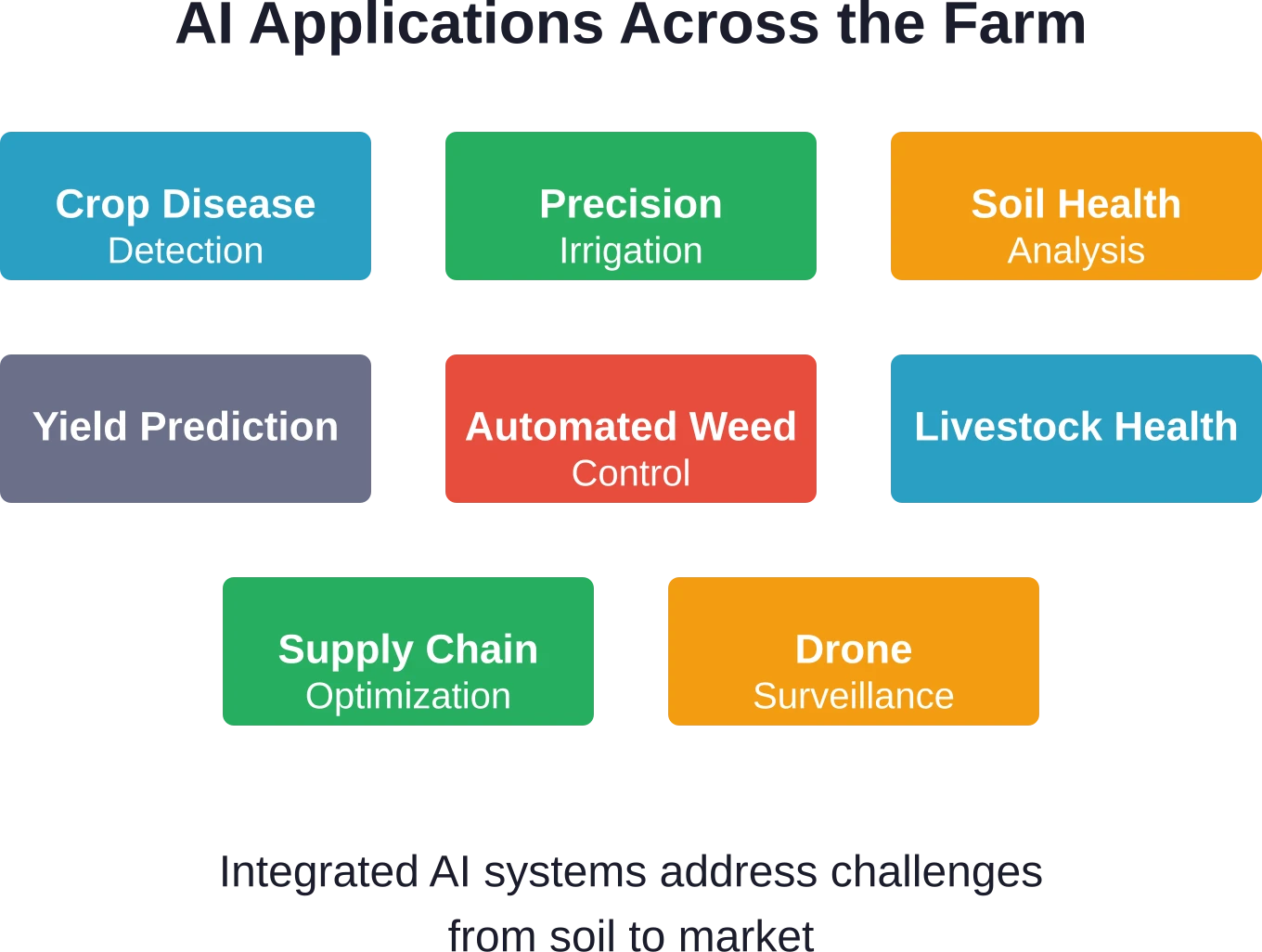
AI isn’t a single technology. It’s a cluster of capabilities—machine learning, computer vision, predictive analytics—that solve distinct agricultural challenges.
Crop Disease Detection and Prevention
Computer vision systems trained on thousands of plant images can now identify diseases before human eyes spot symptoms. One study in Computers and Electronics in Agriculture demonstrated an AI system detecting apple scab with 95% accuracy.
Early detection means targeted intervention. Less pesticide waste. Higher yields.
Precision Irrigation and Water Management
Agriculture already consumes 70% of global freshwater. AI-driven irrigation systems analyze soil moisture data, weather forecasts, and crop water requirements in real-time.
The result? Water gets delivered exactly when and where crops need it. Not a gallon wasted.
Soil Health and Nutrient Optimization
Research from the USDA Agricultural Research Service shows AI accelerating soil dynamics analysis. Machine learning models process complex interactions between soil composition, water movement, and nutrient availability across large land areas.
Traditional soil testing requires lab work and waiting. AI systems deliver insights in hours, not weeks.
Yield Prediction and Crop Planning
Predictive analytics combine historical yield data, weather patterns, soil conditions, and satellite imagery to forecast harvest outcomes months in advance.
Farmers can adjust planting schedules, allocate resources more effectively, and negotiate better prices with advanced knowledge of supply.
Some ongoing AI agriculture projects report yield augmentation of 30-35% compared to conventional methods.
Automated Weed Control Systems
Computer vision distinguishes crops from weeds at the individual plant level. Robotic systems apply herbicides only where needed—or mechanically remove weeds without chemicals.
Herbicide use drops. Costs fall. Soil health improves.
Livestock Health Monitoring
Wearable sensors and computer vision track animal behavior, body temperature, and movement patterns. AI algorithms flag health issues before they become critical.
Early intervention reduces veterinary costs and prevents disease spread through herds.
Supply Chain and Demand Forecasting
Beyond the farm gate, AI optimizes logistics, predicts market demand, and reduces food waste. Machine learning models analyze consumption patterns, weather impacts on supply, and transportation variables.
Perishable goods reach markets faster. Waste shrinks.

Apply Machine Learning to Agriculture Data With AI Superior
Agriculture teams can use machine learning when field data, sensor readings, satellite or drone images, equipment data, and production records need to support better planning. AI Superior provides AI consulting, AI/ML development, predictive analytics, computer vision, data analytics, and custom AI software development. For agriculture, this can be relevant to crop monitoring, yield prediction, anomaly detection, disease detection from images, resource planning, and analysis of sensor or operational data.
For agriculture teams, AI Superior can support:
- Finding useful machine learning use cases in agriculture
- Developing predictive models for yield or resource planning
- Building computer vision tools for crop or image analysis
- Working with sensor, field, and equipment data
- Connecting AI models to existing agriculture platforms
Contact AI Superior to explore machine learning use cases for your agriculture data, workflows, or agritech product.
Real-World Implementation: What’s Working Now
Theory sounds great. But what about actual deployments?
FAO is piloting AI-enhanced agricultural advisory systems in Ethiopia and Mozambique. These use datasets tailored to local conditions rather than generic internet data.
The USDA National Institute of Food and Agriculture (NIFA) funds multiple AI research initiatives. One notable effort is the AI Institute for Future Agricultural Resilience, Management, and Sustainability (AIFARMS) at the University of Illinois, which received $19,998,042 in cumulative funding.
AIFARMS focuses on developing autonomous systems and human-augmented decision-making tools. The research allocation includes 60% basic research, 30% applied research, and 10% developmental work.
Companies like SatSure exemplify commercial success. The satellite data analytics firm operates with a 200-member team across India, the U.S., and EU, serving enterprise customers in 12 countries. The company has raised $25 million in equity capital to date.
Benefits Beyond Yield: The Environmental and Social Case
Higher crop yields matter. But AI’s agricultural impact extends further.
| Benefit Category | Impact | Mechanism |
|---|---|---|
| Resource Efficiency | 30-50% reduction in water use | Precision irrigation based on real-time soil and weather data |
| Chemical Reduction | Up to 90% less herbicide | Targeted application via computer vision and robotics |
| Labor Productivity | 3-5x increase per worker | Automation of monitoring, spraying, and harvesting tasks |
| Climate Resilience | Better adaptation to weather extremes | Predictive models adjust planting and resource allocation |
| Soil Health | Reduced erosion and degradation | Optimized nutrient application prevents overuse and runoff |
Climate change poses an existential threat to agriculture. AI systems help farmers adapt by predicting frost events, optimizing planting windows for shifting seasons, and recommending drought-resistant crop varieties based on long-term weather modeling.
Labor shortages plague agriculture globally. Autonomous tractors, harvesting robots, and AI-guided machinery allow farms to maintain or increase output despite fewer available workers.
Challenges and Barriers to Adoption
AI isn’t a magic solution. Significant obstacles remain.
Data Availability and Quality
Machine learning requires training data. In many regions—particularly low- and middle-income countries—agricultural data is scarce, inconsistent, or non-existent.
Satellite imagery helps bridge this gap, but ground-truth validation still requires local collection efforts.
Infrastructure Requirements
AI systems need connectivity. Rural broadband access remains patchy in many agricultural regions. Without reliable internet, cloud-based AI services become impractical.
Edge computing—running AI models locally on farm equipment—offers a partial solution but increases upfront hardware costs.
Technical Expertise Gap
Operating AI-driven agricultural technology requires new skills. Many farmers lack training in data interpretation, system calibration, and troubleshooting.
Educational programs and extension services must evolve to support AI adoption. NIFA’s funding initiatives explicitly include workforce development components for this reason.
Economic Barriers for Smallholders
Despite falling operational costs, initial investment in sensors, drones, and AI-enabled equipment remains substantial. Smallholders operating on thin margins often can’t afford the capital outlay.
Cooperative models, equipment-sharing arrangements, and government subsidies may ease adoption, but these solutions take time to scale.
Trust and Transparency Issues
AI decisions can feel opaque. When a system recommends a fertilizer application rate or predicts a disease outbreak, farmers want to understand why.
Explainable AI—models that provide reasoning alongside recommendations—addresses this need but remains an active research area.
Policy and Institutional Support
Government agencies recognize AI’s agricultural potential and are backing it with funding.
NIFA’s Agriculture and Food Research Initiative (AFRI) includes multiple AI-focused program areas. The Data Science for Food and Agricultural Systems (DSFAS) priority specifically targets the intersection of AI and agriculture.
Strengthening Agricultural Systems grants for fiscal year 2026 offer funding ranging from $1 million to $10 million, with project durations up to 60 months for Coordinated Agriculture Projects.
The FAO’s Digital Agriculture and AI Innovation initiative promotes responsible AI deployment in agrifood systems, particularly in developing nations. The organization emphasizes ethics-based approaches that account for local contexts and avoid exacerbating inequalities.
Future Trends: What’s Coming Next
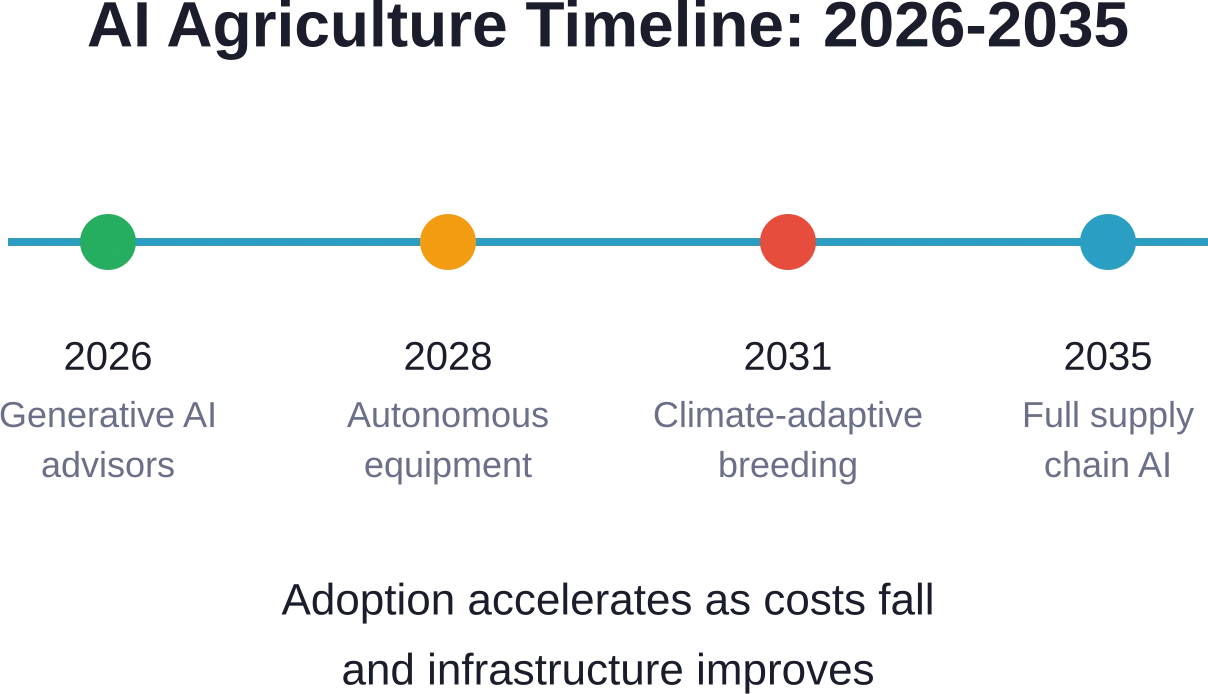
AI capabilities continue to advance rapidly. Several emerging trends will shape agriculture’s next decade.
Generative AI and Large Language Models
Tools like ChatGPT and Gemini are beginning to serve as agricultural decision support interfaces. Farmers can ask natural language questions—“Should I plant corn or soybeans given this year’s weather forecast?”—and receive data-backed recommendations.
Research at institutions like the University of Wisconsin explores how large language models can summarize agronomic research, generate crop reports, and assist with regulatory compliance documentation.
Multi-Modal Sensing Integration
Future systems will combine satellite imagery, drone surveillance, ground-based sensors, and IoT devices into unified analytics platforms. This multi-modal approach delivers more accurate insights than any single data source.
Autonomous Farm Operations
Fully autonomous tractors and harvesters are moving from research labs to commercial deployment. These machines handle planting, weeding, spraying, and harvesting with minimal human supervision.
Autonomy doesn’t eliminate farmers—it shifts their role toward strategic management rather than manual operation.
Blockchain and AI Integration
Combining AI with blockchain creates transparent, verifiable supply chains. Consumers can trace food from farm to table, with AI verifying quality and sustainability claims at each step.
Climate-Adaptive Breeding Programs
AI accelerates crop breeding by predicting which genetic combinations will thrive under future climate scenarios. Machine learning analyzes thousands of trait variations far faster than traditional field trials.
Getting Started: Practical Steps for Farmers
Farmers interested in AI adoption don’t need to overhaul operations overnight. Incremental implementation works better.
Start with a single pain point. If irrigation costs are high, pilot an AI-driven water management system on a small plot. If disease strikes annually, test computer vision disease detection.
Look for government programs and grants. NIFA funding opportunities exist for both research institutions and production agriculture operations. State agriculture departments increasingly offer technology adoption support.
Partner with universities and extension services. Land-grant universities conduct field trials and provide training. Participating in research projects often means accessing AI technology at reduced or zero cost.
Join agricultural cooperatives or technology-sharing networks. Spreading capital costs across multiple farms makes expensive equipment viable. Shared learning accelerates the knowledge curve.
Frequently Asked Questions
How much does AI agricultural technology cost?
Costs vary widely depending on application. Basic soil sensors and smartphone-based AI apps can cost under $500 annually per farm. Comprehensive systems with drones, autonomous equipment, and full analytics platforms may require $50,000-$500,000 in initial investment. According to FAO data, digital tools have reduced advisory costs to around $3 per farmer, compared to $30 for traditional methods, with further reductions anticipated.
Can small farms benefit from AI, or is it only for large operations?
Smallholder farmers are increasingly gaining access to AI tools. Cloud-based analytics, mobile apps, and equipment-sharing cooperatives make AI technology economically viable even for farms under two hectares. FAO initiatives in Ethiopia and Mozambique specifically target small-scale producers. The key is choosing right-sized solutions rather than enterprise-scale systems.
What kind of training is needed to use AI farming tools?
Modern AI agricultural systems emphasize user-friendly interfaces. Basic smartphone literacy is often sufficient for mobile advisory apps. More complex systems—drones, autonomous tractors—require structured training, typically provided by equipment manufacturers or extension services. NIFA-funded programs include workforce development components to address the skills gap.
Does AI replace farmers or help them?
AI augments rather than replaces human expertise. Autonomous systems handle repetitive, physically demanding tasks—monitoring thousands of plants, applying inputs with precision, analyzing sensor data. Farmers shift toward strategic decision-making, relationship management, and business development. Labor productivity increases, but human judgment remains essential.
How accurate are AI crop yield predictions?
Accuracy depends on data quality and model sophistication. Well-trained systems analyzing comprehensive datasets (satellite imagery, weather, soil data, historical yields) achieve 85-95% accuracy for major crops under normal conditions. Extreme weather events and novel pest outbreaks reduce accuracy. Predictions improve as systems accumulate more local data over multiple growing seasons.
What are the main barriers to AI adoption in agriculture?
Five key barriers slow adoption: inadequate rural internet connectivity, lack of training and technical support, high upfront costs for equipment, insufficient local agricultural data for model training, and farmer skepticism about opaque AI recommendations. Infrastructure investment, subsidies, cooperative models, and explainable AI research are addressing these challenges.
How does AI help agriculture adapt to climate change?
AI systems analyze long-term climate trends and predict local impacts on growing conditions. This enables farmers to adjust planting dates, select drought-resistant varieties, optimize irrigation for changing rainfall patterns, and prepare for extreme weather events. Predictive models forecast frost, heat waves, and pest migrations with increasing accuracy, allowing proactive rather than reactive management.
Conclusion: The Path Forward
Artificial intelligence won’t solve every agricultural challenge. But it’s proving indispensable for feeding a growing global population while reducing environmental harm.
The technology exists. Costs are falling rapidly. Government support is expanding. Real-world deployments demonstrate measurable impact—30-35% yield improvements, 90% cost reductions for advisory services, dramatic cuts in water and chemical use.
The question isn’t whether AI will transform agriculture. It’s how quickly farmers, institutions, and policymakers can scale proven solutions and ensure equitable access.
For producers, now is the time to explore pilot projects, seek out training opportunities, and connect with extension services. For policymakers, continued investment in infrastructure, research funding, and workforce development will determine how widely these benefits spread.
Agriculture has always been about working with nature to produce abundance. AI gives farmers more powerful tools for that ancient task. The next decade will show how well those tools deliver on their promise.
Ready to explore AI solutions for your operation? Contact your state agricultural extension service to learn about available programs, pilot opportunities, and training resources.