Quick Summary: AI is reshaping entertainment through automated content creation, personalized recommendations, and production cost savings—while raising questions about creativity, copyright, and job displacement. The technology offers media companies potential cost reductions of 10-30% while opening new creative possibilities, but requires balancing innovation with ethical considerations and data protection.
The entertainment industry stands at a crossroads. Artificial intelligence isn’t just knocking at the door—it’s already inside, rewriting scripts, composing soundtracks, and personalizing what millions watch every night.
And the stakes couldn’t be higher. The global AI market in entertainment jumped from $17.1 billion in 2023 to a projected $195.7 billion by 2033. That’s not a gradual change. That’s an explosion.
But here’s the thing—AI in entertainment isn’t about robots replacing creativity. It’s about smarter production pipelines, hyper-personalized experiences, and cost structures that make premium content accessible to smaller studios. It’s also about navigating copyright minefields, protecting audience data, and figuring out where human artistry ends and algorithmic output begins.
This shift is transforming everything from how blockbusters get made to how indie musicians distribute tracks. Real talk: understanding AI’s role in media isn’t optional anymore. It’s essential.
The Financial Impact: Why Studios Are Betting Big on AI
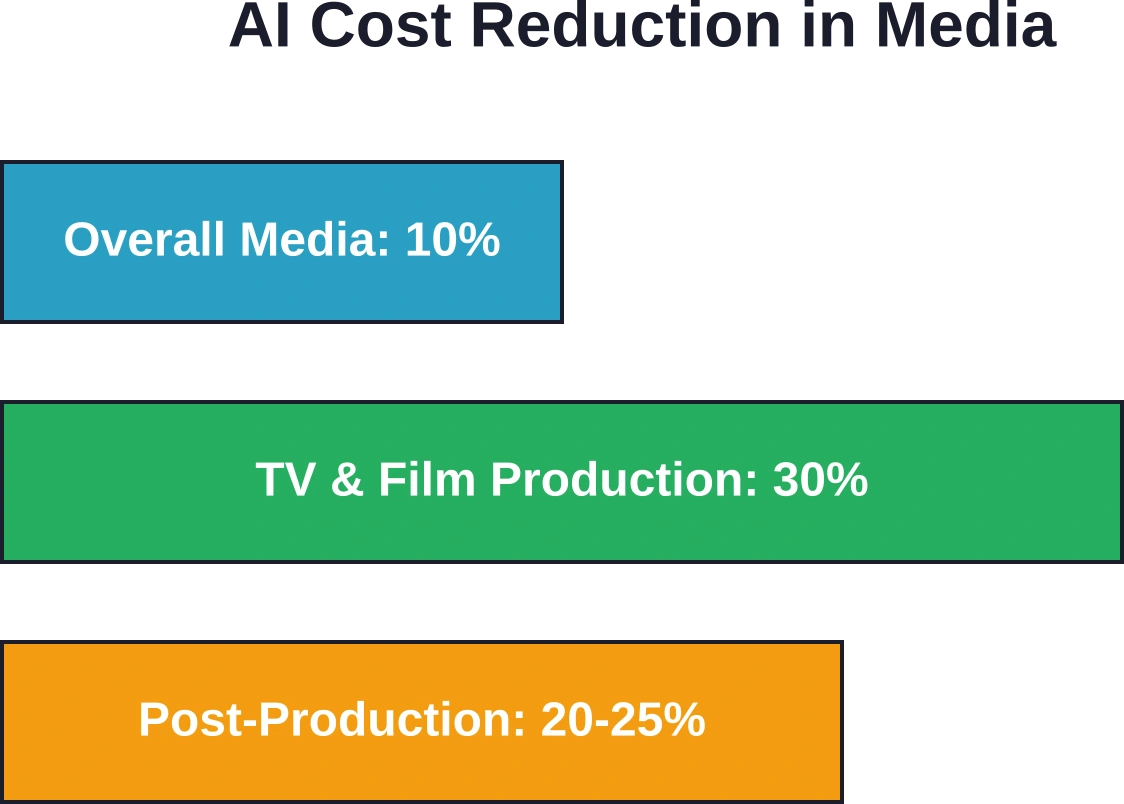
Money talks, and AI is screaming. Generative AI could lead to cost reductions of approximately 10% across the entire media industry. For TV and film production specifically, those savings could hit 30%.
Think about what that means. A major studio recently spent around five years and $250 million producing a blockbuster animated movie. AI-assisted workflows could slash both timelines and budgets dramatically.
The technology handles time-consuming tasks that previously required armies of specialists. Real-time rendering, automated visual effects adjustments, hyper-realistic environment generation—all happening faster and cheaper than traditional methods.
Venture capital funding for generative AI has grown significantly in recent years. Music AI company Suno secured significant funding to support AI music generation, signaling confidence in AI’s creative applications.
But cost savings are just one piece. The competitive landscape is shifting. Smaller companies and new entrants can now produce content that previously required major studio resources. That democratization changes who gets to tell stories—and which stories get told.
Content Creation: Where Automation Meets Artistry
AI-generated content isn’t science fiction anymore. It’s Tuesday.
In partnership with Ross Goodwin, Benjamin AI created the science fiction film “Zone Out” in 48 hours. Sure, it won’t win Oscars. But it proves the concept: AI can handle narrative structure, dialogue generation, and scene composition.
Music production saw similar breakthroughs. AI tools now compose original scores, generate variations for different emotional tones, and even adapt soundtracks in real-time based on gameplay or viewer engagement data.
Visual effects departments use AI for complex tasks that once required weeks of manual labor. Hyper-realistic environments, character de-aging, crowd simulation, weather effects—all accelerated through machine learning algorithms trained on thousands of reference images.
Sound familiar? This is what industry analysts mean when they talk about AI “enhancing real-time rendering” and “automating complex visual tasks.” It’s not replacing artists. It’s changing what they spend time on.
The Creative Paradox
But wait. Does efficiency equal artistry?
According to experts at American University’s Kogod School of Business, the challenge isn’t technical—it’s philosophical. The next generation of industry leaders needs to balance technical fluency with “the enduring power of human creativity.”
Brett Ashley Crawford from Carnegie Mellon University poses the central question: Is art inherently better because a human created it?
There’s no easy answer. AI can generate technically proficient content at scale. What it can’t do—yet—is understand cultural context, lived experience, or the intentional imperfection that makes art resonate emotionally.
Personalization and Audience Engagement
Ever wonder why streaming recommendations feel eerily accurate? AI.
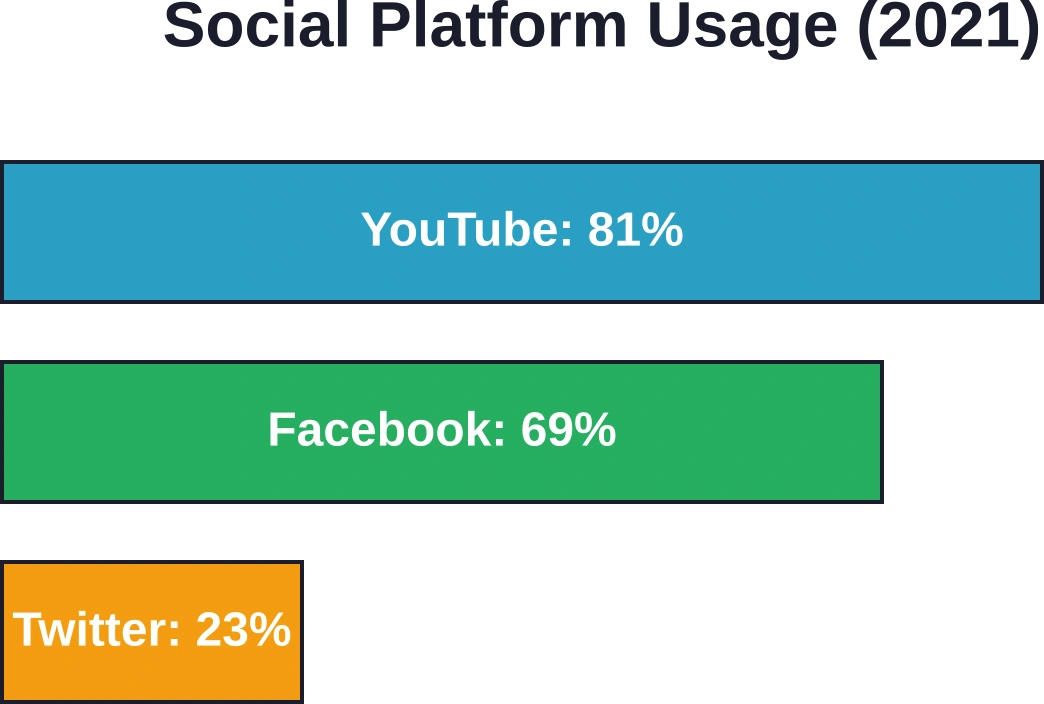
YouTube’s recommendation algorithm drives 70% of all views on the platform. With 81% of American adults using YouTube as of 2021—compared to 69% on Facebook and 23% on Twitter—that algorithmic influence reaches hundreds of millions.
Approximately 55 million Americans regularly get news through YouTube. The platform isn’t just entertainment; it’s a primary information source shaped almost entirely by machine learning.
Now, here’s the important part. Research from Brookings Institution examined YouTube users’ exposure to algorithmically-driven content patterns. Instead, the data suggests users self-select into viewing patterns. The algorithm learns preferences and serves similar content—but it’s not consistently manipulating choices toward extremes.
Personalization extends beyond recommendations. AI analyzes viewing patterns to optimize release schedules, trailer cuts, and even which thumbnail images get shown to different audience segments.
Gaming companies use AI to adapt difficulty curves, generate dynamic quests, and create procedurally generated worlds that respond to individual play styles. That’s not just personalization—it’s mass customization at a scale impossible through manual design.
Use Cases Reshaping the Industry
AI applications in entertainment span the entire production pipeline.
Pre-Production and Development
Script analysis tools evaluate screenplays against thousands of successful films, identifying structural weaknesses and predicting audience appeal. Studios use AI to assess market potential before greenlighting projects.
Casting directors employ facial recognition and performance analysis to match actors with roles. Location scouts use computer vision to find filming sites matching specific visual criteria.
Production Workflows
On set, AI-powered cameras automatically track subjects, adjust focus, and optimize lighting. Virtual production environments blend real-time rendering with live action, letting directors see final composite shots during filming rather than months later in post-production.
Motion capture systems use machine learning to translate actor movements into digital characters with minimal manual cleanup. What used to require weeks of animator time now happens in near real-time.
Post-Production and Distribution
Editing assistants analyze footage to suggest cuts, identify best takes, and even assemble rough cuts based on narrative structure. Color grading AI matches visual tones across scenes automatically.
Localization teams use AI for dubbing and subtitle generation, adapting content for global markets faster and cheaper than traditional methods.
| Production Stage | AI Application | Primary Benefit |
|---|---|---|
| Pre-Production | Script analysis, casting optimization | Risk reduction, market fit |
| Production | Automated camera work, virtual environments | Time savings, creative flexibility |
| Post-Production | Editing assistance, VFX automation | Cost reduction, faster turnaround |
| Distribution | Personalized marketing, localization | Audience reach, engagement optimization |
Content Moderation and Safety
With content volume exploding daily, protecting audiences becomes increasingly difficult. Research conducted by the European Union found concerning levels of harmful content across platforms.
AI moderation systems scan video, audio, and text for policy violations. Machine learning models detect violence, hate speech, copyright infringement, and age-inappropriate content at scales human moderators couldn’t match.
That said—and this matters—automated systems make mistakes. Algorithmic bias in content moderation can silence marginalized voices or miss context-dependent violations. Organizations like RAND Corporation have documented significant risks around bias and errors in AI decision-making.

Build Practical AI Tools for Entertainment With AI Superior
Entertainment companies often sit on useful data from user activity, content libraries, subscriptions, watch time, in-app behavior, ratings, and engagement patterns. AI Superior can support this work through AI consulting, machine learning, predictive analytics, business intelligence, computer vision, and custom AI software development. Their team helps companies move from raw platform data to AI use cases that can actually be built and tested. This can be useful for streaming services, media platforms, gaming products, and digital entertainment teams that need clearer insight into how people interact with content.
AI Superior can help with:
- Defining AI use cases for entertainment platforms
- Building recommendation and personalization tools
- Creating predictive models for churn or engagement
- Analyzing audience, content, and subscription data
- Integrating AI features into existing digital products
Contact AI Superior to discuss how AI can support your entertainment platform, content analytics, or user data workflows.
The Copyright Minefield
Okay, so what about intellectual property?
The U.S. Copyright Office has been examining AI-related copyright issues since early 2023. After hosting public sessions and receiving over 10,000 comments, the Office released a comprehensive report titled “Copyright and Artificial Intelligence, Part 2: Copyrightability” in January 2025. The key finding: existing copyright frameworks are flexible enough to address emerging AI-related copyright issues without the need for new legislation. The Office firmly restated its core position that copyright protection strictly requires human authorship, meaning outputs generated entirely by artificial intelligence with no human creative input are not eligible for copyright protection. However, it clarified that copyright can protect original human expression (such as the creative selection, coordination, modification, or arrangement of elements) within a work that incorporates AI-generated material, provided that the human contribution is distinct and perceptible.
Purely machine-generated content doesn’t qualify. This creates gray areas throughout the industry.
If an AI writes a screenplay with minimal human editing, who owns it? If a composer uses AI to generate melodic variations and then arranges them, is that copyrightable? If a visual effects artist uses AI to create background elements, does that affect the film’s copyright status?
Training data raises separate concerns. Many AI models learned from copyrighted works—potentially millions of songs, films, scripts, and images ingested without explicit permission. Legal battles over this “fair use” question are ongoing.
Privacy and Data Protection Challenges
AI personalization requires data. Lots of it.
Streaming platforms collect viewing histories, pause patterns, skip behaviors, search queries, and device information. Gaming companies track play sessions, in-game choices, social interactions, and spending habits. Music services analyze listening patterns down to which songs get skipped within the first 30 seconds.
All that data feeds recommendation engines and content optimization algorithms. But it also creates privacy risks.
In 2024, AI accounted for 44% of US VC-backed investments, up from 25% in 2023. That growth reflects both opportunity and urgency around data infrastructure.
Entertainment companies must balance innovation with protection. Regulatory frameworks like GDPR in Europe and evolving US state laws impose strict requirements on data collection, storage, and usage.
Algorithmic bias detection and mitigation become critical. Research from Brookings Institution and others shows that AI systems can inadvertently discriminate based on race, gender, age, or other protected characteristics.
Consider online recruitment tools: Amazon discovered its AI hiring system discriminated against women because it was trained on historical data reflecting male-dominated workforces. Similar biases appear in entertainment AI—recommendation systems that underserve diverse content, moderation tools that disproportionately flag certain communities, or casting algorithms that perpetuate industry stereotypes.
The Human Creativity Debate
Here’s where opinions split sharply.
Ge Wang from Stanford argues that using generative AI to create finished art is “the least imaginative use of AI imaginable.” The analogy: asking someone else to play a video game while you watch from the couch, offering occasional prompts.
The criticism isn’t about AI as a tool—it’s about skipping the creative process entirely. Wang suggests the prevailing mindset treats AI purely as labor-saving automation, missing the technology’s potential for genuine creative partnership.
Others see AI as democratizing creativity. Not everyone has years to master animation software, musical composition, or cinematography. AI tools lower barriers, letting more people express ideas that would otherwise remain trapped in imagination.
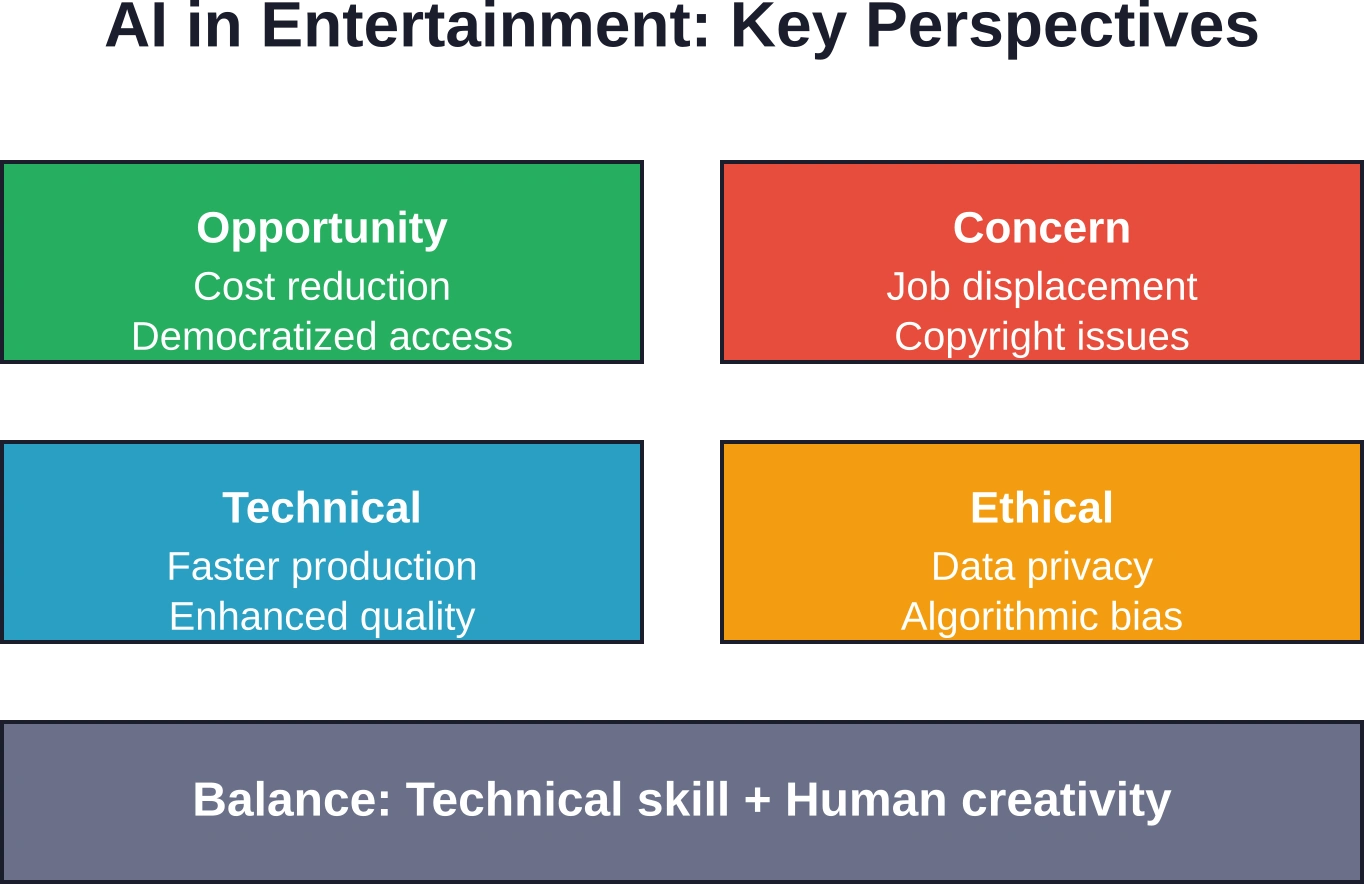
The truth probably lies somewhere between. AI won’t replace human storytellers, but it will change what storytelling looks like—and who gets to do it.
Real-World Industry Examples
Theory meets practice across the industry.
Major streaming platforms use AI to optimize everything from content acquisition to thumbnail A/B testing. Machine learning models predict which shows will succeed in specific markets, informing multi-million dollar licensing decisions.
Video game developers implement AI for non-player character behavior, dynamic difficulty adjustment, and procedural level generation. Some games feature AI-composed adaptive soundtracks that respond to gameplay intensity.
Music streaming services employ AI for playlist curation, artist discovery, and even predicting which emerging artists will break through. Some platforms experiment with AI-generated “mood music” for background listening.
News organizations use AI to generate routine reports—earnings summaries, sports recaps, weather updates—freeing journalists for investigative work requiring human judgment.
Looking Forward: What’s Next?
The entertainment industry faces both tremendous opportunity and genuine disruption.
AI will continue improving efficiency and reducing costs. Production timelines that currently span years could compress to months. Independent creators will access tools previously limited to major studios.
Personalization will get creepily accurate. Interactive content might adapt in real-time to viewer emotional responses, measured through devices or biometric feedback.
Virtual performers—AI-generated characters with consistent personalities across appearances—could become entertainment staples. Some might achieve celebrity status despite not existing physically.
But challenges persist. Copyright frameworks need updating for AI realities. Privacy protections must evolve as data collection intensifies. Algorithmic bias requires ongoing attention and mitigation.
Most critically, the industry must define AI’s role without sacrificing what makes entertainment meaningful. Technical capability doesn’t guarantee cultural value. Efficiency doesn’t equal artistry.
Organizations like MIT Sloan Review emphasize that successful AI integration requires clear governance, ethical guidelines, and commitment to transparency. Companies rushing to implement AI without addressing these fundamentals risk both backlash and failure.
Frequently Asked Questions
How much can AI reduce entertainment production costs?
Industry analyses suggest AI could reduce costs by approximately 10% across all media sectors. For TV and film production specifically, cost reductions could reach 30%, particularly in post-production and visual effects workflows. These savings come from automating time-intensive tasks like rendering, compositing, and color grading.
Will AI replace human creatives in entertainment?
AI is more likely to augment rather than replace human creativity. The technology excels at automating technical tasks, generating variations, and optimizing workflows—but struggles with cultural context, emotional nuance, and intentional artistic choices that define compelling entertainment. Experts at institutions like Carnegie Mellon University and American University emphasize training the next generation to balance technical fluency with uniquely human creative skills.
How do entertainment platforms use AI for personalization?
Streaming services analyze viewing patterns, search behavior, pause points, and skip rates to train recommendation algorithms. YouTube’s algorithm drives 70% of all platform views. These systems predict content preferences, optimize release timing, customize marketing materials, and even influence which thumbnail images different users see for the same content. Gaming platforms use similar approaches to adapt difficulty, suggest content, and personalize in-game experiences.
What are the main privacy concerns with AI in entertainment?
Entertainment AI requires massive data collection—viewing habits, device information, behavioral patterns, and sometimes biometric data. Privacy risks include unauthorized data sharing, inadequate security leading to breaches, lack of transparency about data usage, and algorithmic profiling that reveals sensitive information users didn’t explicitly provide. Regulatory frameworks like GDPR impose strict requirements, but enforcement and compliance remain ongoing challenges.
How does algorithmic bias affect entertainment AI?
AI systems can perpetuate or amplify existing biases present in training data. Research from organizations like Brookings Institution and RAND Corporation documents cases where recommendation algorithms underserve diverse content, moderation tools disproportionately flag certain communities, and automated systems make discriminatory decisions. Amazon discovered its recruitment AI discriminated against women because historical hiring data reflected existing gender imbalances. Entertainment companies must actively detect and mitigate these biases through diverse training data, regular audits, and inclusive design practices.
What investment trends show AI’s growth in entertainment?
Venture capital funding for generative AI has grown significantly in recent years. In 2024, AI accounted for 44% of all US VC-backed investments, up from 25% in 2023. Individual companies across the entertainment sector raised substantial funding for AI music generation and other creative technologies. The global AI market in entertainment is projected to grow from $17.1 billion in 2023 to $195.7 billion by 2033, reflecting both investor confidence and industry transformation.
Conclusion
AI isn’t coming to entertainment—it’s already here, embedded in production pipelines, streaming platforms, and creative tools used daily across the industry.
The technology offers genuine benefits: reduced costs, faster production, democratized access, and personalized experiences at unprecedented scale. Companies achieving 10-30% cost reductions can reinvest savings in more diverse content, experimental projects, and broader distribution.
But the transformation comes with serious questions. Who owns AI-generated content? How do we protect audience privacy while enabling personalization? Can algorithmic systems avoid perpetuating bias? Where does automation end and human creativity begin?
The entertainment industry’s challenge isn’t choosing between AI and human creativity—it’s integrating both thoughtfully. The studios, platforms, and creators who succeed will be those who use AI to amplify human insight rather than replace it.
As technology evolves, one thing seems certain: entertainment in 2026 looks different than it did even two years ago. And 2028 will bring changes we haven’t imagined yet.
The question isn’t whether AI belongs in entertainment. The question is how the industry harnesses this powerful tool while preserving what makes stories, music, and experiences genuinely matter to human audiences.