
Quick Summary: Big data analytics in e-commerce enables online retailers to personalize customer experiences, optimize pricing strategies, forecast demand, and improve supply chain operations through the analysis of massive datasets from transactions, browsing behavior, and market trends. According to U.S. Census Bureau data, e-commerce sales reached $365.2 billion in Q4 2025, growing 5.3% year-over-year, while businesses using data-driven marketing improve customer acquisition efficiency by up to 30%.
The e-commerce industry generates an extraordinary volume of data every second. Every click, search query, purchase, and abandoned cart creates a digital footprint that reveals customer intent, preferences, and behavior patterns.
And retailers who can analyze this information effectively gain a decisive competitive edge.
Big data analytics has evolved from a luxury reserved for tech giants into a baseline requirement for any online retailer serious about growth. According to the U.S. Census Bureau, e-commerce now represents 16.6% of total retail sales, with Q4 2025 generating $365.2 billion in online revenue—a 5.3% increase compared to the same period in 2024.
But here’s the thing: collecting data isn’t the challenge anymore. Turning that data into actionable insights that drive revenue, reduce costs, and improve customer satisfaction is where most businesses struggle.
What Big Data Analytics Actually Means for E-Commerce
Big data analytics refers to the process of examining massive, complex datasets to uncover patterns, correlations, and insights that inform business decisions. In the e-commerce context, this means analyzing information from dozens of sources simultaneously—transaction histories, website behavior, social media engagement, inventory systems, shipping logistics, and market trends.
The defining characteristics of big data are often described as the “three Vs”:
- Volume: The sheer quantity of data generated by millions of customer interactions, product views, and transactions
- Velocity: The speed at which new data flows in—real-time clickstreams, live inventory updates, immediate payment processing
- Variety: The diverse formats and sources—structured database records, unstructured text reviews, images, video engagement metrics, sensor data from IoT devices
Traditional analytics tools can’t handle this scale or complexity. That’s why modern e-commerce platforms rely on specialized big data technologies—distributed computing frameworks, machine learning algorithms, and cloud-based data warehouses designed to process terabytes of information in seconds.
Primary Data Sources Feeding E-Commerce Analytics
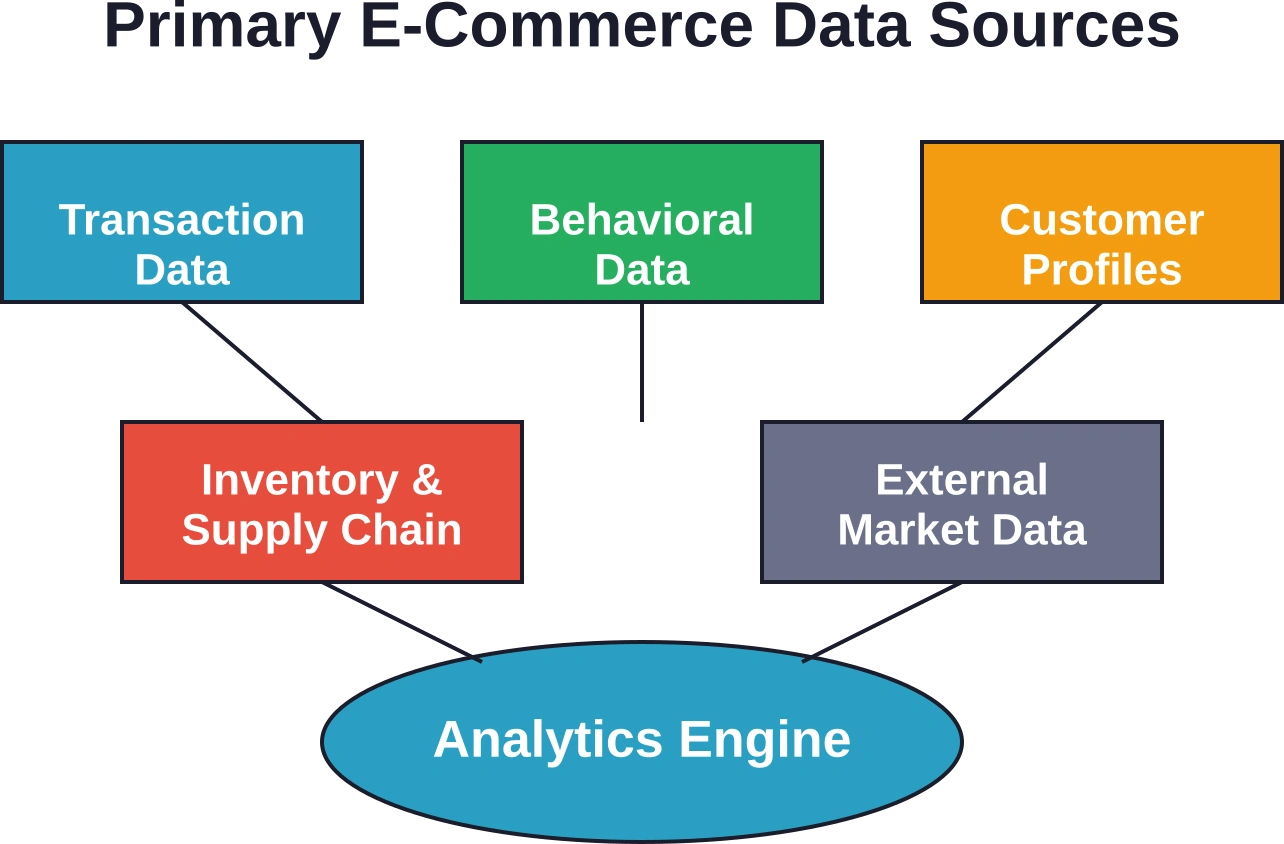
Understanding where e-commerce data originates helps clarify how analytics systems work. Online retailers typically pull information from these core sources:
Transaction and Payment Data
Every completed purchase generates structured data about products bought, quantities, pricing, payment methods, shipping addresses, and timestamps. This transactional data forms the foundation of revenue analysis, customer lifetime value calculations, and product performance metrics.
Payment processing systems also provide fraud detection signals, authorization rates, and payment method preferences across different customer segments.
Website and App Behavioral Data
Analytics platforms track how visitors navigate through digital storefronts. Page views, time on site, scroll depth, search queries, filter selections, product comparisons, and cart additions all reveal customer intent and friction points.
Heatmaps and session recordings show where users click, where they hesitate, and where they abandon the purchase journey. This behavioral data identifies optimization opportunities that can significantly improve conversion rates.
Customer Profile and CRM Data
Customer relationship management systems store demographic information, purchase history, communication preferences, support tickets, loyalty program participation, and email engagement metrics. When combined with behavioral data, these profiles enable sophisticated segmentation and personalization strategies.
Inventory and Supply Chain Data
Warehouse management systems, supplier databases, shipping carriers, and logistics platforms generate data about stock levels, reorder points, delivery times, return rates, and fulfillment costs. This operational data directly impacts pricing strategies, product availability, and customer satisfaction.
External Market Data
Competitive intelligence, social media sentiment, search trends, seasonal patterns, economic indicators, and industry reports provide context for internal data. External data sources help retailers anticipate market shifts and benchmark performance against competitors.
How Big Data Analytics Transforms E-Commerce Operations
The real value of big data analytics emerges when retailers apply insights to specific business challenges. Here’s how leading e-commerce companies leverage analytics across critical operational areas.
Personalization That Actually Drives Revenue
Generic shopping experiences no longer cut it. Modern consumers expect retailers to understand their preferences, anticipate their needs, and present relevant products without requiring extensive searching.
Netflix demonstrated the power of data-driven personalization years ago. According to research from McKinsey & Company, 75% of what users watch on Netflix comes from the platform’s recommendation engine, which analyzes viewing patterns across millions of subscribers.
Amazon generates 35% of its revenue through its product recommendation system.
Personalization extends beyond product recommendations. Analytics systems can customize search results, adjust email content, modify homepage layouts, tailor promotional offers, and even personalize pricing based on customer segment and purchase probability.
Dynamic Pricing and Revenue Optimization
Pricing strategy used to involve setting a margin above cost and occasionally running promotions. Big data analytics enables far more sophisticated approaches.
Dynamic pricing algorithms continuously adjust prices based on dozens of variables—competitor pricing, inventory levels, demand signals, time of day, customer segment, purchase history, and predicted willingness to pay. Airlines and hotels pioneered these techniques, but e-commerce retailers increasingly adopt similar strategies.
Analytics reveals which products are price-sensitive and which compete on other factors. Some items generate higher margins at premium prices because buyers prioritize quality or convenience. Others must match or undercut competitors to maintain sales velocity.
Promotional effectiveness analysis shows which discount strategies actually drive incremental revenue versus simply transferring sales that would have happened anyway at full price. This prevents margin erosion from unnecessary promotions.
Predictive Analytics for Demand Forecasting
Predicting future demand remains one of the most valuable applications of big data in e-commerce. Accurate forecasts prevent two expensive problems: stockouts that lose sales and disappoint customers, and excess inventory that ties up capital and eventually requires clearance markdowns.
Traditional forecasting relied on historical sales patterns and simple seasonal adjustments. Modern predictive analytics incorporates dozens of signals—trending search terms, social media buzz, weather forecasts, economic indicators, promotional calendars, and competitive activity.
Machine learning models identify complex patterns that human analysts would miss. They detect which products experience coordinated demand (customers who buy X often purchase Y within two weeks), how promotions on one category affect sales in adjacent categories, and which external factors most strongly correlate with demand shifts.
These forecasts feed directly into inventory management systems, automatically triggering purchase orders, allocating stock across distribution centers, and optimizing fulfillment routing to minimize shipping costs and delivery times.
Supply Chain Visibility and Optimization
E-commerce operations depend on complex supply chains spanning manufacturers, warehouses, carriers, and last-mile delivery networks. Big data analytics creates visibility across this entire ecosystem.
Real-time tracking systems monitor shipments at every stage, identify delays before they impact delivery promises, and automatically reroute orders through alternative fulfillment centers when necessary. Predictive maintenance algorithms analyze equipment sensor data to schedule warehouse automation repairs before breakdowns occur.
Network optimization models determine the ideal number and location of fulfillment centers to minimize total logistics costs while meeting delivery speed commitments. These models balance facility costs, transportation expenses, and the strategic value of faster delivery in different markets.
Supplier performance analytics track quality metrics, on-time delivery rates, and lead time variability. This data informs procurement decisions and helps retailers diversify supply sources to reduce risk.
Customer Service and Retention Analytics
Customer service interactions generate valuable data about product issues, process friction, and unmet needs. Analyzing support tickets, chat transcripts, and call recordings reveals recurring problems that warrant systematic solutions rather than repeated one-off fixes.
Sentiment analysis algorithms process customer reviews and social media mentions to gauge brand perception and identify emerging issues before they escalate. Natural language processing extracts specific complaints and feature requests from unstructured text.
Churn prediction models identify customers at high risk of defecting based on behavioral signals—declining purchase frequency, increased support contacts, negative review sentiment, or engagement with competitor content. Retention campaigns can target these at-risk customers with personalized incentives.
Customer lifetime value models prioritize service resources toward high-value segments. Not every customer inquiry deserves the same response speed or resolution effort when resource constraints exist.
Marketing Attribution and Channel Optimization
E-commerce marketing spans numerous channels—search advertising, social media, email campaigns, affiliate partnerships, influencer collaborations, and content marketing. Analytics determines which channels drive profitable customer acquisition and which waste budget.
Multi-touch attribution models track the complete customer journey across multiple touchpoints before purchase. Instead of crediting only the last click before conversion, these models assign fractional credit to each interaction based on its influence on the final decision.
Research published by the University of California, Berkeley’s Haas School of Business found that data-driven marketing decisions improve customer acquisition efficiency by up to 30%. Marketing analytics also identifies which customer segments respond to different messages, creative formats, and promotional mechanics.
Campaign performance data feeds back into audience targeting, budget allocation, and creative development. This creates a continuous optimization loop that improves return on ad spend over time.

Turn E-commerce Data Into AI Systems With AI Superior
Big data analytics only becomes useful when it is connected to clear business tasks, not just stored in dashboards. AI Superior works with AI consulting, AI and data strategy, machine learning, predictive analytics, business intelligence, and custom AI software development. For e-commerce companies, this can support demand forecasting, customer segmentation, recommendation systems, pricing analysis, churn prediction, inventory planning, and better use of sales or customer data.
AI Superior can help with:
- Identifying practical AI use cases for e-commerce data
- Building predictive analytics and machine learning models
- Improving customer, product, and sales analytics
- Developing recommendation and forecasting systems
- Integrating AI solutions into existing platforms and workflows
Contact AI Superior to discuss how big data analytics can be turned into practical AI tools for your e-commerce business.
Types of Analytics E-Commerce Businesses Deploy
Not all analytics approaches serve the same purpose. E-commerce companies typically employ four distinct types of analytics, each answering different questions and requiring different technical capabilities.
Descriptive Analytics: Understanding What Happened
Descriptive analytics examines historical data to explain past performance. This includes sales reports, traffic analysis, conversion rate tracking, and customer segmentation studies.
Standard questions answered by descriptive analytics:
- Which products generated the most revenue last quarter?
- What was the average order value by customer segment?
- How did website traffic sources break down across channels?
- What percentage of shopping carts were abandoned at each checkout step?
While descriptive analytics doesn’t predict future outcomes, it provides the foundation for all other analytical approaches. Understanding baseline performance and historical trends is essential before attempting more advanced techniques.
Diagnostic Analytics: Understanding Why It Happened
Diagnostic analytics digs deeper to explain the causes behind observed patterns. When sales dropped last month, was it due to reduced traffic, lower conversion rates, decreased average order value, or some combination?
This type of analysis involves drilling down into data, comparing segments, running correlation studies, and testing hypotheses. Diagnostic analytics often reveals that the obvious explanation isn’t the actual cause.
For example, declining revenue might initially appear to result from reduced marketing spend. Deeper analysis could reveal that the real issue was slower page load times that decreased mobile conversion rates, while marketing actually delivered more traffic than usual.
Predictive Analytics: Understanding What Will Happen
Predictive analytics uses statistical models and machine learning algorithms to forecast future outcomes based on historical patterns and current signals.
Common predictive applications in e-commerce include:
- Demand forecasting for inventory planning
- Customer lifetime value prediction
- Churn risk scoring
- Fraud detection
- Price elasticity modeling
- Conversion probability for individual visitors
These models don’t guarantee future outcomes—they estimate probabilities and provide confidence intervals. But even imperfect predictions enable better decisions than assumptions or guesswork.
Prescriptive Analytics: Understanding What to Do About It
Prescriptive analytics goes beyond predictions to recommend specific actions. These systems consider multiple scenarios, evaluate trade-offs, and suggest optimal strategies given business constraints and objectives.
Examples include pricing optimization engines that recommend specific price points to maximize revenue, inventory allocation systems that determine how to distribute stock across warehouses, and marketing budget optimizers that suggest spend levels across channels to hit acquisition targets at the lowest cost.
Prescriptive analytics often incorporates techniques like simulation modeling, optimization algorithms, and reinforcement learning. This represents the most advanced and valuable type of analytics, but also requires the most sophisticated technical infrastructure and analytical expertise.
| Analytics Type | Core Question | E-Commerce Application | Technical Complexity |
|---|---|---|---|
| Descriptive | What happened? | Sales reports, traffic analysis, conversion tracking | Low |
| Diagnostic | Why did it happen? | Root cause analysis, segment comparison, correlation studies | Medium |
| Predictive | What will happen? | Demand forecasting, churn prediction, fraud detection | High |
| Prescriptive | What should we do? | Pricing optimization, inventory allocation, budget optimization | Very High |
Essential Metrics E-Commerce Retailers Should Track
With unlimited data available, focusing on the metrics that actually matter becomes critical. These key performance indicators provide the clearest picture of e-commerce health and opportunity areas.
Conversion Rate Metrics
Overall conversion rate (percentage of visitors who complete a purchase) serves as the primary measure of website effectiveness. But breaking this down reveals more actionable insights:
- Conversion rate by traffic source (organic search, paid ads, email, social, direct)
- Conversion rate by device type (desktop, mobile, tablet)
- Conversion rate by customer type (new vs. returning)
- Micro-conversions like email signups, wishlist additions, or product reviews
Tracking where conversion rates differ significantly highlights both problems and opportunities.
Customer Acquisition and Retention Metrics
Customer acquisition cost (CAC) measures total marketing and sales expense divided by new customers acquired. This must remain below customer lifetime value (LTV) to maintain profitable growth.
Retention metrics include repeat purchase rate, average time between purchases, and customer churn rate. Acquiring new customers costs five to seven times more than retaining existing ones, making retention economics critical.
Cohort analysis tracks how customer groups acquired in different periods behave over time. Do customers acquired through Instagram ads show better retention than those from Google search? This informs budget allocation.
Revenue and Profitability Metrics
Beyond top-line revenue, e-commerce businesses must track:
- Average order value (AOV)
- Revenue per visitor
- Gross margin by product category
- Contribution margin after variable costs
- Net revenue after returns and refunds
Product-level profitability analysis often reveals that 20% of SKUs generate 80% of profit, while some high-volume products actually destroy value when fulfillment costs and return rates are factored in.
Operational Efficiency Metrics
Logistics and fulfillment metrics directly impact both costs and customer satisfaction:
- Order fulfillment time from purchase to shipment
- On-time delivery rate
- Shipping cost as percentage of order value
- Return rate by product category
- Inventory turnover ratio
- Stockout frequency
These operational metrics often correlate strongly with customer satisfaction scores and repeat purchase rates.
Big Data Analytics Challenges in E-Commerce
Despite the compelling benefits, implementing effective big data analytics presents significant challenges that retailers must navigate.
Data Integration Complexity
E-commerce data lives in siloed systems—the website platform, payment processor, email service provider, inventory management system, shipping carriers, and customer service software all maintain separate databases with different data structures.
Creating a unified view requires data integration pipelines that extract, transform, and load information from all these sources into a centralized data warehouse. Building and maintaining these pipelines demands specialized technical skills and ongoing effort as systems change and new data sources emerge.
Data Quality and Consistency Issues
Analytics is only as good as the underlying data. Common quality problems include:
- Missing or incomplete records
- Duplicate entries from multiple systems
- Inconsistent formatting (product names, customer addresses)
- Delayed data updates that create timing mismatches
- Tracking gaps from ad blockers and privacy tools
Data cleaning and validation requires significant effort before analysis can even begin. Many organizations discover that 60-80% of analytics project time goes to data preparation rather than actual analysis.
Privacy and Security Concerns
E-commerce platforms handle sensitive personal information—names, addresses, payment details, purchase histories. According to the Federal Trade Commission, businesses must implement appropriate data security measures to protect this information and comply with regulations like the Children’s Online Privacy Protection Act (COPPA) for sites serving younger audiences.
The FTC emphasizes that companies should collect only the data they actually need, keep it secure, and dispose of it properly when no longer required. Data breaches can result in regulatory penalties, lawsuits, and devastating reputation damage.
Privacy regulations continue evolving, with requirements around customer consent, data access requests, and the right to deletion. Analytics systems must incorporate privacy controls and audit trails to demonstrate compliance.
Skills and Talent Gaps
Effective big data analytics requires expertise in statistics, programming, machine learning, database management, and business strategy. This combination of technical and commercial skills remains scarce.
Many retailers lack in-house data science teams and struggle to compete with tech companies for analytical talent. Even when organizations hire skilled analysts, they often fail to provide the tools, data infrastructure, and organizational support needed to succeed.
Technology Infrastructure Costs
Big data platforms require significant investment in cloud computing resources, specialized software licenses, and integration development. Smaller retailers may struggle to justify these costs or lack the scale to generate sufficient return on investment.
Cloud-based analytics services have reduced upfront costs compared to on-premise infrastructure, but ongoing expenses for compute power, storage, and software subscriptions still represent a substantial budget commitment.
The Role of Machine Learning and AI
Artificial intelligence and machine learning have become essential components of modern e-commerce analytics. These technologies excel at finding patterns in massive datasets that would be impossible for human analysts to detect.
Recommendation Engines
Machine learning powers the product recommendation systems that drive significant revenue for major retailers. These systems employ several techniques:
- Collaborative filtering analyzes patterns across many users—customers who bought products A and B often purchase product C, so recommend C to others who bought A and B.
- Content-based filtering recommends products similar to items a customer previously viewed or purchased based on product attributes like category, brand, price point, or features.
- Hybrid approaches combine multiple techniques and incorporate additional signals like trending products, seasonal relevance, and inventory considerations.
Computer Vision for Product Recognition
Visual search capabilities allow customers to upload images and find similar products. Computer vision algorithms analyze product photos to extract features, match styles, and suggest alternatives.
These same technologies help automate product categorization, detect image quality issues, and identify counterfeit listings on marketplace platforms.
Natural Language Processing
NLP algorithms process customer reviews, support tickets, social media mentions, and search queries to extract insights from unstructured text. Sentiment analysis gauges overall opinion, while entity recognition identifies specific products, features, or issues mentioned.
Chatbots and virtual shopping assistants use NLP to understand customer questions and provide relevant responses or product suggestions.
Fraud Detection Systems
Machine learning models analyze transaction patterns to identify potentially fraudulent orders. These systems consider hundreds of signals—device fingerprints, IP addresses, billing and shipping address mismatches, order velocity, email domains, and behavioral patterns.
As fraud techniques evolve, machine learning models adapt by learning from new attack patterns. This provides more effective protection than rule-based systems that fraudsters can systematically work around.
Regulatory and Compliance Considerations
E-commerce analytics must navigate an evolving regulatory landscape that governs data collection, usage, and customer rights.
Federal Trade Commission Guidelines
The FTC enforces consumer protection standards that impact how e-commerce businesses collect and use customer data. Companies must implement reasonable data security practices appropriate to the sensitivity and volume of information they handle.
The INFORM Consumers Act, which took effect in 2023, requires online marketplaces to collect and verify information from high-volume third party sellers. The law defines a “high-volume third party seller” as a seller in an online marketplace that doesn’t operate the online marketplace and that, in any continuous 12-month period during which the seller makes 200 or more separate sales totaling at least $5,000 in gross revenue, marketplaces must disclose specific seller information to consumers.
These requirements create additional data collection and verification obligations for marketplace platforms while attempting to reduce fraud and counterfeit products.
Payment Card Industry Standards
Any e-commerce business that processes credit card payments must comply with Payment Card Industry Data Security Standards (PCI DSS). These requirements govern how payment information is collected, transmitted, and stored.
Most retailers minimize PCI compliance burden by using payment processors that handle sensitive card data so it never touches the merchant’s systems. But analytics teams must still ensure that any customer data analysis excludes full payment card numbers or other restricted information.
Privacy and Consent Requirements
Various regulations require clear disclosure of data collection practices and mechanisms for customer consent. Privacy policies must explain what information is collected, how it’s used, who it’s shared with, and how customers can access or delete their data.
Analytics implementations should incorporate consent management, particularly for tracking technologies like cookies and behavioral analytics that monitor customer activity across sessions and devices.
Future Trends in E-Commerce Analytics
Several emerging trends will shape how retailers leverage big data analytics over the next few years.
Real-Time Personalization at Scale
The next generation of personalization systems will process customer signals in real-time to adapt the entire shopping experience instantly. Instead of batch-updating recommendations overnight, these systems will respond to each click, adjusting product displays, search results, promotional messages, and even page layouts within milliseconds.
This requires streaming analytics architectures that process events as they occur rather than analyzing historical batches of data.
Predictive Inventory and Autonomous Supply Chains
Advanced forecasting models will trigger automatic purchasing, production scheduling, and inventory allocation with minimal human intervention. These autonomous systems will optimize across multiple variables simultaneously—demand predictions, supplier lead times, transportation costs, warehouse capacity, and promotional calendars.
Some retailers are already testing systems where algorithms make most routine replenishment decisions, with human oversight reserved for unusual situations or strategic choices.
Voice and Conversational Commerce Analytics
As voice-activated shopping grows, analytics systems must process conversational data differently than traditional clickstream analysis. Understanding natural language queries, tracking multi-turn dialogues, and measuring voice commerce conversion funnels requires new analytical approaches.
Augmented Reality Shopping Data
AR try-on features for furniture, clothing, and cosmetics generate new types of behavioral data. Analytics can reveal which virtual try-ons lead to purchases, how many products customers test before buying, and which product views reduce return rates.
This spatial and interaction data provides entirely new signals about customer preferences and purchase intent.
Privacy-Preserving Analytics Techniques
Growing privacy concerns and regulations are driving development of analytics techniques that extract insights while protecting individual customer data. Approaches like differential privacy, federated learning, and synthetic data generation allow analysis without exposing sensitive information.
These technologies may become essential as privacy regulations tighten and customers demand greater control over their data.
Getting Started: Practical Implementation Steps
For retailers looking to improve their big data analytics capabilities, a phased approach reduces risk and builds momentum through early wins.
Assess Current State and Define Objectives
Start by documenting what data currently exists, where it lives, how it’s collected, and what quality issues are known. Then identify the specific business problems analytics should solve—improving conversion rates, reducing inventory costs, increasing customer retention, or optimizing marketing spend.
Clear objectives focus technical efforts on high-value use cases rather than unfocused experimentation.
Establish Data Infrastructure Foundations
Before advanced analytics can succeed, basic data infrastructure must work reliably. This means implementing:
- Consistent tracking across all customer touchpoints
- A centralized data warehouse or data lake
- Integration pipelines from key source systems
- Data quality monitoring and validation processes
- Access controls and security measures
This foundation work isn’t glamorous, but attempting sophisticated analysis on unreliable data infrastructure inevitably fails.
Start with Descriptive and Diagnostic Analytics
Most retailers should focus initial efforts on thoroughly understanding current performance before jumping to predictive modeling. Comprehensive dashboards, detailed segmentation analysis, and rigorous A/B testing programs deliver immediate value and build organizational analytics literacy.
These foundational capabilities also generate the clean historical data needed to train predictive models later.
Build or Buy Analytics Capabilities
Retailers face a build-versus-buy decision for analytics capabilities. Building custom solutions provides maximum flexibility but requires specialized technical talent and significant development time.
Purchasing commercial analytics platforms or using cloud-based analytics services accelerates deployment but may involve subscription costs and less customization.
Many organizations adopt a hybrid approach—using commercial platforms for standard capabilities while building custom solutions for competitive differentiators.
Cultivate a Data-Driven Culture
Technology and algorithms alone don’t create value. Organizations must develop cultural norms around data-driven decision making—testing assumptions, measuring outcomes, learning from failures, and scaling what works.
This requires training business teams to interpret data correctly, empowering analysts to challenge conventional wisdom, and ensuring executives model data-driven behavior in strategic decisions.
Real-World Success Factors
Looking at retailers who’ve successfully implemented big data analytics reveals common patterns that increase the probability of success.
Executive Sponsorship and Strategic Alignment
Analytics initiatives that begin as isolated technical projects without business sponsorship rarely deliver transformational impact. Successful programs have executive champions who connect analytics directly to strategic priorities and secure necessary resources.
Cross-Functional Collaboration
The most valuable insights emerge when analysts work closely with merchandising, marketing, operations, and customer service teams who understand domain-specific context and constraints. Pure technical teams working in isolation often build sophisticated models that are impractical to implement or miss critical business considerations.
Iterative Development and Quick Wins
Rather than attempting comprehensive analytics transformations all at once, successful retailers pursue iterative development—shipping minimum viable analytics capabilities quickly, gathering feedback, measuring impact, and continuously improving.
Early wins build organizational confidence and secure support for more ambitious initiatives.
Investment in Data Quality
Organizations that treat data quality as an ongoing discipline rather than a one-time cleanup project achieve far better analytical outcomes. This means implementing validation at collection points, monitoring quality metrics continuously, and dedicating resources to maintaining data integrity.
Balance Between Automation and Human Judgment
The most effective analytics programs combine algorithmic automation with human oversight and intervention. Algorithms excel at processing massive datasets and identifying patterns, but humans provide strategic context, ethical judgment, and creative problem-solving.
Successful retailers define clear boundaries—which decisions are fully automated, which receive algorithmic recommendations but require human approval, and which remain primarily human-driven with analytical support.
Frequently Asked Questions
What’s the difference between big data analytics and traditional e-commerce analytics?
Traditional e-commerce analytics typically examines structured data from limited sources using standard reporting tools—website traffic, sales transactions, and basic customer demographics. Big data analytics handles much larger volumes of information from diverse sources (structured and unstructured), processes data in real-time or near-real-time, and employs advanced techniques like machine learning to uncover patterns that traditional methods would miss. The scale, variety, and analytical sophistication differ significantly.
How much does implementing big data analytics cost for a mid-sized e-commerce business?
Costs vary tremendously based on current infrastructure, data volumes, analytical ambitions, and build-versus-buy decisions. A mid-sized retailer might spend $50,000-$200,000 annually on cloud analytics services, data integration tools, and visualization platforms. Adding a small internal analytics team (2-3 people) adds $200,000-$400,000 in compensation costs. Larger implementations with custom development and dedicated data science teams can easily exceed $1 million annually. The key is starting with focused use cases that deliver measurable ROI before scaling investment.
What skills should e-commerce data analysts have?
Effective e-commerce analysts combine technical capabilities with business acumen. Technical skills include SQL for database queries, statistical analysis, data visualization tools, and increasingly Python or R for advanced analytics. Machine learning knowledge helps for predictive applications. But equally important are business skills—understanding e-commerce operations, customer behavior, marketing channels, and supply chain dynamics. The ability to communicate insights clearly to non-technical stakeholders and translate business problems into analytical questions matters as much as technical prowess.
How do privacy regulations affect e-commerce analytics?
Privacy regulations like COPPA (enforced by the Federal Trade Commission) and various state and international laws impose requirements around data collection consent, usage limitations, customer access rights, and security measures. E-commerce analytics must incorporate consent management systems, data anonymization techniques, and retention policies that delete information when no longer needed. Tracking technologies like cookies now require explicit consent in many jurisdictions. These requirements add complexity but don’t prevent effective analytics—they simply demand more careful implementation and ongoing compliance monitoring.
Can small e-commerce businesses benefit from big data analytics, or is it only worthwhile for large retailers?
Small retailers absolutely can benefit from data analytics, though their approach differs from enterprise implementations. Cloud-based analytics platforms have dramatically reduced entry costs—small businesses can start with affordable tools that scale as they grow. Even basic analytics like cohort analysis, customer segmentation, and A/B testing deliver measurable improvements in conversion rates and customer retention. The key is focusing on high-impact use cases rather than attempting comprehensive analytics programs. Many small retailers see significant ROI from relatively simple implementations like email marketing optimization or basic personalization.
What’s the typical timeline to see ROI from big data analytics investments?
ROI timelines depend heavily on implementation scope and organizational readiness. Quick wins from descriptive analytics improvements—better dashboards, customer segmentation, and basic optimization—can deliver measurable value within 3-6 months. More sophisticated predictive models and automated decision systems typically require 12-18 months before full benefits materialize, as they need time to collect training data, refine algorithms, and integrate into business processes. Organizations should structure analytics programs to deliver incremental value throughout the journey rather than treating it as an all-or-nothing investment with distant payoff.
How does big data analytics help reduce cart abandonment rates?
Analytics addresses cart abandonment through several mechanisms. Behavioral analysis identifies where in the checkout process customers drop off, revealing friction points like unexpected shipping costs, complicated forms, or payment issues. Predictive models identify visitors with high abandonment risk in real-time, triggering interventions like exit-intent popups or live chat assistance. Retargeting analytics determine which abandoned cart email strategies work best for different customer segments. A/B testing validates which checkout modifications actually improve completion rates rather than relying on assumptions. Retailers using comprehensive analytics to optimize checkout flows typically reduce abandonment rates by 10-30%.
Conclusion
Big data analytics has transformed from a competitive advantage into a fundamental requirement for e-commerce success. The numbers tell a clear story—U.S. e-commerce sales reached $365.2 billion in Q4 2025 according to the Census Bureau, growing 5.3% year-over-year in an increasingly competitive market. Data-driven retailers consistently outperform competitors through superior personalization, optimized pricing, accurate demand forecasting, and efficient operations.
The retailers winning this data-driven competition aren’t necessarily those with the largest budgets or most sophisticated technology. They’re the ones who clearly connect analytics to business objectives, invest in data quality foundations, start with focused high-value use cases, and continuously iterate based on measured results.
Whether operating a small specialized retailer or a large multi-category marketplace, the path forward requires treating data as a strategic asset. That means building the infrastructure to collect and integrate information reliably, developing the analytical capabilities to extract insights, and cultivating an organizational culture that makes decisions based on evidence rather than intuition.
The e-commerce landscape will only become more data-intensive as technologies like AI-powered personalization, autonomous supply chains, and real-time optimization mature. Retailers who invest now in analytics foundations position themselves to compete effectively while those who delay fall further behind competitors who better understand their customers, markets, and operations.
Start by assessing current analytical capabilities honestly, identifying the business problems that data could solve, and taking concrete steps to build the infrastructure and skills needed to compete in a data-driven future.