
Quick Summary: Digital transformation consulting helps organizations integrate advanced technologies into their business operations through expert guidance, strategic planning, and change management. Consultants assess current systems, design transformation roadmaps, select appropriate technologies, and manage implementation while ensuring employee adoption. This strategic partnership typically delivers measurable improvements in operational efficiency, customer experience, and competitive positioning.
The pressure to digitize isn’t just hype anymore. Organizations worldwide are investing heavily in transformation initiatives, with IDC research showing that companies will invest $3.4 trillion in digital transformation by 2026.
But here’s the thing—throwing money at the problem doesn’t guarantee results. Investment alone won’t move the needle.
That’s where digital transformation consulting comes in. Not as a magic fix, but as strategic expertise that bridges the gap between ambition and execution. The right consulting partner brings frameworks, technical knowledge, and change management capabilities that most organizations lack internally.
This guide breaks down what digital transformation consulting actually involves, why companies pursue it, and how to navigate the process effectively.
Understanding Digital Transformation Consulting
Digital transformation consulting refers to the strategic integration of digital technologies across all business operations to improve efficiency, enhance customer experience, and drive innovation. Consultants work alongside internal teams to simplify complex processes through a design-led approach, enabling organizations to adapt to rapidly changing digital landscapes.
But what does that mean in practice?
Transformation consulting is about reinventing how organizations operate and deliver value by embedding technology across every function. It’s not just implementing new software. It’s fundamentally rethinking business models, workflows, and customer touchpoints through a digital lens.
According to MIT Sloan Management Review research, 93% of workers across industries and geographies affirm that being digitally savvy is essential to performing well in their role. The business world has accepted that markets, customers, and workers have gone digital.
Digital transformation consulting addresses this reality by providing organizations with both tactical advice and strategic vision.
What Makes Transformation Consulting Different
Traditional IT consulting focuses on specific systems or technical problems. Digital transformation consulting takes a broader view. It encompasses strategy development, technology selection, process redesign, organizational change, and adoption management.
The scope typically includes:
- Current state assessment and maturity analysis
- Future state vision and business case development
- Technology architecture and vendor selection
- Implementation roadmap and phasing strategy
- Change management and adoption programs
- Performance measurement and optimization
Research by Polaris Market Research predicts that the digital transformation market size will be constantly growing, reaching a CAGR of 23.6% until 2030. This growth reflects increasing demand for specialized expertise.

Plan Digital Transformation With AI Superior
AI Superior helps companies identify, assess, and define practical AI, data science, and machine learning opportunities. Their services cover AI consulting, AI software development, R&D, training, predictive analytics, NLP, computer vision, BI, and big data analytics.
For digital transformation work, this can help teams understand where AI fits, what data is needed, and which processes can be improved with custom tools instead of adding technology for its own sake.
Need AI Connected to Real Business Workflows?
AI Superior can help with:
- reviewing AI and data opportunities
- building custom automation and analytics tools
- developing PoC or MVP solutions
- integrating AI into current business systems
👉 Contact AI Superior to discuss your project.
Why Companies Hire Digital Transformation Consultants
Organizations pursue transformation consulting for several concrete reasons. Let’s examine the primary drivers.
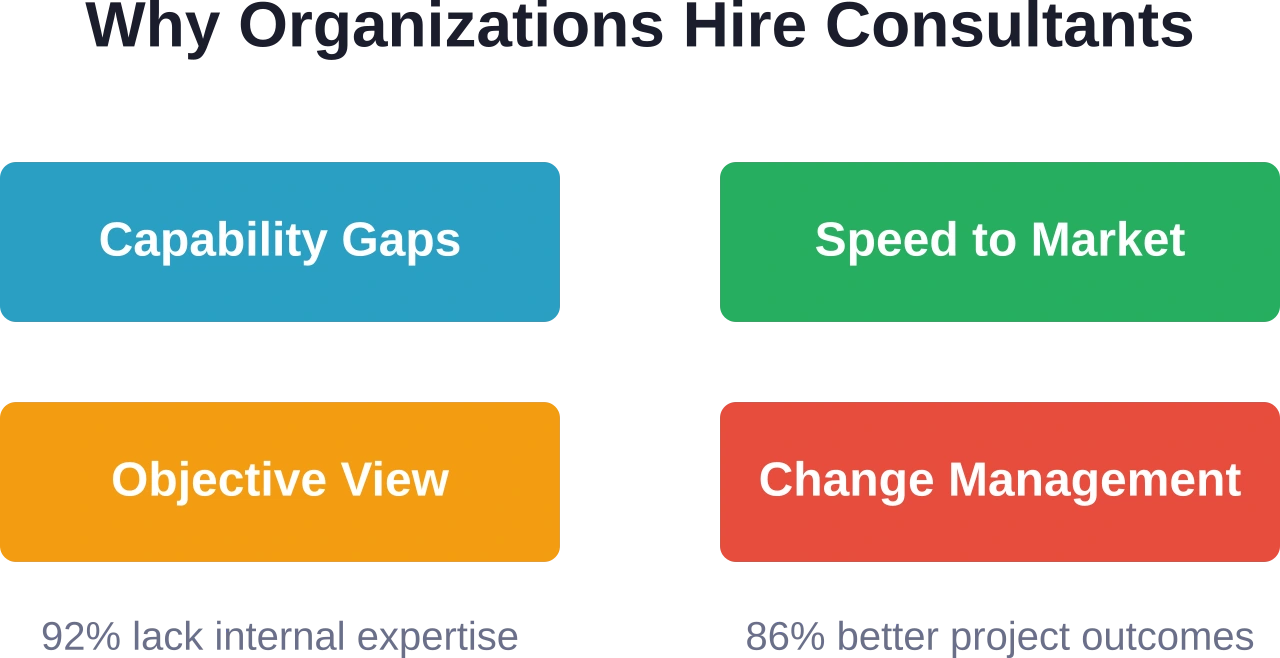
Capability Gaps
Most organizations lack the internal expertise to execute large-scale transformation. They understand the destination but not the path. Consultants fill this knowledge gap with frameworks, methodologies, and technical skills developed across multiple engagements.
According to a McKinsey report, 92% of companies do not believe their business model would remain economically viable through ongoing digitization without significant changes. That’s a sobering statistic.
The gap isn’t just technical. It’s strategic, cultural, and operational.
Accelerated Timelines
Building internal capabilities takes time—time many organizations don’t have. Consultants accelerate transformation by bringing ready-made expertise, established vendor relationships, and proven implementation approaches.
Speed matters. Competitive windows close quickly in digital markets.
Objective Perspective
Internal teams carry organizational baggage. They’re embedded in existing processes, political dynamics, and legacy thinking. External consultants provide objectivity that internal stakeholders can’t.
This outside perspective helps identify blind spots and challenge assumptions that hinder progress.
Change Management Expertise
Technology implementation is the easy part. Getting people to change how they work is harder. Consultants bring structured change management methodologies that address resistance, communicate effectively, and drive adoption.
Data shows this matters. Organizations that invested in change management capabilities saw a 43% increase in change management maturity alongside an 86% improvement in project success rates.
Core Services in Digital Transformation Consulting
Transformation consulting isn’t a single service. It’s a portfolio of capabilities that address different aspects of the transformation journey.
Strategy and Roadmap Development
Consultants start by defining the transformation vision. What business outcomes matter? Which capabilities need development? How should initiatives be sequenced?
This phase produces a transformation roadmap—a phased plan that balances quick wins with long-term structural changes. The roadmap identifies dependencies, resource requirements, and decision points.
Effective roadmaps don’t try to boil the ocean. They prioritize based on value, feasibility, and strategic importance.
Technology Assessment and Selection
The technology landscape is vast and confusing. Cloud platforms, analytics tools, automation solutions, collaboration systems—the options are overwhelming.
Consultants evaluate technologies against specific business requirements. They conduct vendor assessments, proof-of-concept testing, and total cost of ownership analysis. The goal is matching capabilities to needs without over-engineering or under-delivering.
Process Redesign and Optimization
Digital transformation requires reimagining business processes. Automating a broken process just makes it fail faster. Consultants map current workflows, identify inefficiencies, and design optimized future-state processes that leverage digital capabilities.
This work often uncovers opportunities beyond the original scope. Process redesign frequently delivers immediate value even before new technology goes live.
Implementation and Integration
Consultants manage the technical implementation—configuring systems, migrating data, building integrations, and conducting testing. They coordinate across vendors, internal IT teams, and business stakeholders.
Integration is particularly critical. New systems must connect with existing infrastructure. Data needs to flow seamlessly across platforms. APIs, middleware, and data pipelines all require careful design.
Change Management and Training
Technology adoption fails without effective change management. Consultants develop communication plans, conduct training programs, identify change champions, and create feedback loops.
Research shows significant variance in outcomes based on change management approach. According to MIT CISR research, data wrapping represents 26 percent of the value a company creates from data monetization, with performance varying based on execution quality.
The difference? People-focused transformation that addressed both technology and behavior.
The Digital Transformation Consulting Process
While every engagement differs, most follow a recognizable pattern. Here’s how the process typically unfolds.
Phase 1: Discovery and Assessment
Consultants begin by understanding the current state. They conduct stakeholder interviews, review existing systems, analyze processes, and assess organizational readiness. This diagnostic phase identifies strengths, weaknesses, opportunities, and constraints.
Key deliverables include maturity assessments, gap analyses, and preliminary recommendations. The discovery phase typically lasts 4-8 weeks depending on organizational complexity.
Phase 2: Strategy and Planning
Armed with discovery insights, consultants develop the transformation strategy. This includes defining the vision, setting measurable objectives, identifying initiatives, and creating the implementation roadmap.
Business cases are developed for major investments. Governance structures are designed. Risk mitigation strategies are defined. This planning work ensures alignment across leadership before significant resources are committed.
Phase 3: Design and Prototyping
Strategy becomes concrete during the design phase. Consultants detail technical architectures, design new processes, create wireframes for digital experiences, and prototype solutions.
Prototyping is particularly valuable. It makes abstract concepts tangible, uncovers hidden requirements, and builds stakeholder confidence. A working prototype is worth a thousand slide decks.
Phase 4: Implementation and Rollout
This is where transformation becomes real. Systems are configured, data is migrated, integrations are built, and solutions are deployed. Implementation typically happens in phases rather than big-bang cutover.
Agile methodologies are common. Iterative releases allow for course correction based on user feedback. Pilots test assumptions before full-scale rollout.
Phase 5: Adoption and Optimization
Go-live isn’t the finish line. It’s the starting line. Consultants support adoption through training, troubleshooting, and continuous improvement. They monitor performance metrics, gather user feedback, and optimize configurations.
This phase determines whether transformation delivers promised value. Organizations that invested in change management capabilities, including training programs, saw a 43% increase in change management maturity, 50 new practitioners trained (85% increase in certified staff), and 86% improvement in project success rates.
Measuring Success in Digital Transformation
How do organizations know if transformation is working? Measurement frameworks vary, but several metrics consistently matter.
Business Outcome Metrics
Ultimately, transformation should improve business results. Common metrics include:
- Revenue growth from new digital channels
- Customer acquisition cost reduction
- Customer lifetime value improvement
- Market share gains in digital segments
- Time-to-market reduction for new offerings
These outcomes tie transformation directly to financial performance. They answer the executive question: was this investment worth it?
Operational Efficiency Metrics
Transformation should streamline operations. Relevant metrics include:
- Process cycle time reduction
- Error rate decrease
- Manual touchpoint elimination
- Resource utilization improvement
- Cost per transaction reduction
Organizations investing in transformation expect operational leverage. Doing more with less. Scaling without proportional headcount growth.
Customer Experience Metrics
Digital transformation often aims to improve customer experience. Key indicators include:
- Net Promoter Score (NPS) improvement
- Customer satisfaction (CSAT) increases
- Digital engagement rate growth
- Self-service adoption rates
- Customer effort score reduction
Better customer experience drives retention and advocacy. These metrics reflect whether transformation is actually improving what customers feel.
Adoption and Capability Metrics
Technology only creates value when people use it effectively. Track:
- User adoption rates by department
- Feature utilization percentages
- Training completion rates
- Support ticket trends
- Employee satisfaction with new tools
Low adoption indicates change management problems. High adoption with low satisfaction suggests usability issues. Both require intervention.
| Metric Category | Example Indicators | Measurement Frequency |
|---|---|---|
| Business Outcomes | Revenue growth, market share, customer acquisition cost | Quarterly |
| Operational Efficiency | Process cycle time, error rates, cost per transaction | Monthly |
| Customer Experience | NPS, CSAT, engagement rates, self-service adoption | Monthly |
| Technology Adoption | User adoption, feature utilization, training completion | Weekly/Monthly |
| Change Maturity | Change readiness, stakeholder alignment, culture shifts | Quarterly |
Choosing the Right Consulting Partner
Not all consulting firms are created equal. Selecting the right partner significantly impacts transformation outcomes.
Industry Experience
Does the firm understand specific industry dynamics? Financial services transformation differs from manufacturing transformation. Healthcare has unique constraints. Retail faces distinct challenges.
Look for consultants with relevant case studies and industry-specific frameworks. Generic approaches often miss nuances that matter.
Technical Capabilities
Can the firm actually implement what it recommends? Some consultants excel at strategy but lack technical depth. Others are strong technically but weak strategically.
The best partners combine both. They think strategically and execute practically.
Change Management Approach
How does the firm handle the people side of transformation? Do they have structured change methodologies? Can they demonstrate adoption success in previous engagements?
Technology-first consultants often struggle here. People-first consultants tend to deliver better long-term results.
Partnership Philosophy
Does the firm treat clients as partners or customers? Do they transfer knowledge or hoard it? Will they work themselves out of a job or create dependency?
The right partner builds internal capabilities alongside delivering solutions. They measure success by client independence, not ongoing engagement.
Cultural Fit
Transformation is personal and political. Consultants become temporary members of the organization. Cultural alignment matters more than most realize.
Meet the actual team, not just the sales partners. Assess communication styles, work approaches, and values alignment.
Common Challenges and How to Overcome Them
Digital transformation is difficult. Certain challenges appear repeatedly across organizations.
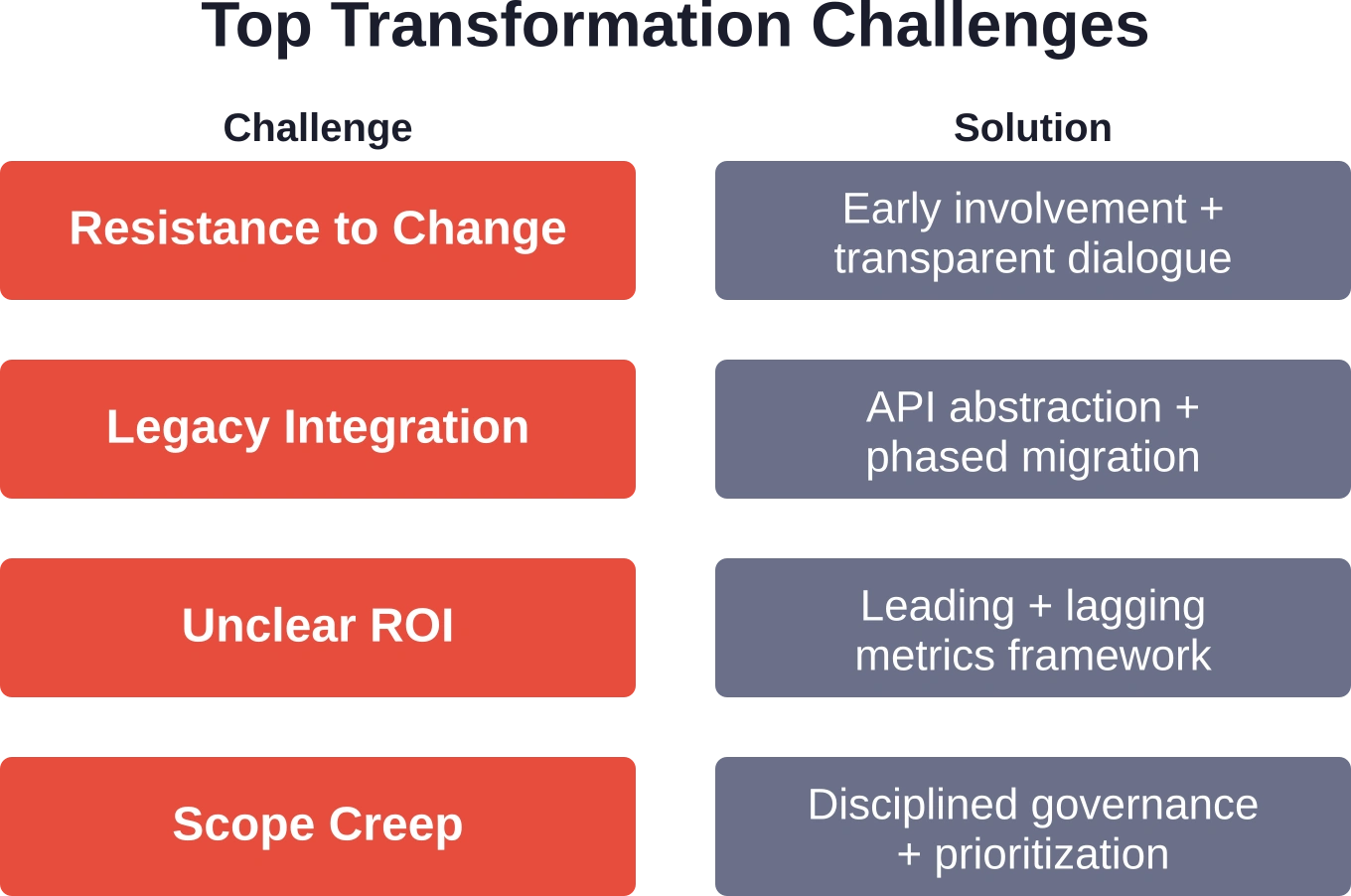
Resistance to Change
People resist change for rational reasons. New systems disrupt familiar workflows. Automation threatens job security. Digital tools require new skills.
The solution isn’t better communication. It’s addressing underlying concerns through early involvement, transparent dialogue, reskilling programs, and redesigned roles that leverage human strengths.
Legacy System Integration
Organizations rarely get to start fresh. New systems must coexist with legacy infrastructure. Integration is expensive and risky.
Successful approaches include API-based architectures that abstract legacy complexity, phased migration strategies that minimize disruption, and pragmatic decisions about when to replace versus integrate.
Unclear ROI Expectations
Transformation benefits are often diffuse and long-term. Traditional ROI calculations don’t capture strategic value. Executives get impatient when immediate results don’t materialize.
Setting realistic expectations upfront is critical. Define both leading indicators (adoption rates, process improvements) and lagging indicators (revenue impact, cost savings). Celebrate incremental progress.
Scope Creep and Initiative Overload
Transformation reveals opportunities everywhere. The temptation to expand scope is constant. Organizations end up with too many simultaneous initiatives and insufficient focus.
Disciplined governance prevents this. Establish clear prioritization criteria. Say no to good ideas that don’t align with strategic priorities. Finish initiatives before starting new ones.
Skills and Talent Gaps
Digital capabilities require new skills. Organizations often lack sufficient data scientists, cloud architects, UX designers, or automation specialists internally.
Solutions include strategic hiring, partnerships with specialized firms, upskilling programs for existing staff, and pragmatic build-versus-buy decisions about capabilities.
Frameworks for Digital Transformation
Several established frameworks guide transformation efforts. Understanding these models helps organizations structure their approach.
Strategic Frameworks from IEEE and ISACA
IEEE has published frameworks for strategic digital transformation that emphasize technical standards and architectural considerations. These frameworks provide structure for technology decisions within transformation initiatives.
ISACA developed the Adaptive Integrated Digital Architecture Framework (AIDAF) specifically for digital transformation and innovation. This framework connects technology implementation with areas including organizational response, healthcare applications, and academic research.
Both frameworks emphasize systematic approaches rather than ad-hoc technology adoption.
Phased Approaches for Manufacturing
MIT Sloan research highlights that manufacturers benefit from three-stage approaches to digital transformation rather than treating it as a single process. This phased methodology increases likelihood of successful outcomes in manufacturing companies.
The stages typically include: foundational infrastructure and data collection, analytical capability development and insight generation, and advanced automation and optimization.
Small and Medium-Sized Enterprise Frameworks
IEEE research on practical digital transformation frameworks for small and medium-sized enterprises in the UK recognizes that SMEs face distinct constraints. Limited budgets, smaller teams, and less complex systems require different approaches than enterprise transformation.
SME-focused frameworks emphasize quick wins, affordable technologies, and manageable scope.
The Role of Data in Transformation Success
Data represents a critical component of digital transformation. MIT CISR research involving 315 product managers identified data wrapping as a key approach to data monetization, representing 26% of value companies create from data monetization.
Data wrapping occurs when organizations amplify product value by adding analytics-based features and experiences. This could mean embedding predictive analytics into existing products, providing personalized recommendations, or offering real-time performance dashboards.
Performance differences are significant. According to MIT CISR research, data wrapping represents 26 percent of the value a company creates from data monetization, with performance varying based on execution quality.
Three activities distinguish top performers: pleasing customers with useful and engaging wraps, designing features that anticipate, advise, adapt, and act, and quantifying financial returns from data initiatives.
Investment Realities and Budget Considerations
Digital transformation requires significant investment. Deloitte research found that organizations now invest 7.5% of their revenue on average into digital transformation initiatives.
But higher investment doesn’t automatically deliver better outcomes or drive business value. Execution quality matters more than budget size.
When evaluating consulting costs, consider:
- Strategy and planning fees (typically fixed or time-and-materials)
- Implementation costs (highly variable by scope and technology)
- Change management and training expenses
- Technology licensing and infrastructure costs
- Ongoing optimization and support
Engagements vary widely in length and complexity. Small initiatives might span 3-6 months. Enterprise-wide transformations often extend 18-36 months or longer.
Building Internal Transformation Capabilities
While consultants accelerate transformation, organizations should build internal capabilities to sustain momentum.
Develop Digital Leaders
MIT research emphasizes that leadership’s digital transformation is about leading purposefully in an era where markets, customers, and workers have gone digital. Effective digital transformation delivers when leadership priorities reflect organizational cultural values.
Organizations need leaders who understand both business strategy and technology possibilities. This doesn’t mean every executive must code, but they should grasp digital fundamentals.
Create Centers of Excellence
Centers of excellence (CoEs) consolidate expertise, establish standards, and spread best practices across the organization. Common CoEs focus on areas like cloud, data analytics, automation, or customer experience.
CoEs accelerate adoption by providing reusable components, proven patterns, and internal consulting to business units.
Invest in Training and Upskilling
The skills needed for digital operations differ from traditional capabilities. Continuous learning becomes essential. Organizations that invested in change management capabilities, including training programs, saw a 43% increase in change management maturity, 50 new practitioners trained (85% increase in certified staff), and 86% improvement in project success rates.
Training should cover both technical skills (cloud platforms, data tools, automation technologies) and adaptive skills (agile methodologies, design thinking, digital collaboration).
Establish Governance and Standards
Without governance, transformation fragments into disconnected initiatives. Establish clear decision rights, architectural standards, security policies, and portfolio management processes.
Governance shouldn’t create bureaucracy. It should enable informed decision-making and prevent costly missteps.
Future Trends in Digital Transformation Consulting
The transformation landscape continues evolving. Several trends are shaping how consulting services develop.
Sustainability Integration
IEEE research on sustainability-based strategic frameworks for digital transformation reflects growing emphasis on environmental and social impact. Transformation initiatives increasingly incorporate sustainability metrics alongside traditional business outcomes.
Consultants now help organizations reduce carbon footprints through digital optimization, design circular economy business models, and measure environmental impact.
AI and Advanced Analytics
Artificial intelligence is moving from experimental to operational. Transformation consulting increasingly involves AI strategy, use case identification, responsible AI governance, and implementation of machine learning solutions.
Organizations that treat AI as a strategic capability rather than a tactical tool gain sustainable advantages.
Platform-Based Business Models
Platform strategies create ecosystems rather than linear value chains. Consultants help traditional organizations adopt platform thinking—connecting producers and consumers, enabling network effects, and monetizing data and interactions.
This shift requires fundamental business model innovation, not just technology implementation.
Continuous Transformation
Digital transformation isn’t a project with a defined end date. It’s an ongoing capability. Forward-thinking organizations embed continuous improvement, experimentation, and adaptation into their operating models.
Consulting relationships are shifting from episodic engagements to ongoing partnerships that support perpetual evolution.
Frequently Asked Questions
How long does a typical digital transformation consulting engagement last?
Engagement duration varies significantly based on scope and organizational complexity. Small, focused initiatives might complete in 3-6 months, while comprehensive enterprise transformations typically span 18-36 months. However, many organizations view transformation as ongoing rather than a one-time project, leading to extended consulting relationships that evolve over time.
What’s the difference between digital transformation consulting and traditional IT consulting?
Traditional IT consulting focuses on specific technical implementations—installing software, managing infrastructure, or solving discrete technology problems. Digital transformation consulting takes a holistic view that encompasses business strategy, operating model redesign, cultural change, and technology enablement. Transformation consultants address how technology fundamentally changes how organizations create and deliver value, not just how they run systems.
Do we need external consultants or can we handle transformation internally?
Some organizations successfully lead transformation with internal resources, but this requires significant expertise, dedicated capacity, and executive support. Most organizations benefit from external consultants who bring cross-industry experience, proven methodologies, objective perspectives, and specialized skills that don’t exist internally. The optimal approach often combines external strategic guidance with internal execution teams.
How much should we budget for digital transformation consulting?
Costs vary dramatically based on engagement scope, firm reputation, and geographic location. Research shows organizations invest 7.5% of revenue on average into digital transformation overall. Consulting fees might represent 15-30% of total transformation costs, with the remainder going to technology, implementation, and change management. For specific pricing, organizations should request detailed proposals from multiple firms and compare value rather than just cost.
What qualifications should we look for in a digital transformation consultant?
Look for consultants with relevant industry experience, proven technical capabilities in emerging technologies, structured change management methodologies, and successful case studies demonstrating measurable outcomes. Certifications in areas like cloud platforms, agile methodologies, or specific technologies add credibility. However, practical experience delivering results matters more than credentials. Request references and speak directly with previous clients.
How do we measure ROI from digital transformation consulting?
ROI measurement should combine financial metrics (revenue growth, cost reduction, efficiency gains) with operational improvements (cycle time reduction, error rate decrease) and strategic outcomes (market position, customer satisfaction, employee engagement). Establish baseline measurements before transformation begins, define clear targets, and track both leading indicators (adoption rates, process changes) and lagging indicators (financial impact). Organizations that invested effectively in transformation initiatives achieved measurable returns across multiple dimensions.
What’s the biggest reason digital transformation projects fail?
While multiple factors contribute to failure, inadequate change management consistently emerges as the primary cause. Technology implementations succeed, but people don’t adopt new ways of working. Organizations that invest in structured change management—including communication, training, stakeholder engagement, and addressing resistance—see 86% better project success rates. Technology is the easy part; changing organizational culture and behavior is hard.
Conclusion: Navigating Your Transformation Journey
Digital transformation consulting provides organizations with expertise, frameworks, and execution capabilities that accelerate successful change. The consulting relationship works best when it combines external strategic guidance with internal ownership and capability building.
Success requires more than technology implementation. It demands clear vision, executive commitment, disciplined execution, effective change management, and sustained focus on business outcomes.
The investment is significant—both financially and organizationally. But the alternative is riskier. Organizations that fail to transform face competitive irrelevance in increasingly digital markets.
Start by honestly assessing current capabilities and transformation readiness. Define what business outcomes matter most. Engage consultants who bring relevant experience and partnership philosophy. Invest in change management as heavily as technology. Measure progress rigorously. Build internal capabilities that outlast the consulting engagement.
Digital transformation isn’t optional anymore. The question isn’t whether to transform, but how to do it effectively. The right consulting partner can mean the difference between transformation that delivers value and expensive technology projects that disappoint.
Ready to begin? Start with a clear-eyed assessment of where the organization stands today and where it needs to go. Then find partners who can bridge that gap while building the capabilities to sustain momentum long after consultants leave.