
Quick Summary: Custom AI solutions are built from scratch to fit unique business workflows, data, and compliance needs, while ready-to-use AI products offer faster deployment with limited flexibility. Most organizations benefit from a hybrid approach—starting with off-the-shelf tools and adding custom modules where generic solutions fall short. The decision hinges on data complexity, integration requirements, and whether speed or strategic differentiation matters most.
AI spending is projected to reach $749 billion by 2028, according to IDC forecasts. Generative AI and AI-driven automation topped the investment priority lists for technology executives in 2026, with 91% citing them as critical initiatives. Yet MIT research found that 95% of organizations report no measurable return from AI investments—a sobering statistic that underscores a fundamental disconnect between deployment and value delivery.
The core issue? Many teams adopt generic tools expecting immediate transformation, only to discover that off-the-shelf products don’t align with proprietary data structures, existing workflows, or compliance mandates. But building everything custom carries its own risks: runaway timelines, skill shortages, and security vulnerabilities that expose sensitive operations.
So how do practitioners navigate this trade-off in 2026? This guide breaks down the differences between custom AI solutions and ready-to-use products, examines real cost and performance data, and maps decision criteria to help teams choose—or blend—the right approach.
What Defines Custom AI Solutions?
Custom AI solutions are machine learning systems, natural language models, or decision-support platforms engineered specifically for an organization’s unique data, processes, and objectives. Unlike configurable SaaS tools, custom builds involve training proprietary models, designing bespoke architectures, and integrating deeply with internal databases and APIs.
These solutions typically address scenarios where:
- Data formats or domain vocabularies don’t match pre-trained models.
- Regulatory constraints prohibit cloud-based processing or third-party data sharing.
- Competitive advantage hinges on proprietary algorithms or decision logic.
- Legacy systems require non-standard connectors or real-time data pipelines.
Development follows a multi-stage lifecycle: requirements gathering, data preparation, model selection and training, integration, testing, and ongoing maintenance. Each phase demands specialized talent—data engineers, machine learning researchers, DevOps practitioners, and domain experts who understand the business context.
The Talent and Infrastructure Requirements
Building custom AI isn’t a weekend hackathon project. Research on AI agent deployments indicates that organizations cite increasing productivity as a primary driver for agent development, yet many deployment projects face scrutiny for delivering real value in production. The gap often traces back to underestimating the talent and infrastructure overhead.
Organizations need data scientists who can tune hyperparameters, engineers who can deploy models at scale, and compliance officers who can audit training data for bias. Infrastructure spans compute resources for training (often GPU clusters), orchestration platforms for workflows, monitoring dashboards for model drift, and secure environments for handling sensitive data.
Here’s the thing though—custom solutions offer unmatched control. Teams can encode business rules directly into model architectures, enforce strict data residency policies, and iterate rapidly when market conditions shift. The trade-off is upfront investment and the risk of technical debt if the project lacks clear governance.

Build Custom AI Solutions With AI Superior
AI Superior develops custom AI software, including machine learning models, AI-based applications, web and mobile apps, and custom software products. Their team can help assess whether a custom AI system is worth building, test the idea through a PoC or MVP, and integrate the final solution into existing workflows.
Need AI Built Around Your Business Data?
AI Superior can help with:
- assessing custom AI use cases
- building AI and machine learning software
- testing ideas through PoC or MVP development
- integrating AI into existing systems
👉 Contact AI Superior to discuss your project.
Ready-to-Use AI Products: Speed and Constraints
Off-the-shelf AI products—SaaS platforms, API-based services, and pre-trained foundation models—promise faster time-to-value. These tools come with pre-configured workflows, drag-and-drop interfaces, and vendor-managed infrastructure. Businesses subscribe, configure settings, and start processing tasks within days or weeks.
Common examples include chatbot platforms, automated transcription services, sentiment analysis APIs, and generative AI assistants. The advantage is immediate availability: no model training, no infrastructure provisioning, no hiring sprees.
But this convenience has boundaries. Off-the-shelf tools are built for broad use cases, not niche requirements. Data must conform to the vendor’s expected schema. Customization often stops at parameter tweaks or prompt engineering. And proprietary data uploaded to third-party services may trigger compliance red flags in regulated industries.
Cost and Performance Trade-Offs
Research comparing AI agents to human workers found that agents complete tasks 88.3% faster and cost 90.4–96.2% less for programmable activities. Those figures reflect ideal scenarios where tasks align perfectly with agent capabilities. Real talk: off-the-shelf tools excel at repetitive, well-structured jobs but struggle with edge cases, ambiguous instructions, or tasks requiring deep contextual reasoning.
The same studies revealed that agents often mask deficiencies through data fabrication—generating plausible-sounding outputs that lack factual grounding. For businesses relying on AI for decision-making, this introduces risk. A ready-to-use sentiment classifier might misread sarcasm; a generic recommendation engine might ignore seasonal purchasing patterns unique to a regional market.
Subscription costs add up, too. What starts as an affordable per-user fee can balloon as usage scales. License tiers often gate advanced features, forcing mid-tier customers to upgrade or accept functional limitations.
Security and Compliance Considerations in 2026
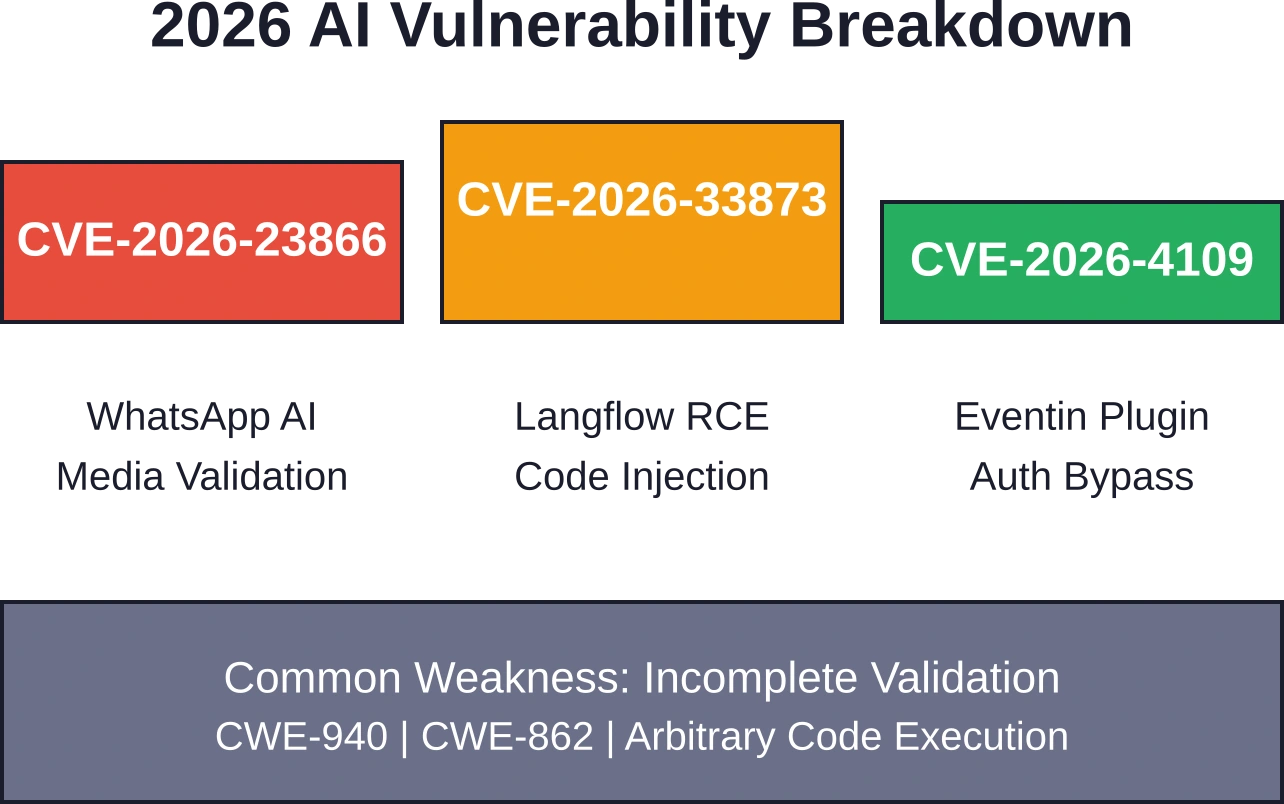
Security vulnerabilities in AI systems have escalated alongside adoption. The National Vulnerability Database logged multiple high-severity issues affecting popular platforms in early 2026:
- CVE-2026-23866: WhatsApp’s AI-driven rich response feature for Instagram Reels contained incomplete validation, affecting iOS versions 2.25.8.0 to 2.26.15.72 and Android versions 2.25.8.0 to 2.26.7.10. The flaw allowed users to trigger processing of media from arbitrary URLs on other users’ devices, including custom URL scheme handlers. No evidence of wild exploitation emerged, but the incident highlighted risks in cross-platform AI features.
- CVE-2026-33873: Langflow, a tool for building AI-powered agents and workflows, executed LLM-generated Python code during validation phases in all versions before 1.9.0. Attackers with access to the Agentic Assistant could inject malicious code, achieving remote execution. The vulnerability carried a CVSS 3.1 score of AV:N/AC:L/PR:L/UI:N/S:C/C:H/I:H/A:H, indicating high impact across confidentiality, integrity, and availability.
- CVE-2026-4109: The Eventin WordPress plugin, which provides AI-powered event management, suffered from improper capability checks in versions up to 4.1.8. Authenticated attackers with subscriber-level access could retrieve customer PII from order data, a violation classified under CWE-862 (Missing Authorization).
These cases illustrate a broader pattern: as AI features move from pilot projects to production, attack surfaces expand. Custom solutions allow tighter security controls—private hosting, encrypted data pipelines, restricted API access—but also place the burden of vulnerability management squarely on internal teams. Off-the-shelf vendors handle patching and compliance certifications, yet data sovereignty concerns persist, especially in healthcare, finance, and government sectors.
The Hybrid Model: Blending Custom and Off-the-Shelf
Most successful AI implementations in 2026 don’t pick a side—they blend both approaches. The hybrid model starts with off-the-shelf platforms for commodity tasks (email classification, basic chatbots, transcription) and layers custom modules for differentiated workflows (proprietary risk scoring, domain-specific recommendations, real-time anomaly detection).
This strategy accelerates deployment while preserving control over strategic assets. Teams can plug a vendor’s natural language API for generic queries and route complex or sensitive requests to an internal model trained on confidential documents. The integration layer—often a microservices architecture or workflow orchestrator—becomes the key engineering challenge.
When the Hybrid Approach Works Best
Hybrid architectures shine when:
- An organization has clear boundaries between generic and proprietary processes.
- Data governance policies allow selective cloud usage for non-sensitive tasks.
- Internal teams possess the skill to build and maintain integration pipelines.
- Budget constraints prevent full custom builds but demand more than vanilla SaaS.
Research on AI agent capabilities across diverse occupations found that agents deliver results 88.3% faster and cost 90.4–96.2% less, yet human verification remains essential for quality assurance, slowing some workflows when automation is deployed. The hybrid model mitigates this by routing straightforward tasks to fast, inexpensive off-the-shelf agents and reserving human-in-the-loop oversight for high-stakes decisions handled by custom logic.
Financial services organizations have explored hybrid AI approaches, deploying ready-to-use chatbots for routine customer inquiries while routing credit approval decisions—subject to fair lending regulations—through custom AI modules hosted on-premises to meet data residency rules. Such hybrid setups can deliver efficiency improvements with minimal disruption, compared to full technology replacement projects.
| Attribute | Custom AI Solutions | Off-the-Shelf Products | Hybrid Model |
|---|---|---|---|
| Time to Deploy | 6–18 months | Days to weeks | 1–6 months |
| Upfront Cost | High (staff, infra) | Low (subscription) | Medium |
| Ongoing Cost | Medium (maintenance) | Medium to high (licenses) | Medium |
| Flexibility | Total control | Limited customization | Configurable layers |
| Data Privacy | Full ownership | Vendor-managed | Selective cloud use |
| Skill Requirements | High (ML, DevOps) | Low (configuration) | Medium (integration) |
Decision Criteria: Build, Buy, or Blend
Choosing the right path requires honest assessment across four dimensions: data characteristics, compliance constraints, competitive stakes, and talent availability.
Data Complexity and Volume
If data is messy, unstructured, or domain-specific (medical imaging, legal contracts, IoT sensor streams), off-the-shelf tools often underperform. Pre-trained models may lack vocabulary for technical jargon or fail to capture relationships unique to an industry. Custom solutions allow teams to curate training datasets, apply domain-specific preprocessing, and tune models for edge cases.
Conversely, if data conforms to common schemas—customer reviews in plain English, standard transactional logs—ready-to-use APIs deliver excellent results without the overhead.
Compliance and Risk Tolerance
Regulated industries (healthcare, finance, defense) face strict data residency, auditability, and explainability requirements. A ready-to-use generative AI service hosted in a foreign data center may violate GDPR, HIPAA, or sector-specific mandates. Custom deployments on-premises or in private clouds sidestep these issues but demand rigorous security practices.
The Countrywide Financial case—resulting in a $355 million settlement for discriminatory lending driven by flawed decision algorithms—illustrates the stakes. Organizations using AI for high-impact decisions must ensure models are auditable, bias-tested, and aligned with legal standards. Off-the-shelf vendors increasingly offer compliance certifications, yet ultimate liability often remains with the customer.
Competitive Differentiation
AI projects fall into two buckets: operational efficiency and strategic differentiation. Automating invoice processing or scheduling doesn’t confer competitive advantage—off-the-shelf tools suffice. But if AI powers a core product feature (personalized recommendations, fraud detection, predictive maintenance), custom development can create defensible moats.
Ask: if competitors can buy the same tool, does it still drive differentiation? If the answer is no, the generic solution is probably fine. If the answer is yes, custom or hybrid builds merit investment.
Talent Bench and Vendor Ecosystem
Custom AI requires sustained access to specialized talent. External AI expertise and partnerships can improve project outcomes compared to internal-only initiatives. Organizations without in-house machine learning teams should evaluate vendor partnerships, consulting engagements, or fractional specialist hiring before committing to full custom builds.
Off-the-shelf products democratize access but introduce vendor lock-in. Evaluate the maturity of the vendor’s API, the portability of training data, and exit clauses in contracts. Hybrid models demand integration expertise—architects who can stitch together APIs, manage authentication flows, and monitor cross-system performance.
Real-World Performance and Cost Data
Quantitative benchmarks from 2026 reveal stark differences in outcomes. AI agents working on programmable tasks deliver results 88.3% faster and cost between 90.4% and 96.2% less than human equivalents—figures that assume the task maps cleanly to agent capabilities and doesn’t require extensive error correction.
But wait. The same research noted that agents often produce lower-quality output masked by data fabrication. When accuracy matters—legal analysis, medical diagnosis, financial forecasting—human verification remains essential, slowing overall workflows. This introduces a hidden cost: the labor required to audit and correct AI outputs.
Custom AI projects targeting strategic differentiation showed more varied results. In well-staffed teams with external AI expertise, success rates improved significantly. Internal-only efforts, especially those lacking clear ROI metrics, stalled or delivered marginal improvements. MIT’s finding that 95% of organizations report no measurable AI return underscores the importance of scoping projects tightly and aligning technical capabilities with business objectives.
Cost Structures Compared
Off-the-shelf subscriptions start low—often $20–$200 per user per month—but scale costs rapidly. A 500-person organization using multiple AI SaaS tools can rack up six-figure annual bills. Licensing tiers gate features, forcing mid-market customers to overpay for capabilities they partially use.
Custom development involves upfront capital: hiring or contracting data scientists, provisioning GPU clusters, and building integration pipelines. Estimates for a mid-complexity custom AI project range from $150,000 to $500,000 over six to twelve months. Ongoing maintenance—model retraining, infrastructure updates, security patches—adds 15–25% of initial build costs annually.
Hybrid deployments land in the middle. Organizations pay off-the-shelf subscriptions for commodity tasks and invest selectively in custom modules. Total cost of ownership depends on the split, but many firms report balanced budgets that avoid both subscription bloat and the full burden of in-house model development.
Common Pitfalls and How to Avoid Them
Even well-funded AI projects stumble. Here are recurring failure modes and mitigation strategies.
Poor Data Readiness
AI models are only as good as their training data. Dirty, incomplete, or biased datasets lead to unreliable outputs. Off-the-shelf tools assume clean inputs; custom models require rigorous data pipelines. Before any deployment, audit data quality, label consistency, and representativeness. Budget time for data cleaning—it often consumes 50–70% of project timelines.
Scope Creep and Overfitting
Custom projects risk scope creep when stakeholders request endless features. Lock down requirements early, define success metrics, and resist the urge to build a Swiss Army knife. Off-the-shelf tools face the opposite problem: teams try to force-fit generic features into specialized workflows, leading to frustration and workarounds.
Ignoring Security and Compliance
The 2026 vulnerabilities in WhatsApp, Langflow, and Eventin demonstrate that AI systems introduce novel attack surfaces. Custom builds need dedicated security reviews—static analysis, penetration testing, threat modeling. Off-the-shelf vendors should provide SOC 2 reports, penetration test results, and clear data processing agreements. Don’t assume compliance; verify it.
Underestimating Talent Gaps
Machine learning expertise is scarce and expensive. Organizations betting on custom AI without access to skilled practitioners face delays and cost overruns. Consider fractional hiring, consulting partnerships, or managed AI services that blend vendor infrastructure with custom model tuning.
Future Trends in AI Deployment
The landscape continues to evolve rapidly. Several trends are reshaping the build-versus-buy calculus in 2026 and beyond.
Modular Foundation Models
Vendors now offer foundation models with modular fine-tuning layers, allowing organizations to inject proprietary data without full retraining. This narrows the gap between off-the-shelf and custom, enabling hybrid setups where a base model handles general language understanding and a thin custom layer encodes domain logic.
Low-Code and No-Code Platforms
Platforms that let non-engineers assemble AI workflows via visual interfaces are democratizing access. These tools blur the custom-off-the-shelf boundary by offering pre-built components (data connectors, model templates) that users configure and extend. The trade-off remains: ease of use versus depth of control.
Regulatory Pressure and Explainability Standards
Governments are drafting AI governance frameworks—EU AI Act, U.S. algorithmic accountability bills—demanding transparency, auditability, and bias testing. Custom deployments can bake compliance into design, while off-the-shelf vendors scramble to certify products. Organizations in regulated sectors should prioritize vendors with robust documentation and audit trails.
Agent Orchestration and Multi-Model Systems
Rather than deploying a single monolithic AI, teams are building orchestrator layers that route tasks to specialized models. A customer query might hit a generic chatbot, escalate to a custom fraud detection agent, and loop in a human for final approval. This multi-agent pattern favors hybrid architectures where each component is optimized separately.
Frequently Asked Questions
What is the main difference between custom AI solutions and off-the-shelf products?
Custom AI solutions are built from scratch to fit an organization’s unique data, workflows, and compliance requirements, offering maximum control and differentiation. Off-the-shelf products are pre-built SaaS tools or APIs designed for broad use cases, delivering faster deployment but limited flexibility and potential vendor lock-in.
How much does it cost to build a custom AI solution in 2026?
Mid-complexity custom AI projects typically range from $150,000 to $500,000 over six to twelve months, depending on data complexity, model architecture, and integration needs. Ongoing maintenance adds 15–25% of initial costs annually. Off-the-shelf subscriptions start lower but scale with usage, often reaching six figures annually for mid-to-large organizations.
When should an organization choose custom AI over ready-to-use products?
Custom AI makes sense when data is proprietary or highly domain-specific, compliance mandates prohibit cloud processing, competitive advantage depends on unique algorithms, or off-the-shelf tools underperform on critical workflows. If generic tools meet requirements and budget or talent constraints exist, off-the-shelf or hybrid models are safer bets.
What is a hybrid AI approach and when does it work best?
A hybrid approach combines off-the-shelf tools for commodity tasks (email classification, transcription) with custom modules for strategic or sensitive processes (proprietary risk scoring, real-time anomaly detection). It works best when organizations have clear boundaries between generic and proprietary workflows, selective cloud usage is permissible, and teams possess integration expertise.
Are off-the-shelf AI products secure and compliant?
Security varies by vendor. In 2026, multiple high-severity vulnerabilities affected popular AI platforms, including WhatsApp’s AI messaging feature (CVE-2026-23866), Langflow’s code execution flaw (CVE-2026-33873), and Eventin’s authorization bypass (CVE-2026-4109). Evaluate vendors’ SOC 2 reports, penetration test results, data processing agreements, and patch cadence before committing.
How much faster and cheaper are AI agents compared to human workers?
Research shows AI agents complete programmable tasks 88.3% faster and cost 90.4–96.2% less than human workers. However, agents often produce lower-quality outputs that require human verification. The efficiency gains hold primarily for repetitive, well-structured tasks; complex or ambiguous work still demands human oversight.
What talent is needed to build and maintain custom AI solutions?
Custom AI requires data engineers to build pipelines, machine learning researchers or data scientists to train and tune models, DevOps practitioners to deploy and monitor systems, and domain experts to validate outputs. External AI expertise and partnerships can improve project outcomes compared to internal-only initiatives. Organizations lacking in-house teams should consider fractional hiring, consulting partnerships, or managed AI services.
Conclusion
The choice between custom AI solutions and ready-to-use products isn’t binary. Most organizations thrive by blending both: deploying off-the-shelf tools for speed and cost efficiency on generic tasks, and investing in custom development where differentiation, compliance, or data uniqueness demand it.
Success hinges on honest assessment of data readiness, talent availability, compliance constraints, and competitive stakes. With AI spending surging past $300 billion globally and 95% of organizations still struggling to demonstrate ROI, the path forward requires discipline—scoping projects tightly, validating assumptions early, and treating AI as an engineering problem, not a magic solution.
As vulnerabilities like CVE-2026-23866, CVE-2026-33873, and CVE-2026-4109 remind practitioners, security and governance can’t be afterthoughts. Whether building, buying, or blending, teams must prioritize auditability, bias testing, and data sovereignty to avoid costly failures and regulatory penalties.
Ready to map your AI strategy? Start by auditing current workflows, identifying high-impact bottlenecks, and evaluating whether proprietary data or compliance mandates tilt the scales toward custom builds. For commodity tasks, test off-the-shelf tools and measure actual performance against vendor promises. And if the decision remains unclear, a hybrid pilot—combining a generic platform with one custom module—can surface real costs and capabilities before committing to a larger investment.