
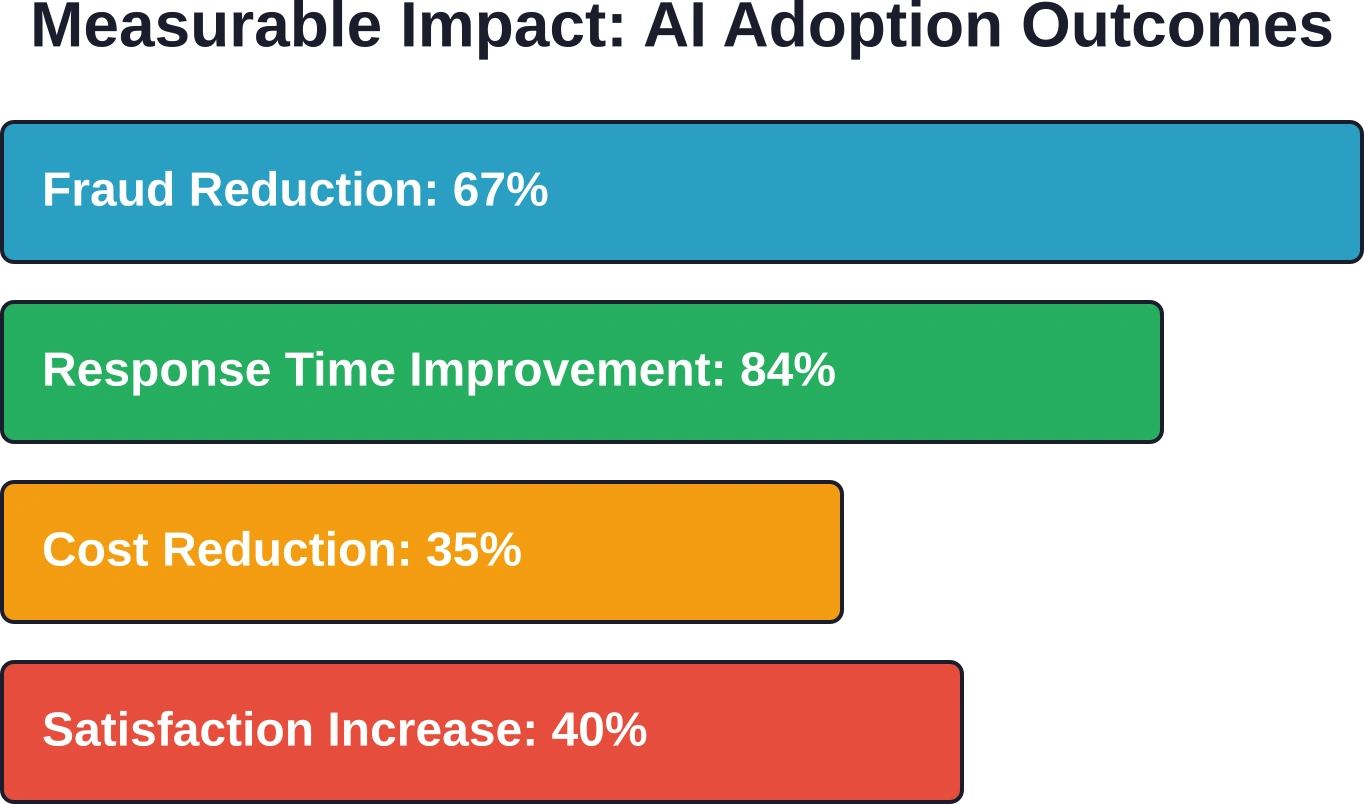
Quick Summary: AI consulting helps small businesses implement artificial intelligence strategically, from customer service automation to risk management and operations optimization. Recent studies show SMEs adopting AI-driven solutions achieve up to 67% fraud reduction, 84% faster response times, and 35% operational cost savings. Professional consultants bridge the knowledge gap, ensuring cost-effective deployment tailored to limited budgets and resources.
Small businesses face a crossroads. Artificial intelligence has moved from experimental technology to competitive necessity, yet most SMEs struggle with where to start.
The numbers tell the story. Academic research shows that businesses integrating AI solutions report operational cost reductions, with customer service improvements documented in academic research. But here’s the catch—only 23% of small businesses have adopted AI-driven risk management, and just 19% use AI for customer service automation.
That gap represents both a challenge and an opportunity.
AI consulting bridges this divide. Professional consultants help small businesses navigate implementation without the trial-and-error that wastes resources. The U.S. Small Business Administration notes that AI allows small businesses to “do more with less” in today’s fast-paced economy.
This guide breaks down what AI consulting actually delivers, how to choose the right partner, and which applications drive measurable results for resource-constrained businesses.
Why Small Businesses Need AI Consulting in 2026
Raw AI tools won’t solve business problems by themselves. That’s the reality most small business owners discover after purchasing software that sits unused or delivers disappointing results.
The technology doesn’t align with established workflows. Staff lack training. Integration with existing systems fails. These are the hurdles that AI consulting addresses head-on.
The Knowledge Gap Problem
Most small business owners understand their industry deeply but lack technical expertise in machine learning, natural language processing, or predictive analytics. Consultants translate business objectives into technical requirements.
Instead of “implement AI,” a consultant defines concrete goals: reduce customer service response time by 30% within six months using AI-powered chatbots. That specificity makes the difference between success and wasted investment.
According to the U.S. Small Business Administration, this strategic approach helps small businesses leverage AI as a competitive tool rather than just another expense.
Resource Constraints Demand Efficiency
Small businesses can’t afford expensive mistakes. Every dollar spent on technology needs to generate measurable returns.
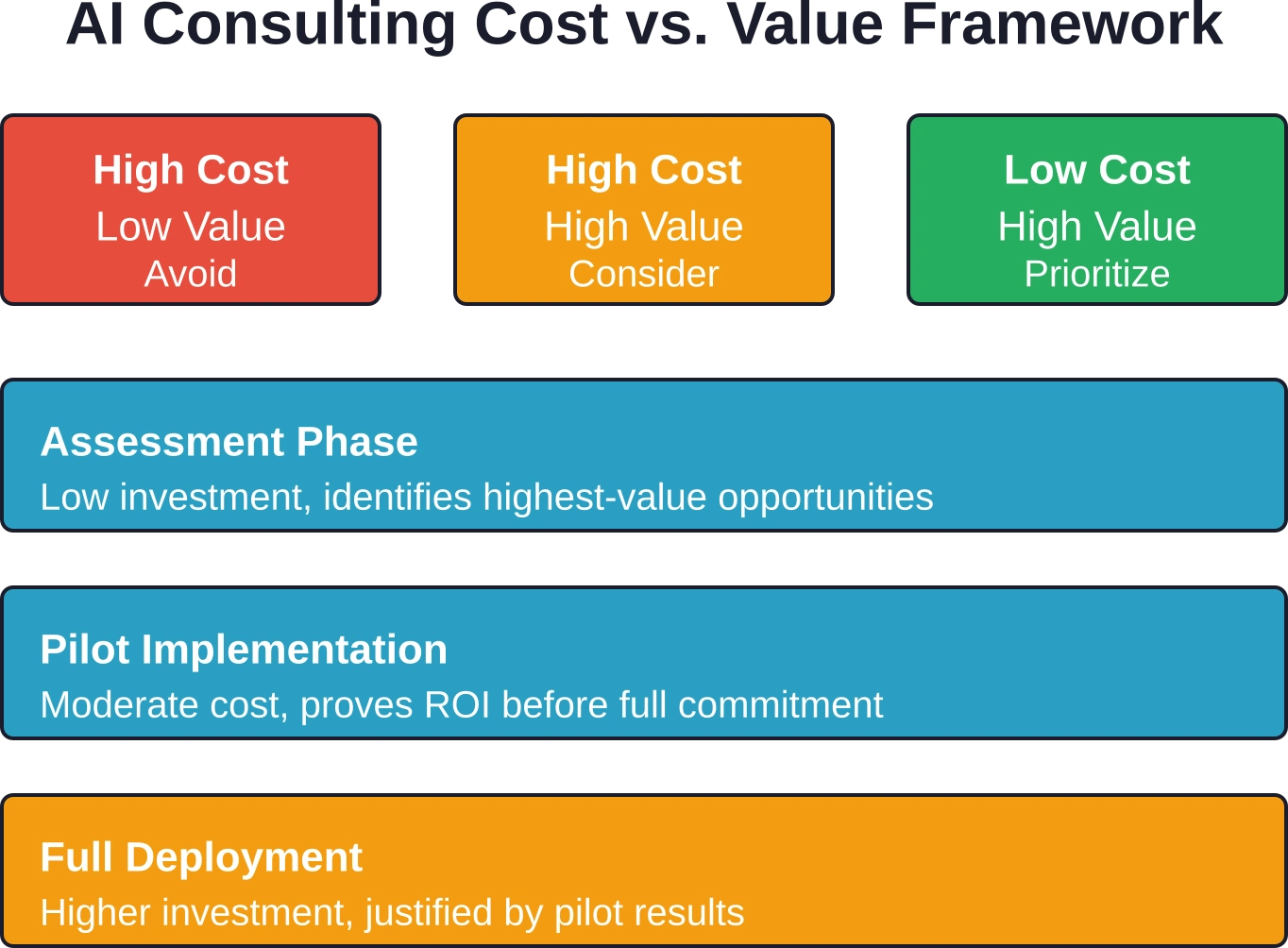
AI consulting minimizes risk by starting with pilot projects, measuring outcomes, and scaling what works. This staged approach prevents the all-in commitments that drain budgets without delivering value.

Create AI Solutions With AI Superior
AI Superior provides AI consulting services to help small businesses identify realistic AI opportunities before development begins. Their team helps assess use cases, review available data, define project scope, and decide whether AI is the right fit for a specific business problem. They also develop AI-based applications, custom software products, and machine learning systems.
For small businesses, this can help turn practical needs - such as automation, forecasting, customer data analysis, document processing, or internal reporting - into a clear and manageable AI project.
Need AI Built for a Real Business Problem?
AI Superior can help with:
- identifying practical AI use cases
- building custom AI and ML tools
- testing ideas through PoC or MVP work
- integrating AI into existing workflows
👉 Contact AI Superior to discuss your project.
Proven AI Applications That Deliver ROI
Not all AI applications work equally well for small businesses. Some require massive datasets or infrastructure beyond SME capabilities. Others deliver quick wins with modest investment.
Here are the applications with proven track records.
Customer Service Automation
AI-powered chatbots handle routine inquiries without human intervention. Academic research demonstrates that these systems manage 72% of routine inquiries, reducing response times by 84%.
The financial impact? Service costs drop by 31%, with customer satisfaction improvements documented in supporting research.
These aren’t theoretical numbers. Small businesses implementing chatbot solutions see immediate relief in support ticket volume, freeing staff to handle complex issues that require human judgment.
Risk Management and Fraud Prevention
Small businesses lose significant revenue to fraud, payment defaults, and operational risks. AI-driven risk management systems analyze patterns humans miss.
The results are striking. SMEs adopting these solutions achieve a 67% reduction in fraud incidents. Credit risk assessment accuracy improves by 43%. Operational risk incidents decline by 38%.
For businesses in e-commerce, financial services, or any sector handling transactions, these improvements translate directly to protected margins.
Operations Optimization
Inventory management, scheduling, supply chain coordination—these operational tasks consume time and generate costly errors when done manually.
AI systems optimize these processes by learning patterns, predicting demand, and automating routine decisions. Businesses integrating AI for operations report operational cost reductions, primarily through reduced waste and improved resource allocation.
Choosing the Right AI Consultant for Your Business
The consulting market is crowded. Firms range from massive consultancies charging enterprise rates to specialized boutiques focusing on specific industries or technologies.
Small businesses need consultants who understand resource constraints and deliver practical solutions—not theoretical frameworks that look impressive in presentations but fail in implementation.
Industry Experience Matters
A consultant with retail experience understands inventory challenges, seasonal patterns, and customer behavior specifics that don’t apply to professional services firms. Industry knowledge accelerates implementation because the consultant already knows which solutions work in that context.
Look for case studies or client references in your sector. Generic AI expertise isn’t enough.
Transparent Pricing Models
Vague pricing structures create budget uncertainty. The best consultants for small businesses offer clear, staged pricing: assessment phase costs X, strategy development costs Y, implementation costs Z.
This transparency allows businesses to commit to one phase at a time, evaluating results before investing further. No small business should sign a six-figure contract without understanding deliverables at each stage.
Focus on ROI Measurement
How will the consultant measure success? “Implementing AI” isn’t a success metric. Reducing customer service costs by 25% is. Decreasing fraud losses by 50% is.
Effective consultants define key performance indicators upfront and track them throughout implementation. This data-driven approach proves value and guides adjustments when results don’t meet expectations.
| Consultant Type | Best For | Typical Approach | Cost Structure |
|---|---|---|---|
| Boutique Specialist | Specific industry needs | Deep expertise, focused solutions | Project-based, moderate rates |
| Mid-Size Firm | Balanced expertise and cost | ROI-driven, staged implementation | Phased pricing, flexible |
| Enterprise Consultancy | Complex, large-scale projects | Comprehensive, resource-intensive | High retainers, long-term contracts |
| Freelance Expert | Tight budgets, simple projects | Direct, hands-on implementation | Hourly or small project fees |
Common Implementation Challenges and Solutions
Even with expert guidance, AI implementation hits obstacles. Understanding these challenges in advance helps businesses prepare and avoid common pitfalls.
Data Quality Issues
AI systems require clean, structured data to function effectively. Many small businesses have data scattered across spreadsheets, legacy systems, and manual records.
Solution: Start with a data audit. Identify what data exists, where it lives, and its quality. Consultants often begin by establishing data collection and cleaning processes before implementing AI tools.
Staff Resistance and Training Gaps
Employees fear job loss or struggle with new systems. Without buy-in, even well-designed AI solutions fail because staff work around them rather than with them.
Solution: Involve staff early in the process. Explain how AI handles repetitive tasks, freeing them for higher-value work. Provide thorough training and ongoing support during the transition period.
Integration with Legacy Systems
Small businesses often use older software that doesn’t easily connect with modern AI tools. Integration failures create data silos and workflow disruptions.
Solution: Consultants should assess existing systems during the initial evaluation phase and design integration strategies—whether through APIs, middleware, or phased system upgrades—before implementing AI solutions.
What to Expect: The Consulting Engagement Process
Understanding the typical engagement structure helps businesses prepare and set realistic expectations.
Phase 1: Discovery and Assessment
The consultant analyzes current operations, identifies pain points, and evaluates technical readiness. This phase typically takes 2-4 weeks and involves interviews with key staff, system audits, and data reviews.
Deliverable: A detailed assessment report outlining opportunities, challenges, and recommended priorities.
Phase 2: Strategy Development
Based on the assessment, the consultant develops a roadmap. Which AI applications will deliver the highest ROI? What’s the implementation sequence? What resources are required?
This strategy document becomes the blueprint for all subsequent work. Timeline: 2-3 weeks.
Phase 3: Pilot Implementation
Rather than full-scale deployment, effective consultants start with a pilot project. Test the AI solution in a limited context, measure results, and refine before expanding.
This stage might run 1-3 months depending on the solution’s complexity. A chatbot pilot might take 4-6 weeks; a risk management system might need 8-12 weeks.
Phase 4: Evaluation and Scaling
Did the pilot meet KPI targets? What adjustments are needed? Based on results, the consultant and business decide whether to scale, iterate, or pivot to a different approach.
Successful pilots expand company-wide. Unsuccessful ones provide valuable learning without catastrophic costs—the key benefit of staged implementation.
Phase 5: Ongoing Support and Optimization
AI systems require monitoring and tuning. Performance drifts over time as data patterns change. Consultants often provide ongoing support contracts for maintenance, updates, and optimization.
Real-World Success: Small Business AI Adoption
Theory matters less than results. Real small businesses have implemented AI with measurable outcomes.
Take the example documented by the U.S. Small Business Administration: rockITdata saw a 280% increase in revenue in 2021 compared to 2020, reaching over $6 million in 2021 revenue. While not exclusively AI-driven, their success demonstrates how small businesses leverage technology consulting to achieve exponential growth.
Another pattern emerges from academic research. Small businesses that commit to AI adoption see compound benefits. Initial implementations in one area—say, customer service—generate cost savings that fund expansion into other areas like risk management or operations.
But adoption rates remain low. Only 19% of SMEs have implemented AI for customer service, despite the proven 84% response time improvement. Only 23% use AI-driven risk management, despite the 67% fraud reduction.
This gap represents opportunity for early adopters. Competitors who delay AI adoption fall further behind in efficiency and customer experience.
Cost Considerations and Budgeting
Small businesses rightfully worry about consulting costs. Exact pricing varies widely based on project scope, consultant expertise, and implementation complexity.
Consulting costs vary based on project scope and complexity. Strategy development adds similar costs. Pilot implementation costs vary significantly based on solution complexity.
The key question isn’t what it costs but what it returns. A $25,000 chatbot implementation that reduces customer service costs by $60,000 annually delivers clear value. A $50,000 fraud detection system that prevents $200,000 in losses pays for itself immediately.
Frame consulting costs as investments, not expenses. Measure them against projected savings and revenue gains, not against the absolute dollar amount.
Funding Options
The U.S. Small Business Administration offers various programs supporting technology adoption, including Regional Innovation Clusters that provide services like market research and customer discovery to innovative small businesses. These resources can offset some implementation costs or provide guidance that reduces consulting needs.
Some consultants offer performance-based pricing, where fees tie to achieved results. This model aligns incentives but typically applies only after initial assessment phases.
Frequently Asked Questions
What exactly does an AI consultant do for small businesses?
AI consultants assess current operations, identify opportunities where artificial intelligence can improve efficiency or reduce costs, develop implementation strategies, and guide deployment. They bridge the gap between technical AI capabilities and practical business needs, ensuring solutions align with budget constraints and deliver measurable ROI.
How long does a typical AI consulting engagement take?
Initial assessments typically require 2-4 weeks. Strategy development adds another 2-3 weeks. Pilot implementations vary widely—from 4-6 weeks for straightforward solutions like chatbots to 3-6 months for complex systems like predictive analytics or custom machine learning models. Full deployment and scaling can extend 6-12 months depending on scope.
Can small businesses afford AI consulting and implementation?
Yes, when approached strategically. Staged implementation allows businesses to validate ROI at each phase before additional investment. Many solutions deliver cost savings that fund expansion. For example, businesses implementing AI chatbots typically see 31% service cost reduction, which can finance subsequent AI projects. Start with high-impact, lower-cost pilots rather than comprehensive overhauls.
What’s the difference between buying AI software and hiring a consultant?
AI software provides tools; consultants provide strategy and implementation expertise. Many businesses purchase AI platforms that sit unused because they lack the knowledge to integrate them effectively, train staff, or align them with business processes. Consultants ensure the technology actually solves business problems rather than creating new ones. They’re particularly valuable when businesses lack in-house technical expertise.
Which AI applications deliver the fastest ROI for small businesses?
Customer service automation typically shows the quickest returns. AI chatbots handle 72% of routine inquiries and reduce response times by 84%, delivering immediate cost savings and satisfaction improvements. Fraud prevention systems also generate fast ROI by preventing losses. Operations optimization takes longer to implement but delivers sustained cost reductions over time.
Do I need technical expertise to work with an AI consultant?
No. Effective consultants translate technical concepts into business terms and handle implementation details. Business owners need to understand their operations, pain points, and goals—consultants handle the AI expertise. The relationship works best when business leaders clearly communicate priorities and constraints while remaining open to consultant recommendations on technical approaches.
What happens if the AI implementation doesn’t work?
Staged approaches minimize this risk. Pilots test solutions before full deployment, allowing businesses to adjust or abandon approaches that don’t deliver expected results. Clear KPIs defined upfront make success measurable. Reputable consultants adjust strategies based on pilot results rather than pushing forward with failing implementations. Some offer performance guarantees or success-based pricing to align incentives.
Taking the Next Step
Small businesses can no longer treat AI as future technology. It’s present-day competitive reality. Competitors implementing AI solutions gain efficiency advantages that compound over time—lower costs, faster service, better decision-making.
The evidence is clear. SMEs adopting AI achieve 67% fraud reduction, 84% faster customer responses, and operational cost savings. Yet adoption rates remain under 25% across most applications.
That gap won’t last. Early adopters gain advantages. Late adopters play catch-up under pressure.
Start with assessment. Find a consultant who understands small business constraints and speaks your industry language. Define clear goals—not “implement AI” but “reduce support costs by X%” or “improve fraud detection by Y%.”
Pilot before you scale. Test solutions in limited contexts, measure results rigorously, and expand what works.
The U.S. Small Business Administration and other resources provide guidance and support for technology adoption. Regional Innovation Clusters offer services specifically designed for technology-focused small businesses.
The question isn’t whether to adopt AI. It’s when and how. Professional consulting makes the difference between expensive experiments and profitable transformations.
Small businesses that strategically implement AI today position themselves as tomorrow’s industry leaders. Those that delay face steeper climbs as efficiency gaps widen.
The tools exist. The consultants are available. The data proves ROI. What remains is the decision to start.