
Quick Summary: Generative AI is transforming industries from manufacturing to healthcare, with real-world applications driving measurable results. Manufacturers report 72% are investing in AI to reduce costs, while more than 30% of all workers could see at least 50% of their occupation’s tasks disrupted. This comprehensive analysis explores proven use cases, quantifiable benefits, and strategic implementation patterns across sectors, backed by government data and enterprise examples.
Generative AI has moved past the experimental phase. Organizations across every sector are deploying AI systems that produce tangible outcomes—not just proof-of-concept demos.
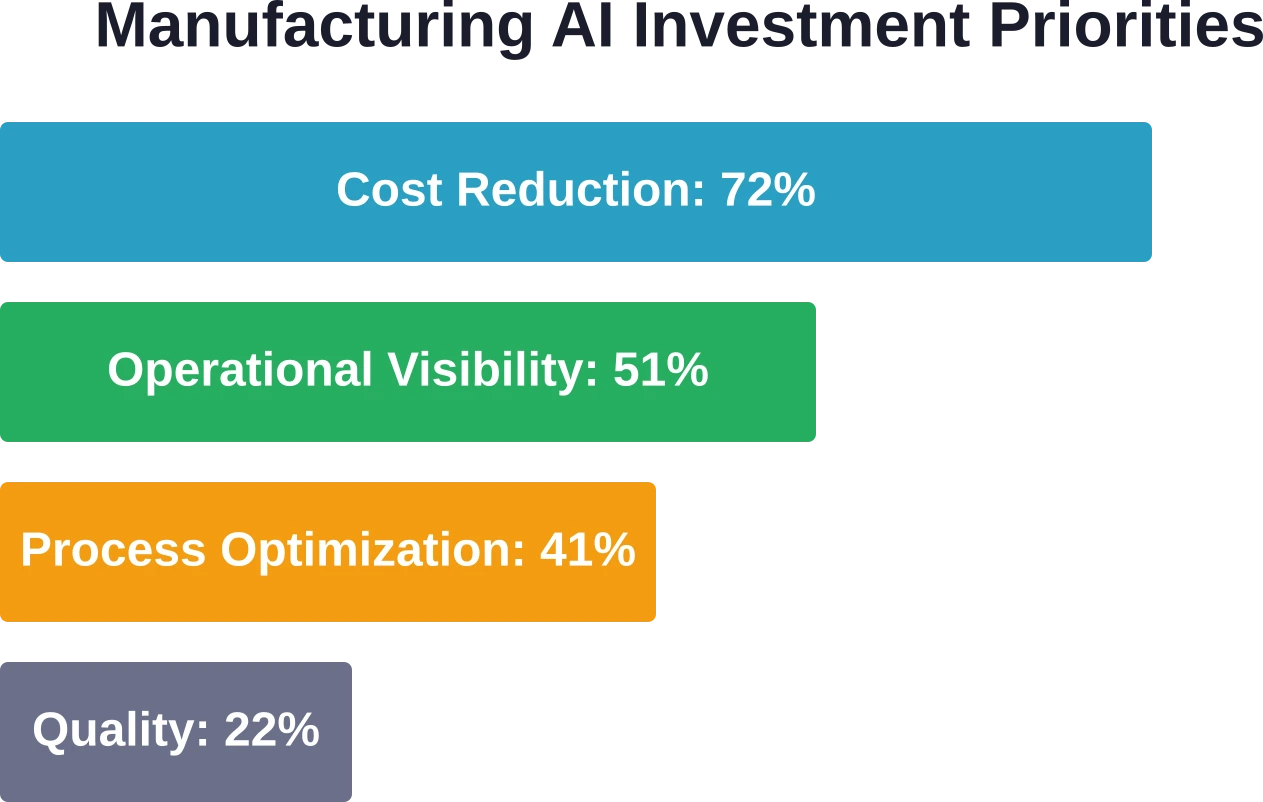
The data tells a compelling story. According to NIST, according to NIST data from May 2026, 72% of manufacturers cite reducing costs and improving operational efficiency as an AI investment priority. That’s not a marginal interest—that’s a fundamental shift in how production operations function.
But here’s what makes 2026 different from previous years: we now have verifiable metrics. Real deployments. Actual case studies with numbers attached.
This analysis examines where generative AI delivers measurable value, which industries are leading adoption, and what the authoritative data reveals about implementation success rates.
The Manufacturing Transformation: Where AI Investment Concentrates
Manufacturing stands out as the sector with the clearest AI deployment data. Recent NIST research published in May 2026 provides unprecedented visibility into how manufacturers prioritize AI investments.
The numbers reveal specific strategic priorities:
- According to NIST data from May 2026, 72% of manufacturers cite reducing costs and improving operational efficiency as an AI investment priority
- 51% prioritize enhancing operational visibility and responsiveness
- 41% target process optimization and control
- 22% aim to improve quality
- 21% seek sustained competitive advantage
Cost reduction dominates. That makes sense—manufacturing operates on thin margins, and even small efficiency gains translate to significant bottom-line impact.
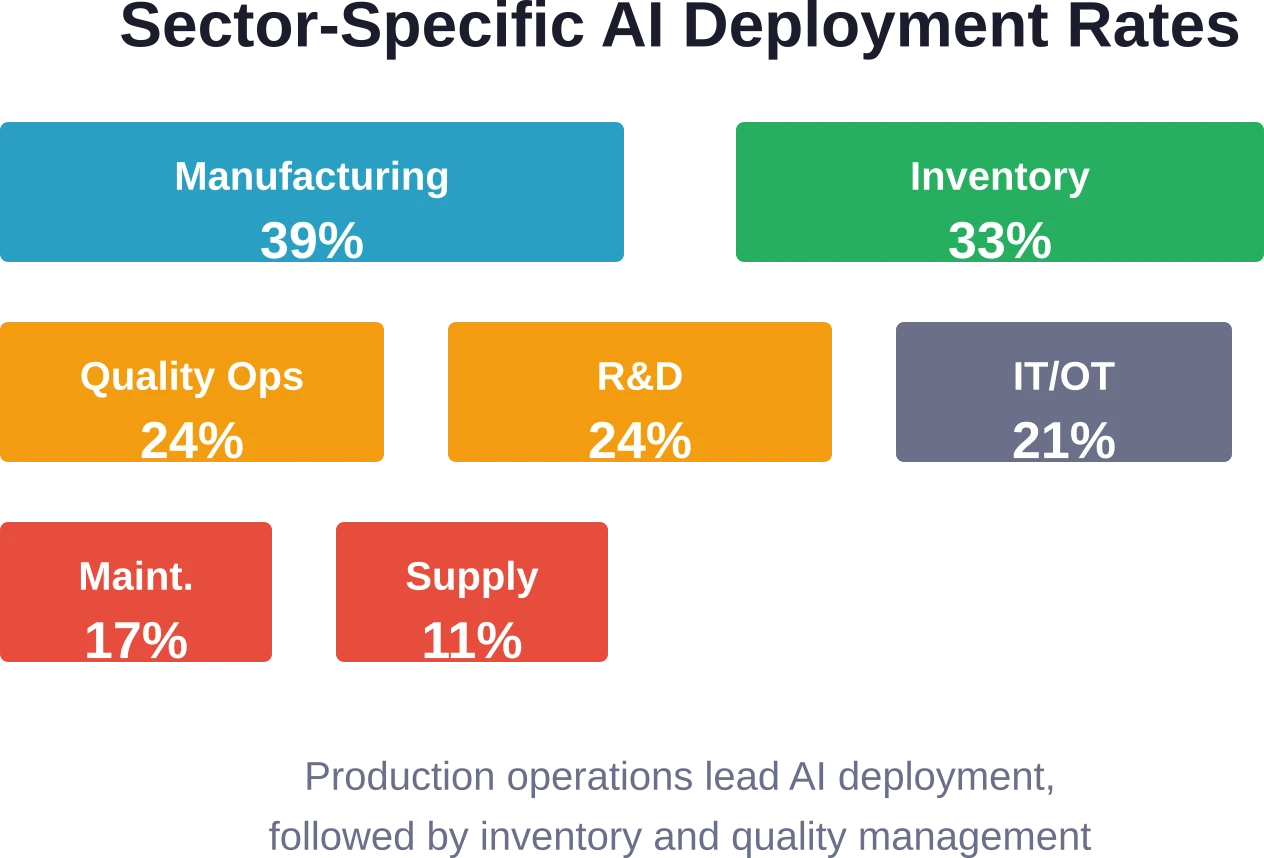
Look at where AI actually gets deployed on factory floors. According to the same NIST data, 39% of AI deployment happens in manufacturing and production operations themselves. Another 33% goes to inventory management, while 24% appears in both quality operations and research and development.
Where AI Makes the Biggest Impact on Factory Floors
Deployment location matters less than what the AI actually does. The functional applications tell the real story.
Process improvement and preventative maintenance tie for the top role at 54% each. That’s not surprising—unplanned downtime costs manufacturers millions, and AI excels at pattern recognition that predicts equipment failures before they happen.
Productivity and cost reduction come in at 50%, with quality improvement close behind at 49%. The pattern is clear: manufacturers deploy AI where it directly impacts the metrics that determine profitability.
Automated performance metrics and dashboards account for 41% of AI roles, while production planning sits at 40%. These applications share a common thread—they turn massive data streams into actionable insights faster than human analysts can.
Real talk: the 24% deployment in robotics gets more press attention, but process optimization drives more actual value for most manufacturers.
Workforce Impact: The Brookings Data on AI Disruption
Let’s address the elephant in the room. What happens to workers when generative AI scales across industries?
Brookings research provides sobering numbers. More than 30% of all workers could see at least 50% of their occupation’s tasks disrupted by generative AI. Even more striking: some 85% of workers could see at least 10% of their work tasks impacted.
That’s not a future prediction—that’s an assessment of current generative AI capabilities applied to existing job structures.
But disruption doesn’t equal replacement. The data shows something more nuanced happening.
The Performance Paradox: When AI Helps (and When It Doesn’t)
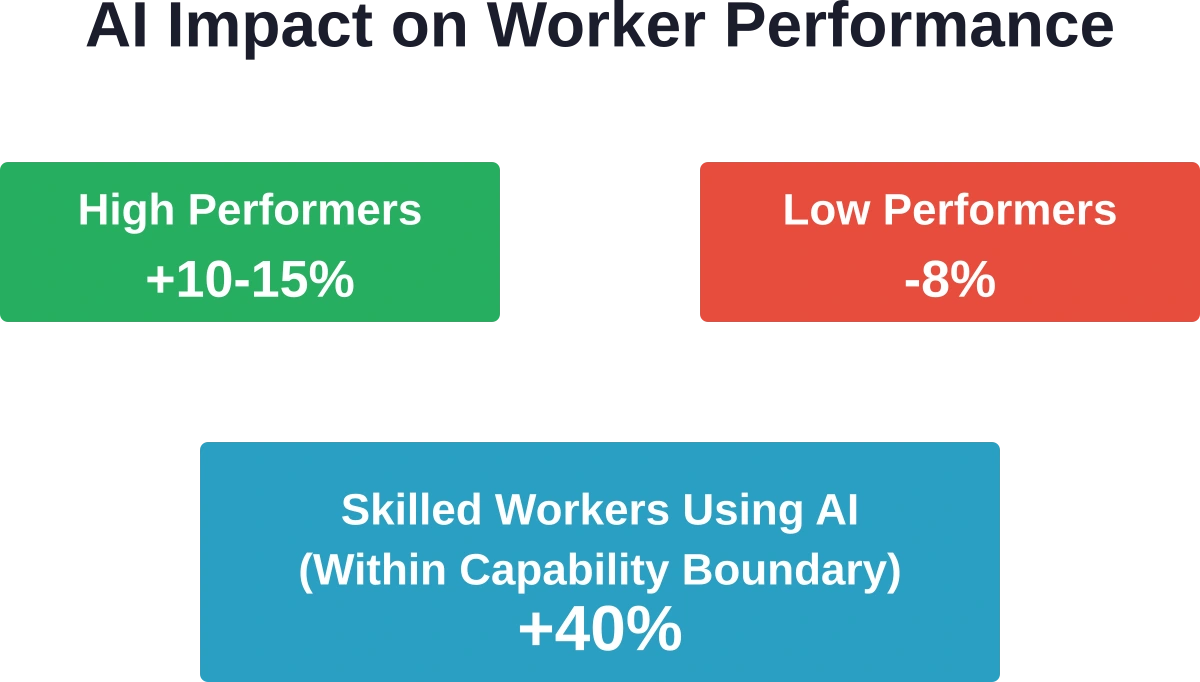
Harvard Business School research from September 2025 reveals a counterintuitive finding. When entrepreneurs used an AI assistant, high performers saw profits and revenues increase by 10-15%. Meanwhile, low performers actually decreased performance by 8%.
The difference? Experience and judgment in knowing when to trust AI recommendations versus when to override them.
MIT research on highly skilled workers (including consultants) found that when AI is used within the boundary of its capabilities, worker performance improves by nearly 40%. Outside that boundary, AI recommendations led people astray.
Here’s the thing though—that boundary keeps shifting. AI capabilities expand monthly, which means the territory where AI provides reliable assistance constantly changes.
Organizations need to maintain awareness of what researchers call the “jagged frontier”—the irregular border between what AI can and cannot do reliably.
The research also uncovered a concerning gender gap. Women showed 25% lower usage rates of AI tools compared to men on average. That disparity creates compounding effects—if AI becomes essential for competitive performance, unequal adoption rates will widen existing workplace inequities.
Cross-Sector Applications: Use Cases That Work Everywhere
Some generative AI applications transcend industry boundaries. They work in manufacturing, healthcare, finance, and retail with minimal customization.
Content Creation and Communication
Every organization produces content. Marketing materials, technical documentation, customer communications, internal reports—the list goes on.
Generative AI accelerates content production while maintaining quality standards. But it’s not about replacing writers. The highest-value application involves AI handling first drafts, data synthesis, and format conversion while human experts provide strategic direction and refinement.
LUXGEN, a Taiwanese electric vehicle brand, uses Vertex AI to power an AI agent that answers customer questions on its official LINE account. The chatbot has reduced the workload of human customer service agents by 30%.
Code Generation and Developer Productivity
Software development represents one of the clearest generative AI success stories. Amazon’s Q Developer platform reportedly saved over 4,500 years of work, equating to approximately $260 million a year.
That number sounds almost impossible. But when thousands of developers each save hours per week on boilerplate code, test generation, and documentation, the cumulative impact reaches that scale.
The pattern repeats across organizations. AI coding assistants handle routine tasks—unit test creation, code translation between languages, documentation generation, common algorithm implementation—freeing developers to focus on architecture, business logic, and complex problem-solving.
Predictive Analytics and Forecasting
Traditional forecasting models require extensive feature engineering and domain expertise to build. Generative AI models can ingest raw historical data and generate predictions with minimal preprocessing.
The applications span demand planning, inventory optimization, maintenance scheduling, financial projections, and resource allocation. What used to require dedicated data science teams now runs with AI systems that non-technical business analysts can configure.
But—and this matters—the quality of predictions depends entirely on the quality and relevance of training data. AI doesn’t magically overcome poor data hygiene or fundamental market uncertainty.
Industry-Specific Applications: Where Specialization Matters
While cross-sector use cases deliver value broadly, the highest-impact applications often involve deep domain expertise combined with AI capabilities.
Healthcare: Diagnostic Assistance and Medical Discovery
Healthcare AI applications require extreme accuracy and regulatory compliance. That creates higher barriers to entry but also higher value for successful implementations.
Diagnostic assistance tools analyze medical imaging, patient histories, and clinical notes to flag potential issues physicians might miss. These systems don’t replace medical judgment—they serve as a second set of eyes that never gets tired or distracted.
Medical discovery represents another frontier. Generative AI models can predict protein structures, identify drug candidates, and analyze clinical trial data at scales impossible for human researchers alone.
The key distinction: these systems augment specialist expertise rather than replacing it. The physician makes the diagnosis; the AI surfaces relevant patterns from millions of similar cases.
Financial Services: Risk Assessment and Fraud Detection
Financial institutions process enormous transaction volumes where patterns indicate either legitimate activity or potential fraud. Generative AI excels at identifying anomalies in high-dimensional data.
One financial institution’s payment system improved recovery rates by 30-40% and increased payment conversions by 45% using AI systems. Those gains directly impact bottom-line performance—every prevented fraudulent transaction saves money, and every recovered payment increases revenue.
Risk assessment applications analyze loan applications, investment portfolios, and market conditions to provide more accurate risk scoring than traditional statistical models. The AI considers hundreds of variables simultaneously and detects complex interaction effects that linear models miss.
Customer Service: Intelligent Routing and Response
Customer service represents one of the most widely deployed generative AI applications. The technology has evolved beyond simple chatbots to sophisticated agentic systems.
Modern customer service AI doesn’t just answer questions—it routes inquiries to the right department, synthesizes information from multiple knowledge bases, escalates complex issues appropriately, and learns from resolution patterns.
A healthcare organization built a generative AI assistant that routed members to relevant answers instantly, driving 1.5M+ interactions and increasing web chats by 25%. That increase isn’t a bug—it’s a feature. Lower friction to getting help means more members actually seek assistance rather than giving up.

Build Generative AI Use Cases With AI Superior
Generative AI can be useful across industries when it is tied to a clear task – not added only because the technology is popular. AI Superior works with generative AI development, AI chatbot development, LLM development and consulting, AI consulting, AI software development, and AI use case discovery. Across industries, this can support internal assistants, document processing, content workflows, customer support tools, knowledge search, and AI features inside existing products.
Relevant AI Superior services include:
- Defining generative AI use cases across business functions
- Developing AI chatbots and LLM-based tools
- Building custom AI software with generative AI features
- Supporting document, knowledge, or content-related workflows
- Integrating generative AI into existing platforms
👉Reach out to AI Superior to discuss practical generative AI use cases for your industry, product, or internal operations.
The Enterprise Reality: Computing Costs and Budget Constraints
Generative AI delivers value, but it’s not free. Infrastructure costs represent a significant barrier for many organizations.
Industry analyses indicate that 70% of executives say generative AI plays a key role in driving computing cost increases. The average cost of compute is rising sharply, and AI workloads accelerate that trend.
Simultaneously, 73% of executives agree that generative AI can make better use of computing resources. The technology creates cost pressure while also promising efficiency gains—a paradox that requires careful management.
Organizations face a strategic decision: invest in AI infrastructure now to gain competitive advantages, or wait until costs decrease and risk falling behind competitors who moved earlier.
The Trustworthiness Question
Enterprise AI deployment raises trust and governance concerns that consumer applications don’t face. When AI makes decisions that affect customer finances, medical treatment, or safety-critical operations, reliability becomes paramount.
IEEE is developing standards for trustworthy generative and agentic AI in enterprise applications. The P7022 standard specifies technical requirements and evaluation criteria for trustworthiness across all economic, policy, and regulatory sectors.
Similarly, the P3511 standard defines risk management guidelines for generative AI systems, helping organizations integrate risk assessment into the entire AI lifecycle.
These standards matter because they provide frameworks for evaluating AI systems beyond just accuracy metrics. Trustworthiness encompasses explainability, fairness, robustness, privacy protection, and accountability—dimensions that don’t show up in benchmark tests but determine real-world viability.
Agentic AI: The Next Evolution
Generative AI applications are evolving from passive tools that respond to prompts into active agents that initiate actions and coordinate complex workflows.
Agentic AI systems don’t wait for instructions—they monitor conditions, detect situations requiring intervention, and take appropriate actions within defined boundaries.
The distinction matters. A generative AI customer service tool might answer questions when asked. An agentic AI system proactively identifies customers likely to churn, initiates outreach, personalizes retention offers, and coordinates follow-up across channels.
Manufacturing provides clear examples. Traditional AI might flag a potential equipment failure. An agentic system automatically orders replacement parts, schedules maintenance windows that minimize production impact, notifies relevant personnel, and adjusts production schedules to compensate.
The shift from reactive to proactive AI amplifies both potential value and potential risk. Organizations gain automation of end-to-end processes but must carefully define boundaries and oversight mechanisms.
Implementation Patterns: What Actually Works
Successful AI implementations follow recognizable patterns. Organizations that achieve measurable results share common approaches.
Start with High-Value, Low-Risk Use Cases
The most successful deployments begin with applications where AI provides clear value but errors carry limited consequences. Content generation for internal documentation fits this profile—high effort savings, low risk if the AI produces occasional errors.
Once teams build confidence and expertise, they expand to higher-stakes applications. The learning curve matters more than most organizations expect. Teams need time to understand AI capabilities, limitations, and integration requirements.
Maintain Human Oversight at Decision Points
AI should inform decisions, not make them autonomously—at least initially. Human-in-the-loop designs keep people engaged at critical junctures while allowing AI to handle routine processing.
That approach provides safety while also generating the feedback loops necessary for continuous improvement. Humans correcting AI errors create training signals that improve future performance.
Invest in Data Infrastructure Before AI Models
The unsexy truth: data quality determines AI success more than model sophistication. Organizations with clean, well-organized, properly labeled data achieve better results with simpler models than organizations with cutting-edge models trained on messy data.
That means investing in data governance, integration pipelines, quality monitoring, and documentation before deploying AI systems. It’s less exciting than experimenting with the latest models, but it creates the foundation for sustainable AI operations.
| Implementation Phase | Key Activities | Common Pitfalls |
|---|---|---|
| Assessment | Identify high-value use cases, evaluate data readiness, estimate resource requirements | Overestimating data quality, underestimating change management needs |
| Pilot | Deploy limited scope system, establish metrics, gather user feedback | Picking too complex use cases, insufficient user training |
| Scale | Expand to additional use cases, integrate with existing systems, formalize governance | Scaling too fast, neglecting performance monitoring |
| Optimization | Refine models, automate retraining, measure business impact | Set-and-forget approach, ignoring model drift |
Measuring Success: Metrics That Matter
Organizations need clear metrics to evaluate AI system performance. But the right metrics depend on the application.
For customer service AI, relevant metrics include resolution rate, escalation rate, customer satisfaction scores, and average handling time. For manufacturing predictive maintenance, track prediction accuracy, false positive rate, prevented downtime, and maintenance cost reduction.
The mistake many organizations make: focusing exclusively on AI model metrics (accuracy, precision, recall) while ignoring business outcome metrics (revenue impact, cost savings, customer retention).
Model metrics matter for the AI team. Business metrics matter for everyone else. Successful AI programs translate model performance into business language that executives and stakeholders understand.
The ROI Challenge
Calculating AI ROI proves difficult because benefits often appear in multiple places. A customer service AI might reduce support costs, but it also improves customer satisfaction, which affects retention, which influences lifetime value.
Attributing that full chain of effects to the AI system requires careful analysis. Many organizations settle for measuring direct effects only, which underestimates total value but provides conservative estimates that justify continued investment.
Risk Management and Governance
Every AI deployment carries risks—technical risks like model failures, operational risks like integration issues, and strategic risks like dependency on AI vendors.
The National Institute of Standards and Technology published an AI Risk Management Framework to help organizations identify and mitigate these risks. The framework emphasizes that AI risk management shouldn’t be separate from enterprise risk management—it’s an integrated component of overall organizational governance.
Key risk categories include:
- Bias and fairness issues that create discriminatory outcomes
- Reliability problems where AI systems fail in unexpected ways
- Security vulnerabilities that create attack surfaces
- Privacy violations from improper data handling
- Explainability gaps that prevent understanding AI decisions
Addressing these risks requires technical controls, policy frameworks, and organizational culture that prioritizes responsible AI deployment.
The Policy Landscape: Government Frameworks Taking Shape
Government policy around AI is evolving rapidly. President Trump signed an Executive Order in December 2025 establishing a national AI policy framework designed to protect innovation from inconsistent state regulations.
The order directs the Attorney General to establish an AI Litigation Task Force to challenge state laws that might be unconstitutional, preempted by federal law, or otherwise problematic for AI innovation.
That policy direction suggests federal preference for innovation-friendly regulation rather than restrictive approaches. But it also creates uncertainty as the boundaries between federal and state authority get tested in courts.
For organizations deploying AI, this means monitoring the regulatory landscape closely and building flexible systems that can adapt as requirements change.
Looking Forward: Where AI Applications Are Headed
Current generative AI applications represent early stages of what’s possible. Several trends will shape the next wave of deployments.
Multimodal Systems
First-generation generative AI specialized in single modalities—text, images, or code. Next-generation systems process and generate across modalities simultaneously.
A multimodal manufacturing system might analyze machinery sounds, vibration patterns, thermal images, and operational logs together to predict failures more accurately than any single data source enables.
Smaller, More Efficient Models
The computing cost pressure mentioned earlier is driving innovation in model efficiency. Researchers are developing smaller models that achieve comparable performance to larger ones through better training techniques and architecture innovations.
That matters because smaller models cost less to run, respond faster, and can deploy on edge devices rather than requiring cloud infrastructure. Organizations will gain access to AI capabilities that were previously cost-prohibitive.
Domain-Specific Fine-Tuning
General-purpose AI models provide broad capabilities but lack deep domain expertise. The trend toward fine-tuning models on industry-specific data creates AI systems that understand specialized terminology, regulations, and business contexts.
A healthcare AI trained on medical literature performs differently than the same base model fine-tuned on actual clinical notes from a hospital system. The fine-tuned version understands that institution’s workflows, documentation practices, and patient population.
Practical Next Steps for Organizations
Organizations considering generative AI deployment should take a systematic approach.
First, assess current data readiness. AI systems require substantial volumes of clean, relevant data. If data infrastructure isn’t mature, address that foundation before investing heavily in AI models.
Second, identify 2-3 high-value use cases where AI can deliver measurable outcomes. Avoid trying to deploy AI everywhere simultaneously. Focused deployments that demonstrate clear value build organizational support for broader initiatives.
Third, establish governance frameworks before scaling deployments. Define who owns AI systems, how performance gets monitored, what approval processes apply for new applications, and how risks get managed. Retrofitting governance onto existing deployments proves much harder than building it in from the start.
Fourth, invest in training and change management. AI tools only deliver value when people use them effectively. That requires training on both technical capabilities and strategic application.
| Organizational Maturity Level | Recommended First Steps | Expected Timeline |
|---|---|---|
| Exploring | Pilot single use case, assess data readiness, build internal expertise | 3-6 months |
| Implementing | Deploy 2-3 use cases, establish governance, measure business impact | 6-12 months |
| Scaling | Expand across departments, integrate with enterprise systems, automate operations | 12-24 months |
| Optimizing | Develop proprietary models, implement agentic systems, drive continuous improvement | Ongoing |
Common Pitfalls to Avoid
Organizations frequently make predictable mistakes when deploying generative AI. Learning from others’ errors saves time and resources:
- Overestimating current capabilities: Generative AI is powerful but not magic. It struggles with reasoning tasks, can’t access real-time information without integration, and makes mistakes that superficially appear correct.
- Underestimating integration complexity: Deploying a model is easy. Integrating it into existing workflows, systems, and processes is hard. Budget significantly more time for integration than for the AI system itself.
- Neglecting ongoing maintenance: AI systems degrade over time as data distributions shift. Model performance that looks good at launch can deteriorate without monitoring and retraining.
- Ignoring user adoption: Building an AI system doesn’t mean people will use it. Understanding user needs, providing adequate training, and demonstrating clear value are necessary for adoption.
- Skipping governance frameworks: Moving fast without governance creates technical debt and risk exposure. Organizations need clear policies on data usage, model approval, performance monitoring, and incident response.
The Competitive Dynamics Shift
AI adoption is creating competitive separation between organizations. Early movers gain experience, refine processes, and build capabilities that create compounding advantages.
That dynamic appears clearly in manufacturing, where 21% of organizations explicitly invest in AI to create sustained competitive advantage. They recognize that AI capabilities are becoming table stakes, not differentiators.
But wait. If everyone adopts similar AI tools, how does anyone achieve advantage?
The advantage comes from application and integration, not from model access. OpenAI’s models are available to everyone. The competitive edge comes from knowing which problems to apply AI to, how to integrate it effectively with proprietary data and workflows, and how to leverage AI output strategically.
Frequently Asked Questions
What percentage of manufacturers are currently investing in AI?
According to NIST data from May 2026, 72% of manufacturers cite reducing costs and improving operational efficiency as an AI investment priority. Other investment priorities include enhancing operational visibility (51%), improving process optimization and control (41%), and improving quality (22%).
How much can generative AI improve worker productivity?
MIT research on highly skilled workers (including consultants) found that when AI is used within the boundary of its capabilities, worker performance improves by nearly 40%. However, Harvard research showed results vary significantly by user experience—high-performing entrepreneurs saw 10-15% revenue gains with AI assistance, while low-performing entrepreneurs experienced 8% performance decreases.
What are the most common AI deployment areas in manufacturing?
NIST data shows 39% of AI deployment occurs in manufacturing and production operations, 33% in inventory management, 24% in both quality operations and research and development, 21% in IT/operational technology, and 17% in equipment maintenance and installation.
What risks should organizations consider when deploying generative AI?
Key risk categories include bias and fairness issues, reliability problems where systems fail unexpectedly, security vulnerabilities, privacy violations from improper data handling, and explainability gaps. The NIST AI Risk Management Framework provides guidance for identifying and mitigating these risks as part of integrated enterprise risk management.
How is generative AI affecting employment across industries?
Brookings research indicates that more than 30% of all workers could see at least 50% of their occupation’s tasks disrupted by generative AI, while some 85% of workers could see at least 10% of work tasks impacted. However, disruption doesn’t equal replacement—the data suggests AI augments worker capabilities rather than fully replacing human roles in most cases.
What computing cost considerations should organizations plan for?
Industry analyses indicate 70% of executives say generative AI plays a key role in driving computing cost increases, with the average cost of compute rising sharply. Organizations need to balance these infrastructure costs against efficiency gains, with 73% of executives agreeing that generative AI can make better use of computing resources despite the increased expense.
What industries beyond manufacturing show strong AI adoption?
Healthcare shows significant adoption in diagnostic assistance and medical discovery applications. Financial services deploy AI extensively for risk assessment, fraud detection, and payment processing—one financial institution’s payment system improved recovery rates by 30-40% and increased payment conversions by 45%. Customer service across industries has widely adopted AI, with implementations driving millions of interactions and reducing human agent workload by up to 30%.
Conclusion: Strategic Implementation Over Technology Chasing
Generative AI has moved decisively past the hype phase. The 2026 data shows clear deployment patterns, measurable outcomes, and identifiable success factors across industries.
The organizations achieving the strongest results share common characteristics. They focus on specific high-value use cases rather than trying to deploy AI everywhere. They invest in data infrastructure and governance frameworks. They maintain realistic expectations about AI capabilities while pushing boundaries where appropriate.
Most importantly, they view AI as a tool for augmenting human capabilities rather than replacing human judgment. The MIT finding that AI can improve performance by 40% within capability boundaries—but leads people astray outside those boundaries—captures the essential dynamic.
Success requires knowing where those boundaries lie and maintaining human expertise to recognize when AI guidance should be questioned rather than automatically accepted.
For organizations beginning their AI journey, the path forward involves assessment, pilot implementations, measured scaling, and continuous optimization. The competitive pressure is real—organizations investing in AI to reduce costs creates urgency for everyone in the sector.
But rushing into AI deployment without proper foundation creates technical debt and risk exposure that undermines long-term value. Strategic, well-governed implementation wins over hasty technology chasing.
The question for most organizations is no longer whether to deploy generative AI, but where to deploy it first and how to build the organizational capabilities necessary to extract sustained value. The data presented here provides benchmarks for evaluating progress and identifying high-value opportunities.
Start with clear use cases. Build solid data foundations. Establish governance frameworks. Measure actual business outcomes. Then scale what works.
 English
  German
  Arabic
  French
  Dutch
Dutch  Spanish