Quick Summary: Big data use cases span healthcare, finance, retail, manufacturing, and government sectors, enabling organizations to detect fraud, personalize customer experiences, optimize supply chains, and improve decision-making. By analyzing massive datasets in real-time, companies achieve competitive advantages through predictive analytics, behavioral insights, and operational efficiency gains that traditional data systems cannot deliver.
Big data isn’t just a buzzword anymore. It’s the engine driving decisions at organizations that consistently outperform their competition.
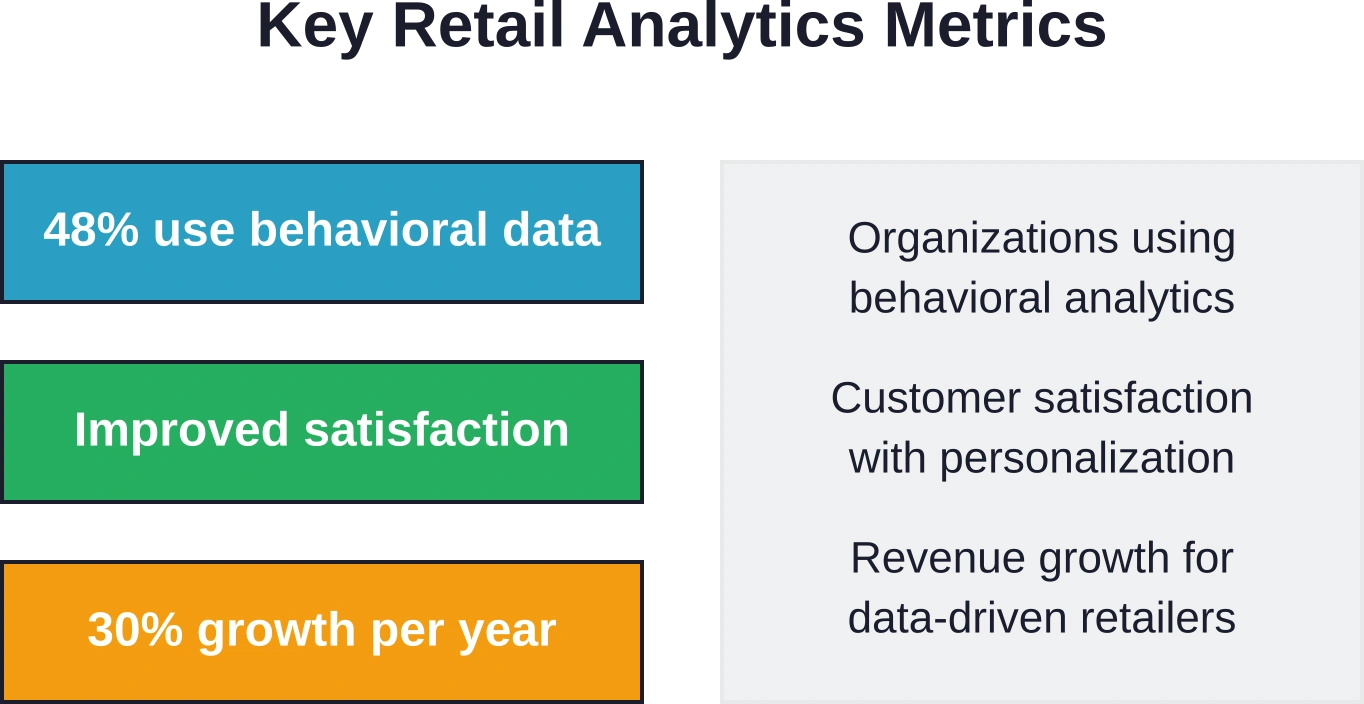
The numbers back this up. According to research cited across multiple industry analyses, 58% of companies that make data-based decisions are more likely to beat revenue targets than those that don’t. Data-driven organizations generate, on average, more than 30% growth per year.
But what does this actually look like in practice?
That’s what this article tackles. Real implementations. Specific use cases. Measurable outcomes from organizations that turned massive, messy datasets into strategic assets.
Understanding Big Data Use Cases
Big data use cases are distinct situations where organizations collect, process, and analyze big data to complete tasks and achieve goals. These aren’t theoretical exercises—they’re practical applications solving real business problems.
According to the National Institute of Standards and Technology (NIST), big data describes the large amount of data in the networked, digitized, sensor-laden, information-driven world. Volume alone doesn’t define it. What matters is what organizations do with that data.
The defining characteristics show up in what industry professionals call the Vs of big data: volume, velocity, variety, veracity, and value. Some frameworks add variability as a sixth dimension.
Here’s the thing though—these characteristics create both opportunities and challenges. The same velocity that enables real-time fraud detection also demands infrastructure capable of processing millions of transactions per second. The variety that enriches customer profiles also requires systems that handle structured databases alongside unstructured social media posts.
Organizations that succeed with big data focus on specific use cases rather than trying to boil the ocean. They identify business problems where large-scale data analysis delivers measurable value, then build the technical and organizational capabilities to execute.
Big Data Use Cases in Healthcare
Healthcare generates massive amounts of data daily—electronic health records, medical imaging, insurance claims, patient surveys, wearable devices, genomics data, and pharmaceutical research. The challenge has always been turning this flood of information into better patient outcomes.
That’s changing rapidly.
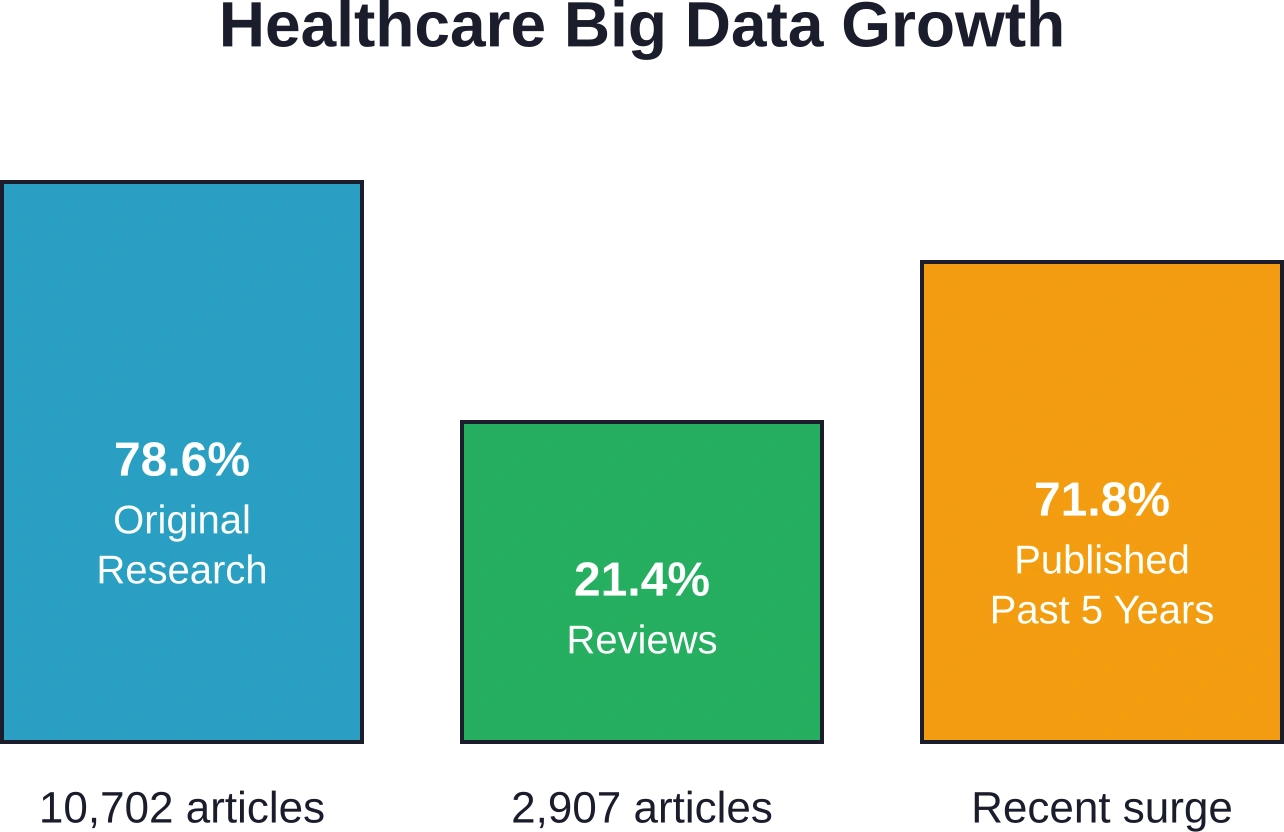
A bibliometric analysis published in medical research databases examined 13,609 articles on big data applications in the medical industry. The research found that 10,702 articles (78.6%) were original research, while 2,907 (21.4%) were reviews. Notably, 71.8% of the literature was published in the past five years, showing explosive recent growth in healthcare analytics adoption.
Scholars have published articles on big data technology applications in the medical industry since 2009, but the acceleration happened much more recently. The USA leads with 4,053 publications, followed by China with 3,184 articles.
Predictive Analytics for Patient Care
Healthcare providers use big data analytics to predict patient deterioration before it becomes critical. By analyzing vital signs, lab results, medication records, and historical patterns across thousands of patients, predictive models identify early warning signs that human clinicians might miss.
This approach supports evidence-based and outcome-driven decision-making in clinical practice. Data analytics in healthcare identifies patterns, enhances patient care, and improves system efficiency.
Healthcare Operations and Resource Management
Research conducted by the Center for Research and Expertise of the University of Economics in Katowice examined healthcare entities’ big data adoption. The study found that 23.5% of surveyed entities were financed from public sources (the National Health Fund), 11.5% operated commercially, and 64.9% had hybrid public and commercial financing.
The entity size distribution showed 34% were medium-sized (10-50 employees) and 27% were large (51-250 employees). These organizations are using big data to optimize staffing, reduce wait times, and improve resource allocation across facilities.
Medical Research and Drug Development
Pharmaceutical companies analyze genomic data, clinical trial results, and real-world patient outcomes to accelerate drug discovery and development. What used to take years can now happen in months by identifying patterns across millions of data points.
Big data enables researchers to identify patient populations most likely to benefit from specific treatments, predict adverse drug interactions, and optimize clinical trial designs before investing millions in development.
Big Data Use Cases in Financial Services
Financial institutions were early adopters of big data analytics, and for good reason. The stakes are high, the data volumes are massive, and the competitive advantages are measurable.
Real talk: a single day of trading on major exchanges generates terabytes of transaction data. Credit card companies process billions of transactions annually. Banks maintain decades of customer financial history. That’s exactly the kind of volume, velocity, and variety where big data shines.
Fraud Detection and Prevention
Financial fraud costs billions annually. Big data analytics enables instant detection by analyzing patterns across millions of transactions in real-time.
The analysis can quickly flag unusual patterns and customer behavior that could signify credit card fraud, identity theft, or other fraudulent activity. Instant detection means expedient intervention—global financial services firm JP Morgan Chase developed a real-time fraud detection system that analyzes transaction patterns across their entire customer base simultaneously.
Traditional rule-based systems catch known fraud patterns. Machine learning models trained on big data catch new fraud schemes by identifying subtle anomalies that rules miss.
Risk Management and Credit Scoring
Banks use big data to assess credit risk more accurately than traditional scoring models. By analyzing thousands of variables—transaction history, payment patterns, social connections, employment stability, even smartphone usage patterns—lenders can better predict default risk.
This benefits both institutions and consumers. Banks reduce losses from defaults. Creditworthy customers who might have been rejected by traditional scoring get approved.
Algorithmic Trading
Investment firms analyze market data, news feeds, social media sentiment, and economic indicators in real-time to execute trades in milliseconds. The advantage isn’t just speed—it’s the ability to process thousands of signals simultaneously and identify patterns invisible to human traders.
High-frequency trading firms process market data at a scale where microseconds matter. The infrastructure investment is substantial, but the competitive edge is measurable.
Customer Personalization
Banks analyze customer transaction data to personalize product recommendations, optimize service delivery, and improve customer satisfaction. By understanding spending patterns, life events, and financial goals, institutions can offer relevant products at the right time.
This isn’t just good service—it’s profitable. Personalized offers convert at significantly higher rates than generic marketing campaigns.
Big Data Use Cases in Retail
Retail generates some of the richest behavioral data available. Every click, every purchase, every abandoned cart tells a story. Retailers that decode these stories win.
The transformation is visible. Traditional retailers struggled to compete with digital-native companies precisely because they couldn’t match the data-driven personalization that online platforms offered. Now, the gap is closing as physical retailers deploy big data analytics across their operations.
Behavioral Analytics and Customer Insights
Analysis shows that 48% of organizations use big data to unlock meaningful insights from customer behavioral data. Organizations are harnessing behavioral analytics to deliver significant value to businesses.
Nordstrom reports improved customer satisfaction through personalized experiences based on behavioral data analysis. The system recommends products customers are likely to want before they search for them.
Inventory and Supply Chain Optimization
Retailers use predictive analytics to optimize inventory levels across thousands of SKUs and hundreds of locations. By analyzing historical sales data, seasonal patterns, weather forecasts, local events, and trend signals, systems predict demand with remarkable accuracy.
The payoff is substantial. Optimal inventory levels reduce carrying costs while minimizing stockouts that cost sales. Supply chain optimization extends this logic backward through the entire distribution network.
Dynamic Pricing
Big data enables retailers to adjust prices in real-time based on demand, competitor pricing, inventory levels, and customer segments. Airlines pioneered this approach decades ago. Now it’s spreading across retail categories.
The systems analyze millions of data points to find the price that maximizes revenue for each product at each moment. Done right, dynamic pricing increases profitability without alienating customers.
Store Layout and Merchandising
Retailers analyze in-store traffic patterns using sensors and cameras to optimize store layouts. Which aisles get the most foot traffic? Where do customers pause? What placement increases impulse purchases?
This data-driven approach to merchandising replaces intuition with evidence. Test, measure, optimize, repeat.
Big Data Use Cases in Manufacturing
Manufacturing generates continuous streams of data from sensors, machines, quality control systems, and supply chains. The Industrial Internet of Things (IoT) amplified this trend dramatically.
General Electric’s transformation illustrates the opportunity. As documented in MIT Sloan Management Review case studies, GE launched a major initiative to become a leader of the Industrial Internet, betting billions on data and analytics capabilities.
The promise: using data to optimize operations at a scale impossible through traditional approaches.
Predictive Maintenance
Sensors on manufacturing equipment generate continuous streams of operational data—temperature, vibration, pressure, output quality, energy consumption. By analyzing patterns across thousands of machines over years of operation, predictive models identify subtle signatures that precede equipment failures.
The value proposition is straightforward. Unplanned downtime costs manufacturers millions. Predictive maintenance shifts from reactive repairs (expensive, disruptive) to planned maintenance (scheduled, optimized). Replace parts before they fail, during scheduled downtime, when replacement parts are in stock.
Quality Control and Defect Detection
Computer vision systems analyze products at speeds and accuracy levels exceeding human inspectors. Machine learning models trained on millions of images detect defects that traditional automated systems miss.
The systems improve continuously. Each defect caught feeds back into training data, making the model more accurate. The result is higher quality products with lower inspection costs.
Supply Chain and Production Optimization
Manufacturers analyze data across their entire supply chain to optimize production schedules, minimize inventory, and reduce costs. By understanding demand patterns, supplier reliability, transportation logistics, and production capacity constraints, systems optimize decisions that involve thousands of variables.
What used to require armies of analysts and weeks of work now happens automatically, continuously, based on real-time data.
Energy Management
Manufacturing is energy-intensive. Big data analytics identifies opportunities to reduce energy consumption without compromising production. By analyzing energy usage patterns across equipment, production schedules, and operational conditions, systems identify inefficiencies and optimization opportunities.
The savings compound. A 5% reduction in energy costs across a large manufacturing operation translates to millions annually.
Big Data Use Cases in Entertainment and Media
Entertainment companies pioneered personalization at scale. The recommendation algorithms that suggest what to watch next, what to listen to, what to read—these systems analyze billions of user interactions to predict preferences with uncanny accuracy.
Content Recommendations
Streaming platforms analyze viewing patterns across millions of users to recommend content. The systems don’t just match genres—they identify subtle preference patterns based on viewing time, completion rates, rewatching behavior, and hundreds of other signals.
This isn’t just better user experience. Recommendation systems directly impact subscription retention and content consumption, which drive revenue.
Content Production Decisions
Media companies use big data to inform content production decisions. Which genres are trending? Which actors or directors drive viewership? What story elements resonate with specific audience segments?
By analyzing viewing data, social media buzz, and market trends, studios make more informed decisions about which projects to greenlight and how to market them.
Advertising Optimization
Media platforms analyze user data to deliver targeted advertising at scale. The same technology that recommends content also matches users with relevant advertisements, increasing ad effectiveness while improving user experience by showing more relevant ads.
Advertisers pay premium rates for this targeting capability because it delivers measurably better results than broadcast advertising.
Big Data Use Cases in Government and Public Sector
Government agencies manage massive datasets—census data, tax records, healthcare information, transportation systems, public safety data, and more. The challenge has always been turning this data into better outcomes for citizens.
That’s changing as public sector organizations adopt big data analytics.
Public Safety and Crime Prevention
Law enforcement agencies use predictive analytics to allocate resources more effectively. By analyzing crime patterns, seasonal trends, event schedules, and environmental factors, systems predict where crimes are most likely to occur.
This enables proactive policing—putting officers in the right places at the right times to prevent crimes rather than just responding after they occur.
Transportation and Urban Planning
Cities analyze traffic patterns, public transportation usage, and infrastructure data to optimize transportation systems. Sensors on roads and vehicles generate real-time data that informs traffic light timing, route planning, and infrastructure investment decisions.
The result is reduced congestion, shorter commutes, and more efficient public transportation systems.
Public Health Monitoring
Health agencies analyze population health data to identify disease outbreaks, monitor public health trends, and allocate healthcare resources. The COVID-19 pandemic demonstrated both the potential and the challenges of big data analytics in public health.
By analyzing testing data, hospitalization rates, vaccination coverage, and mobility patterns, agencies make more informed decisions about public health interventions.
Social Services Optimization
Government agencies use data analytics to identify citizens who need services, detect fraud in benefit programs, and optimize service delivery. By analyzing patterns across multiple data sources, agencies can target interventions more effectively and reduce waste.
| Industry | Primary Use Case | Key Benefit | Implementation Challenge |
|---|---|---|---|
| Healthcare | Predictive patient care | Improved outcomes | Data privacy regulations |
| Financial Services | Fraud detection | Real-time prevention | System latency requirements |
| Retail | Behavioral analytics | Personalized experience | Data integration complexity |
| Manufacturing | Predictive maintenance | Reduced downtime | Sensor infrastructure costs |
| Entertainment | Content recommendations | Increased engagement | Algorithm transparency |
| Government | Public safety analytics | Crime prevention | Bias and fairness concerns |
Marketing Analytics and Customer Targeting
Marketing was transformed by big data analytics. The ability to measure campaign effectiveness, target specific customer segments, and optimize spending in real-time changed how companies approach marketing.
Research published by Stanford Graduate School of Business examined big data and marketing analytics in gaming. The study described efforts to develop, implement, and evaluate a marketing analytics framework at MGM Resorts International using individual-level transaction data.
The framework used empirical models of consumer response to marketing efforts to optimize segmentation and targeting. The models incorporated consumer heterogeneity and state-dependence into choice modeling, with controls for the endogeneity of historical targeting rules.
The research demonstrated substantial improvements in marketing effectiveness through data-driven analytics approaches applied to real-world casino operations.
The case study underscores the value of using empirically-relevant marketing analytics solutions for improving outcomes in real-world settings.
Customer Segmentation
Big data enables granular customer segmentation based on hundreds of variables—demographics, purchase history, browsing behavior, social media activity, and more. Instead of broad categories like “millennial women,” companies can identify micro-segments with specific preferences and behaviors.
This precision enables personalized marketing at scale. Different messages, offers, and channels for different segments, all optimized based on data rather than intuition.
Attribution Modeling
Multi-touch attribution analyzes customer journeys across dozens of touchpoints—ads, emails, social media, website visits, store visits—to understand which marketing activities actually drive conversions.
Traditional attribution gave all credit to the last click before purchase. Big data analytics reveals the complex reality: customers interact with brands through multiple channels over time before purchasing. Understanding this journey enables smarter budget allocation.
Campaign Optimization
Marketers use A/B testing and multivariate testing at scale to optimize campaigns continuously. Test different messages, images, offers, and targeting parameters. Measure results in real-time. Double down on what works.
The cycle time collapsed from months to days or hours. Campaigns improve continuously based on performance data rather than waiting for post-campaign analysis.

Turn Big Data Use Cases Into Working AI Solutions
Big data becomes more valuable when companies know what they want to predict, optimize, automate, or understand. AI Superior supports this kind of work through AI consulting, AI and data strategy, business intelligence solutions, core machine learning, predictive analytics, and custom AI software development. For industry use cases, this can apply to customer analytics, operational reporting, forecasting, anomaly detection, process analysis, and decision support based on large datasets.
For big data projects, AI Superior can support:
- Identifying practical AI and analytics use cases
- Building predictive models from business data
- Developing business intelligence and data analytics tools
- Creating AI software around large or complex datasets
- Connecting analytics outputs to existing systems
👉Contact AI Superior to explore how big data use cases can be turned into practical AI or analytics solutions.
Challenges and Considerations in Big Data Implementation
Big data delivers measurable value. But implementation isn’t trivial. Organizations face technical, organizational, and ethical challenges.
Data Quality and Integration
Big data is only valuable if it’s accurate. Data quality issues—incomplete records, inconsistent formats, duplicate entries, outdated information—undermine analytics.
Integration compounds the challenge. Organizations typically need to combine data from dozens of sources, each with different schemas, formats, and quality standards. Building pipelines that clean, transform, and integrate data reliably requires significant technical investment.
Technical Infrastructure
Processing big data requires specialized infrastructure. Traditional database systems weren’t designed for the volume, velocity, and variety of big data. Organizations need distributed computing systems, cloud infrastructure, specialized storage solutions, and analytics platforms.
The cost can be substantial. But the alternative—trying to do big data analytics on traditional infrastructure—doesn’t work.
Skills and Talent
Big data requires specialized skills. Data engineers build pipelines. Data scientists develop models. Analysts interpret results. Business stakeholders translate insights into decisions.
The talent shortage is real. Organizations compete for professionals who understand both the technical aspects of big data and the business context where it creates value.
Privacy and Security
Big data often includes sensitive information. Healthcare records. Financial transactions. Personal behavior. Organizations must protect this data while using it for analytics.
Regulations like GDPR and HIPAA impose strict requirements. Violations carry substantial penalties. Security breaches damage reputation and customer trust.
Organizations need technical controls, governance processes, and organizational culture that prioritizes privacy and security.
Bias and Fairness
Machine learning models trained on historical data can perpetuate or amplify existing biases. If historical lending data reflects discriminatory practices, models trained on that data will learn to discriminate.
This isn’t just an ethical problem—it’s a business and legal risk. Organizations need processes to identify and mitigate bias in their data and models.
Organizational Change
Becoming data-driven requires cultural change. Decisions that used to be based on intuition, experience, or politics need to be based on evidence. That’s uncomfortable for organizations accustomed to traditional decision-making.
Leadership support is essential. But so is education, incentives, and processes that embed data-driven decision-making into daily operations.
| Challenge | Impact | Mitigation Strategy |
|---|---|---|
| Data quality issues | Inaccurate insights | Automated validation and cleansing pipelines |
| Infrastructure costs | High initial investment | Cloud platforms with pay-as-you-go pricing |
| Talent shortage | Implementation delays | Training programs and managed services |
| Privacy regulations | Compliance risk | Privacy-by-design and governance frameworks |
| Algorithm bias | Unfair outcomes | Bias testing and diverse training data |
| Cultural resistance | Low adoption | Executive sponsorship and change management |
Getting Started with Big Data
Organizations don’t need to boil the ocean. The most successful big data initiatives start small, prove value, then scale.
Identify High-Value Use Cases
Start by identifying business problems where data analysis can deliver measurable value. Focus on problems where the organization already collects relevant data or can collect it easily.
The best initial projects have clear success metrics, manageable scope, and executive sponsorship. Win there first, then tackle harder problems.
Assess Data Readiness
What data does the organization already have? What condition is it in? What gaps exist? Data inventory and quality assessment prevent surprises later.
Organizations often discover they have more data than they realized. The challenge is making it accessible and usable.
Build or Buy Capabilities
Organizations can build big data capabilities internally, use managed services, or adopt hybrid approaches. The right choice depends on technical maturity, budget, and strategic importance.
Many organizations start with cloud-based platforms that provide infrastructure and tools without requiring massive upfront investment. This lowers the barrier to entry and enables faster experimentation.
Start with Pilot Projects
Pilot projects test hypotheses and prove value before committing to large-scale implementation. Pick a bounded problem, apply analytics, measure results.
Learn from pilots. What worked? What didn’t? What surprised you? Use those lessons to refine the approach before scaling.
Scale What Works
Once pilots demonstrate value, scale successful approaches. Build the infrastructure, processes, and organizational capabilities needed to make data-driven decision-making routine rather than exceptional.
This is where the cumulative value appears. One successful analytics project delivers value. A dozen do more. An organization where data-driven decisions are standard practice transforms performance.
Future Trends in Big Data
Big data continues evolving rapidly. Several trends are shaping the next generation of use cases.
Real-Time Analytics
The time between data collection and insight continues shrinking. Real-time analytics enable immediate responses—fraud detection in milliseconds, dynamic pricing that updates continuously, predictive maintenance alerts that prevent failures.
Infrastructure and algorithms that support real-time processing at scale unlock use cases impossible with batch processing.
Edge Computing
Processing data closer to where it’s generated reduces latency and bandwidth costs. Instead of sending all sensor data to centralized cloud systems, edge devices do preliminary processing and send only relevant information.
This matters for use cases where milliseconds count—autonomous vehicles, industrial automation, medical devices.
AI and Machine Learning Integration
Machine learning models are becoming standard components of big data systems. The combination is powerful: big data provides the training data and real-time inputs that machine learning needs, while machine learning extracts insights from data at scales impossible for human analysts.
As AI capabilities advance, the line between big data analytics and artificial intelligence blurs. They’re becoming integrated capabilities rather than separate disciplines.
Privacy-Preserving Analytics
Techniques like differential privacy, federated learning, and secure multiparty computation enable analytics on sensitive data without exposing individual records. This unlocks use cases previously blocked by privacy concerns.
Healthcare, financial services, and government sectors particularly benefit from analytics approaches that preserve privacy while extracting insights.
Frequently Asked Questions
What are the most common big data use cases?
The most common big data use cases include fraud detection in financial services, predictive maintenance in manufacturing, customer behavior analytics in retail, personalized recommendations in entertainment, and patient care optimization in healthcare. These use cases share characteristics: large data volumes, need for real-time or near-real-time processing, and measurable business value from improved decision-making.
How do companies measure ROI from big data initiatives?
Companies measure big data ROI through metrics tied to specific business outcomes. Financial services track fraud losses prevented and false positive reduction. Retailers measure increased conversion rates and customer lifetime value. Manufacturers track reduced downtime and maintenance costs. Research at MGM Resorts demonstrated substantial improvements in marketing effectiveness through data-driven analytics approaches.
What’s the difference between big data analytics and traditional analytics?
Traditional analytics typically processes structured data from limited sources using standard database tools and statistical methods. Big data analytics handles massive volumes of structured and unstructured data from diverse sources, often in real-time, using distributed computing systems and advanced machine learning algorithms. The scale, speed, and variety of data processed fundamentally differ, enabling insights impossible with traditional approaches.
What industries benefit most from big data?
Healthcare, financial services, retail, manufacturing, and entertainment see particularly strong benefits from big data. Research shows 13,609 articles have been published on big data in the medical industry alone, with 71.8% appearing in the past five years. Financial services use big data for fraud detection and risk management. Retail applies it to personalization and supply chain optimization. Manufacturing uses it for predictive maintenance. Entertainment relies on it for content recommendations.
What are the biggest challenges in implementing big data?
Organizations face several major challenges: data quality and integration issues across disparate sources, substantial infrastructure costs for specialized computing and storage systems, talent shortages in data science and engineering roles, privacy and security concerns with sensitive data, algorithmic bias that can perpetuate discrimination, and organizational resistance to data-driven decision-making. Successful implementations address these through proper planning, governance, and change management.
Do small businesses need big data?
Small businesses can benefit from data analytics principles even without “big data” scale infrastructure. The question isn’t data volume—it’s whether data-driven insights create competitive advantage. Research shows 58% of companies making data-based decisions are more likely to beat revenue targets. Small businesses can start with cloud-based analytics platforms that don’t require massive investment, focusing on high-value use cases like customer segmentation or inventory optimization.
What technical skills are needed for big data projects?
Big data projects require diverse technical skills including data engineering (building pipelines, managing infrastructure), data science (statistical analysis, machine learning model development), database administration (managing distributed systems), and software engineering (integrating analytics into applications). Business analysis skills translate technical insights into actionable recommendations. Most successful projects use cross-functional teams rather than expecting individuals to master all skills.
Conclusion
Big data use cases span every major industry, delivering measurable competitive advantages to organizations that implement them effectively. From healthcare analytics improving patient outcomes to financial services detecting fraud in real-time, from retailers personalizing customer experiences to manufacturers preventing equipment failures—the applications are proven and the results are quantifiable.
The data backs up the hype. Companies making data-based decisions are 58% more likely to beat revenue targets. Data-driven organizations generate over 30% growth per year on average. Specific implementations like MGM Resorts’ marketing analytics demonstrated substantial improvements in marketing effectiveness through data-driven approaches.
But here’s the thing: success isn’t automatic.
Organizations that win with big data start with high-value use cases, build the necessary technical capabilities, address privacy and security concerns proactively, and drive organizational change that embeds data-driven decision-making into daily operations.
The organizations still relying on intuition and experience alone are falling behind competitors that base decisions on evidence extracted from massive datasets. The gap widens every quarter.
Start small. Pick a bounded problem where analytics can deliver measurable value. Prove the concept. Build from there. The cumulative advantage of dozens of data-driven improvements compounds over time into a sustainable competitive edge.
The question isn’t whether big data creates value—the evidence is overwhelming. The question is whether your organization will capture that value before your competitors do.