
Quick Summary: AI development in 2026 centers on agentic systems, massive-scale language models reaching 1.6 trillion parameters, and practical enterprise deployment. Key trends include agentic AI systems with strong performance benchmarks across coding and reasoning tasks, diffusion transformers powering next-generation creative tools, and government frameworks reshaping cybersecurity standards. The year marks a shift from experimental AI to production-grade systems embedded in healthcare, coding, and business workflows.
The AI landscape has undergone seismic shifts since late 2025. Where experimentation once dominated, production-grade systems now power mission-critical workflows. Trillion-parameter models run on consumer hardware. Autonomous agents schedule meetings, analyze data, and manage infrastructure without human intervention.
But what’s actually changing things? Beyond the hype cycles and product launches, specific technical breakthroughs are reshaping how businesses and developers interact with artificial intelligence. The trends emerging in 2026 aren’t theoretical—they’re backed by measurable performance gains, government policy shifts, and enterprise adoption data.
This deep dive examines the eight most significant AI developments defining 2026, from architectural innovations in diffusion models to the IEEE’s global survey data on agentic adoption. Real talk: some predictions from 2024 missed the mark entirely. Others have exceeded even optimistic projections.
Agentic AI Reaches Mass-Market Adoption
The IEEE Global Survey published in January 2026 revealed something remarkable: 52% of technologists now expect personal assistant and scheduler AI to reach mass adoption by year-end. That’s not a fringe technology anymore—it’s mainstream infrastructure.
Agentic AI differs fundamentally from chatbots or search tools. These systems don’t wait for prompts. They monitor contexts, make autonomous decisions, and execute multi-step workflows. Think scheduling software that reads your email, checks participants’ calendars, negotiates meeting times, books conference rooms, and sends prep materials—all without a single manual action.
The same survey found that 91% of respondents anticipate increased use of agentic AI for data analysis in 2026. That jump reflects a broader shift: AI moving from answering questions to proactively solving problems.
What’s driving this? Better context windows, improved reasoning capabilities, and cost reductions. Models like DeepSeek-V4-Pro now process 1 million tokens in a single context window—that’s roughly 750,000 words, enough to analyze entire codebases or multi-month email threads in one pass.
Here’s the thing though—enterprise adoption lags consumer enthusiasm. Security concerns, compliance requirements, and integration complexity slow deployment. Accenture reports that 87% of customers will avoid a brand after a single negative experience, raising the stakes for autonomous customer service agents.
Trillion-Parameter Models Redefine Scale
Model size hit a new threshold in early 2026. DeepSeek-V4-Pro launched with 1.6 trillion parameters, activating 49 billion per inference. That’s an order of magnitude larger than 2023’s frontier models, yet inference costs have dropped substantially thanks to mixture-of-experts (MoE) architecture.
The technical breakthrough? Hybrid attention mechanisms. DeepSeek-V4 combines dense attention for critical tokens with sparse attention for context, reducing computational overhead while maintaining performance. On MMLU benchmarks, DeepSeek-V4-Pro-Base scores 90.1% in 5-shot evaluation—near-human expert level on graduate-level knowledge tasks.
| Model | Total Parameters | Activated Params | Context Length | Key Innovation |
|---|---|---|---|---|
| DeepSeek-V4-Pro | 1.6T | 49B | 1M tokens | Hybrid attention |
| DeepSeek-V4-Flash | 284B | 13B | 1M tokens | FP4/FP8 mixed precision |
| Mistral Medium 3.5 | 128B | 128B (dense) | 256k tokens | Unified instruct/code |
| Qwen3.6-27B | 27B | 27B (dense) | 128k tokens | Real-world utility focus |
But here’s where it gets interesting. Smaller models are closing the gap. Qwen3.6-27B from Alibaba delivers competitive performance on coding and reasoning tasks despite being 60× smaller. The team prioritized “stability and real-world utility” over raw parameter counts, and it shows—developers report fewer hallucinations and more consistent outputs.
Mistral Medium 3.5, a dense 128-billion-parameter model, achieved 91.4% on τ³-Telecom and 77.6% on SWE-Bench Verified. That second number matters: SWE-Bench tests real-world software engineering tasks, like fixing GitHub issues from natural language descriptions. Performance above 75% suggests these models can handle production coding workflows autonomously.
Diffusion Transformers Transform Creative AI
Text-to-image generation has evolved past simple prompt-to-picture workflows. The latest diffusion transformers combine layout control, style consistency, and multi-modal conditioning in unified architectures.
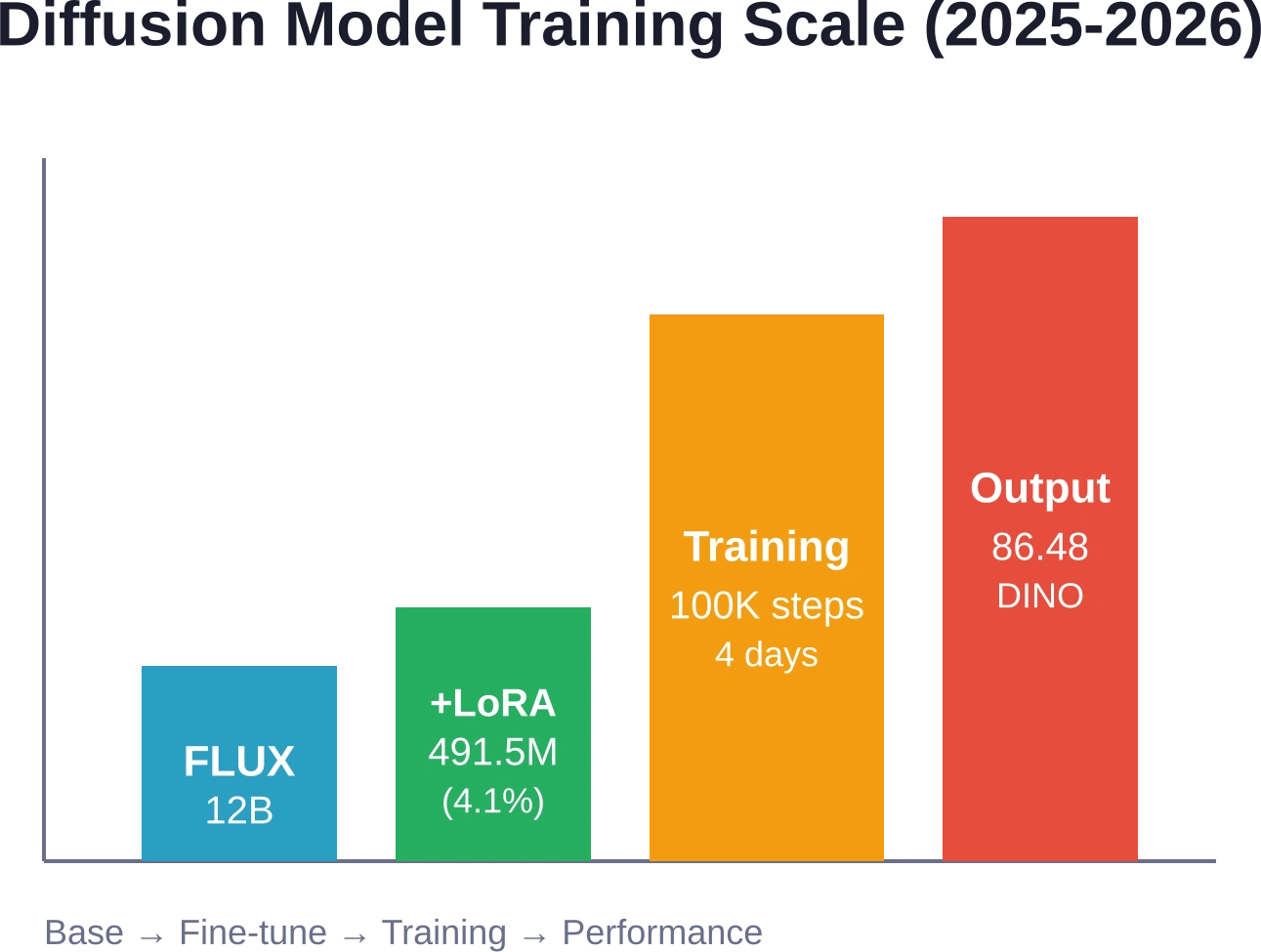
CreatiDesign, a research project from ByteDance and Fudan University, fine-tuned FLUX.1-dev (a 12-billion-parameter base model) using LoRA with 256 rank. That introduced just 491.5 million extra parameters—4.1% overhead—yet enabled precise control over graphic design layouts. The system accepts text prompts, spatial layouts, style references, and subject consistency constraints simultaneously.
Training took four days on eight H20-96G GPUs, running 100,000 steps with a fixed learning rate of 1e-4. The results? 86.48 DINO score for subject preservation and 78.30 for textual element semantic accuracy. Translation: generated designs maintain visual consistency across variations and accurately render complex text layouts—two areas where earlier models struggled.
Representation Autoencoders (RAEs) are another architectural shift. Traditional diffusion models use VAE encoders from 2021—outdated backbones that compromise efficiency. RAEs train vision transformers specifically for the latent space, producing 256 tokens for 224×224 images with better reconstruction. ImageNet models show 0.288 reconstruction error, substantially lower than FLUX’s legacy encoder.
Training data matters too. Scaling from 1.28 million ImageNet images to 73 million web, synthetic, and text samples improved GenEval scores from baseline to 76.8 on DPG-Bench. More diverse training data yields models that generalize better to edge cases and unusual prompts.
Government Frameworks Reshape AI Cybersecurity
Policy moves in late 2025 and early 2026 established new baselines for AI security and governance. The National Institute of Standards and Technology (NIST) released draft guidelines in December 2025 titled “Rethinking Cybersecurity for the AI Era.”
The guidelines address a fundamental tension: AI systems automate security monitoring and threat response, but they also introduce new attack surfaces. Adversarial inputs, model extraction, and poisoned training data weren’t concerns in pre-AI cybersecurity frameworks. NIST’s updated approach treats AI models as critical infrastructure assets requiring dedicated protection.
Simultaneously, President Trump’s December 2025 executive order “Ensuring a National Policy Framework for Artificial Intelligence” directed the Attorney General to establish an AI Litigation Task Force. The goal? Challenge state-level AI regulations deemed unconstitutional or preempted by federal authority. That creates a unified compliance landscape—controversial among state regulators but welcomed by multi-state enterprises facing patchwork requirements.
A separate July 2025 order, “Preventing Woke AI in the Federal Government,” mandates that federal AI systems avoid ideological bias. Agencies must document training data sources, audit outputs for viewpoint neutrality, and establish review processes before deployment. Whether this improves AI reliability or introduces new compliance overhead remains debated.
The White House’s “Winning the AI Race: America’s AI Action Plan” (released July 2025) identifies over 90 federal policy actions across three pillars: accelerating infrastructure, removing regulatory barriers, and protecting national security interests. Concrete measures include streamlining data center permits, expanding AI research funding, and restricting certain model exports.
Healthcare AI Narrows the Global Gap
The World Health Organization projects an 11-million-worker shortage by 2030, leaving 4.5 billion people without essential health services. AI-assisted diagnostics and telehealth systems offer a partial solution—not by replacing clinicians but by extending their reach.
Microsoft’s AI Diagnostic Orchestrator (MAI-DxO) achieved 85.5% accuracy on complex medical case resolution versus 20% average for experienced physicians. That doesn’t mean AI diagnoses better than doctors. It means AI systems analyzing comprehensive patient data, medical literature, and imaging can surface insights human practitioners miss due to time constraints or information overload.
AI systems assist clinicians through triage and decision support, with clinicians reviewing recommendations. The efficiency gain comes from AI handling data aggregation, literature review, and differential diagnosis generation—tasks that consume hours of physician time.
Hybrid care models combining in-person visits with AI-monitored remote care are expanding rapidly. Wearable devices stream vitals to AI systems that flag anomalies, predict complications, and recommend interventions. For chronic conditions like diabetes or heart disease, continuous monitoring catches deteriorations early, reducing emergency interventions.
According to the IEEE Global Survey, 41% see health monitor agentic AI reaching mass or near-mass adoption in 2026. That aligns with Apple, Google, and Samsung embedding advanced health tracking in consumer devices. The infrastructure is already in place—AI layers are making the data actionable.
AI Becomes Central to Research Workflows
Scientific research generates data faster than humans can analyze it. Genomics produces terabytes per experiment. Particle physics detectors capture billions of collision events. Climate models run for weeks generating petabytes of atmospheric simulations.
AI tools now integrate directly into research pipelines. Language models summarize literature, suggest experimental designs, and identify gaps in existing studies. Computer vision models analyze microscopy images, satellite data, and telescope observations. Reinforcement learning optimizes experimental parameters and resource allocation.
arXiv, the preprint server for physics, mathematics, and computer science, hosted over 200,000 submissions in 2025. A growing fraction acknowledges AI assistance in literature review, hypothesis generation, or data analysis. Researchers aren’t outsourcing thinking—they’re automating tedious components of the scientific method.
But AI introduces new challenges. Models trained on published research inherit publication bias, favoring positive results over null findings. They can’t distinguish robust studies from methodologically flawed ones without explicit training. Researchers must validate AI suggestions against domain expertise, a skill not universally taught in graduate programs.
NIST’s June 2025 report on “The Impact of Artificial Intelligence on the Cybersecurity Workforce” highlights a parallel concern: as AI automates routine tasks, workforce skills must shift toward oversight, validation, and edge-case handling. The same pattern applies across disciplines—automation doesn’t eliminate expertise; it raises the baseline for what constitutes expert work.
Infrastructure Gets Smarter and More Efficient
Training DeepSeek-V4-Pro required data centers, not just GPUs. The energy and cooling infrastructure to sustain trillion-parameter training runs at scale represents a bottleneck as significant as compute availability.
AI infrastructure in 2026 optimizes for efficiency as much as raw capacity. Liquid cooling systems reduce energy consumption by 30-40% compared to air cooling. Dynamic workload allocation shifts training to off-peak hours or regions with renewable energy surplus. Model compression techniques like mixed-precision training (FP4 and FP8) cut memory bandwidth requirements, allowing larger batches per GPU.
DeepSeek-V4-Flash demonstrates the trend: 284 billion parameters with only 13 billion activated per token, using FP4 and FP8 mixed precision. That reduces inference cost by roughly 75% compared to full-precision equivalents, making trillion-scale models economically viable for production use.
Edge AI is another frontier. Running models on-device eliminates latency and privacy risks from cloud round-trips. Quantized models under 10 billion parameters now run on smartphones and IoT devices, enabling real-time computer vision, voice processing, and sensor analytics without network connectivity.
Production use cases for edge AI remain focused: manufacturing quality control, retail inventory tracking, predictive maintenance on industrial equipment, and basic sensor analytics. These applications don’t need frontier model capabilities—they need reliability, low latency, and offline operation.
Coding AI Learns Context, Not Just Syntax
Earlier code-generation models treated programming as text prediction. Give them a function signature and docstring, they’d complete the implementation. But real software engineering involves understanding system architecture, API contracts, performance constraints, and team conventions.
Mistral Medium 3.5’s performance on SWE-Bench Verified—77.6%—reflects better contextual reasoning. The benchmark presents GitHub issues from real repositories: bug reports, feature requests, and edge cases. Models must read the issue, locate relevant code across multiple files, implement a fix, and ensure tests pass. That’s end-to-end software engineering, not snippet generation.
Kimi K2.6, an open-weight multimodal agentic model released in April 2026, advances long-horizon coding capabilities. The model handles “complex, end-to-end coding tasks” across Rust, Go, and Python, generalizing across front-end, DevOps, and performance optimization domains. It scores 54.0 on HLE-Full (with tools), a benchmark for multi-step task completion requiring planning, tool use, and error recovery.
Coding-driven design is emerging as a distinct capability. Developers describe high-level product requirements; AI generates UI mockups, API schemas, database migrations, and initial implementations. Human developers review, refine architecture, and handle edge cases. The division of labor shifts: AI handles boilerplate and first-draft implementations, humans ensure robustness and maintainability.
But here’s the catch—code quality varies. Models produce syntactically correct code that sometimes violates best practices, introduces security vulnerabilities, or fails on untested inputs. Code review remains essential. Organizations deploying AI coding assistants report productivity gains of 20-40% on routine tasks but emphasize that junior developers still require mentorship and oversight.
Chief Data Officers See Expanded Mandates
Survey research indicates increasing belief that chief data officer roles should encompass analytics and AI, with significant year-over-year growth reported. That reflects AI’s inseparability from data infrastructure.
Training large models requires curated datasets, quality controls, and governance frameworks. Deploying AI systems demands monitoring for drift, bias, and compliance. Both functions fall naturally under data leadership, but many CDOs lack AI expertise or sufficient authority to drive AI strategy.
The IEEE survey identified AI ethical practices as experiencing 44% demand growth in 2026 hiring, up 9 percentage points year-over-year. Organizations are seeking professionals with expertise in AI ethical practices, fairness assessment, and compliance—roles bridging data engineering, legal, and domain knowledge.
Real talk: most enterprises still operate in silos. Data teams manage storage and pipelines. ML engineers build models. Legal reviews compliance. Product teams define requirements. CDOs with cross-functional authority can unify these efforts, but organizational politics often prevent it.

Turn AI Trends Into Practical Projects With AI Superior
New AI trends only matter when a company can connect them to a real product, process, or business problem. AI Superior supports companies through AI consulting, AI use case discovery, R&D for AI, generative AI development, LLM consulting, computer vision, NLP, machine learning, and custom AI software development. This fits companies that want to explore AI developments with a practical filter before moving into development.
AI Superior can help teams with:
- Evaluating AI use cases based on business needs
- Exploring generative AI, LLM, NLP, or computer vision opportunities
- Supporting AI research and development
- Planning custom AI software around realistic requirements
- Integrating AI solutions into existing products or workflows
👉Contact AI Superior to discuss which AI developments are worth exploring for your business, product, or internal operations.
What 2026 Means for AI Strategy
The trends converging in 2026 share a common thread: AI moving from proof-of-concept to production infrastructure. Agentic systems automate workflows. Trillion-parameter models deliver near-expert performance. Diffusion transformers generate publication-ready creative work. Government frameworks establish compliance baselines.
For enterprises, that means two things. First, pilot projects need transition plans. “We’re experimenting with AI” isn’t a strategy anymore—competitors are deploying at scale. Second, infrastructure matters as much as algorithms. The best model is useless without data pipelines, monitoring, and compliance processes.
Community discussions reflect pragmatic concerns. Developers debate edge AI hardware trade-offs, benchmark reproducibility, and model licensing terms. The hype cycle hasn’t disappeared, but it coexists with production deployment conversations—a healthier equilibrium.
By 2028, AI software is predicted to reach $58 billion according to industry projections. That growth funds not just model development but tooling, infrastructure, and services enabling organizations to operationalize AI. The bottleneck is shifting from “can we build it?” to “can we deploy it responsibly at scale?”
Frequently Asked Questions
What is agentic AI and how does it differ from chatbots?
Agentic AI systems operate autonomously, monitoring contexts and executing multi-step workflows without human prompts for each action. Unlike chatbots that respond to queries, agents schedule meetings, analyze data streams, and manage infrastructure proactively. The IEEE Global Survey found 91% of technologists expect increased agentic AI use for data analysis in 2026, reflecting the shift from reactive to proactive automation.
How large are the biggest AI models in 2026?
DeepSeek-V4-Pro reached 1.6 trillion parameters with 49 billion activated per inference, using mixture-of-experts architecture. Mistral Medium 3.5 is a dense 128-billion-parameter model. Context windows now reach 1 million tokens (DeepSeek-V4) or 256k tokens (Mistral Medium 3.5), enabling analysis of entire codebases or document collections in single passes.
Are trillion-parameter models practical for production use?
Yes, due to efficiency innovations. Mixed-precision training (FP4/FP8) cuts inference costs by roughly 75% compared to full precision. Mixture-of-experts architecture activates only a fraction of parameters per token—DeepSeek-V4-Pro uses 49B of its 1.6T parameters per inference. These optimizations make massive models economically viable for enterprise deployment despite their size.
What AI skills are most in-demand for 2026?
AI ethical practices saw 44% demand growth in 2026, up 9 percentage points year-over-year according to IEEE data. Organizations need professionals bridging data engineering, legal compliance, and AI fairness. The MIT Sloan survey found 70% believe the chief data officer role should encompass AI strategy, signaling demand for leaders who integrate data governance with AI deployment.
How is AI changing healthcare delivery?
Microsoft’s AI Diagnostic Orchestrator achieved 85.5% accuracy on complex medical cases versus 20% for experienced physicians on the same test set. AI doesn’t replace doctors but extends their reach through triage, decision support, and continuous remote monitoring. The WHO projects an 11-million-worker shortage by 2030; AI-assisted systems help bridge that gap by automating data analysis and literature review, freeing clinicians for patient care.
What are the biggest AI infrastructure challenges in 2026?
Energy consumption, cooling requirements, and compute availability limit training scale. Liquid cooling reduces energy use 30-40% versus air cooling. Mixed-precision training and MoE sparse activation save 60-70% compute. Organizations must balance model performance against operational costs, often choosing smaller fine-tuned models over frontier-scale systems for specific tasks where efficiency matters more than raw capability.
Will government AI regulations slow innovation?
Federal frameworks aim to unify compliance, replacing patchwork state regulations that increase costs. NIST’s December 2025 cybersecurity guidelines and the White House’s “Winning the AI Race” action plan identify over 90 policy actions accelerating infrastructure while establishing security baselines. Whether these foster or hinder innovation depends on implementation—streamlined data center permits help, but litigation over state preemption creates uncertainty.
The Path Forward
AI in 2026 isn’t about speculation anymore. Performance benchmarks, enterprise adoption data, and government policy shifts provide concrete evidence of where the technology stands. Agentic systems, trillion-parameter models, and diffusion transformers represent technical milestones, not marketing claims.
But the hardest problems remain organizational. Integrating AI into legacy systems, training staff on new workflows, and ensuring responsible deployment require leadership and investment beyond algorithm development. The technology works—the question is whether organizations can adapt quickly enough to capitalize on it.
The Stanford AI Index and IEEE surveys will provide updated metrics by mid-2026. Track those for quantitative evidence of adoption rates, compute trends, and workforce shifts. For now, the trajectory is clear: AI is infrastructure, and infrastructure decisions shape competitive advantage for years.
Stay informed. Test carefully. Deploy responsibly. The AI breakthroughs of 2026 aren’t theoretical—they’re production-grade systems reshaping industries right now.
 English
  German
  Arabic
  French
  Dutch
Dutch  Spanish