
Quick Summary: Predictive analytics uses historical data, machine learning, and statistical algorithms to forecast future outcomes, offering major advantages like improved decision-making, cost efficiency, and risk mitigation. However, it also presents challenges including data quality requirements, implementation costs, bias risks, and the need for specialized expertise.
Every single day, humans generate around 2.5 quintillion bytes of data. That’s an incomprehensible amount of information flowing through businesses, hospitals, financial systems, and online platforms. But here’s the thing—most of that data just sits there, unused.
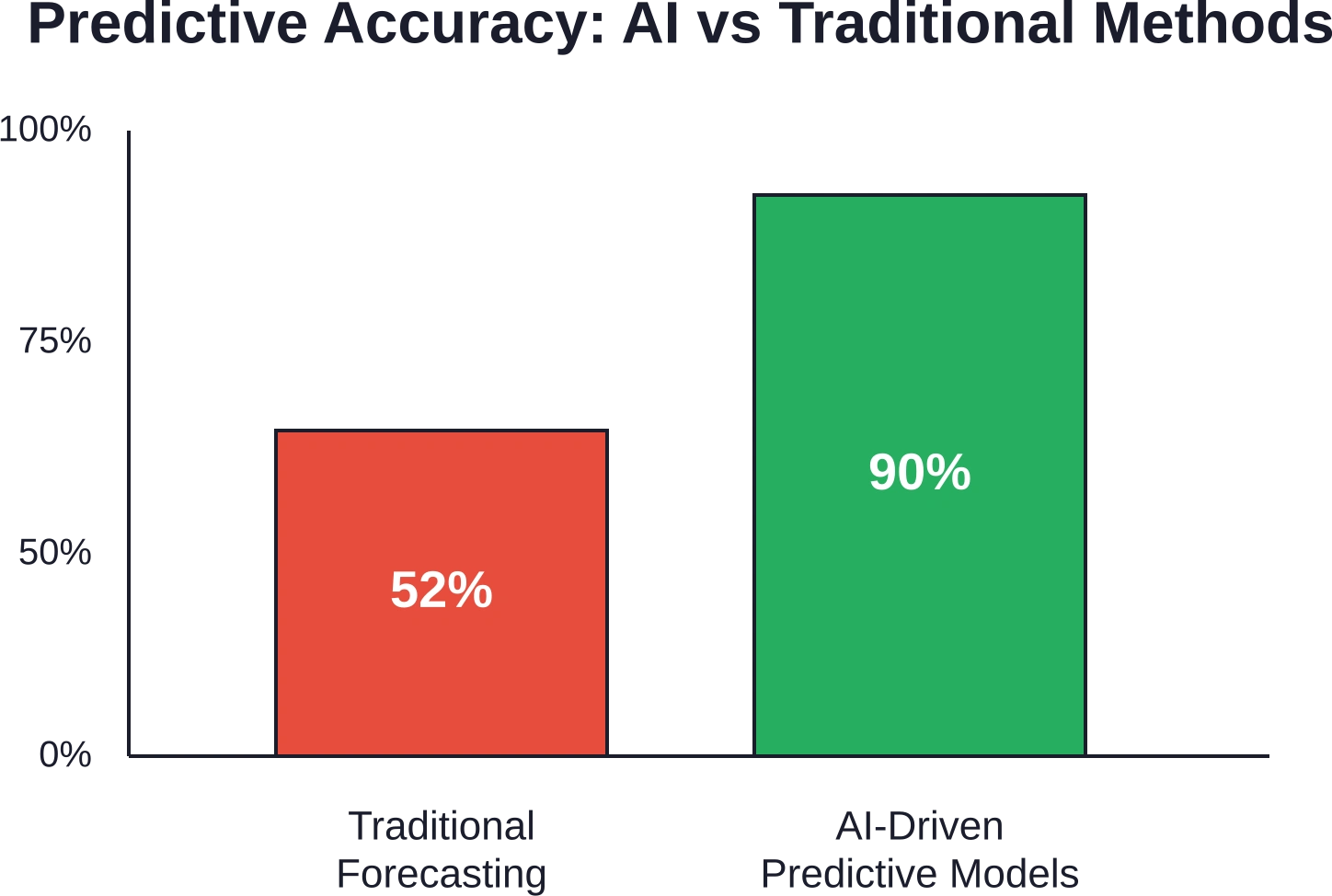
Predictive analytics changes that equation. By applying statistical methods and machine learning techniques to historical data, organizations can forecast future events, behaviors, and trends with remarkable accuracy. According to a 2026 academic study on AI and consumer behavior prediction, AI-driven forecasting in financial commerce achieved higher accuracy rates compared to traditional approaches.
That performance gap explains why adoption has skyrocketed. In financial commerce enterprises alone, AI implementation jumped from 30% in 2018 to 76% in 2024—more than doubling in just six years.
But does predictive analytics actually deliver on its promise? And what trade-offs come with implementing these systems?
This guide breaks down the real advantages and disadvantages of predictive analytics, drawing on authoritative research, industry data, and practical applications across sectors.
What is Predictive Analytics?
Predictive analytics represents an advanced branch of data analytics that examines current and historical data to make informed predictions about future outcomes. The discipline combines multiple techniques: statistical modeling, machine learning algorithms, data mining, and pattern recognition.
Unlike descriptive analytics—which tells what happened—or diagnostic analytics—which explains why it happened—predictive analytics focuses on what’s likely to happen next.
The process typically follows this pattern:
- Collect and prepare historical data from relevant sources
- Identify patterns, correlations, and trends within that data
- Build statistical or machine learning models trained on those patterns
- Apply the models to current data to generate predictions
- Continuously refine models as new data becomes available
Organizations across industries now deploy predictive models for everything from demand forecasting and customer churn prediction to fraud detection and equipment maintenance scheduling.
Major Advantages of Predictive Analytics
The benefits that drive organizations toward predictive analytics span multiple dimensions. Let’s examine the most significant advantages.
Enhanced Decision-Making Capabilities
One of the core advantages of predictive analytics is its capacity to refine decision-making across all organizational levels. Rather than relying on intuition or limited samples, companies can base strategic choices on comprehensive data analysis.
Predictive models illuminate which actions are most likely to produce desired outcomes. Marketing teams can identify which customer segments will respond best to specific campaigns. Supply chain managers can anticipate demand fluctuations weeks or months ahead. Healthcare providers can flag patients at high risk for certain conditions before symptoms appear.
This shift from reactive to proactive strategy represents a fundamental competitive advantage.
Cost Reduction and Resource Optimization
Predictive analytics directly impacts the bottom line by helping organizations allocate resources more efficiently. When companies accurately forecast demand, they avoid both overproduction waste and stockout losses.
Maintenance provides a clear example. Traditional scheduled maintenance replaces parts on fixed intervals, whether they need replacement or not. Predictive maintenance monitors equipment condition in real time and forecasts failures before they occur. This approach reduces unnecessary maintenance while preventing costly unplanned downtime.
In healthcare settings, predictive analysis identifies high-risk patients who need intervention, concentrating resources where they’ll have maximum impact rather than spreading them uniformly.
Risk Management and Fraud Detection
Financial institutions have become particularly adept at using predictive models to assess credit risk and detect fraudulent transactions. Machine learning algorithms can analyze thousands of variables simultaneously, identifying suspicious patterns that would escape human notice.
Research examining machine learning models for credit risk assessment found that data quality issues significantly impact predictive performance. Studies also documented performance disparities across demographic groups for minority and low-income borrowers. This highlights both the power and the pitfalls of predictive systems.
Insurance companies similarly use predictive analytics to price policies more accurately, balancing risk across their portfolios while identifying potentially fraudulent claims.
Personalization at Scale
Modern recommendation systems demonstrate predictive analytics’ ability to personalize experiences for millions of users simultaneously. Analysis of traffic sources shows that AI-driven recommendation systems now generate approximately 35% of traffic, compared to 40% from direct searches and 10% from other sources.
E-commerce platforms predict which products individual customers are most likely to purchase. Streaming services forecast which content will keep subscribers engaged. Healthcare providers can tailor treatment plans based on predictive models trained on similar patient outcomes.
This mass personalization was simply impossible before predictive analytics matured.
Competitive Intelligence and Market Positioning
Organizations that effectively leverage predictive insights often establish positions that competitors struggle to match. By identifying emerging trends early, companies can adapt products, adjust pricing, or enter new markets ahead of rivals.
Real talk: predictive analytics has become table stakes in many sectors. Companies that don’t adopt these capabilities increasingly find themselves reacting to competitors’ moves rather than shaping market direction.

Weigh Predictive Analytics With AI Superior Before Scaling
Predictive analytics can be useful, but it needs the right data, a clear business goal, and a realistic understanding of its limits. AI Superior provides AI consulting, predictive analytics, machine learning, business intelligence, data analytics, and custom AI software development. Their work can help companies assess whether predictive models are suitable for tasks such as forecasting, churn analysis, demand planning, risk detection, operational analytics, or decision support.
AI Superior’s predictive analytics support may include:
- Assessing whether predictive analytics fits the use case
- Reviewing data readiness and business requirements
- Building machine learning and forecasting models
- Developing BI or analytics tools around model outputs
- Integrating predictive insights into business workflows
👉Get in touch with AI Superior to discuss whether predictive analytics is the right fit for your data, planning process, or business goals.
Significant Disadvantages of Predictive Analytics
Now, this is where it gets interesting. Predictive analytics isn’t a magic solution, and several substantial challenges limit its effectiveness.
Data Quality Requirements
Predictive models are only as good as the data they’re trained on. Poor data quality—missing values, noisy attributes, outliers, incorrect labels—directly degrades model accuracy.
Research examining machine learning models for credit risk assessment found that data quality issues significantly impact predictive performance. Notably, certain types of errors can counterintuitively improve specific metrics, with studies documenting improvements measured by F1 score, but this improvement reflects overfitting rather than genuine predictive power.
Research on end-to-end data quality frameworks for machine learning in production environments documented significant data filtering when applying quality thresholds. This highlights the challenge of maintaining sufficient data volume while ensuring quality standards.
Organizations must invest heavily in data cleaning, validation, and governance before predictive analytics becomes viable.
Implementation and Maintenance Costs
Building effective predictive analytics capabilities requires substantial investment. Companies need specialized software platforms, computational infrastructure, and—most importantly—skilled personnel who understand both the technical and business domains.
Data scientists, machine learning engineers, and analytics specialists command premium salaries. The tools themselves often carry significant licensing costs. Cloud computing resources for training complex models add recurring expenses.
But wait. The costs don’t stop after initial implementation. Models degrade over time as underlying patterns shift. Continuous monitoring, retraining, and refinement become ongoing operational requirements.
Bias and Fairness Concerns
Machine learning models trained on historical data inevitably absorb the biases embedded in that data. If past lending decisions discriminated against certain demographics, predictive models learn to perpetuate that discrimination unless explicitly corrected.
IEEE research on bias mitigation in machine learning highlights this as a fundamental challenge. Predictive models can systematically underserve minority groups, rural populations, or low-income individuals—often in ways that aren’t immediately obvious.
Credit scoring provides a stark example, with documented performance disparities across demographic groups for minority and low-income borrowers. Healthcare predictive models have shown similar biases, sometimes recommending less aggressive treatment for minority patients with identical clinical profiles.
Addressing these issues requires specialized techniques, diverse training data, and constant vigilance—adding complexity and cost to predictive analytics initiatives.
Complexity and Interpretability Challenges
Advanced machine learning models—particularly deep neural networks—often function as “black boxes.” They generate accurate predictions but offer little insight into why they made specific forecasts.
This opacity creates problems in regulated industries where organizations must explain their decisions. A bank can’t simply tell a loan applicant “the algorithm said no” without explaining the reasoning. Healthcare providers need to understand why a model recommends a particular treatment.
Research on counterfactual explanations for machine learning model validation addresses this challenge, but interpretability remains a significant limitation. Simpler, more transparent models often sacrifice accuracy for explainability.
Risk of Overfitting and Data Leakage
Models can become so finely tuned to historical data that they fail when encountering new situations. This overfitting produces impressive results on test datasets but poor performance in production.
Data leakage represents another critical issue. Data quality research emphasizes minimizing overlap between test/validation and training datasets to prevent artificially inflated performance metrics. Excessive overlap creates inflated performance metrics that don’t reflect real-world capabilities.
Organizations without strong data science practices frequently deploy models that look good on paper but fail in practice.
Privacy and Security Considerations
Predictive analytics requires collecting, storing, and analyzing vast amounts of data—often including sensitive personal information. This creates multiple risks.
Data breaches could expose confidential information about customers, patients, or business operations. Regulatory frameworks like GDPR impose strict requirements on data handling and algorithmic decision-making. Companies must balance predictive capabilities against privacy protections.
Some jurisdictions now require organizations to explain automated decisions and allow individuals to challenge them, adding legal and operational complexity.
| Advantage | Disadvantage | Mitigation Strategy |
|---|---|---|
| Improved decision accuracy | Requires high-quality data | Invest in data governance and validation |
| Cost and resource optimization | High implementation costs | Start with focused pilot projects |
| Better risk management | Potential for bias and discrimination | Apply bias detection and mitigation techniques |
| Personalized experiences | Privacy and security risks | Implement strong data protection measures |
| Competitive advantage | Requires specialized expertise | Develop internal talent and partner with experts |
| Proactive problem-solving | Black-box interpretability issues | Use explainable AI techniques where needed |
Real-World Applications and Performance
Understanding how predictive analytics performs in practice provides crucial context for weighing its advantages against its limitations.
Healthcare Predictive Analytics
Medical settings demonstrate both the potential and the pitfalls of predictive systems. Hospitals use predictive models to identify patients at high risk for readmission, allowing early intervention that improves outcomes and reduces costs.
Disease forecasting models help healthcare systems allocate resources during flu season or other predictable health events. Treatment recommendations based on similar patient outcomes can guide clinical decisions.
However, healthcare predictive analytics faces significant challenges with data quality, interoperability between systems, and bias concerns. Medical data is notoriously messy, inconsistent across institutions, and often reflects historical disparities in care quality.
Financial Services and Credit Assessment
Banks and financial institutions rely heavily on predictive models for credit scoring, fraud detection, and risk assessment. These applications process millions of transactions daily, making human review impractical.
Research shows that data quality issues particularly impact credit risk models. Missing values, noisy data, and label errors all degrade performance. More concerning, models show differential accuracy across demographic groups—exactly the kind of bias that regulators and advocacy groups scrutinize.
The financial sector continues investing in bias mitigation techniques and explainable AI to address these challenges while maintaining the efficiency gains predictive analytics provides.
Retail and E-Commerce Optimization
Online retailers use predictive analytics for demand forecasting, inventory management, dynamic pricing, and recommendation engines. The competitive pressure is intense—companies that predict customer preferences accurately capture more sales.
Recommendation systems now drive significant traffic, accounting for roughly 35% of visits to e-commerce platforms. These systems analyze browsing history, purchase patterns, and behavioral signals to predict which products individual customers want to see.
The challenge lies in the computational cost and the need for real-time processing. Models must update continuously as new data arrives, requiring sophisticated infrastructure.
Critical Success Factors for Implementation
Organizations that successfully deploy predictive analytics share several common characteristics. Understanding these factors helps frame realistic expectations.
Data Infrastructure and Governance
Strong data foundations prove essential. This includes systems for data collection, storage, cleaning, and validation. Organizations need clear data governance policies defining ownership, access controls, and quality standards.
Research on end-to-end data quality frameworks for machine learning emphasizes integrating quality assessment directly into production pipelines. Real-time monitoring catches data quality degradation before it impacts model performance.
Cross-Functional Collaboration
Predictive analytics projects fail when data scientists work in isolation from business stakeholders. Successful implementations require close collaboration between technical teams and domain experts who understand the business context.
The business side must clearly articulate problems worth solving and metrics for success. The technical side must translate those requirements into appropriate modeling approaches and communicate limitations honestly.
Regulatory and Ethical Frameworks
Government policy increasingly shapes predictive analytics deployment. The White House Executive Order on AI policy frameworks emphasizes United States leadership in artificial intelligence while establishing governance requirements.
Organizations must stay current with evolving regulations around algorithmic decision-making, data privacy, and fairness. Building ethical review processes into the development lifecycle prevents costly problems later.
Continuous Monitoring and Improvement
Deploying a model is just the beginning. Production systems require ongoing monitoring to detect performance degradation, data drift, or emerging bias.
Research on governance frameworks for machine learning validation and monitoring stresses the importance of systematic approaches to model lifecycle management. Models that aren’t actively maintained become liabilities rather than assets.
When Predictive Analytics Makes Sense
Not every organization needs predictive analytics, and not every business problem warrants the investment. Community discussions among data science practitioners suggest predictive analytics works best when:
- Sufficient historical data exists to train reliable models
- The business problem has clear, measurable outcomes
- Predictions provide actionable insights that inform decisions
- The expected value of improved decisions exceeds implementation costs
- The organization has or can develop necessary technical capabilities
Small businesses with limited data and resources may find traditional analytics sufficient. The question isn’t whether predictive analytics is good or bad in absolute terms—it’s whether the advantages outweigh the disadvantages for a specific use case.
Frequently Asked Questions
What are the main benefits of predictive analytics?
The primary benefits include enhanced decision-making through data-driven insights, cost reduction via optimized resource allocation, improved risk management and fraud detection, personalized customer experiences at scale, and competitive advantages from early trend identification. Research shows AI-driven predictive models achieve higher accuracy rates compared to traditional forecasting approaches.
What are the biggest challenges with predictive analytics?
Major challenges include strict data quality requirements, high implementation and maintenance costs, potential algorithmic bias that can perpetuate discrimination, complexity and interpretability issues with advanced models, risks of overfitting and data leakage, and privacy and security concerns around sensitive data. Organizations must address these systematically for successful deployment.
How accurate are predictive analytics models?
Accuracy varies significantly based on the problem domain, data quality, and modeling approach. Academic research demonstrates that AI-driven forecasting achieves strong accuracy rates in well-structured problems. However, credit risk models show lower performance for certain demographic groups, highlighting how accuracy isn’t uniform across all populations. Real-world performance depends heavily on implementation quality.
What industries benefit most from predictive analytics?
Financial services use predictive analytics extensively for credit scoring and fraud detection. Healthcare applies it to patient risk stratification and disease forecasting. Retail and e-commerce leverage predictive models for demand forecasting and recommendation engines. Manufacturing uses predictive maintenance to reduce downtime. Insurance, telecommunications, and logistics also see substantial benefits. Adoption in financial commerce enterprises increased from 30% in 2018 to 76% in 2024.
How does data quality affect predictive analytics?
Data quality directly determines model reliability. Studies examining machine learning for credit risk found that missing values, noisy attributes, outliers, and label errors significantly degrade predictive accuracy. Research on data quality frameworks documented significant data filtering when applying quality thresholds. Organizations must invest in data governance, validation, and cleaning before predictive analytics becomes viable.
Can predictive analytics be biased?
Yes, predictive models trained on historical data absorb biases embedded in that data. IEEE research on bias mitigation highlights this as a fundamental challenge in machine learning. Credit scoring models demonstrate performance disparities for minority and low-income borrowers. Healthcare models have shown similar disparities. Organizations must apply specialized bias detection and mitigation techniques throughout the model lifecycle.
What’s the difference between predictive and prescriptive analytics?
Predictive analytics forecasts what is likely to happen based on historical patterns and current conditions. Prescriptive analytics goes further, recommending specific actions to achieve desired outcomes. Predictive models might forecast customer churn risk, while prescriptive systems would suggest which retention strategies to deploy for each customer segment. Prescriptive analytics builds on predictive capabilities by adding optimization and decision logic.
Final Thoughts on Predictive Analytics Trade-Offs
Predictive analytics represents a powerful capability that fundamentally changes how organizations operate. The advantages—improved decisions, cost savings, risk reduction, personalization, and competitive positioning—explain why adoption has accelerated so dramatically over the past decade.
But the disadvantages are equally real. Data quality requirements, implementation costs, bias risks, interpretability challenges, and privacy concerns create substantial hurdles. Organizations that underestimate these challenges often face disappointing results.
The evidence suggests predictive analytics works best when organizations approach it strategically rather than as a universal solution. Success requires strong data foundations, cross-functional collaboration, appropriate governance frameworks, and ongoing investment in maintenance and improvement.
Sound familiar? That’s because predictive analytics follows the pattern of most transformative technologies. The capabilities are genuine, but realizing them demands more than just adopting the technology—it requires organizational commitment to doing the hard work of implementation correctly.
For organizations willing to make that investment, predictive analytics delivers measurable value. For those hoping for quick wins without addressing fundamentals like data quality and bias mitigation, disappointment likely awaits.
The question isn’t whether predictive analytics is worth pursuing in absolute terms. It’s whether your organization has the data, resources, expertise, and commitment to deploy it effectively while managing its limitations responsibly.
 English
  German
  Arabic
  French
  Dutch
Dutch  Spanish