
Quick Summary: Big data analytics is the systematic process of examining massive volumes of structured and unstructured data to uncover patterns, trends, and actionable insights. According to NIST, big data describes the large amounts of data in the networked, digitized, sensor-laden world, while analytics tools transform this information into competitive advantages through improved decision-making, operational efficiency, and strategic planning.
The business world has become a data factory. Every customer interaction, transaction, sensor reading, and social media post generates information that could transform how organizations operate.
But here’s the thing—raw data is worthless without the right tools and methods to make sense of it.
Big data analytics has shifted from a competitive advantage to a business necessity. Organizations that effectively harness their data uncover opportunities their competitors miss, make faster decisions backed by evidence, and create customer experiences that feel almost prescient.
This guide breaks down what big data analytics actually means for business, how it works in practice, and what organizations need to know to implement it successfully.
What is Big Data Analytics?
Big data analytics refers to the systematic processing and analysis of large amounts of data and complex data sets to extract valuable insights. According to the National Institute of Standards and Technology (NIST), big data is a term used to describe the large amount of data in the networked, digitized, sensor-laden, information-driven world.
The process allows organizations to uncover trends, patterns, and correlations in large amounts of raw data to help analysts make data-informed decisions.
What separates big data from traditional data analysis? Scale, velocity, and variety. Traditional databases handled structured information—neat rows and columns that fit into conventional spreadsheets. Big data encompasses everything from structured databases to unstructured social media posts, sensor readings, video files, and clickstream data.
Modern analytics examines data and delivers answers almost immediately. That speed matters when customer preferences shift overnight or supply chain disruptions demand instant response.
The Five V’s That Define Big Data
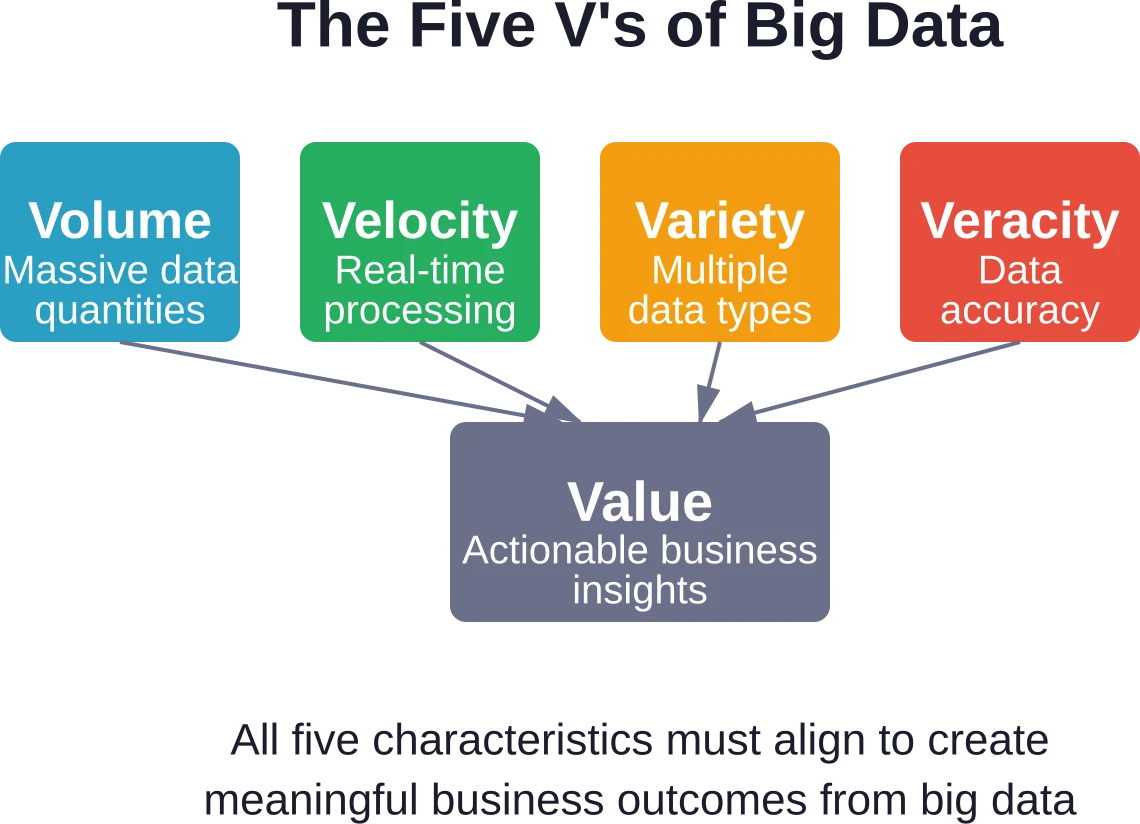
Industry experts categorize big data using five characteristics:
- Volume: The sheer amount of data generated. Organizations now process terabytes and petabytes rather than gigabytes.
- Velocity: The speed at which data arrives. Real-time streams from IoT devices, social platforms, and transaction systems demand instant processing.
- Variety: Data comes from varied sources—structured databases, unstructured text, semi-structured logs, images, and video.
- Veracity: Data quality and trustworthiness. Not all data is accurate or relevant, and analytics must account for noise and inconsistencies.
- Value: The ultimate measure. Data only matters when it generates actionable insights that drive business outcomes.
How Big Data Analytics Works
The analytics process follows a structured workflow that transforms raw data into business intelligence. Understanding this flow helps organizations identify where investments deliver the highest returns.
Data Collection and Integration
Data arrives from multiple sources—customer relationship management systems, enterprise resource planning platforms, social media feeds, IoT sensors, web analytics, and third-party data providers. The methods, tools, and applications used collect this varied, high-volume, high-velocity information from web, mobile, email, social media, and networked smart devices.
Integration combines these disparate sources into unified datasets. Without proper integration, analytics tools examine incomplete pictures and generate misleading conclusions.
Data Processing and Preparation
Raw data contains errors, duplicates, and inconsistencies. Processing cleans and standardizes information, handles missing values, and structures data for analysis.
This stage consumes significant time and resources in analytics projects. Solid preparation determines whether insights prove reliable or misleading.
Analysis and Pattern Recognition
This is where big data analytics examines large amounts of data to uncover hidden patterns, correlations, and other insights. Modern technologies make it possible to analyze data and get answers almost immediately.
Four primary analysis types serve different business needs:
| Analysis Type | Purpose | Business Question |
|---|---|---|
| Descriptive Analytics | Understand what happened | What were last quarter’s sales by region? |
| Diagnostic Analytics | Determine why it happened | Why did sales drop in the northeast region? |
| Predictive Analytics | Forecast what will happen | What will sales look like next quarter? |
| Prescriptive Analytics | Recommend actions | What should we do to optimize sales? |
Descriptive and diagnostic analytics examine historical data. Predictive and prescriptive analytics leverage machine learning models to forecast outcomes and recommend optimal decisions.
Visualization and Communication
Even the most sophisticated analysis fails if stakeholders can’t understand it. Visualization translates complex findings into dashboards, charts, and reports that communicate insights clearly.
Interactive dashboards let business users explore data without technical expertise, democratizing analytics across organizations.
Types of Big Data
Not all data looks the same. Understanding these categories helps organizations choose appropriate analytics tools and methods:
- Structured Data fits neatly into relational databases—customer records, transaction histories, inventory levels. Traditional SQL databases handle structured data efficiently.
- Unstructured Data lacks predefined organization—emails, social media posts, images, video files, audio recordings. Much of the data organizations generate is unstructured, yet many struggle to extract value from it.
- Semi-Structured Data sits between the two—JSON files, XML documents, log files with consistent patterns but flexible schemas. APIs typically exchange semi-structured data.
Modern analytics platforms must handle all three types simultaneously. A customer sentiment analysis might combine structured transaction data, semi-structured clickstream logs, and unstructured social media comments.
Essential Big Data Analytics Tools and Technologies
The technology landscape has expanded dramatically. Organizations now choose from numerous platforms, each optimized for specific use cases.
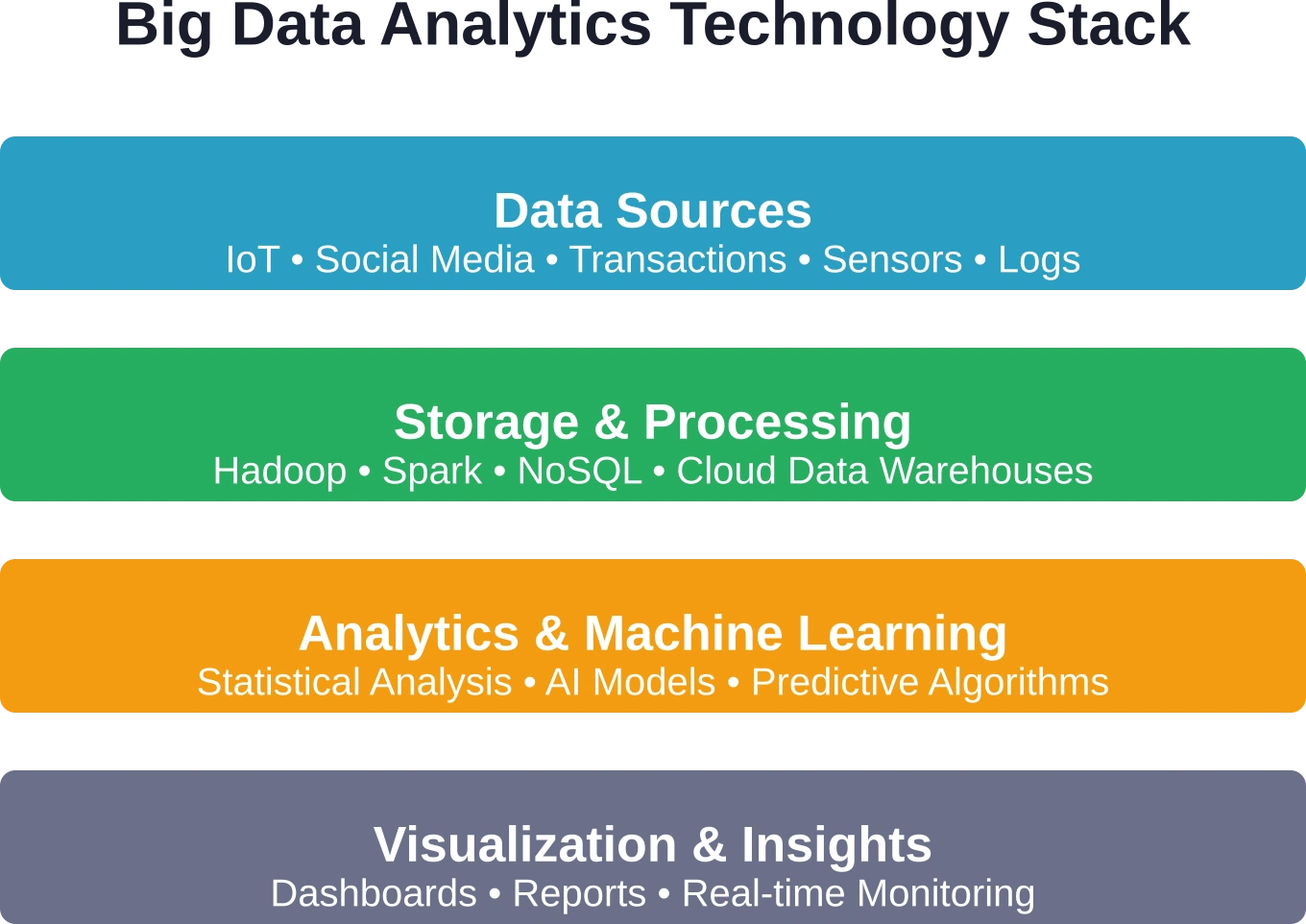
Data Storage and Processing Frameworks
Hadoop pioneered distributed big data storage and processing. Its MapReduce framework processes massive datasets across clusters of computers. While newer technologies have emerged, Hadoop remains foundational for many enterprise systems.
Apache Spark processes data in-memory rather than writing to disk, delivering faster performance for iterative algorithms and interactive queries. It’s become the preferred framework for machine learning and real-time analytics.
NoSQL Databases like MongoDB, Cassandra, and Redis handle unstructured and semi-structured data at scale. They trade some consistency guarantees for performance and flexibility.
Analytics and Business Intelligence Platforms
Commercial platforms provide comprehensive environments that integrate data preparation, analysis, visualization, and deployment. These tools let business analysts perform sophisticated analytics without programming expertise.
Cloud-based analytics services from major providers offer managed infrastructure, reducing operational complexity. Organizations can scale computing resources up or down based on demand.
Machine Learning and AI Integration
Research on artificial intelligence-driven big data analytics for business intelligence has accelerated rapidly. Machine learning models identify patterns humans would miss, automate repetitive analysis tasks, and continuously improve predictions as new data arrives.
Deep learning handles unstructured data particularly well—image recognition, natural language processing, and speech analysis that would be impossible with traditional methods.

Turn Business Data Into Analytics Systems With AI Superior
Big data analytics for business is not only about collecting more information. The real value comes from knowing what to measure, predict, automate, or improve. AI Superior supports companies with AI consulting, AI and data strategy, business intelligence, data analytics, machine learning, predictive analytics, and custom AI software development. Their team can help businesses move from disconnected reports to analytics systems that support daily decisions. This fits companies that already have data across departments but need a clearer way to use it for planning, performance tracking, and AI development.
AI Superior can support business analytics through:
- Identifying useful analytics and AI use cases
- Building BI and data analytics solutions
- Creating predictive models from business data
- Improving operational, sales, or customer analytics
- Connecting analytics tools with existing systems
Get in touch with AI Superior to discuss how big data analytics can support your business planning, reporting, or decision-making.
Business Benefits of Big Data Analytics
Organizations implement big data analytics to solve specific problems and create competitive advantages. The benefits span operational efficiency, strategic planning, and customer experience.
Enhanced Decision-Making
Data-driven decisions consistently outperform intuition-based approaches. Analytics provides objective evidence about what’s working, what’s not, and where opportunities exist.
Real-time dashboards give executives immediate visibility into key metrics. When problems emerge, teams can respond within hours rather than waiting for monthly reports.
Improved Operational Efficiency
Process optimization identifies bottlenecks, waste, and inefficiencies that drain resources. Supply chain analytics reduces inventory costs while maintaining service levels. Predictive maintenance prevents equipment failures before they occur.
Manufacturing organizations have used big data analytics to achieve improved vehicle design and reduced maintenance costs by analyzing sensor data from production equipment and finished products.
Customer Experience and Personalization
Understanding customer behavior enables personalized experiences that feel tailored rather than generic. Recommendation engines suggest products customers actually want. Sentiment analysis detects dissatisfaction before customers churn.
Research shows big data has opened up possibilities for building customer loyalty and commercial business by proactively engaging customers and developing products aligned with consumer needs.
Risk Management and Fraud Detection
Financial institutions analyze transaction patterns to identify fraudulent activity in real-time. Insurance companies assess risk more accurately by incorporating broader data sources. Healthcare organizations detect disease outbreaks earlier by monitoring multiple data streams.
Innovation and Product Development
Analytics reveals unmet customer needs and market gaps. Organizations test hypotheses faster by analyzing customer feedback, usage patterns, and competitive positioning. This accelerates innovation cycles and reduces development risk.
Real-World Applications Across Industries
Big data analytics transforms operations across virtually every sector. Here’s how different industries apply these capabilities.
Retail and E-Commerce
Retailers optimize pricing dynamically based on demand, competition, and inventory levels. Personalization engines recommend products based on browsing history, purchase patterns, and similar customer behavior. Supply chain analytics ensures products arrive when and where customers want them.
Healthcare and Life Sciences
Predictive models identify patients at risk for specific conditions, enabling preventive interventions. Clinical analytics improve treatment protocols by analyzing outcomes across thousands of cases. Drug discovery accelerates by examining molecular interactions and trial data at massive scale.
Financial Services and Banking
Research examining the impact of big data analytics on banking demonstrates how institutions use analytics for fraud detection, risk assessment, algorithmic trading, and customer segmentation. Credit scoring models incorporate alternative data sources to assess borrowers traditional methods would miss.
Manufacturing and Industrial
Sensor data from equipment enables predictive maintenance that reduces downtime. Quality control systems detect defects immediately rather than in post-production inspection. Supply chain optimization balances costs against delivery times and inventory levels.
Telecommunications
Network analytics optimize infrastructure investments and identify capacity constraints before customers experience degraded service. Churn prediction models identify at-risk customers, enabling targeted retention campaigns.
Media and Entertainment
Streaming platforms use big data analytics to understand listening and viewing patterns, enabling highly personalized content recommendations. Content producers analyze audience engagement to inform programming decisions and marketing strategies.
| Industry | Primary Use Cases | Key Benefits |
|---|---|---|
| Retail | Personalization, inventory optimization, pricing | Increased sales, reduced waste |
| Healthcare | Predictive diagnostics, treatment optimization | Better outcomes, cost reduction |
| Finance | Fraud detection, risk assessment, trading | Loss prevention, higher returns |
| Manufacturing | Predictive maintenance, quality control | Reduced downtime, fewer defects |
| Telecommunications | Network optimization, churn prediction | Better service, customer retention |
Key Challenges in Big Data Analytics Implementation
The benefits are compelling, but implementation presents real obstacles. Organizations must navigate technical, organizational, and strategic challenges.
Data Quality and Integration Issues
Garbage in, garbage out remains the fundamental rule. Poor data quality produces unreliable insights that lead to flawed decisions. Integration across disparate systems requires significant technical effort and ongoing maintenance.
Data silos compound the problem. When marketing, sales, operations, and finance maintain separate systems without integration, organizations can’t generate comprehensive insights.
Talent and Skills Gaps
Demand for data scientists, engineers, and analysts far exceeds supply. Organizations compete intensely for qualified professionals. Building internal capabilities requires time and investment in training programs.
The challenge extends beyond hiring technical specialists. Business stakeholders need data literacy to interpret analytics effectively and ask the right questions.
Privacy and Security Concerns
Collecting and analyzing customer data creates privacy obligations and regulatory compliance requirements. Data breaches carry enormous financial and reputational costs.
Regulations vary across jurisdictions, complicating compliance for global organizations. Privacy-preserving analytics techniques help but add complexity.
Technology Complexity and Costs
The technology landscape changes rapidly. Organizations struggle to evaluate options and make durable technology choices. Cloud platforms reduce infrastructure management burden but introduce new cost optimization challenges.
Integration with existing systems rarely goes smoothly. Legacy infrastructure wasn’t designed for modern analytics workloads.
Organizational Change Management
Analytics initiatives fail when organizations can’t change how decisions get made. Cultural resistance to data-driven approaches undermines even technically successful projects.
Effective implementation requires executive sponsorship, cross-functional collaboration, and systematic change management.
Building a Big Data Analytics Strategy
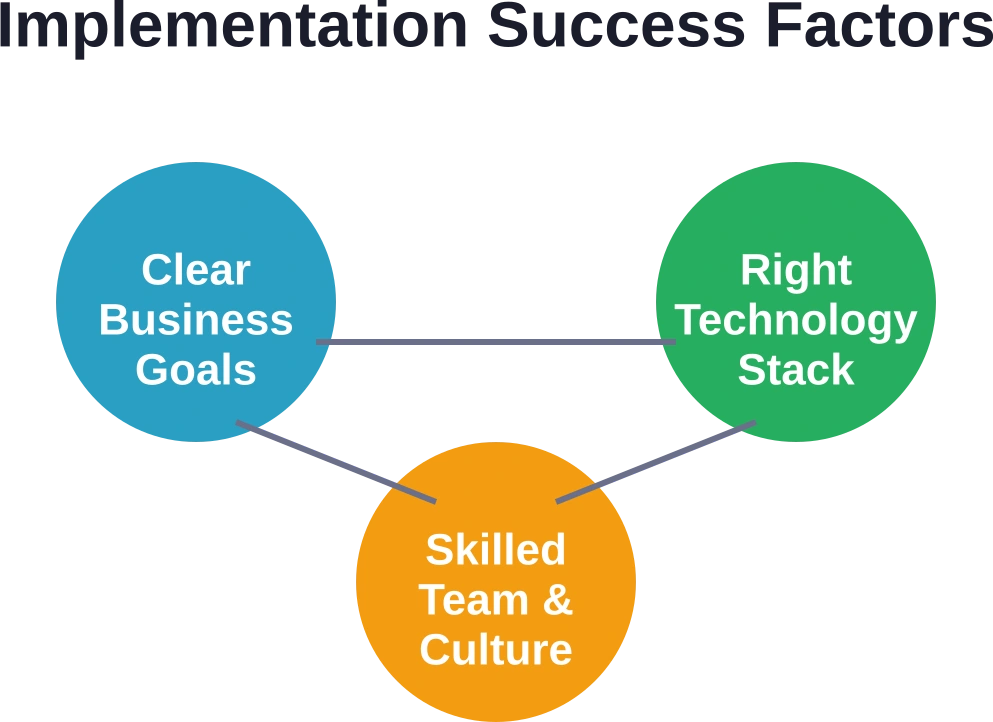
Successful implementation starts with clear strategy, not technology selection. Organizations need frameworks that align analytics initiatives with business objectives.
Define Specific Business Objectives
Start with problems worth solving. Which decisions would benefit most from better data? Where are current blind spots causing missed opportunities or operational inefficiencies?
Vague goals like “become more data-driven” don’t provide sufficient direction. Specific objectives like “reduce customer churn by 15%” or “decrease supply chain costs by 10%” create measurable targets.
Assess Current Data and Capabilities
Inventory existing data sources, quality levels, and accessibility. Evaluate current analytics capabilities, tools, and team skills. Identify gaps between current state and requirements.
This assessment prevents unrealistic expectations and highlights necessary investments in infrastructure, tools, or talent.
Start with High-Impact Use Cases
Prioritize initiatives that deliver quick wins—measurable business value within months rather than years. Early successes build momentum and secure ongoing executive support.
Balance impact against feasibility. The highest-value use case might require capabilities the organization doesn’t yet possess.
Build Cross-Functional Teams
Effective analytics requires collaboration between technical specialists and business stakeholders. Data scientists understand methods and tools. Business experts understand context, priorities, and how decisions get made.
Neither group succeeds alone. Structure teams to facilitate continuous collaboration throughout project lifecycles.
Establish Data Governance
Governance frameworks define data ownership, quality standards, access controls, and compliance procedures. Without governance, data quality deteriorates and security vulnerabilities multiply.
Governance shouldn’t strangle agility with bureaucracy. The goal is enabling responsible data use, not preventing it.
Plan for Scalability
Pilot projects often succeed but can’t scale to production workloads. Technology architectures must handle production data volumes and user concurrency. Operational processes must support ongoing model maintenance and monitoring.
Cloud platforms provide elastic scalability but require expertise to configure and optimize effectively.
The Future of Big Data Analytics
The field continues evolving rapidly. Several trends shape where analytics capabilities are heading.
Automated Machine Learning
AutoML platforms automate model selection, feature engineering, and hyperparameter tuning. This democratizes machine learning by reducing the expertise required for effective implementation.
Automation won’t replace data scientists but will shift their focus toward higher-value activities—problem formulation, business alignment, and ethical considerations.
Edge Analytics and IoT
Processing data at the edge—on devices rather than centralized servers—reduces latency and bandwidth requirements. This enables real-time decision-making for autonomous systems, smart manufacturing, and connected vehicles.
The volume of IoT-generated data will continue accelerating, making edge processing increasingly necessary.
Augmented Analytics
Natural language interfaces let business users query data conversationally. Automated insight generation surfaces important patterns without requiring users to know what questions to ask.
These capabilities make analytics accessible to broader audiences while maintaining analytical rigor.
Real-Time and Streaming Analytics
Batch processing gives way to continuous analysis of streaming data. Organizations detect opportunities and threats as they emerge rather than reviewing historical reports.
Real-time capabilities require different architectures and introduce new complexity around data consistency and processing guarantees.
Privacy-Preserving Analytics
Techniques like differential privacy, federated learning, and homomorphic encryption enable analytics on sensitive data while protecting individual privacy. These approaches will become essential as privacy regulations expand.
Frequently Asked Questions
What’s the difference between big data analytics and traditional data analysis?
Big data analytics handles much larger volumes of data from more varied sources at higher velocity than traditional analysis. Traditional analysis typically examines structured data in relational databases using SQL and statistical tools. Big data analytics processes structured, semi-structured, and unstructured data using distributed computing frameworks. The scale difference means big data requires specialized storage and processing technologies that traditional methods can’t handle efficiently.
How much does it cost to implement big data analytics?
Costs vary enormously based on scope, scale, and approach. Cloud-based solutions reduce upfront infrastructure investment but carry ongoing usage costs. Organizations should expect investments in technology platforms, data integration, talent acquisition or training, and change management. Starting with focused use cases rather than enterprise-wide transformations controls initial costs while demonstrating value. Check with specific vendors for current pricing, as costs and subscription models change frequently.
What skills do I need to work in big data analytics?
Technical roles require programming skills in languages like Python, R, or Scala, understanding of statistics and machine learning, experience with big data frameworks like Hadoop or Spark, and database knowledge including SQL and NoSQL systems. Business analyst roles emphasize data visualization, communication skills, business domain expertise, and ability to translate business questions into analytics requirements. Both paths benefit from curiosity, problem-solving ability, and continuous learning habits as technologies evolve rapidly.
How do organizations ensure big data analytics insights are accurate?
Accuracy depends on data quality, appropriate methodology, and proper validation. Organizations establish data quality processes that clean, standardize, and validate input data. They use appropriate statistical methods and machine learning techniques for each problem type. Model validation uses holdout datasets to test performance on data the model hasn’t seen. Regular monitoring detects when models degrade as conditions change. Cross-functional review ensures business logic makes sense and catches obvious errors before decisions are made.
Can small businesses benefit from big data analytics?
Absolutely. Cloud platforms and software-as-a-service analytics tools make capabilities affordable that once required massive infrastructure investments. Small businesses often have cleaner data and more agile cultures than large enterprises, enabling faster implementation. The key is starting with specific, high-value problems rather than trying to build comprehensive analytics platforms. Many small businesses successfully use analytics for customer segmentation, inventory optimization, digital marketing effectiveness, and operational efficiency.
What industries benefit most from big data analytics?
Nearly every industry derives value from big data analytics, but data-intensive sectors see particularly dramatic impact. Financial services use analytics for fraud detection, risk management, and algorithmic trading. Healthcare improves diagnostics and treatment through clinical analytics. Retail optimizes pricing, inventory, and personalization. Manufacturing reduces downtime through predictive maintenance. The common thread is organizations with large volumes of data about operations, customers, or products where insights drive competitive advantage.
How long does it take to see results from big data analytics initiatives?
Timeline depends on project scope and organizational readiness. Focused use cases with good existing data can deliver insights within weeks to months. Enterprise-wide transformations spanning multiple business units and requiring significant data infrastructure investments might take one to two years before realizing full value. Starting with pilot projects that address specific business problems delivers faster results and builds momentum for broader initiatives. Many organizations see measurable benefits from initial use cases within three to six months.
Conclusion
Big data analytics has moved from competitive differentiator to business necessity. Organizations that effectively collect, process, and analyze large amounts of data uncover insights that drive better decisions, improve operations, and create superior customer experiences.
The systematic processing and analysis of complex datasets reveals patterns and correlations that intuition alone would miss. From healthcare organizations detecting disease patterns to retailers optimizing inventory, big data analytics delivers measurable business value across industries.
Success requires more than implementing new technology. Organizations need clear business objectives, appropriate tools and infrastructure, skilled teams combining technical and business expertise, and cultural commitment to data-driven decision-making.
The challenges are real—data quality issues, talent gaps, privacy concerns, and organizational resistance all create obstacles. But the benefits justify the effort. Organizations that build strong analytics capabilities gain sustainable competitive advantages in markets where customer expectations and competitive intensity only increase.
Start with specific, high-value use cases. Build cross-functional teams. Invest in data quality and governance. And maintain realistic expectations about timelines and resource requirements.
The data is already there. The question is whether organizations will harness it effectively or let competitors capture the value instead.
Ready to transform your business with big data analytics? Begin by identifying one high-impact decision that better data could improve, then build from there.
 English
  German
  Arabic
  French
  Dutch
Dutch  Spanish