
Quick Summary: AI in healthcare consulting helps organizations navigate the complex adoption of artificial intelligence technologies while maintaining compliance and maximizing clinical outcomes. Consulting firms provide strategic guidance, technical implementation, regulatory expertise, and change management support to healthcare providers, payers, and medical technology companies. With over 70% of healthcare organizations pursuing AI capabilities and proven productivity gains up to 30%, specialized consulting has become essential for successful AI transformation.
The healthcare sector stands at a crossroads. Artificial intelligence promises to revolutionize everything from diagnostic accuracy to administrative workflows, yet the path forward isn’t straightforward.
Organizations face regulatory complexity, data integration challenges, and workforce concerns. That’s where specialized consulting comes in.
Healthcare AI consulting bridges the gap between technological possibility and clinical reality. These firms bring expertise that spans regulatory compliance, clinical workflows, data science, and change management—knowledge that most healthcare organizations simply don’t have in-house.
Here’s the thing though—not all consulting engagements deliver value. Some become expensive experiments that never reach production. Others implement technology without addressing the human and organizational factors that determine success.
What Healthcare AI Consulting Actually Involves
Healthcare AI consulting isn’t about installing software and walking away. It’s a comprehensive process that addresses strategy, technology, compliance, and organizational change.
Consulting firms typically begin with strategic assessment. They evaluate an organization’s readiness for AI adoption, identify high-value use cases, and develop implementation roadmaps aligned with business objectives.
According to a 2024 survey by McKinsey, over 70% of healthcare organizations are pursuing or have already implemented generative AI capabilities. But pursuing isn’t the same as succeeding.
The technical implementation phase involves data infrastructure evaluation, model selection or development, integration with existing systems, and rigorous testing. Consultants bridge the gap between clinical needs and technical constraints.
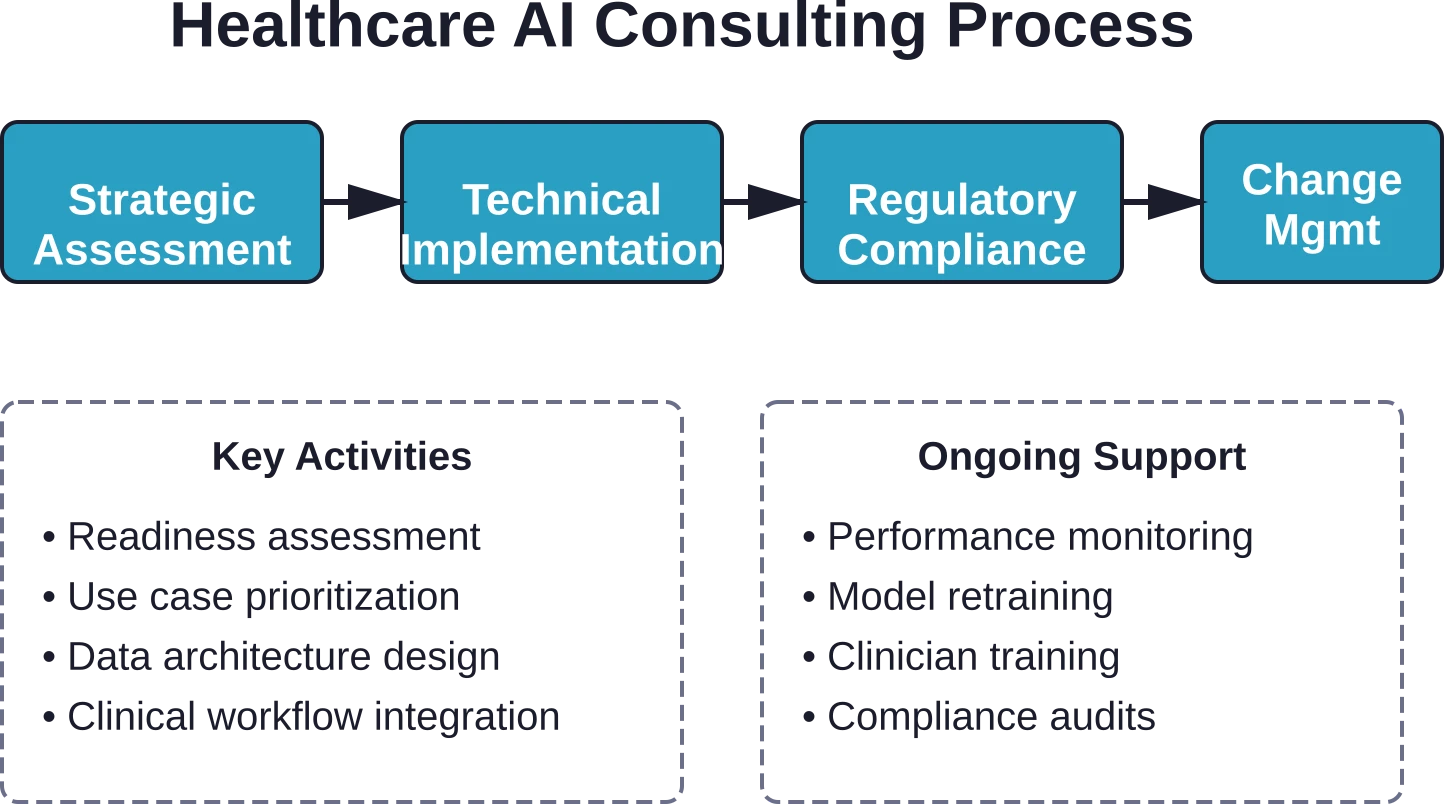
Regulatory compliance represents a critical component. The FDA has qualified AI tools for medical use, and the WHO has published guidance on ethics and governance of artificial intelligence for health. Navigating this landscape requires specialized expertise.
Change management often determines whether AI projects succeed or stall. Consultants work with clinical staff to address concerns, redesign workflows, and ensure adoption. Research shows that less than 5% of hospital patients view AI in medicine unfavorably, but clinician trust remains a more complex issue.
Clinical Decision Support: Where AI Delivers Measurable Impact
Clinical decision support systems represent one of the most mature applications of artificial intelligence in healthcare. These tools assist clinicians in diagnosis, treatment planning, and risk assessment.
Recent research on AI-enabled clinical decision support has demonstrated concrete outcomes. One study published in medical research journals examined a machine learning model for predicting complications from Bevacizumab treatment in oncology patients.
The optimized Random Forest model trained on the 80/20 split demonstrated the best balance between accuracy (70.63%), sensitivity (66.67%), specificity (73.85%), and AUC-ROC (0.75). The model was implemented as an interactive HTML form that clinicians can use at the point of care.
But here’s the challenge: implementing these systems requires more than technical expertise. Integration with electronic health records, clinical workflow design, and ongoing validation all demand specialized knowledge.
| AI Application Area | Primary Benefit | Implementation Complexity | Typical Timeline |
|---|---|---|---|
| Diagnostic imaging analysis | Increased accuracy and speed | Moderate | 6-12 months |
| Clinical decision support | Improved treatment outcomes | High | 12-18 months |
| Administrative automation | 30% productivity gain | Low to Moderate | 3-9 months |
| Predictive risk modeling | Early intervention capability | High | 12-24 months |
| Drug development tools | Accelerated research timelines | Very High | 18+ months |
According to the National Center for Biotechnology Information, AI in clinical decision support faces distinct challenges for evaluation. Traditional software assessment frameworks don’t adequately address the adaptive nature of machine learning systems.
Consulting firms that specialize in healthcare AI understand these nuances. They implement continuous monitoring, establish performance thresholds, and create processes for model updates as clinical evidence evolves.
Administrative Workflows: The Quick Win for Healthcare Organizations
While clinical applications capture headlines, administrative workflow automation delivers faster returns with lower risk. AI-powered tools are producing remarkable results in operational efficiency.
Administrative workflow automation has increased productivity by up to 30% in nursing environments, reducing documentation time and allowing more focus on direct patient care. Natural language processing enables automated clinical documentation, extracting structured data from unstructured notes. Scheduling optimization algorithms reduce wait times and improve resource utilization. Claims processing automation accelerates revenue cycles.
Real talk: these applications face fewer regulatory hurdles than diagnostic or treatment-related AI. That makes them ideal starting points for organizations new to artificial intelligence adoption.
Consulting firms often recommend beginning with administrative use cases to build organizational confidence, demonstrate value, and establish governance frameworks before tackling higher-risk clinical applications.
Regulatory Navigation: FDA, WHO, and Evolving Standards
The regulatory landscape for healthcare AI continues to evolve rapidly. The FDA has created pathways for AI-enabled medical devices, with hundreds of products authorized for marketing. The FDA’s approach distinguishes between locked algorithms (which don’t change after deployment) and adaptive algorithms (which learn from new data). Each requires different validation approaches.
On December 8, 2025, the U.S. Food and Drug Administration (FDA) qualified the first AI drug development tool, the AI-Based Histologic Measurement of NASH (AIM-NASH), to help pathologists assess metabolic dysfunction-associated steatohepatitis (MASH) disease activity in clinical trials. This represents a new category of AI application in the development process itself.
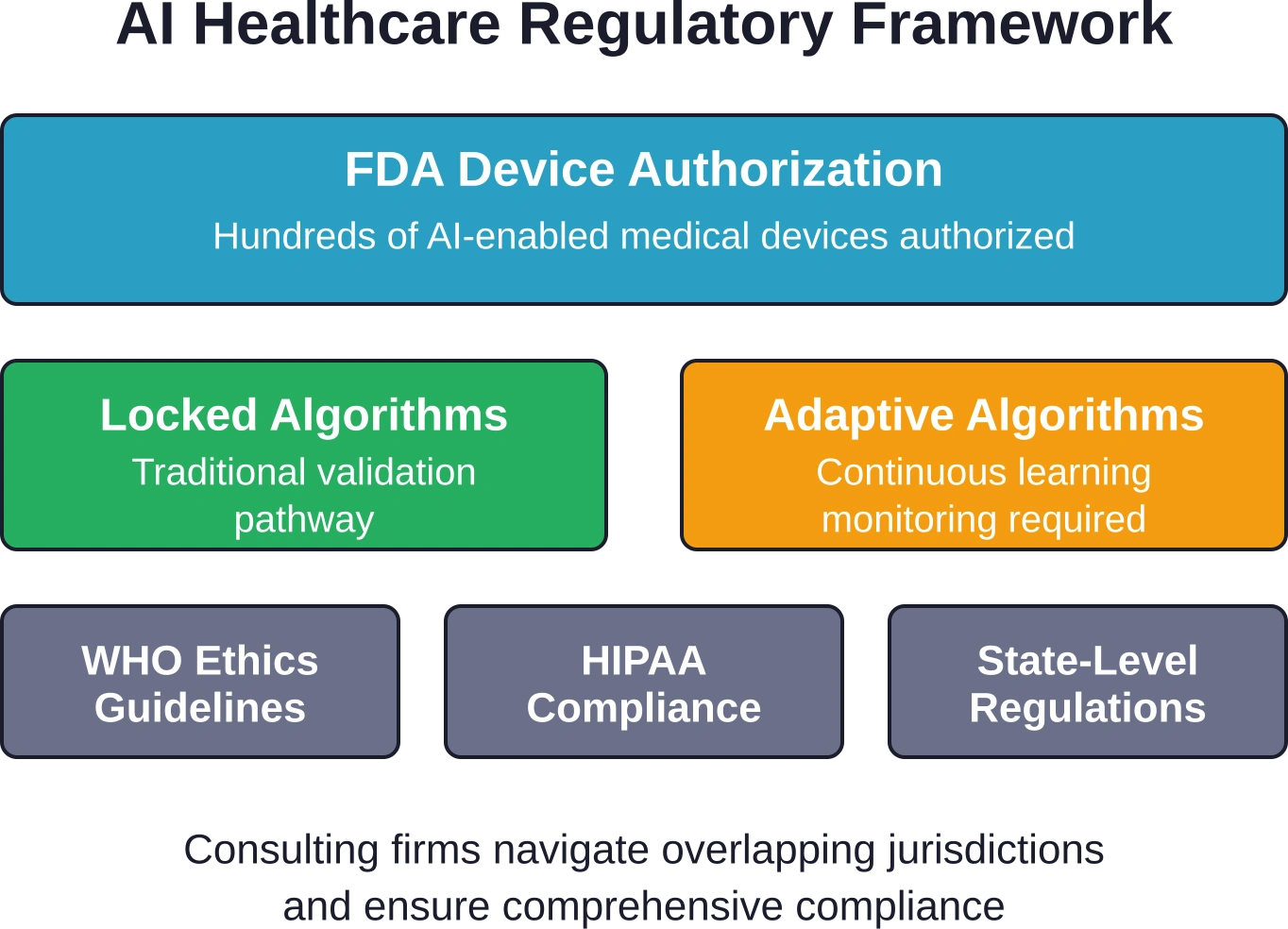
The World Health Organization has published comprehensive guidance on ethics and governance of artificial intelligence for health. This guidance identifies six consensus principles to ensure AI works for the public benefit across all countries.
Healthcare organizations must also navigate HIPAA requirements for data privacy, state-level regulations, and institutional review board requirements for research applications. One wrong step can derail an entire project.
Experienced consulting firms maintain deep regulatory expertise and often employ former FDA reviewers or regulatory affairs specialists who understand the approval process from the inside.
Trust, Transparency, and Clinician Adoption
Technology capability doesn’t guarantee adoption. Clinicians must trust AI systems enough to incorporate their recommendations into patient care decisions.
Research published in medical law reviews explores clinicians’ perspectives on trust, trustworthiness, and liability in artificial intelligence and clinical decision support. The findings reveal nuanced concerns that go beyond technical accuracy.
Clinicians worry about AI being given undue primacy in establishing what the empirically “best” care might be, potentially missing other relevant aspects of individual cases. They’re concerned about liability when AI recommendations conflict with clinical judgment.
But wait. The data shows these concerns are manageable with proper implementation. Research indicates that AI can actually reduce punitiveness in medical decision-making—one study found punitiveness scores dropped from 63% to 53% when clinical decision support systems were used in cases with guilty verdicts.
Consulting firms address trust through several mechanisms:
- Transparency in how models make decisions (explainable AI)
- Clear documentation of training data and validation results
- Defined roles for AI as decision support, not decision replacement
- Ongoing clinician education and feedback loops
- Liability frameworks that clarify responsibilities
The organizations that succeed with healthcare AI prioritize these human factors as much as technical implementation. Consultants facilitate this by designing workflows that enhance rather than threaten clinical autonomy.
Data Infrastructure: The Foundation That’s Often Neglected
Here’s what nobody tells you upfront: your data infrastructure probably isn’t ready for AI. Most healthcare organizations discover this painful truth after they’ve already committed to a project.
Electronic health records contain valuable data, but it’s often fragmented across systems, inconsistently formatted, and riddled with errors. Medical imaging archives lack standardized annotations. Lab results use different reference ranges across facilities.
AI models are only as good as the data they’re trained on. Garbage in, garbage out isn’t just a cliché—it’s the reality that kills healthcare AI projects.
Consulting firms begin engagements with comprehensive data assessments. They evaluate data quality, completeness, accessibility, and governance. They identify gaps and create remediation roadmaps before model development begins.
This unglamorous work often represents the difference between success and failure. Organizations that invest in data infrastructure first achieve better outcomes with lower risk.
Selecting the Right Consulting Partner
Not all healthcare AI consulting firms bring equivalent expertise. The sector includes massive management consultancies with dedicated healthcare practices, specialized AI firms expanding into healthcare, and boutique consultancies with deep clinical domain knowledge.
Organizations should evaluate several dimensions when selecting a partner:
- Domain expertise matters more than general AI capability: Healthcare’s regulatory complexity, clinical workflows, and ethical considerations demand specialized knowledge. A firm that’s implemented successful retail recommendation engines may struggle with clinical decision support.
- Look for regulatory and compliance depth: Has the firm successfully navigated FDA approval processes? Do they understand HIPAA requirements beyond surface-level compliance? Can they cite specific examples?
- Assess their change management capabilities: Technical implementation represents perhaps 40% of the challenge. The rest is organizational change, clinician training, and workflow redesign.
- Evaluate their data science team composition: The best teams include data scientists with healthcare backgrounds or clinicians with technical training. This combination bridges the communication gap that derails many projects.
- Request specific case studies with measurable outcomes: Vague success stories don’t count. Look for detailed descriptions of challenges overcome, metrics achieved, and lessons learned.
The short answer? Choose a firm that demonstrates both technical AI expertise and deep healthcare domain knowledge. One without the other rarely works.

Apply AI to Healthcare Projects With AI Superior
Healthcare AI projects usually need more than a model. They need a clear use case, careful work with data, and a solution that fits existing clinical, operational, or administrative workflows.
AI Superior can support healthcare companies through AI consulting, AI strategy, machine learning, predictive analytics, computer vision, NLP, data analytics, and custom AI software development. The value here is in narrowing the idea before development starts. AI Superior can help assess whether the data is ready, which AI approach is suitable, and how the final tool should be integrated into the healthcare environment without making the system more complicated than it needs to be.
AI Superior can support healthcare projects with:
- AI use case discovery for healthcare workflows
- Predictive models for planning or operational analytics
- Computer vision for medical image-related tasks
- NLP for healthcare documents and text data
- Custom AI software connected to existing systems
👉Contact AI Superior to discuss AI consulting for your healthcare data, operations, or digital health product.
Cost Structures and ROI Expectations
Healthcare AI consulting engagements vary dramatically in scope and cost. Small assessments might run $50,000 to $150,000. Comprehensive implementation projects can exceed several million dollars for large health systems.
Most firms structure engagements in phases:
- Discovery and strategy: Fixed-fee assessment (typically 6-12 weeks)
- Proof of concept: Time and materials or fixed fee (3-6 months)
- Production implementation: Combination of fixed milestones and time and materials (6-18 months)
- Ongoing support: Retainer or time and materials
This phased approach allows organizations to validate value before committing to full-scale implementation. It also provides natural decision points to pivot or terminate if results don’t justify continued investment.
Return on investment timelines depend on the application. Administrative automation often shows positive ROI within 12-18 months. Clinical decision support may require 24-36 months to demonstrate meaningful outcome improvements and corresponding financial benefits.
Organizations should establish clear success metrics before engagement begins. These might include reduced readmission rates, decreased length of stay, improved diagnostic accuracy, or administrative cost savings.
The Implementation Timeline: From Assessment to Production
Most healthcare organizations underestimate how long AI implementation takes. The technology itself isn’t the bottleneck—organizational factors are.
A typical timeline breaks down like this:
- Months 1-3: Strategic assessment and planning. The consulting firm evaluates current state, identifies use cases, assesses data readiness, and develops an implementation roadmap. This phase includes stakeholder interviews, technical architecture review, and regulatory gap analysis.
- Months 4-6: Proof of concept development. A limited-scope implementation tests feasibility and demonstrates value. This phase uses a subset of data, focuses on a single department or use case, and produces a working prototype.
- Months 7-12: Production system development. Full-scale implementation includes comprehensive data integration, model training and validation, clinical workflow design, and regulatory documentation. This phase requires extensive testing with clinical users.
- Months 13-18: Deployment and adoption. Phased rollout begins with a pilot group, expands to additional departments, and eventually reaches full organizational deployment. Ongoing monitoring, model retraining, and workflow optimization continue throughout.
Sounds long? It is. But rushing the process creates risks that far outweigh the time savings. Organizations that skip proper validation, skimp on clinician training, or neglect workflow design end up with expensive shelfware.
Common Pitfalls and How to Avoid Them
Healthcare AI projects fail in predictable ways. Consulting firms worth their fees help organizations avoid these traps.
- Pilotitis: The condition where projects perpetually stay in pilot phase, never reaching production deployment. This happens when success criteria aren’t defined upfront or when organizational commitment wavers. The cure? Establish clear graduation criteria for pilots and secure executive sponsorship before beginning.
- Data optimism: The mistaken belief that existing data is cleaner and more accessible than it actually is. Most organizations discover data quality issues months into implementation. Mitigation requires honest assessment upfront and realistic timelines for data preparation.
- Technology-first thinking: Selecting AI solutions before fully understanding the problem. This puts the cart before the horse. Better approach: define clinical or operational needs clearly, then identify appropriate technologies.
- Regulatory surprise: Discovering late in development that the intended use requires FDA approval or other regulatory clearance. Early regulatory strategy prevents this expensive mistake.
- Ignoring clinician concerns: Treating adoption as an afterthought rather than a central design consideration. Projects that fail to address workflow disruption and trust concerns face passive resistance that kills even technically sound solutions.
According to IEEE Regulating AI in the Digital Mental Health Forum, research shows only 20% of digital mental health technologies are safe. Working with experienced consultants who prioritize safety, validation, and clinical integration improves those odds considerably.
Emerging Trends: What’s Coming in Healthcare AI
The healthcare AI landscape continues evolving rapidly. Several trends are shaping consulting priorities for 2026 and beyond:
- Generative AI in clinical documentation: Large language models are transforming ambient clinical intelligence, automatically generating clinical notes from patient encounters. Early implementations show promise for reducing documentation burden, though accuracy and hallucination risks require ongoing attention.
- Multimodal AI systems: Next-generation systems integrate multiple data types—medical imaging, genomics, electronic health records, and patient-reported outcomes—for more comprehensive clinical insights. These systems promise more accurate diagnosis and personalized treatment recommendations.
- AI for healthcare workforce shortages: According to the Health Resources and Services Administration (HRSA), approximately 89% of U.S. counties have been designated as primary care Health Professional Shortage Areas (pc-HPSAs), affecting approximately 77 million people or about 24% of the U.S. population. AI-powered telemedicine, triage systems, and clinical decision support help extend provider capacity.
- Federated learning: This approach trains AI models across multiple institutions without sharing patient data, addressing privacy concerns while enabling broader training datasets. Expect growing adoption as technical maturity increases.
- Continuous learning systems: Adaptive algorithms that improve from real-world use present both opportunities and regulatory challenges. The FDA’s evolving framework for these systems will shape how organizations approach ongoing model updates.
| Technology Trend | Current Maturity | Expected Impact | Key Challenge |
|---|---|---|---|
| Generative AI documentation | Early adoption | High (30% productivity gain) | Accuracy validation |
| Multimodal diagnostic systems | Research/pilot | Very high | Data integration complexity |
| Federated learning | Emerging | High (privacy-preserving) | Technical implementation |
| Continuous learning models | Experimental | Very high | Regulatory framework |
Healthcare AI Ethics and Equity Considerations
Technical capability doesn’t equal ethical implementation. Healthcare AI raises profound questions about equity, bias, and access.
Training data often underrepresents certain populations. Models trained primarily on data from academic medical centers may perform poorly in community health settings. Algorithms developed with predominantly white patient populations may be less accurate for other racial and ethnic groups.
According to research from Brookings Institution, limited health access can exacerbate health disparities and adverse health outcomes. If AI tools are only available to well-resourced health systems, they may widen rather than narrow existing gaps.
WHO guidance on AI ethics identifies protecting human autonomy, promoting human well-being and safety, ensuring transparency, fostering responsibility and accountability, ensuring inclusiveness and equity, and promoting responsive and sustainable AI as core principles.
Consulting firms should help organizations address these concerns through:
- Diverse training data that represents the populations served
- Bias testing across demographic groups before deployment
- Transparency about model limitations and performance variation
- Equity impact assessments as part of implementation planning
- Governance structures that include diverse perspectives
Organizations that neglect these considerations risk implementing systems that perpetuate or amplify existing inequities—creating both ethical problems and potential liability.
Questions to Ask Before Engaging a Consulting Firm
Due diligence matters. Ask these questions before selecting a healthcare AI consultant:
- What specific healthcare AI projects have you completed from assessment through production deployment? Request detailed case studies, not just client lists.
- How do you approach regulatory strategy for AI-enabled medical devices? Their answer should demonstrate familiarity with FDA pathways, quality system requirements, and post-market surveillance.
- What’s your approach to data privacy and security? They should articulate specific technical and administrative safeguards beyond generic HIPAA compliance claims.
- How do you measure project success? Look for concrete metrics tied to clinical outcomes or operational efficiency, not just technical benchmarks.
- What happens when models underperform in production? Their answer reveals whether they plan for ongoing monitoring and have processes for addressing performance degradation.
- How do you address clinician adoption and change management? Implementation without adoption is failure. They should have concrete strategies beyond training sessions.
- What’s your team composition for our engagement? Understand who will actually do the work, not just who sells it.
- Can you provide references from similar organizations? Then actually call those references and ask about challenges encountered and how the firm responded.
The firms that give thoughtful, specific answers earn consideration. Those that speak in generalities or avoid difficult questions probably lack the depth required.
Frequently Asked Questions
How much does healthcare AI consulting typically cost?
Healthcare AI consulting costs vary widely based on project scope, organization size, and engagement duration. Initial assessments typically range from $50,000 to $150,000 for 6-12 weeks of work. Comprehensive implementation projects for large health systems can run from several hundred thousand to several million dollars over 12-24 months. Most firms structure engagements in phases, allowing organizations to validate value before committing to full-scale implementation. Factors affecting cost include data complexity, regulatory requirements, number of use cases, and level of change management support required.
How long does it take to implement an AI solution in healthcare?
Timeline varies significantly based on application complexity and organizational readiness. Simple administrative automation projects may reach production in 6-9 months. Clinical decision support systems typically require 12-18 months from initial assessment through full deployment. Complex predictive modeling or diagnostic applications can take 18-24 months or longer. These timelines include strategic assessment, proof of concept, production development, regulatory review if needed, and phased deployment. Organizations with clean data infrastructure and strong change management processes can move faster, while those requiring extensive data remediation or facing regulatory hurdles need longer timelines.
What qualifications should healthcare AI consultants have?
The strongest healthcare AI consulting teams combine multiple expertise areas. Look for consultants with healthcare domain knowledge—clinical backgrounds, health IT experience, or years working specifically in healthcare settings. Technical capabilities should include data science, machine learning, and health data standards like HL7 and FHIR. Regulatory expertise is essential, particularly familiarity with FDA approval processes for medical devices and HIPAA compliance requirements. Change management skills matter tremendously since adoption determines success. The best teams include former clinicians with technical training or data scientists with extensive healthcare project experience. Certifications in healthcare quality, regulatory affairs, or clinical informatics add credibility.
What are the biggest risks in healthcare AI implementation?
Several risks can derail healthcare AI projects. Data quality and availability issues frequently emerge later than expected, delaying timelines and increasing costs. Regulatory compliance surprises occur when organizations underestimate approval requirements. Model performance in real-world settings often differs from controlled testing environments. Clinician adoption remains challenging when workflows aren’t properly redesigned or trust concerns aren’t addressed. Privacy breaches or security incidents carry massive financial and reputational consequences. Bias in algorithms can perpetuate health disparities and create liability. Budget overruns happen when projects underestimate data preparation work or change management needs. Experienced consulting firms help mitigate these risks through thorough assessment, phased implementation, and comprehensive validation before production deployment.
How do we measure ROI for healthcare AI investments?
ROI measurement should tie directly to organizational priorities and use case objectives. For administrative applications, track metrics like time saved on documentation, claims processing speed, or scheduling efficiency. Administrative workflow automation has demonstrated productivity gains up to 30% in some implementations. For clinical applications, measure outcome improvements such as diagnostic accuracy, readmission rates, length of stay, or adverse event reduction. Population health initiatives might track risk stratification accuracy or intervention effectiveness. Calculate both direct financial returns and indirect benefits like improved clinician satisfaction or patient experience. Establish baseline metrics before implementation and plan for 12-36 months of data collection post-deployment, as clinical outcome improvements take time to manifest and measure with statistical significance.
Should we build AI capabilities in-house or work with consultants?
This decision depends on organizational resources, strategic priorities, and existing capabilities. Building in-house makes sense for organizations with strong data science teams, robust IT infrastructure, and AI as a core strategic differentiator. However, most healthcare organizations lack the specialized expertise required for successful AI implementation. Healthcare AI demands knowledge that spans clinical workflows, medical devices regulations, data privacy law, machine learning, and change management—a rare combination. Consultants provide immediate access to this expertise without long hiring timelines. They bring experience from multiple implementations, helping organizations avoid common pitfalls. A hybrid approach often works best: consultants lead initial implementations while transferring knowledge to internal teams who eventually manage ongoing operations and future projects. Start with consultants for first projects, then evaluate building internal capabilities as organizational AI maturity increases.
How do we ensure our AI implementation complies with regulations?
Regulatory compliance requires attention throughout the project lifecycle, not just at the end. Begin with regulatory strategy during the assessment phase—determine whether your intended use constitutes a medical device requiring FDA clearance. The FDA has authorized hundreds of AI-enabled medical devices, each navigating specific regulatory pathways. Implement quality management systems aligned with ISO 13485 and FDA requirements from the start. Maintain detailed documentation of data sources, model development, validation testing, and risk management activities. Conduct clinical validation studies with appropriate statistical rigor. Establish post-market surveillance systems for ongoing performance monitoring. Address HIPAA requirements for data privacy and security through technical and administrative safeguards. Consider state-level regulations that may impose additional requirements. Working with consulting firms experienced in regulatory affairs significantly improves approval odds and reduces timeline risks.
Moving Forward: Building Your Healthcare AI Strategy
Healthcare AI isn’t a luxury anymore—it’s becoming infrastructure. Organizations that wait for the technology to fully mature will find themselves increasingly disadvantaged.
But rushing in without proper guidance creates expensive failures. The gap between AI’s promise and healthcare’s reality is where consulting expertise delivers value.
Start with an honest assessment of organizational readiness. Evaluate data infrastructure, technical capabilities, clinical engagement, and change management capacity. Identify high-value use cases that align with strategic priorities.
Select consulting partners carefully based on demonstrated healthcare expertise, not just general AI capability. Look for firms that prioritize clinical outcomes over technological sophistication.
Implement in phases, validating value before scaling. Expect longer timelines than initially anticipated. Invest in data preparation, clinician engagement, and workflow redesign as much as in the technology itself.
Establish governance frameworks that address ethics, equity, and ongoing performance monitoring from day one. These aren’t afterthoughts—they’re foundations.
The healthcare organizations succeeding with AI share common characteristics: executive commitment, realistic expectations, investment in foundational capabilities, and willingness to learn from early implementations. They view AI adoption as a journey requiring sustained effort rather than a destination reached through a single project.
With over 70% of healthcare organizations now pursuing AI capabilities and proven results including 30% productivity gains in administrative workflows, the competitive pressure to adopt continues increasing. According to the Health Resources and Services Administration (HRSA), approximately 89% of U.S. counties have been designated as primary care Health Professional Shortage Areas (pc-HPSAs), affecting approximately 77 million people or about 24% of the U.S. population, making AI-assisted care delivery not just advantageous but increasingly necessary.
The question isn’t whether to pursue healthcare AI, but how to do it successfully. That’s where experienced consulting partners separate themselves—turning technological possibility into clinical reality.
 English
  German
  Arabic
  French
  Dutch
Dutch  Spanish