
Quick Summary: Natural Language Processing (NLP) enables businesses to analyze customer feedback, automate customer service, extract insights from unstructured data, and improve decision-making. From sentiment analysis and chatbots to document processing and competitive intelligence, NLP applications transform how organizations operate, reduce costs, and enhance customer experiences across industries.
Natural Language Processing has shifted from academic curiosity to business necessity. Organizations now process millions of text documents daily—customer reviews, support tickets, social media posts, legal contracts, and market reports. Manual analysis doesn’t scale anymore.
But here’s the thing: only 18% of organizations analyze unstructured data such as natural text to gain business insights, according to research from Deloitte. That’s a massive opportunity gap.
The businesses leveraging NLP aren’t just keeping up. They’re pulling ahead with faster decision-making, deeper customer understanding, and operational efficiency that competitors can’t match with traditional methods.
This article breaks down the most impactful NLP applications reshaping business operations right now. Real use cases, measurable benefits, and practical implementation considerations.
What Is Natural Language Processing in Business?
Natural Language Processing sits at the intersection of artificial intelligence, linguistics, and computer science. It enables machines to understand, interpret, and generate human language in ways that create business value.
The technology processes both structured and unstructured text data. That includes everything from customer emails and chat transcripts to product reviews, social media conversations, and internal documents.
Modern NLP systems don’t just match keywords. They understand context, sentiment, intent, and even subtle linguistic nuances like sarcasm or regional dialects. This capability transforms how organizations extract insights from the massive volume of text data generated daily.
For enterprise deployment, efficiency matters as much as accuracy. Lightweight transformer architectures have made real-time NLP processing viable for business applications. DistilBERT, for example, achieves a 40% size reduction through knowledge distillation while retaining comparable performance and improving inference efficiency.
This enables practical deployment with optimized inference times and compact model sizes suitable for standard business infrastructure.
Core Benefits of NLP for Business Operations
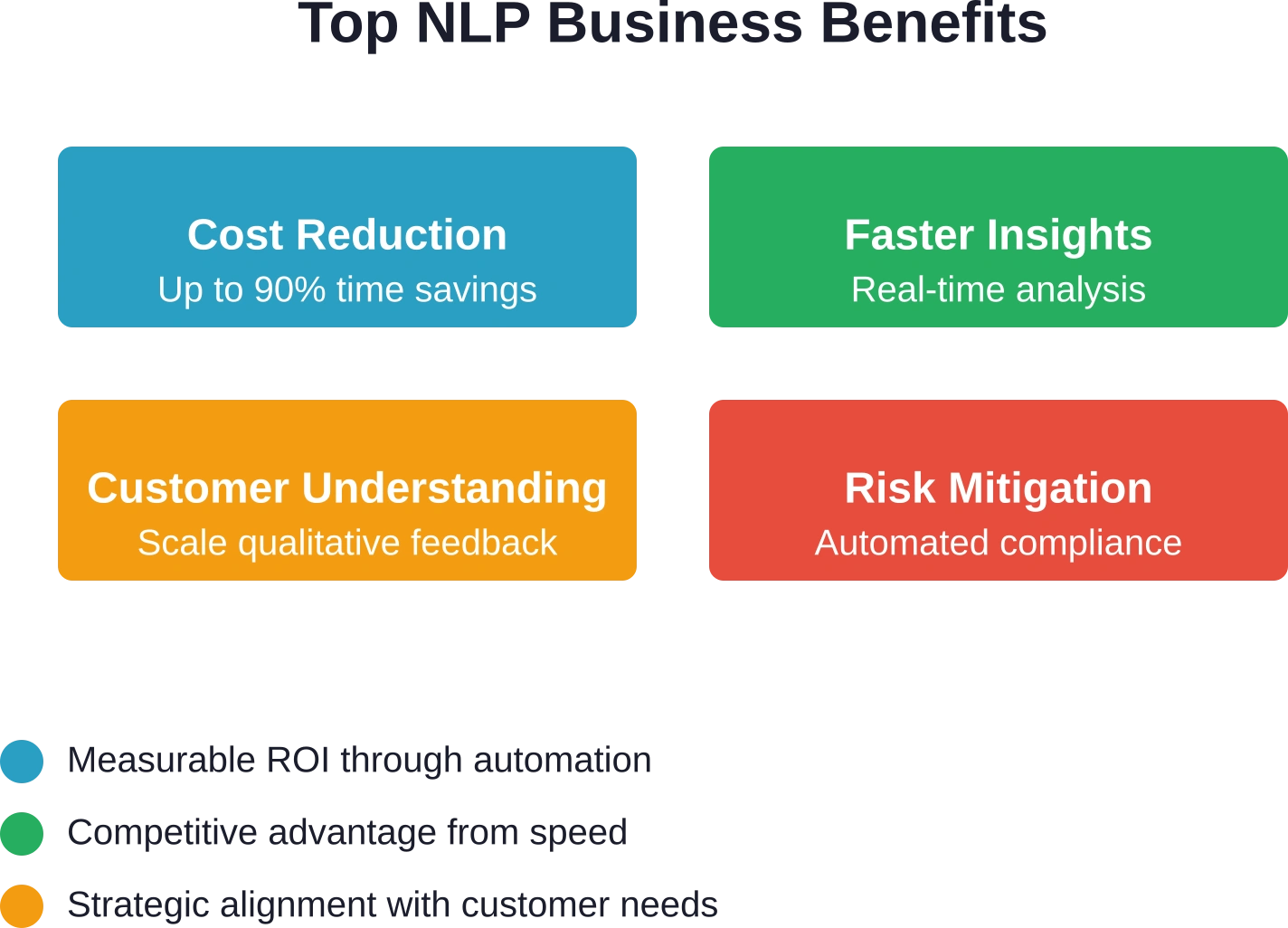
Organizations implementing NLP solutions report quantifiable improvements across multiple operational areas. These aren’t theoretical advantages—they’re measurable impacts on the bottom line.
Cost Reduction Through Automation
Text-intensive business processes consume enormous employee hours. Contract review, customer inquiry responses, document classification, and data entry all involve human language processing that NLP can accelerate or automate entirely.
The Tough Mudder team reduced manual survey coding time by 90% using text analytics to process post-event feedback. That’s hundreds of hours reclaimed for strategic work rather than categorizing open-ended survey responses.
Customer service automation delivers similar gains. Chatbots handle routine inquiries without human intervention, freeing support teams to focus on complex issues requiring empathy and creative problem-solving.
Speed to Insight
Market conditions change quickly. Organizations that extract insights faster from customer feedback, competitor announcements, and market reports gain decisive advantages.
Amazon recently implemented text analytics to analyze millions of product reviews, identifying key features that drive customer satisfaction. This led to targeted product improvements and a 15% increase in positive ratings—a competitive edge gained through faster feedback analysis than rivals could match manually.
Enhanced Customer Understanding
Customers express needs, frustrations, and preferences constantly through support tickets, reviews, social media, and surveys. Most of this qualitative feedback goes unanalyzed because manual review doesn’t scale.
NLP sentiment analysis processes this feedback at scale, identifying emerging trends before they become obvious. Organizations spot product issues early, understand feature requests better, and align offerings with actual customer language rather than internal assumptions.
Risk Mitigation and Compliance
Regulatory requirements generate enormous documentation burdens. Financial services, healthcare, and legal sectors face particular challenges ensuring compliance across thousands of documents and communications.
NLP systems scan contracts, communications, and reports for compliance issues, flagging potential violations before they become regulatory problems. This automated monitoring provides consistent oversight impossible to maintain with manual review.
Customer Experience Enhancement Applications
Customer-facing NLP applications directly impact satisfaction, retention, and lifetime value. These use cases handle the frontline interactions that shape customer perception.
Intelligent Chatbots and Virtual Assistants
Modern conversational AI has moved beyond rigid decision trees. Current systems understand intent, handle context across multi-turn conversations, and escalate gracefully to human agents when needed.
These assistants operate 24/7 across channels—website chat, mobile apps, messaging platforms, and voice interfaces. Customers get immediate responses to routine questions about order status, account information, product specifications, and troubleshooting steps.
The business impact extends beyond availability. Chatbots handle unlimited concurrent conversations without wait times, eliminating the queue-based frustration of traditional call centers. Response consistency improves too—every customer receives accurate, brand-aligned information rather than varying quality depending on which agent they reach.
Implementation requires training on actual customer conversations. Generic chatbots frustrate users. Effective systems learn company-specific terminology, product names, common issues, and the conversational patterns customers actually use.
Sentiment Analysis for Customer Feedback
Customer sentiment appears everywhere—reviews, surveys, social media, support tickets. Aggregating this sentiment at scale reveals patterns invisible in individual interactions.
Sentiment analysis classifies text as positive, negative, or neutral, often with granular emotion detection (frustrated, delighted, confused). Organizations track sentiment trends over time, correlate sentiment with product features or service changes, and identify emerging issues before they escalate.
Delta Air Lines used text analytics to process customer feedback across multiple channels, identifying specific pain points in the travel experience. This granular sentiment understanding enabled targeted improvements to the most impactful friction points.
The analysis extends beyond binary good/bad classifications. Aspect-based sentiment reveals which specific features customers love or hate. A product might receive overall positive sentiment but negative sentiment specifically about packaging or documentation—actionable insights that aggregate star ratings miss.
Voice of Customer Intelligence
Organizations collect vast amounts of qualitative feedback that never gets analyzed. Open-ended survey responses, support call transcripts, user interviews, and community forum discussions contain rich insights but resist traditional quantitative analysis.
NLP extracts themes, trends, and patterns from this unstructured feedback. Topic modeling automatically discovers what customers discuss most frequently. Feature extraction identifies which capabilities matter most to users. Pain point analysis highlights the obstacles frustrating customers before they churn.
This intelligence informs product roadmaps, marketing messaging, and customer success strategies with actual customer language rather than internal assumptions about what matters.
Operational Efficiency Applications
Internal operations generate as much text as customer interactions—emails, reports, documentation, contracts, meeting notes. NLP applications streamline these text-intensive processes.
Document Processing and Information Extraction
Business documents contain structured information trapped in unstructured formats. Invoices, contracts, resumes, insurance claims, and purchase orders all require human review to extract key data points.
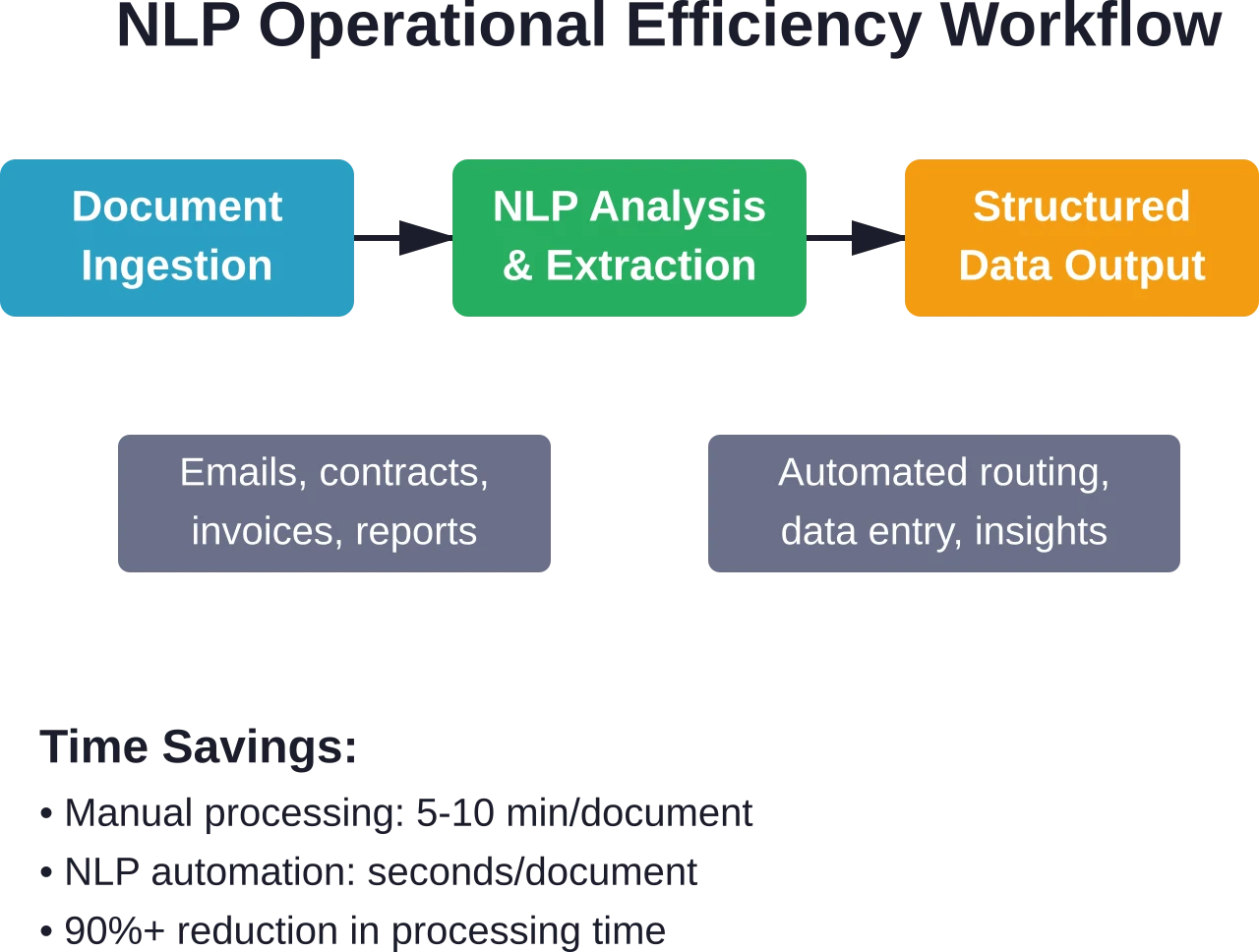
NLP-powered document processing automatically identifies and extracts relevant information—dates, amounts, names, addresses, terms, conditions. This structured data flows directly into business systems without manual data entry.
Invoice processing exemplifies the impact. Organizations receiving thousands of invoices from varied vendors in different formats can automate extraction of vendor name, invoice number, line items, amounts, and payment terms. Processing time drops from minutes per invoice to seconds, with accuracy exceeding tired human reviewers.
Contract analysis follows similar patterns. Legal teams use NLP to review contracts for specific clauses, obligations, dates, and non-standard terms. This automated first-pass review identifies items requiring attorney attention while routine contracts flow through faster.
Email Management and Routing
Corporate email volumes overwhelm employees. Customer inquiries arrive at generic inboxes requiring routing to appropriate teams. Internal communications bury important requests in noise.
NLP classifies incoming emails by topic, urgency, and required action. Customer service emails route automatically to teams based on issue type—billing, technical support, account changes. Urgent requests flag for immediate attention rather than waiting in queue.
Automated email classification ensures inquiries reach qualified handlers on first contact rather than bouncing between departments. Response times improve because the right expert sees the issue immediately.
Meeting Summarization and Action Item Extraction
Organizations spend countless hours in meetings. The value depends on clear documentation and follow-through on decisions and action items.
NLP systems process meeting transcripts to generate summaries highlighting key decisions, action items, and owners. Participants receive clear documentation without designating a note-taker, and nothing falls through cracks because someone forgot to write it down.
This capability extends to recorded calls, webinars, and presentations. The content becomes searchable and scannable rather than requiring time-consuming replay to find specific discussions.
Internal Search and Knowledge Management
Employees waste significant time searching for information across SharePoint sites, wikis, documentation repositories, and shared drives. Traditional keyword search returns irrelevant results because it ignores context and intent.
Semantic search powered by NLP understands the meaning behind queries, not just keyword matches. Searching for “how to handle upset customers” returns relevant customer service protocols even if those documents never use the phrase “upset customers.”
The system understands synonyms, related concepts, and context. Results improve because search recognizes that “client,” “customer,” and “account” often mean the same thing in business contexts.
Market Intelligence and Competitive Analysis
Understanding market dynamics and competitor movements requires processing massive amounts of public information—news articles, press releases, social media, earnings calls, patent filings, and regulatory documents.
Competitive Intelligence Gathering
NLP systems monitor competitor mentions across news sources, social media, review sites, and industry publications. Organizations track competitor product launches, pricing changes, customer sentiment, hiring patterns, and strategic announcements.
This automated monitoring surfaces competitive threats and opportunities faster than manual research. When competitors announce new capabilities, NLP alerts relevant teams immediately rather than waiting for someone to stumble across the information.
The analysis extends beyond simple mentions. Sentiment analysis reveals how markets receive competitor announcements. Topic modeling identifies which competitor features generate the most discussion. Share of voice metrics show relative market attention across competitors.
Market Trend Analysis
Industry trends emerge from patterns across thousands of articles, reports, and discussions. Individual pieces reveal little, but aggregate analysis spots emerging themes.
NLP processes industry publications, analyst reports, conference proceedings, and social media to identify growing topics, declining interests, and shifting terminology. Organizations spot market opportunities early and avoid investing in declining approaches.
This trend detection works across timeframes. Short-term spike detection identifies immediate market reactions to events. Long-term trend analysis reveals gradual shifts in industry focus, customer priorities, and technology adoption.
Brand Monitoring and Reputation Management
Brand mentions multiply across platforms—social media, review sites, forums, news articles, blogs. Manual monitoring misses most mentions and responds too slowly to emerging issues.
NLP-powered brand monitoring tracks mentions in real-time, analyzes sentiment, identifies trending topics, and alerts teams to potential reputation issues. Organizations respond quickly when negative sentiment spikes, engaging customers before isolated complaints become viral problems.
The monitoring distinguishes between different contexts. A mention in a complaint requires different handling than a mention in a positive review or neutral industry article. Intent classification ensures appropriate response prioritization.
Risk Management and Compliance Applications
Regulatory requirements and risk management create extensive documentation and monitoring needs. NLP automates much of this compliance burden.
Regulatory Compliance Monitoring
Financial services, healthcare, and other regulated industries must ensure communications and documents comply with complex regulations. Manual review of every email, report, and document doesn’t scale.
NLP systems scan communications for compliance red flags—prohibited terminology, required disclosures, insider information, fair lending violations. Potential issues flag for human review before becoming violations.
The monitoring adapts as regulations change. When new compliance requirements emerge, organizations update NLP models to detect new patterns rather than retraining entire compliance teams.
Fraud Detection in Text Communications
Fraudulent activity leaves linguistic traces. Insurance claims, loan applications, and financial statements contain language patterns that distinguish legitimate documents from fraudulent ones.
NLP analyzes text for fraud indicators—inconsistencies, suspicious patterns, language typical of known fraud schemes. This automated screening prioritizes cases for investigator attention, directing limited fraud investigation resources to highest-risk cases.
Legal Document Analysis
Legal departments process thousands of contracts, agreements, and regulatory filings. Attorney time costs hundreds of dollars per hour—expensive for routine document review.
NLP performs initial contract analysis, extracting key terms, identifying standard versus non-standard clauses, flagging unusual provisions, and comparing contracts against templates. Attorneys focus on genuinely complex legal issues rather than routine review.
Case law research benefits similarly. Instead of manually reading hundreds of cases to find relevant precedents, NLP searches based on legal concepts and fact patterns, surfacing the most applicable cases quickly.
Human Resources Applications
HR departments handle enormous volumes of text—resumes, job descriptions, performance reviews, employee feedback, exit interviews. NLP makes this text data actionable.
Resume Screening and Candidate Matching
Popular job postings attract hundreds of applications. Manual resume review creates bottlenecks and risks overlooking qualified candidates buried in volume.
NLP-powered applicant tracking systems parse resumes to extract skills, experience, education, and qualifications. Candidates match against job requirements automatically, ranking applicants by fit rather than arrival order.
The analysis moves beyond keyword matching. Semantic understanding recognizes that “Python developer” and “software engineer with Python experience” describe similar qualifications even with different wording.
Employee Sentiment and Engagement Analysis
Employee surveys, feedback platforms, and exit interviews contain candid insights about workplace culture, management effectiveness, and organizational issues. This feedback drives retention when acted upon—but only if someone analyzes it.
NLP processes employee feedback at scale, identifying common themes, emerging concerns, and sentiment trends across teams and departments. Organizations spot engagement problems early and measure the impact of culture initiatives with quantitative metrics.
Performance Review Analysis
Performance reviews generate rich qualitative data about employee strengths, development needs, and career interests. This information typically lives in individual documents rather than informing organizational talent strategies.
NLP extracts patterns from performance review text—skills appearing frequently in high performer reviews, common development needs across teams, promotion readiness indicators. Talent management becomes data-driven rather than anecdotal.
Implementation Considerations for Business NLP
Successful NLP implementation requires more than picking an algorithm. Organizations must address data quality, model training, integration, and ongoing maintenance.
Data Requirements and Preparation
NLP models learn from examples. Model quality depends directly on training data quality and volume. Organizations need representative samples of the text they want to process—enough examples to cover terminology, formats, and edge cases.
Data preparation consumes significant effort. Text data requires cleaning, standardization, and labeling. Removing formatting artifacts, handling special characters, and normalizing abbreviations all impact model performance.
For supervised learning tasks like classification, someone must label training examples. A sentiment analysis model needs hundreds or thousands of text samples manually classified as positive, negative, or neutral. This labeling requires domain expertise and clear guidelines ensuring consistency.
Model Selection and Customization
Pre-trained language models provide strong foundations but require customization for business contexts. Generic models don’t understand company-specific terminology, product names, or industry jargon.
Fine-tuning adapts pre-trained models to specific business needs. This transfer learning approach requires far less training data than building models from scratch while achieving better performance than generic models.
Model selection balances accuracy and efficiency. The most accurate models require more computational resources, creating latency and infrastructure costs. Lightweight architectures like DistilBERT provide strong accuracy on business datasets while meeting real-time processing requirements.
Integration with Existing Systems
NLP applications must fit into existing workflows and systems. Standalone analysis tools provide limited value if insights don’t reach decision-makers or trigger appropriate actions.
API-based integration connects NLP capabilities to CRM systems, support platforms, document management systems, and business intelligence tools. Sentiment scores flow into customer records, document extraction populates database fields, and chatbot conversations integrate with ticketing systems.
The integration includes human-in-the-loop workflows for tasks requiring human judgment. NLP handles initial processing and routing, but complex cases escalate to employees with appropriate context from the automated analysis.
Privacy and Security Considerations
Business text data contains sensitive information—customer details, financial information, proprietary data, employee records. NLP systems must protect this information throughout processing.
Data governance policies define which text can be processed, who can access results, and how long data is retained. Organizations must ensure NLP processing complies with privacy regulations like GDPR, CCPA, and industry-specific requirements.
Model training introduces additional privacy concerns. Training data shouldn’t leak into model outputs. Organizations using cloud NLP services must understand where data is processed and stored, especially for regulated industries with data residency requirements.
| Implementation Phase | Key Activities | Typical Timeline | Success Factors |
|---|---|---|---|
| Discovery & Planning | Use case definition, data assessment, requirements gathering | 2-4 weeks | Clear business objectives, executive sponsorship |
| Data Preparation | Data collection, cleaning, labeling, quality checks | 4-8 weeks | Domain expertise, labeling guidelines, data volume |
| Model Development | Model selection, training, validation, tuning | 6-12 weeks | Representative training data, evaluation metrics |
| Integration & Testing | System integration, UAT, workflow design | 4-6 weeks | Clear workflows, stakeholder involvement |
| Deployment & Monitoring | Production rollout, performance tracking, iteration | Ongoing | Monitoring infrastructure, feedback loops |

Build NLP Tools Around Real Business Tasks With AI Superior
NLP becomes useful when it solves a specific text-related problem – sorting, searching, extracting, classifying, summarizing, or answering questions from business content. AI Superior works with NLP development, LLM consulting, generative AI development, AI chatbot development, AI software development, and AI integration. For companies, this can apply to customer messages, support tickets, reports, internal documents, reviews, contracts, knowledge bases, and other text-heavy data sources.
AI Superior’s NLP work can include:
- Mapping business tasks that depend on text data
- Building document processing and classification tools
- Developing LLM-based assistants or search features
- Applying NLP to support, reviews, reports, or internal content
- Integrating language AI into business software
👉Contact AI Superior to explore NLP applications for your documents, customer communication, or digital products.
Measuring NLP Impact and ROI
Justifying NLP investments requires demonstrating measurable business impact. Organizations should define success metrics before implementation and track them consistently.
Quantitative Metrics
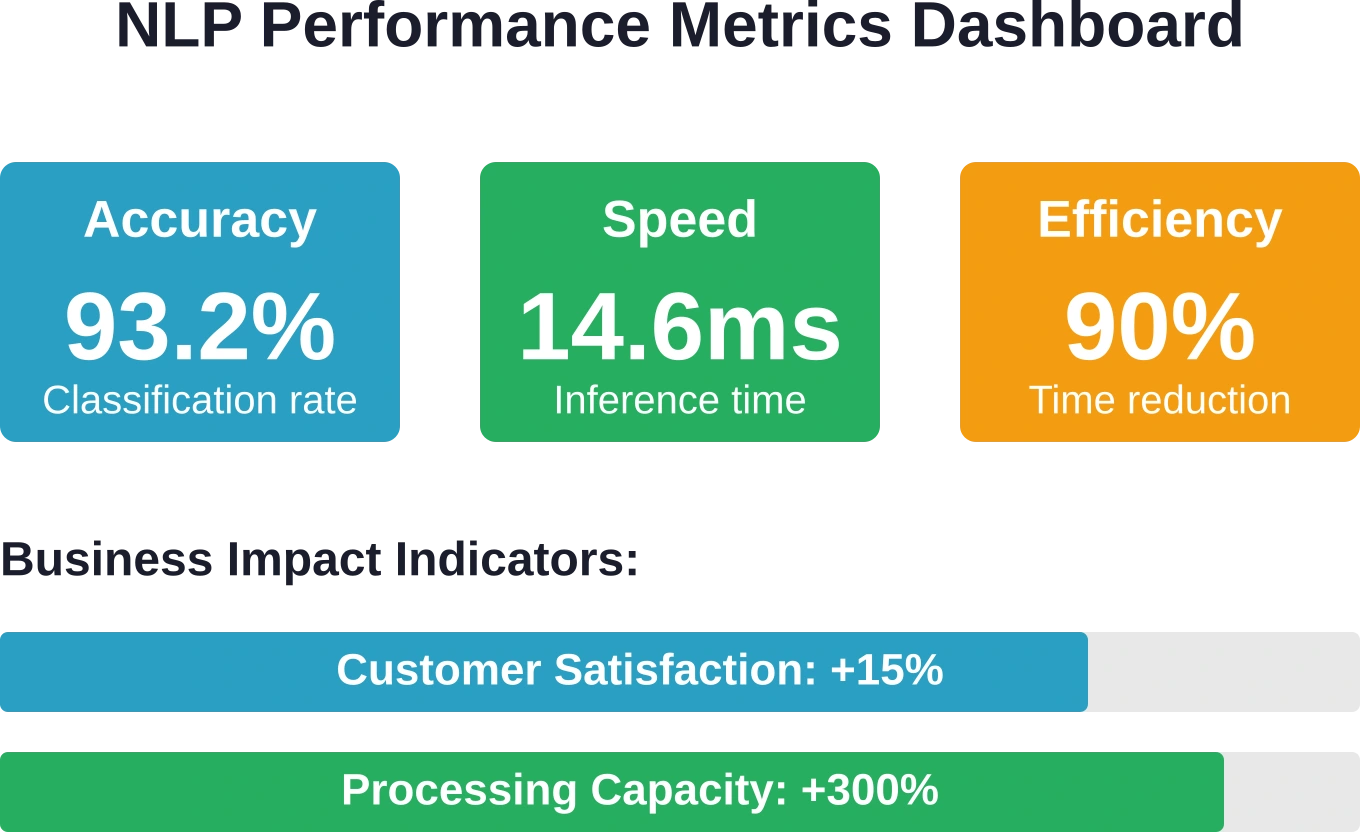
Time savings provide the most straightforward ROI calculation. Document processing time, customer inquiry resolution time, and manual analysis hours convert directly to cost savings when automated.
Volume metrics show scale impact. The number of documents processed, customer conversations handled, or contracts analyzed demonstrate capacity increases impossible with manual approaches.
Quality improvements appear in accuracy rates, consistency metrics, and error reduction. NLP classification accuracy, extraction precision, and routing correctness indicate whether automated systems perform comparably to human baselines.
Business Outcome Metrics
The ultimate impact appears in business outcomes rather than process metrics. Customer satisfaction scores, retention rates, revenue per customer, and time-to-resolution connect NLP capabilities to results that matter.
A customer service chatbot might handle 10,000 inquiries monthly, but the business impact is the improvement in customer satisfaction scores and the reduction in support costs per customer.
Organizations should track these outcome metrics before and after NLP implementation, isolating the impact from other changes when possible.
Continuous Improvement
NLP systems require ongoing monitoring and refinement. Language evolves, business contexts change, and new edge cases emerge. Model performance degrades without maintenance.
Regular retraining with new examples keeps models current. Monitoring dashboards track accuracy trends, error patterns, and edge cases requiring attention. Feedback loops connect user corrections back to training data, improving models continuously.
Future Trends in Business NLP
NLP capabilities continue advancing rapidly. Organizations planning implementations should consider emerging capabilities likely to become standard in the coming years.
Generative AI Integration
Large language models now generate human-quality text, not just analyze it. Business applications expand beyond understanding to creation—draft emails, summarize reports, generate product descriptions, create documentation.
This generative capability changes workflows. Instead of purely automated or purely manual processes, human-AI collaboration emerges. Systems generate drafts and suggestions; humans review, refine, and approve.
Multimodal Understanding
Business communication increasingly combines text, images, audio, and video. Future NLP systems process these modalities together rather than separately.
A customer support system might analyze call audio, screen share video, and chat transcript simultaneously, understanding the issue more completely than any single channel reveals. Marketing analysis might process social media posts including images, captions, and comments as unified content.
Low-Code NLP Tools
NLP implementation currently requires data science expertise. Emerging platforms democratize access with low-code interfaces enabling business users to build simple NLP applications without programming.
These tools lower barriers to experimentation and deployment for straightforward use cases, though complex applications still benefit from expert involvement.
Explainable AI
Black-box models create trust and compliance concerns. Explainable AI techniques reveal why models make specific predictions, showing which text features influenced classification decisions.
This transparency matters for regulated industries, high-stakes decisions, and debugging model errors. Organizations can validate that models use appropriate signals rather than spurious correlations.
Common Implementation Challenges
Organizations encounter predictable obstacles when deploying NLP applications. Anticipating these challenges enables better planning and risk mitigation.
Data Quality Issues
Real-world text data is messy. Typos, abbreviations, formatting inconsistencies, and incomplete entries all degrade model performance. Organizations often underestimate the effort required to clean and prepare training data.
Domain-specific terminology creates additional challenges. Industry jargon, product names, and company-specific language don’t appear in general-purpose training data. Models must learn this specialized vocabulary from business-specific examples.
Change Management
NLP implementations change workflows and job responsibilities. Employees may resist automation they perceive as threatening or may distrust algorithmic decisions over human judgment.
Successful deployments include change management addressing these concerns. Communication emphasizes augmentation rather than replacement, showing how automation eliminates tedious work while preserving human roles for complex judgment.
Managing Expectations
NLP capabilities get overhyped. Stakeholders sometimes expect perfect human-level understanding from initial deployments. Setting realistic accuracy expectations prevents disappointment.
Organizations should frame NLP as continuous improvement rather than one-time implementation. Initial accuracy may match or slightly trail human performance, but systems improve with feedback while maintaining consistency humans struggle to achieve.
Handling Edge Cases
No model handles every scenario correctly. Edge cases, unusual inputs, and novel situations will occur. Systems need graceful failure modes and escalation paths when confidence is low.
Human-in-the-loop design addresses this limitation. Uncertain predictions route to human reviewers rather than proceeding automatically. Over time, these edge cases enrich training data, teaching models to handle previously unfamiliar situations.
Frequently Asked Questions
What is the difference between NLP and traditional text analysis?
Traditional text analysis relies on keyword matching and simple pattern recognition. NLP understands context, intent, and meaning through machine learning models trained on language patterns. NLP recognizes that “not bad” expresses positive sentiment despite containing the negative word “bad,” while keyword analysis would incorrectly classify it as negative. NLP handles synonyms, ambiguity, and context in ways rule-based systems cannot.
How much training data does an NLP model need?
Required training data varies by task complexity and model architecture. Transfer learning approaches using pre-trained models like BERT can achieve good results with hundreds of labeled examples for simple classification tasks. Complex domain-specific applications may require thousands of labeled examples. The key is data quality and representativeness rather than pure volume—diverse examples covering edge cases matter more than redundant similar examples.
Can NLP handle multiple languages for global businesses?
Modern NLP models support dozens of languages, though performance varies by language. High-resource languages like English, Spanish, and Chinese have extensive training data and mature models. Lower-resource languages may require more customization. Multilingual models can process multiple languages with a single model, though language-specific models typically perform better for mission-critical applications. Organizations should evaluate model performance specifically for their target languages.
How long does NLP implementation typically take?
Implementation timelines range from weeks to months depending on complexity, data availability, and integration requirements. A simple sentiment analysis deployment using existing tools and clean data might complete in 4-6 weeks. Complex custom models requiring extensive training data collection, labeling, and enterprise system integration can take 4-6 months. Most business NLP projects fall in the 2-4 month range including data preparation, model development, testing, and deployment.
What are the ongoing costs of maintaining NLP systems?
Maintenance costs include infrastructure for model hosting and inference, data storage, monitoring systems, and periodic retraining. Cloud-based NLP services shift infrastructure costs to usage-based pricing. Organizations must also budget for periodic model updates as language and business contexts evolve. Typically, ongoing costs run 15-25% of initial implementation costs annually, though this varies significantly based on scale and complexity.
How do you ensure NLP models don’t perpetuate bias?
Bias mitigation starts with training data review, ensuring examples represent diverse populations and contexts without encoding stereotypes. Evaluation metrics should measure fairness across demographic groups, not just overall accuracy. Regular audits check for biased predictions in production. Diverse teams building NLP systems help identify potential bias issues. Organizations should establish clear policies for handling bias discoveries and commit to ongoing monitoring rather than treating it as a one-time check.
What accuracy rate should businesses expect from NLP applications?
Accuracy expectations depend on task difficulty and baseline human performance. Document classification often achieves 90-95% accuracy for well-defined categories. Sentiment analysis typically ranges from 80-90% depending on domain specificity and nuance required. Named entity extraction achieves 85-95% for common entity types. Organizations should benchmark against human performance on the same task—if trained employees achieve 85% agreement, expecting 95% from NLP is unrealistic. The key question is whether NLP accuracy meets business requirements, not whether it achieves perfection.
Conclusion
Natural Language Processing transforms business operations by automating text-intensive processes, extracting insights from unstructured data, and enhancing customer experiences at scale. The applications span customer service, operations, market intelligence, compliance, and human resources—essentially any business function dealing with human language.
Organizations that successfully implement NLP gain measurable advantages: reduced operational costs through automation, faster decision-making from real-time analysis, improved customer understanding from scaled qualitative feedback processing, and risk mitigation through consistent compliance monitoring.
The technology has matured beyond research projects into production-ready systems. Lightweight models like DistilBERT deliver strong performance with practical deployment requirements. Cloud platforms and pre-trained models lower implementation barriers. Business value is proven across industries.
But success requires more than technology selection. Organizations must invest in quality training data, customize models for business contexts, integrate with existing workflows, and maintain systems as language and business needs evolve. Change management addressing employee concerns and realistic accuracy expectations prevent disappointment.
The question is no longer whether NLP provides business value—evidence overwhelmingly confirms it does. The question is which applications deliver the highest impact for specific organizational needs and how to implement them effectively.
Organizations still relying entirely on manual text processing increasingly find themselves at competitive disadvantages as rivals leverage NLP for speed, scale, and insight. The time to explore NLP applications for your business context is now.
Start with a focused use case addressing a clear pain point, invest in data preparation and model customization, measure impact with concrete metrics, and expand from proven successes. That pragmatic approach builds NLP capability that delivers lasting competitive advantage.
 English
  German
  Arabic
  French
  Dutch
Dutch  Spanish