
Quick Summary: Text classification in AI is a natural language processing technique that automatically assigns predefined categories or labels to text data. Machine learning and deep learning models analyze textual content to sort documents, emails, social media posts, and customer feedback into organized groups, enabling businesses to process large volumes of unstructured text efficiently and extract actionable insights.
Every minute, millions of emails land in inboxes. Social media posts flood platforms. Customer reviews pile up faster than any human team can read them.
Text classification in artificial intelligence solves this problem by automatically sorting text into meaningful categories. It’s the technology behind spam filters, sentiment analyzers, chatbot intent detection, and content moderation systems.
But how does AI actually learn to categorize text? And what makes modern deep learning approaches so much more effective than earlier methods?
What Is Text Classification?
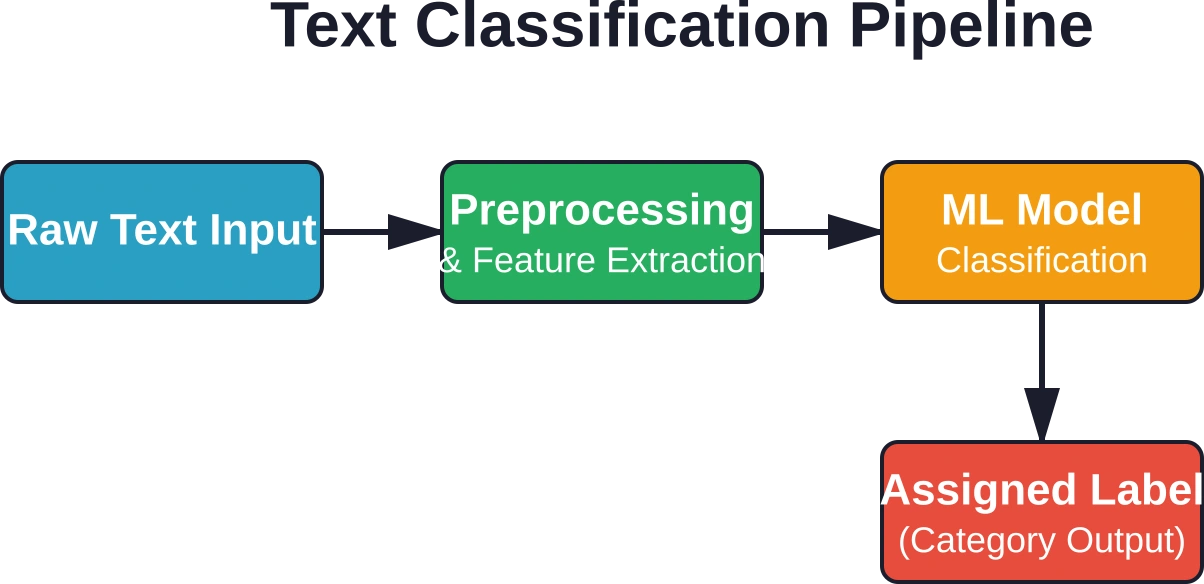
Text classification is the process of assigning predefined categories or labels to text data. As a core task in Natural Language Processing, it transforms raw textual information into structured, organized groups that machines can process and analyze.
The goal is straightforward: take a piece of text—a document, sentence, paragraph, or tweet—and automatically determine which category it belongs to. That category might be “spam” versus “not spam,” “positive” versus “negative” sentiment, or one of dozens of topic labels like “sports,” “politics,” or “technology.”
Unlike human reading, which relies on context and experience, AI text classification uses mathematical patterns learned from training data. Machine learning models identify features in text—word frequencies, sentence structures, semantic relationships—and map them to specific labels.
How It Differs From Other NLP Tasks
Text classification sits within a broader family of natural language processing techniques, but it’s distinct from tasks like named entity recognition (which identifies specific entities) or machine translation (which converts text between languages).
The key difference? Classification assigns discrete labels to entire text segments, rather than extracting information from within the text or transforming it into something else.
Why Text Classification Matters in AI
Businesses and platforms deal with exponentially growing volumes of unstructured text. Manual categorization doesn’t scale when handling millions of customer messages, support tickets, or social media mentions.
Text classification provides a powerful way to organize this chaos automatically. It enables organizations to extract actionable insights from massive text datasets, respond faster to customer needs, and automate repetitive decision-making tasks.
Real talk: without automated text classification, modern customer service platforms, email providers, and content moderation systems simply couldn’t function.
The Shift Toward Deep Learning
Traditional machine learning approaches—using algorithms like Naive Bayes, Support Vector Machines, or logistic regression—dominated text classification for years. These methods required manual feature engineering, where experts hand-crafted representations of text (like TF-IDF vectors or n-grams).
Deep learning changed everything. Neural networks, especially transformer-based models, learn rich text representations automatically during training. They capture context, semantic meaning, and subtle linguistic patterns that earlier methods missed entirely.
BERT revolutionized classification text structure by using bidirectional prediction—analyzing both previous and next tokens to understand the present one. The model also employs masked language modeling, masking 15% of inputted tokens during training to improve contextual understanding.
Core Methods for Text Classification
Text classification algorithms fall into three broad categories: rule-based systems, traditional machine learning, and deep learning approaches. Each has distinct strengths and appropriate use cases.
Rule-Based Classification
The simplest approach uses hand-crafted rules and keyword matching. If a document contains specific words or phrases, assign it a particular label.
Rule-based systems work well for narrow, well-defined categories where domain experts can articulate clear decision criteria. They’re transparent, fast, and require no training data.
But they don’t scale. Maintaining rule sets becomes unwieldy as categories multiply, and they fail to handle linguistic variation, synonyms, or context-dependent meaning.
Traditional Machine Learning
Classic algorithms treat text classification as a supervised learning problem. After converting text to numerical features (typically word frequencies or TF-IDF vectors), models learn statistical patterns that separate categories.
Common algorithms include Naive Bayes (fast and effective for many tasks), Support Vector Machines (powerful for high-dimensional text data), and logistic regression (interpretable and reliable).
These methods require labeled training data—examples of text already assigned to correct categories. The model learns from these examples, then predicts labels for new, unseen text.
| Algorithm | Strengths | Weaknesses |
|---|---|---|
| Naive Bayes | Fast training, works with small datasets, probabilistic output | Assumes feature independence, limited context understanding |
| Support Vector Machines | Effective in high dimensions, strong theoretical foundation | Slow on large datasets, sensitive to parameter tuning |
| Logistic Regression | Interpretable, efficient, reliable baseline | Linear decision boundaries, limited feature interactions |
| Random Forests | Handles non-linearity, robust to overfitting | Computationally expensive, harder to interpret |
Deep Learning for Text Classification
Neural network architectures learn hierarchical text representations, capturing everything from individual word meanings to document-level semantics.
Convolutional Neural Networks (CNNs) apply filters across text sequences, detecting local patterns like key phrases. Recurrent Neural Networks (RNNs) and Long Short-Term Memory (LSTM) networks process text sequentially, maintaining memory of earlier words.
Transformers—the architecture behind BERT, GPT, and similar models—currently dominate. They use attention mechanisms to weigh the importance of every word relative to every other word, creating rich contextual embeddings.
Here’s the thing though—transformers are short text classifiers that achieve state-of-the-art accuracy across benchmarks. Research confirms they often outperform specialized techniques, questioning whether task-specific architectures remain necessary.
Key Applications and Use Cases
Text classification powers dozens of real-world applications across industries. Some common examples include spam detection, sentiment analysis, topic labeling, intent detection, and content moderation.
Spam and Email Filtering
Email providers classify incoming messages as spam or legitimate mail. Classification algorithms analyze sender patterns, subject lines, message content, and embedded links to make this decision automatically.
Modern spam filters use ensemble methods combining multiple signals, achieving accuracy rates above 99% while minimizing false positives (legitimate email incorrectly marked as spam).
Sentiment Analysis
Businesses monitor customer sentiment by classifying reviews, social media posts, and survey responses as positive, negative, or neutral. This provides rapid insight into brand perception, product reception, and customer satisfaction trends.
Sentiment classification ranges from simple binary decisions (thumbs up or down) to fine-grained emotional categorization (joy, anger, sadness, surprise).
Topic Labeling and Content Categorization
News aggregators, content management systems, and digital libraries automatically tag articles and documents with topic labels. This enables better search, recommendation systems, and content organization.
The Reuters-21578 dataset, one of the most widely used collections for text categorization research, was collected from Reuters newswire and contains diverse topic categories.
Customer Support Automation
Intent classification determines what customers want from their messages—technical support, billing questions, product information, or account changes. Routing tickets to appropriate teams or triggering automated responses depends on accurate classification.
Chatbots use intent classification continuously, interpreting user messages to select relevant responses or actions.
Content Moderation
Platforms employ classification models to identify inappropriate content—hate speech, harassment, misinformation, adult content, or violent imagery descriptions. Human moderators review flagged content, but AI classification provides the first screening layer at scale.
| Application | Classification Type | Typical Categories |
|---|---|---|
| Email Filtering | Binary | Spam / Not Spam |
| Sentiment Analysis | Multi-class | Positive / Neutral / Negative |
| News Categorization | Multi-class | Politics / Sports / Business / Tech / etc. |
| Intent Detection | Multi-class | Question / Command / Complaint / Greeting |
| Content Moderation | Multi-label | Hate Speech / Violence / Adult / Misinformation |

Build Text Classification Systems With AI Superior
Text classification helps businesses sort and understand large volumes of written data without reviewing everything manually. AI Superior works with NLP, machine learning, LLM consulting, generative AI, AI chatbot development, data analytics, and custom AI software development. Their team considers text classification as an NLP solution for business automation and handling large volumes of unstructured text.
AI Superior can develop text classification tools for:
- Business documents and internal reports
- Emails, tickets, reviews, and customer messages
- NLP-based routing or categorization workflows
- LLM-supported search or assistant features
- Integration with existing platforms and data systems
👉Contact AI Superior to discuss text classification tools for your business documents, customer communication, or internal workflows.
Training Text Classification Models
Building effective classifiers requires quality training data, proper preprocessing, and careful model selection. The process follows several standard steps.
Dataset Preparation
Training begins with labeled examples—text samples already assigned correct categories. Dataset size matters: traditional ML often works with thousands of examples, while deep learning typically needs tens of thousands or more.
Several benchmark datasets support text classification research. The Stanford Sentiment Treebank (SST-2), available on Hugging Face, contains approximately 70,000 rows split into training (67.3k rows), validation (872 rows), and test (1.82k rows) sets for binary sentiment classification.
Labels must be balanced (roughly equal examples per category) or models develop bias toward majority classes. Class imbalance requires techniques like oversampling, undersampling, or weighted loss functions.
Text Preprocessing and Feature Engineering
Raw text rarely feeds directly into models. Preprocessing cleans and standardizes input through steps like lowercasing, removing punctuation, eliminating stop words, and stemming or lemmatization.
Traditional ML requires explicit feature extraction—converting text to numerical vectors. Common approaches include bag-of-words (word frequency counts), TF-IDF (term frequency-inverse document frequency weighting), and n-grams (sequences of adjacent words).
Deep learning models handle much of this automatically, using learned embeddings that map words to dense vector representations capturing semantic relationships.
Model Training and Evaluation
Split datasets into training, validation, and test sets. The model learns patterns from training data, tunes hyperparameters using validation performance, and reports final metrics on the held-out test set.
Standard evaluation metrics include accuracy (percentage of correct predictions), precision (of predicted positives, how many were correct), recall (of actual positives, how many were found), and F1 score (harmonic mean of precision and recall).
Cross-validation—repeatedly splitting data into different train/test combinations—provides more robust performance estimates, especially with limited data.
Challenges in Text Classification
Despite impressive progress, several challenges persist in building robust classification systems.
Ambiguity and Context Dependence
Language is inherently ambiguous. The same word carries different meanings in different contexts (“bank” as financial institution versus riverbank). Sarcasm, irony, and figurative language complicate sentiment classification.
Short texts, common in social media and customer messages, provide limited context for models to work with. A tweet’s meaning might depend on current events, cultural references, or conversational history not present in the text itself.
Domain Adaptation
Models trained on one domain (like product reviews) often perform poorly when applied to different domains (like medical records or legal documents). Vocabulary, writing style, and category definitions shift across domains.
Transfer learning—pretraining on large general corpora, then fine-tuning on domain-specific data—helps but doesn’t eliminate the gap entirely.
Multilingual and Low-Resource Languages
Most research focuses on English, leaving other languages underserved. Low-resource languages lack large labeled datasets, making training difficult.
Multilingual models like mBERT attempt to handle multiple languages simultaneously, but performance still trails language-specific models trained on abundant data. Benchmark datasets exist for some non-English languages, such as the Dengue Dataset in Filipino with 4,015 training examples, 500 testing examples, and 500 validation examples for low-resource multiclass classification.
Evolving Language and Concept Drift
Language changes constantly. New slang, abbreviations, and terminology emerge. Events create new entities and topics. Models trained on historical data gradually become outdated as the distribution of text shifts.
Continuous retraining and model updates are necessary to maintain performance over time.
NIST GenAI Text Classification Evaluation
Government initiatives evaluate AI text classification capabilities, particularly distinguishing AI-generated content from human-written text. The NIST GenAI Text-to-Text evaluation series supports research in generative AI detection.
This evaluation series measured which generative AI models produce synthetic content capable of deceiving discriminators and humans, while also testing discriminative models’ ability to detect AI-generated text.
NIST GenAI evaluation series includes multiple rounds of submissions and evaluations.
Such standardized evaluations help advance safe and trustworthy AI by establishing benchmarks for text classification and generation capabilities.
Implementing Text Classification: Practical Considerations
Organizations considering text classification need to evaluate several factors before deployment.
Build Versus Use Pre-trained Models
Building custom models from scratch requires significant data science expertise, computational resources, and training data. For many applications, fine-tuning pre-trained models offers a faster path to production.
Pre-trained transformers, available through platforms like Hugging Face, come already trained on massive text corpora. Fine-tuning adapts them to specific tasks with far less labeled data than training from scratch.
Compute and Infrastructure Requirements
Training large deep learning models demands substantial computational power—typically GPUs or TPUs running for hours or days. Inference (making predictions on new text) is lighter but still resource-intensive at scale.
Cloud platforms provide managed machine learning services that handle infrastructure complexity. For low-volume applications, pre-trained API services (from providers like Google Cloud, AWS, or Azure) eliminate model management entirely.
Monitoring and Maintenance
Deployed models require ongoing monitoring. Track prediction confidence scores, watch for declining accuracy, and collect user feedback on misclassifications.
Active learning strategies identify uncertain predictions for human review, creating new labeled data that improves the model through retraining cycles.
FAQ
What’s the difference between text classification and text clustering?
Text classification assigns predefined labels from a fixed set of categories—the categories exist before analyzing the text. Text clustering groups similar documents together without predefined categories, discovering natural groupings in the data. Classification is supervised learning (requires labeled training data), while clustering is unsupervised (works on unlabeled data).
How much training data do I need for text classification?
Traditional machine learning algorithms can work with hundreds to thousands of labeled examples per category. Deep learning models typically need tens of thousands of examples for training from scratch. However, fine-tuning pre-trained transformers often achieves strong performance with just hundreds of examples per class, since the model already understands general language patterns.
Can text classification handle multiple languages?
Yes, but with varying effectiveness. Multilingual models like mBERT, XLM-RoBERTa, and similar architectures support dozens of languages in a single model. Performance is strongest for high-resource languages with abundant training data (English, Spanish, French, Chinese) and weaker for low-resource languages. Language-specific models typically outperform multilingual ones when sufficient training data exists.
What’s the difference between multi-class and multi-label classification?
Multi-class classification assigns exactly one label from multiple possible categories (a news article is either “sports” or “politics” or “business,” but not multiple simultaneously). Multi-label classification allows assigning multiple labels to the same text (a movie review might be tagged as both “romantic” and “comedy”). Multi-label requires different model architectures or output layers that treat each label as an independent binary decision.
How do I handle imbalanced datasets where some categories have far more examples?
Several techniques address class imbalance. Oversample minority classes by duplicating examples or generating synthetic samples. Undersample majority classes by randomly removing examples. Apply class weights that penalize misclassifying minority classes more heavily during training. Use evaluation metrics like F1 score or area under the ROC curve that account for imbalance, rather than raw accuracy which can be misleading.
What accuracy should I expect from a text classifier?
It depends heavily on the task complexity, data quality, and chosen approach. Simple binary classification (like spam detection) often achieves 95-99% accuracy with modern methods. Multi-class problems with many similar categories or limited training data might see 70-85% accuracy. State-of-the-art transformer models reach 90-96% on standard benchmarks, but real-world performance varies based on domain-specific challenges.
How can I explain why my model made a specific classification decision?
Model interpretability remains challenging, especially for deep learning. Techniques include attention visualization (showing which words the model focused on), LIME or SHAP (explaining individual predictions by testing perturbations), and feature importance scores. Simpler models like logistic regression offer more transparent decision-making through interpretable coefficients. The trade-off between accuracy and interpretability often drives model selection—transparent models for regulated industries, black-box models for maximum performance.
Conclusion
Text classification in artificial intelligence has evolved from simple rule-based systems to sophisticated deep learning models that rival human performance on many tasks. It enables organizations to process massive volumes of text automatically, extracting structure and insights from unstructured data.
The shift toward transformer-based architectures continues to push accuracy higher while requiring less task-specific engineering. Pre-trained models democratize access, allowing teams with limited machine learning expertise to deploy effective classifiers through fine-tuning.
Challenges remain—handling domain shifts, supporting low-resource languages, managing ambiguity, and maintaining performance as language evolves. But the core technology is mature, battle-tested, and ready for production deployment across countless applications.
Whether filtering spam, analyzing customer sentiment, routing support tickets, or moderating content, text classification provides the foundation for making sense of the text data deluge facing modern organizations. Understanding how these systems work, their capabilities, and their limitations is essential for anyone building AI-powered applications that process language.
 English
  German
  Arabic
  French
  Dutch
Dutch  Spanish