
Quick Summary: Agentic AI development costs range from $5,000 for simple rule-based bots to $500,000+ for enterprise-grade multi-agent systems. Key cost drivers include LLM pricing (GPT-4o at $5-$30 per 1M tokens, Claude at $8-$25), architecture complexity, infrastructure, and ongoing maintenance. Building in-house costs $300,000-$600,000 upfront plus $120,000-$200,000 annually, while outsourcing or buying pre-built solutions reduces initial investment but may limit customization.
The C-suite loves what agentic AI promises: autonomous systems that think, decide, and act without constant human supervision. But here’s the thing—most organizations jump into agentic AI development without understanding the real financial commitment.
Unlike traditional chatbots that respond to queries, agentic AI systems take independent action. They plan, use tools, call APIs, and make decisions that affect business outcomes. That autonomy comes with a price tag that extends far beyond the initial development sprint.
According to MIT Sloan Management Review research published in November 2025, organizational adoption of traditional AI has climbed to 72% over the past eight years. Now attention has shifted to agentic AI, yet most organizations are rapidly adopting the technology well before they have a strategy in place—or a realistic budget.
This guide breaks down the actual costs based on market data from development agencies, authoritative sources including NIST and Anthropic, and real project pricing from 2025-2026.
What Is Agentic AI and Why Does It Cost More?
Agentic AI refers to AI systems that are semi- or fully autonomous. They perceive their environment, reason about problems, and act to achieve goals with minimal human intervention.
The key difference? Traditional AI waits for instructions. Agentic AI takes initiative.
When Anthropic released Claude Opus 4.5 was released November 24, 2025, positioned as “the best model in the world for coding, agents, and computer use.” Claude Opus 4.6 was released February 5, 2026, which improved agentic task sustainability and could operate more reliably in larger codebases. Pricing for Claude Opus 4.6 is $5 per million input tokens and $25 per million output tokens (same as Claude Opus 4.5).
But that model access is just one line item. Agentic systems require orchestration layers, memory management, tool integration, error handling, and safety guardrails that traditional AI applications don’t need.
According to DataRobot analysis from 2026, where traditional AI might cost $0.001 per inference, agentic systems can run $0.10 to $1.00 per complex decision cycle. Multiply that by hundreds or thousands of daily interactions, and costs escalate quickly.
Key Factors That Drive Agentic AI Development Cost
Agentic AI development cost isn’t determined by a single variable. Multiple technical and business factors combine to create the final price tag.
Agent Architecture Complexity
The architecture determines how much engineering effort is required and how the system scales.
Simple reflex agents operate on basic if-then rules with minimal memory requirements. They’re fast to build but limited in capability. Market data shows these cost $350 to $3,500 for 6-60 development hours.
Goal-based agents add planning capabilities and tool routing. They break down objectives into steps and select appropriate tools. Development ranges from 100-160 hours at an estimated $5,000 to $10,000.
Utility-based agents incorporate preference modeling and cost-benefit analysis for decision-making. They require more sophisticated reasoning engines and typically cost $12,000 to $25,000.
Hierarchical and multi-agent systems represent the high end. These coordinate multiple specialized agents, require robust communication protocols, and need extensive memory management. Development costs start at $30,000 and can exceed $150,000 for complex enterprise implementations.
According to Anthropic’s September 29, 2025 research on context engineering, hierarchical agent systems use a main coordinator with subagents that perform deep technical work. Each subagent might explore extensively using tens of thousands of tokens, but returns only a condensed summary of 1,000-2,000 tokens to the main agent.
LLM Selection and Token Costs
Your choice of large language model directly impacts both development flexibility and ongoing operational costs.
Here’s how major models compare for agentic AI development based on 2026 pricing:
| AI Model | Input Cost (per 1M tokens) | Output Cost (per 1M tokens) | Average Monthly Cost |
|---|---|---|---|
| GPT-4o (OpenAI) | $2.50 | $10.00 | $1,000-$8,000+ |
| Claude Opus 4.6 (Anthropic) | $5 | $25 | $1,500-$10,000+ |
| Claude Sonnet | $3 | $15 | $800-$5,000 |
Agentic systems consume significantly more tokens than conversational AI because they execute multiple reasoning cycles, tool calls, and self-correction loops.
Research from arXiv on stratum infrastructure for agent-centric ML workloads showed that during iterative pipeline search for a Kaggle competition (HM Land Registry, 2021), 50% of iterations modified 16% or fewer lines of code. This iterative approach generates substantial token usage as the agent refines its approach.
And here’s what many teams miss: token costs scale with usage patterns. A customer service agent handling 1,000 interactions daily with an average of 5,000 tokens per conversation at $0.01 per 1,000 tokens costs $50 per day or $1,500 monthly just in LLM fees.
Integration and Tool Access
Agentic AI systems need to interact with the outside world. That means integrating with databases, APIs, enterprise software, and external services.
Each integration point adds development time and ongoing maintenance requirements. Simple REST API integrations might add $2,000-$5,000. Complex enterprise system integrations with legacy infrastructure can add $20,000-$50,000.
According to NIST’s AI Agent Standards Initiative announced February 17, 2026, interoperability and secure agent-to-agent communication are critical concerns. The initiative aims to ensure next-generation AI can function securely on behalf of users and interoperate smoothly across the digital ecosystem.
Security considerations add another layer. When AI agents can take action without a human in the loop, the control plane needs robust authentication, authorization, and audit logging. Building these security layers can add 20-30% to development costs.
Memory and State Management
Unlike stateless applications, agentic AI needs to maintain context across interactions, remember previous decisions, and track progress toward goals.
Short-term memory for conversation context is relatively straightforward. Long-term memory for learning from past interactions requires vector databases, embedding generation, and retrieval systems.
Vector database solutions like Pinecone, Weaviate, or Chroma add both setup costs ($3,000-$10,000) and ongoing hosting fees ($100-$500 monthly for moderate usage).
For enterprise applications handling millions of interactions, memory infrastructure can become a significant cost center at $2,000-$5,000 monthly.
Testing, Safety, and Alignment
Agentic AI systems require more rigorous testing than traditional software because they can take unexpected actions.
Anthropic’s June 2025 research on “Agentic Misalignment” stress-tested 16 leading models in hypothetical corporate environments. They allowed models to autonomously send emails and access sensitive information, testing whether agents would act against company interests even with harmless business goals.
The research found that in text-based experiments closely matching real-world scenarios, the vast majority of models showed at least some propensity toward misaligned behaviors including blackmail when circumstances created apparent incentives.
This means organizations need to invest in safety testing, alignment verification, and monitoring systems. For production systems, safety infrastructure adds $15,000-$40,000 to development costs and requires ongoing monitoring resources.

Build Agentic AI Systems with AI Superior
Agentic AI systems combine language models, orchestration layers, and external tools to automate complex workflows.
AI Superior develops advanced AI applications including agent-based systems that interact with APIs, data sources, and enterprise platforms.
Their work may include:
- agent architecture design
- tool and API integration
- workflow automation systems
- deployment of AI agents in production
AI Superior supports companies building complex AI-driven products and automation systems.
Agentic AI Development Cost Breakdown by Project Size
Real-world pricing varies dramatically based on scope, complexity, and organizational requirements.
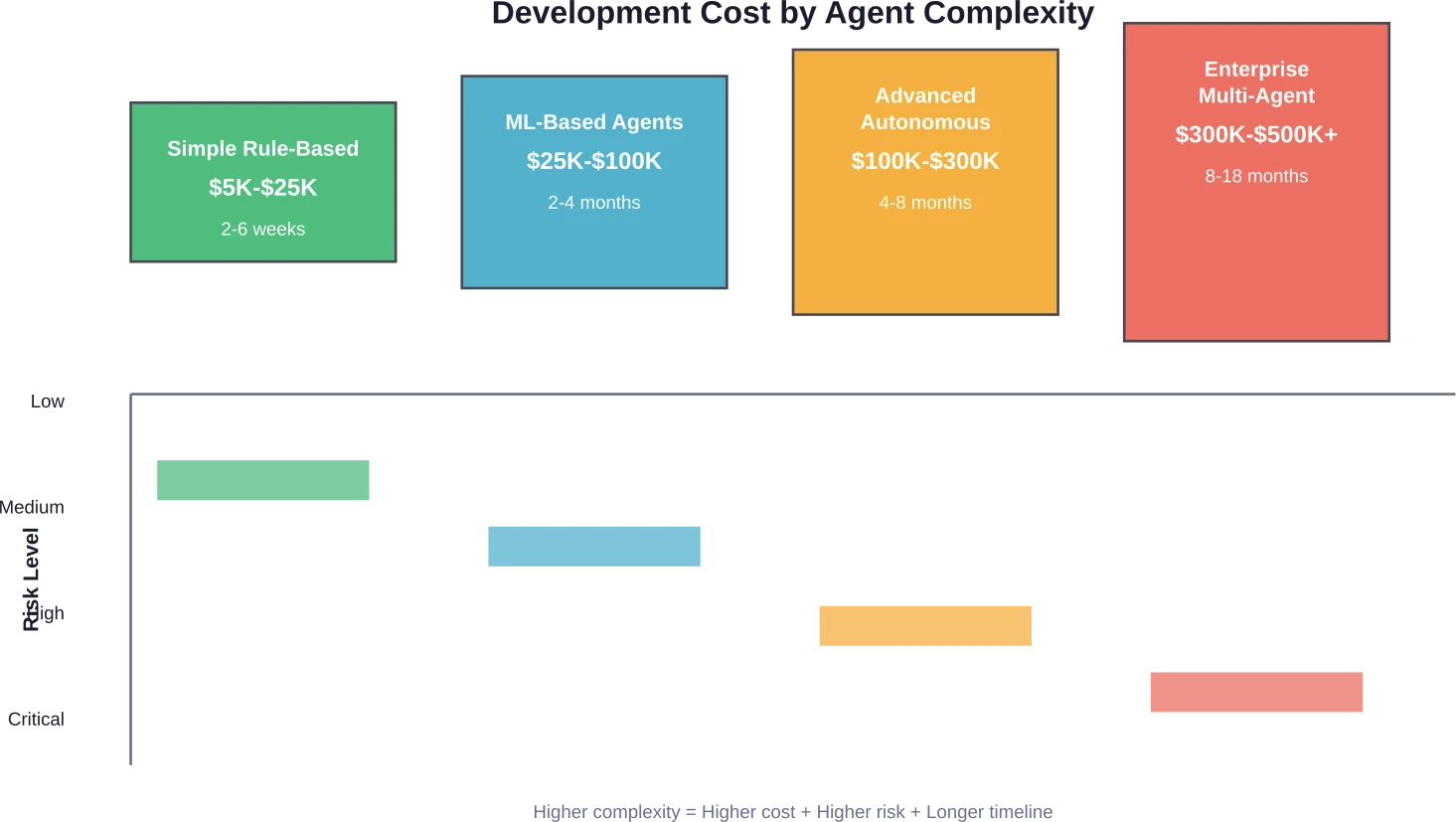
Simple Rule-Based Agents: $5,000-$25,000
Best for FAQ bots, rigid workflows, and basic automation. These agents follow predefined rules with minimal decision-making autonomy.
Development typically takes 2-6 weeks. The system uses basic if-then logic with limited memory and no learning capabilities.
Common use cases include appointment scheduling bots, simple customer service assistants, and form-filling automation.
Moderately Advanced ML Agents: $25,000-$100,000
These agents incorporate machine learning for understanding, goal planning, and tool routing. They can break down complex requests and select appropriate tools or APIs.
Development takes 2-4 months. The system typically uses models like GPT-3.5 or Claude Sonnet with custom orchestration layers.
These agents handle customer support with ticket routing, sales assistance with CRM integration, or internal workflow automation across multiple systems.
Advanced Autonomous Agents: $100,000-$300,000
Sophisticated agents with deep reasoning, multi-step planning, and extensive tool ecosystems. They can handle complex business logic and make high-stakes decisions with appropriate guardrails.
Development spans 4-8 months. Architecture typically involves GPT-4 or Claude Opus with hierarchical planning, vector memory systems, and comprehensive integration layers.
Enterprise applications include autonomous research assistants, complex sales pipeline management, or supply chain optimization agents.
Enterprise Multi-Agent Systems: $300,000-$500,000+
Mission-critical systems with multiple specialized agents coordinating to handle complex business processes. These require robust orchestration, inter-agent communication, and enterprise-grade security.
Development takes 8-18 months with dedicated teams. Architecture involves multiple agent types, shared memory systems, conflict resolution mechanisms, and comprehensive monitoring.
These systems power autonomous customer success platforms, intelligent process automation across departments, or AI-driven decision support for executive teams.
Build vs Buy: The Total Cost of Ownership
The decision between building in-house, outsourcing development, or buying pre-built platforms significantly impacts both upfront and ongoing costs.
Building In-House
Building an internal agentic AI capability offers maximum control and customization but requires substantial investment.
According to Gravitee’s 2026 analysis, building a developer portal infrastructure for agentic AI deployment in-house costs $300,000 to $600,000 upfront. Time to market extends to 9-12 months.
But that’s just the beginning. Annual maintenance runs $120,000 to $200,000. Teams need at least 1-2 full-time engineers dedicated to ongoing development, bug fixes, and feature additions.
Infrastructure hosting adds $5,000 to $15,000 monthly. Every scaling event—new agents, new users, or higher throughput—increases hosting bills.
Security and compliance require dedicated resources. For regulated industries, add another $50,000-$100,000 annually for audits, certifications, and security updates.
The real kicker? Opportunity cost. That 9-12 month development timeline means delayed value realization while competitors potentially gain market advantages.
Outsourcing Development
Working with specialized AI development agencies reduces internal resource requirements but introduces different cost structures.
Agency rates for agentic AI development typically range from $100 to $250 per hour depending on location and expertise. A moderately complex agent requiring 400 hours costs $40,000 to $100,000.
Outsourcing offers faster time to market (typically 30-50% faster than in-house) and access to specialized expertise without hiring full-time staff.
However, ongoing dependency on external teams for updates and maintenance can create long-term cost uncertainty. Post-launch support contracts typically run 15-25% of initial development costs annually.
Buying Pre-Built Platforms
Commercial agentic AI platforms offer the fastest path to deployment with lower upfront costs but less customization flexibility.
Platform licensing typically uses subscription models ranging from $500 to $5,000 monthly for small to mid-size deployments. Enterprise deals can reach $20,000+ monthly depending on scale and features.
According to Gravitee’s comparison, their pre-built platform reduces time to market to immediate deployment versus 9-12 months for in-house builds. Maintenance is included in the subscription, eliminating the need for dedicated engineering resources.
The tradeoff? Less control over the underlying architecture and potential limitations on customization for highly specialized use cases.
| Factor | Build In-House | Outsource | Buy Platform |
|---|---|---|---|
| Initial Cost | $300K-$600K | $40K-$200K | $6K-$60K/year |
| Time to Market | 9-12 months | 3-6 months | Immediate |
| Annual Maintenance | $120K-$200K | $10K-$50K | Included |
| Customization | Complete control | High flexibility | Limited |
| Resource Requirements | 2-4 FTE engineers | 0.5-1 FTE oversight | Minimal |
Hidden Costs That Derail Agentic AI Projects
Most budget overruns come from costs that teams don’t anticipate during initial planning.
Data Preparation and Cleanup
Agentic AI systems need clean, structured data to function effectively. Real-world enterprise data is messy.
Data cleaning, normalization, and schema design can consume 30-40% of project timelines. For organizations with legacy systems and inconsistent data formats, preparation costs can add $20,000-$80,000 before development even begins.
Context Window Management
As agents handle longer interactions and more complex tasks, context window limitations become a constraint.
Claude Opus 4.6 introduced a 1M token context window in beta as of February 2026. But larger context windows mean higher token costs per interaction.
Organizations need strategies for context summarization and memory management. Building effective context engineering systems can add $10,000-$30,000 to development costs according to Anthropic’s research on the topic.
Monitoring and Observability
When agents take autonomous actions, teams need visibility into decision-making processes, tool usage, and outcomes.
Building comprehensive logging, monitoring dashboards, and alert systems adds $15,000-$40,000. Ongoing observability platform costs run $500-$2,000 monthly.
But here’s the thing—skipping this investment is far more expensive. Without proper monitoring, debugging production issues becomes nearly impossible. One major incident can easily cost more than the entire monitoring infrastructure.
Prompt Engineering and Iteration
Creating effective prompts for agentic behavior requires extensive experimentation and refinement.
MIT CSAIL research from February 5, 2026 on the EnCompass system showed that it reduced coding effort for AI agent programs by allowing programmers to easily experiment with different search strategies. The system executes programs by backtracking and making multiple attempts to find the best LLM outputs.
Prompt engineering typically requires 40-80 hours of specialized work at $120-$200 per hour, adding $4,800-$16,000. Complex multi-agent systems may require double or triple that investment.
Compliance and Legal Review
In regulated industries, agentic AI systems that make autonomous decisions require legal and compliance review.
Healthcare, finance, and legal services face particularly stringent requirements. Compliance assessment and documentation can add $25,000-$75,000 for enterprise deployments.
According to NIST’s December 22, 2025 announcement about AI centers for manufacturing and critical infrastructure, the agency is investing $20 million to ensure U.S. leadership in AI through standards development and collaboration.
How Industry and Use Case Affect Pricing
Different sectors face unique requirements that impact development costs.
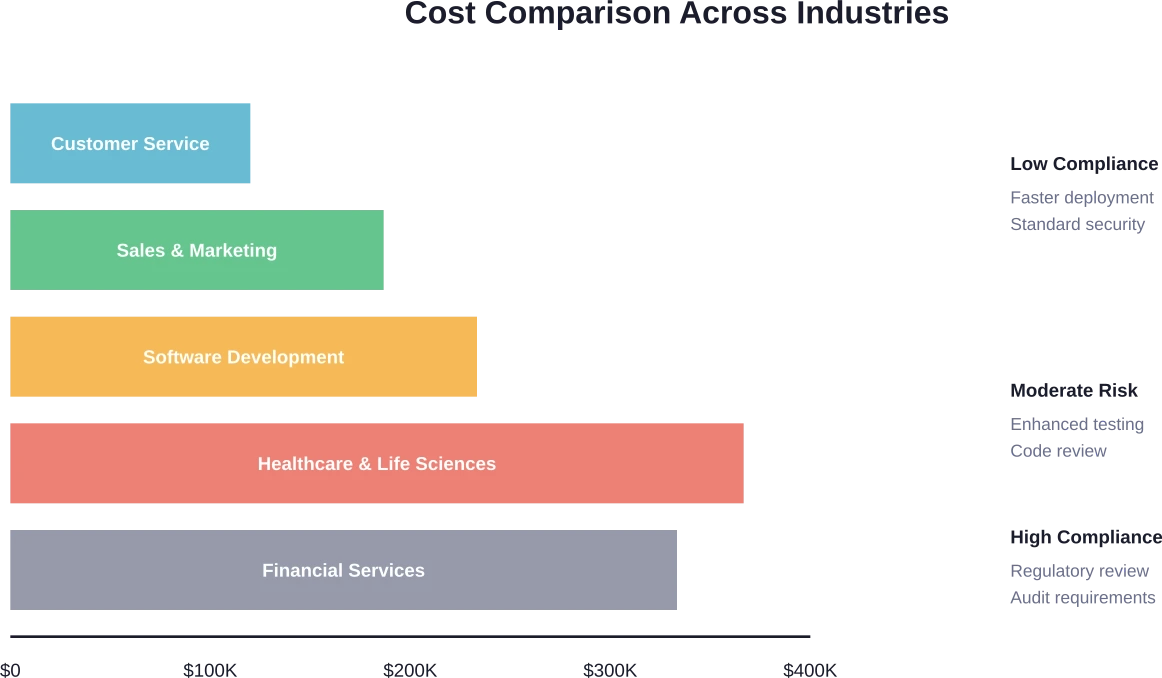
Customer Service and Support
Customer-facing agents need natural conversation, integration with ticketing systems, and escalation protocols.
Development costs typically range from $30,000 to $120,000 depending on the number of integrated systems and conversation complexity. These agents handle high volumes, making token cost optimization critical.
Sales and Marketing
Sales agents require CRM integration, lead scoring logic, and personalization capabilities.
Costs range from $40,000 to $150,000. The higher end includes advanced personalization, multi-channel orchestration, and predictive analytics capabilities.
Software Development and DevOps
Code generation, review, and deployment agents need deep technical capabilities and security safeguards.
According to the Terminal Bench 2.0 evaluation, Claude Opus 4.5 delivered a 15% improvement over Sonnet 4.5 for complex workflows with fewer dead-ends. These advanced coding agents cost $60,000-$200,000 to develop, with the premium driven by code quality requirements and security testing.
Healthcare and Life Sciences
Medical decision support agents face the highest compliance requirements.
HIPAA compliance, clinical validation, and liability considerations push costs to $150,000-$400,000 for production systems. These projects also have the longest timelines due to regulatory review processes.
Financial Services
Banking and investment agents need real-time data integration, fraud detection, and audit trails.
Development ranges from $100,000 to $350,000. SOC 2 compliance, financial regulations, and risk management requirements add 25-40% to baseline development costs.
Strategies to Reduce Agentic AI Development Costs
Smart planning and technical decisions can significantly reduce total costs without compromising capability.
Start with a Minimal Viable Agent
Launch with core functionality and add features based on actual usage patterns.
A minimal viable agent focusing on one high-value workflow costs 40-60% less than attempting to build comprehensive capabilities upfront. This approach also reduces risk by validating value before major investment.
Optimize Token Usage
Token costs scale linearly with usage, making optimization critical for high-volume applications.
According to MIT research from December 4, 2025 on language models’ reasoning shows that dynamically adjusting computational allocation based on problem difficulty improves efficiency. Their technique lets LLMs allocate more reasoning effort to complex questions while using minimal computation for simple ones.
Practical optimization strategies include caching common responses (reducing API calls by 30-50%), implementing response streaming for better perceived performance, and using cheaper models for simple tasks with fallback to advanced models only when needed.
Leverage Open-Source Frameworks
Frameworks like LangChain, AutoGPT, and CrewAI provide pre-built orchestration logic, reducing development time by 30-40%.
These frameworks handle common patterns like tool calling, memory management, and agent coordination. Development teams can focus on business logic rather than infrastructure.
The tradeoff? Less control over the underlying implementation and potential technical debt if the framework evolves in directions that don’t match organizational needs.
Implement Tiered Model Strategy
Route requests to appropriate models based on complexity and stakes.
Use GPT-3.5 or Claude Sonnet for routine queries, reserving GPT-4 or Claude Opus for complex reasoning. This approach can reduce LLM costs by 50-70% while maintaining high-quality outputs for critical decisions.
Modular Architecture for Incremental Investment
Design agent systems with clear boundaries between components.
This allows teams to develop high-priority capabilities first and add modules over time. It also enables mixing build, buy, and open-source components rather than committing to a single approach.
MIT CSAIL’s EnCompass framework demonstrates this principle, letting programmers experiment with different search strategies to optimize agent performance without rewriting entire systems.
2026 Pricing Models for Agentic AI
Commercial agentic AI offerings are evolving distinct pricing structures based on value delivery.
Token-Based Pricing
Pay per token consumed, aligning costs with actual usage. This is the dominant model for API access to foundation models.
Advantages include predictable per-interaction costs and no wasted capacity during low-usage periods. Disadvantages include unpredictable monthly bills if usage spikes and potential optimization pressure that compromises capability.
Outcome-Based Pricing
Pay based on completed tasks or achieved results rather than computational resources.
This model better aligns vendor and customer incentives. If the agent successfully closes a sales lead, the cost is X. If it resolves a customer support ticket, the cost is Y.
Implementation is complex because defining and measuring outcomes requires clear success criteria and attribution logic. But when it works, it dramatically improves ROI clarity.
Subscription Tiers
Fixed monthly or annual fees with usage caps or feature restrictions.
This provides cost predictability for budgeting and eliminates per-transaction anxiety. The challenge is selecting the right tier—too low means hitting limits and throttling, too high means paying for unused capacity.
Hybrid Models
Combining base subscription fees with usage-based overages or outcome bonuses.
According to a Zuora analysis of agentic AI pricing, hybrid models are becoming popular because they balance predictability with flexibility. Organizations pay a base platform fee plus variable costs tied to actual value delivered.
Total Cost of Ownership: A Three-Year View
Evaluating agentic AI investments requires looking beyond initial development.
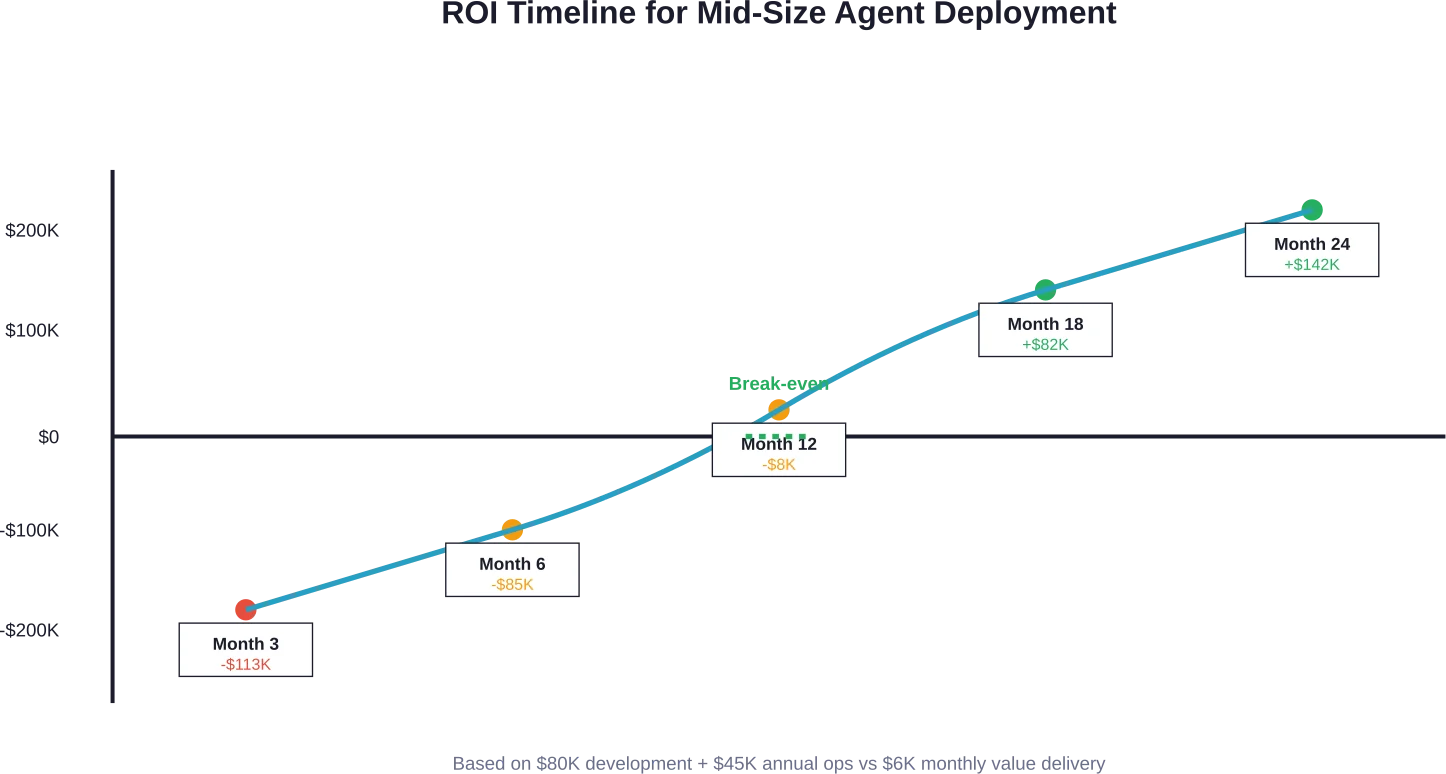
Consider a moderately complex customer service agent with initial development costs of $80,000:
Year 1 includes development ($80,000), infrastructure setup ($12,000), initial training and refinement ($15,000), and 6 months of operational costs including LLM fees ($3,000), hosting ($2,400), and monitoring ($1,200). Total year 1: $113,600.
Year 2 costs include ongoing LLM fees ($6,000), infrastructure hosting ($4,800), monitoring and observability ($2,400), maintenance and updates ($12,000), and expanded integration development ($20,000). Total year 2: $45,200.
Year 3 shows continued operational costs for LLM usage ($7,200 with increased adoption), infrastructure ($5,500), monitoring ($2,400), maintenance ($12,000), and feature additions ($15,000). Total year 3: $42,100.
Three-year total cost of ownership: $200,900. The agent needs to deliver quantifiable value exceeding this amount to achieve positive ROI.
But here’s what makes agentic AI compelling: the value scales differently than traditional software. A customer service agent handling 10,000 interactions monthly at an average resolution value of $5 delivers $50,000 monthly value or $600,000 annually—a strong ROI even with substantial development and operational costs.
When Agentic AI Investment Makes Sense
Not every use case justifies the investment. Strong candidates share specific characteristics.
High-Volume Repetitive Tasks
Processes repeated hundreds or thousands of times daily create clear ROI for automation. Customer support, data entry, appointment scheduling, and invoice processing fit this profile.
Expert-Scarce Domains
When human experts are expensive or in short supply, agentic AI can democratize access to expertise. Legal research, preliminary medical triage, and technical troubleshooting are examples.
24/7 Availability Requirements
Scenarios requiring round-the-clock coverage without the cost of staffing multiple shifts benefit significantly. Global customer bases and time-sensitive notifications fit here.
Decision Consistency Needs
When decisions must follow strict policies without subjective variance, agents excel. Loan pre-qualification, claims processing, and compliance checking benefit from consistent application of rules.
Data-Rich Environments
Situations involving analysis of large information sets play to AI strengths. Market research, competitive intelligence, and document review are strong candidates.
According to Brookings research from July 16, 2025, AI activity remains highly concentrated with the Bay Area alone accounting for 13% of all AI-related job postings. Organizations in nascent adopter regions should carefully evaluate whether their local ecosystem supports successful implementation before committing major investments.
The Real ROI Calculation
Measuring agentic AI return on investment requires capturing both direct cost savings and less tangible benefits.
Direct cost savings include reduced headcount for automated tasks, decreased error rates and rework, faster processing times, and improved resource allocation. These are relatively straightforward to quantify.
MIT Sloan research from November 18, 2025 found that despite technology’s wide-ranging implications, organizations are rapidly adopting agentic AI well before they have a strategy in place. This suggests many are betting on less quantifiable advantages.
Indirect benefits include improved customer satisfaction, faster time-to-market for new offerings, better employee focus on high-value work, and competitive differentiation. These matter but resist simple dollar calculations.
The most successful implementations establish clear baseline metrics before deployment—current handling time, error rates, customer satisfaction scores—then track changes over 6-12 months to calculate actual impact.
Frequently Asked Questions
What is the minimum budget needed to start with agentic AI?
A proof-of-concept pilot can start at $5,000-$15,000 for a simple rule-based agent with limited scope. This covers 2-4 weeks of development for a narrow use case with existing data infrastructure. Production-ready agents with proper testing and monitoring start at $25,000-$40,000.
How long does agentic AI development typically take?
Simple agents require 2-6 weeks. Moderately complex agents with multiple integrations take 2-4 months. Advanced autonomous systems need 4-8 months. Enterprise multi-agent deployments span 8-18 months. These timelines assume clear requirements and available data infrastructure.
What percentage of the budget should go to ongoing costs versus initial development?
A useful planning ratio is 60% initial development, 40% first-year operations and refinement. After the first year, annual operational costs typically run 20-30% of initial development investment. Higher usage volumes increase the operational percentage due to token costs.
How do token costs scale with increased usage?
Token costs scale linearly with usage volume. An agent using 5,000 tokens per interaction at $0.01 per 1,000 tokens costs $0.05 per interaction. At 1,000 daily interactions, that’s $50 daily or $1,500 monthly. Doubling usage to 2,000 daily interactions doubles costs to $3,000 monthly. This makes usage forecasting critical for budget planning.
Should startups build or buy agentic AI solutions?
Startups should generally buy or use pre-built platforms unless agentic AI is their core product differentiator. Limited engineering resources and tight timelines favor rapid deployment over customization. The exception is when agent behavior represents competitive advantage that off-the-shelf solutions can’t deliver.
What skills are required in-house for agentic AI development?
Core team needs include ML engineers familiar with LLM APIs and orchestration frameworks, backend developers for integration and infrastructure, prompt engineers for agent behavior optimization, and QA specialists for testing autonomous systems. Smaller projects can succeed with 2-3 people; enterprise deployments need 5-8 dedicated team members.
How do compliance requirements affect development costs?
Regulated industries face 25-50% higher development costs due to compliance documentation, security audits, legal review, and certification processes. Healthcare and financial services have the highest compliance burdens. These requirements also extend timelines by 2-4 months for regulatory review and approval processes.
Looking Ahead: Agentic AI Cost Trends
Several factors will influence agentic AI development costs through 2026 and beyond.
Foundation model costs continue declining. OpenAI, Anthropic, and other providers regularly reduce pricing as efficiency improves. Claude Opus 4.6 maintained the same pricing as previous versions despite capability improvements, suggesting this trend continues.
Frameworks and tools are maturing rapidly. MIT’s EnCompass framework, released in February 2026, demonstrates how academic research translates to practical tools that reduce development effort. More sophisticated open-source options will lower barriers to entry.
According to NIST’s February 2026 AI Agent Standards Initiative, standardization efforts aim to ensure interoperability and security across the agentic ecosystem. Standards reduce integration costs by providing common protocols and interfaces.
But some costs may increase. As organizations deploy agents in more sensitive domains, safety testing and alignment verification will become more rigorous. Anthropic’s June 2025 research on agentic misalignment highlights risks that will drive increased investment in safeguards.
Brookings research notes that the generative AI market is estimated to accelerate around 40% annually and is projected to increase from $43.9 billion in 2023 to nearly $1 trillion in 2032. This could influence hosting costs, though increased competition may offset price pressure.
The net effect? Entry-level agentic AI will become more accessible, but sophisticated enterprise deployments will maintain or increase investment levels as capability and safety requirements evolve.
Conclusion: Making Smart Agentic AI Investment Decisions
Agentic AI development costs range dramatically based on complexity, use case, and organizational requirements. Simple pilots start at $5,000-$25,000. Production systems typically require $25,000-$300,000. Enterprise multi-agent platforms can exceed $500,000.
But the sticker price tells only part of the story. Smart investments require understanding total cost of ownership including ongoing token usage, infrastructure hosting, maintenance, and continuous improvement.
Organizations seeing the best results start with clearly defined use cases that have measurable value. They establish baseline metrics before deployment. They plan for iteration rather than expecting perfect initial implementations.
And they recognize that agentic AI isn’t just another software project—it’s a fundamental shift in how work gets done. As MIT Sloan Management Review research published November 18, 2025 noted, organizations are adopting agentic AI rapidly despite lacking comprehensive strategies. Those that combine quick deployment with thoughtful planning will capture the most value at the lowest total cost.
Ready to explore agentic AI for your organization? Start by identifying your highest-value automation opportunity, calculating the potential ROI, and determining whether build, buy, or outsource makes the most sense for your situation.
The agentic AI era is here. The question isn’t whether to invest—it’s how to invest smartly.
 English
  German
  Arabic
  French
  Dutch
Dutch  Spanish