
Quick Summary: AI implementation strategies require a structured approach that balances technical capabilities with organizational readiness, compliance, and ethical considerations. Successful adoption hinges on clear business objectives, robust governance frameworks, quality data infrastructure, and a culture that supports continuous learning. Organizations that treat AI as a strategic transformation—not just a technology deployment—achieve measurable outcomes while managing risks effectively.
Artificial intelligence has moved beyond experimental pilot projects. Businesses across industries are deploying AI to automate workflows, enhance decision-making, and unlock competitive advantages that weren’t possible a few years ago.
But here’s the thing—successful AI implementation doesn’t happen by accident. Organizations that achieve meaningful results follow deliberate strategies that address technical, organizational, and ethical dimensions simultaneously.
The gap between hype and reality is wide. Many businesses struggle to move from proof-of-concept to production-scale deployment because they lack a coherent implementation strategy. Others rush ahead without considering governance, compliance, or the human factors that determine whether AI tools actually get used.
This guide breaks down the essential components of AI implementation strategies that work in practice. From defining clear objectives to building governance frameworks that scale, these insights draw on real-world case studies and authoritative guidance from organizations leading the field.
Why AI Implementation Strategy Matters
Throwing AI tools at business problems without a strategic framework typically produces disappointing outcomes. Technology alone doesn’t create value—it’s how organizations deploy, govern, and integrate AI into existing workflows that determines success.
According to the National Institute of Standards and Technology (NIST), effective AI risk management frameworks cultivate trust in AI technologies while promoting innovation and mitigating risk. This balance is critical. Organizations need to move fast enough to capture competitive advantages while establishing guardrails that prevent costly failures.
The stakes are rising quickly. The global AI governance market size was valued at $227.6 million in 2024 and is projected to grow at a CAGR of 35.7% by 2030. Companies worldwide are realizing that ethical AI isn’t optional—it’s a business imperative with real financial and reputational consequences.
Consider the legal sector. When the Los Angeles County Public Defender’s Office implemented AI, the office handled 300,000 cases annually with over 1,000 attorneys. Time spent on administrative case processing was reduced by 40%. Legal research time reduction reported in case studies demonstrates the value of deliberate implementation strategies that digitize case files, integrate machine learning classification, and automate routine administrative processes.
Real talk: organizations that skip strategic planning typically hit walls around data quality, team resistance, or compliance issues that could have been anticipated and addressed upfront.
Core Components of a Successful AI Implementation Strategy
Building an effective strategy requires coordinating multiple workstreams simultaneously. The following components form the foundation of successful AI adoption.
Define Clear Business Objectives
Every AI implementation should start with specific, measurable business goals—not with technology selection. What problems are you solving? What outcomes define success?
Vague objectives like “become more data-driven” or “innovate with AI” don’t provide enough direction. Strong objectives specify measurable targets: reduce customer service response time by 30%, improve demand forecasting accuracy by 15%, or automate 40% of routine administrative tasks.
These concrete goals shape every downstream decision about data requirements, technology choices, team composition, and success metrics.
Assess Data Quality and Accessibility
AI systems are only as good as the data they’re trained on. Poor data quality consistently ranks among the top reasons AI projects fail to deliver expected value.
Organizations need to audit existing data infrastructure before selecting AI tools. Key questions include: Is data complete and accurate? Is it accessible across silos? Does it contain biases that could produce unfair outcomes? Are there governance policies controlling how data can be used?
The Los Angeles County Public Defender’s Office spent years digitizing decades of case files before they could apply machine learning. That foundational work enabled everything that followed.
Select Appropriate AI Technologies
Not every business problem requires cutting-edge generative AI. Sometimes traditional machine learning, rules-based automation, or statistical models deliver better results with lower complexity and cost.
Technology selection should follow from business objectives and data realities—not from vendor marketing or media hype. Organizations should evaluate options based on fit for purpose, explainability requirements, integration complexity, and total cost of ownership.
According to research from MIT Sloan Management Review, companies achieving practical success with generative AI focus on small and medium-sized wins while ensuring powerful AI tools are used appropriately for their specific contexts.
Build AI-Proficient Teams
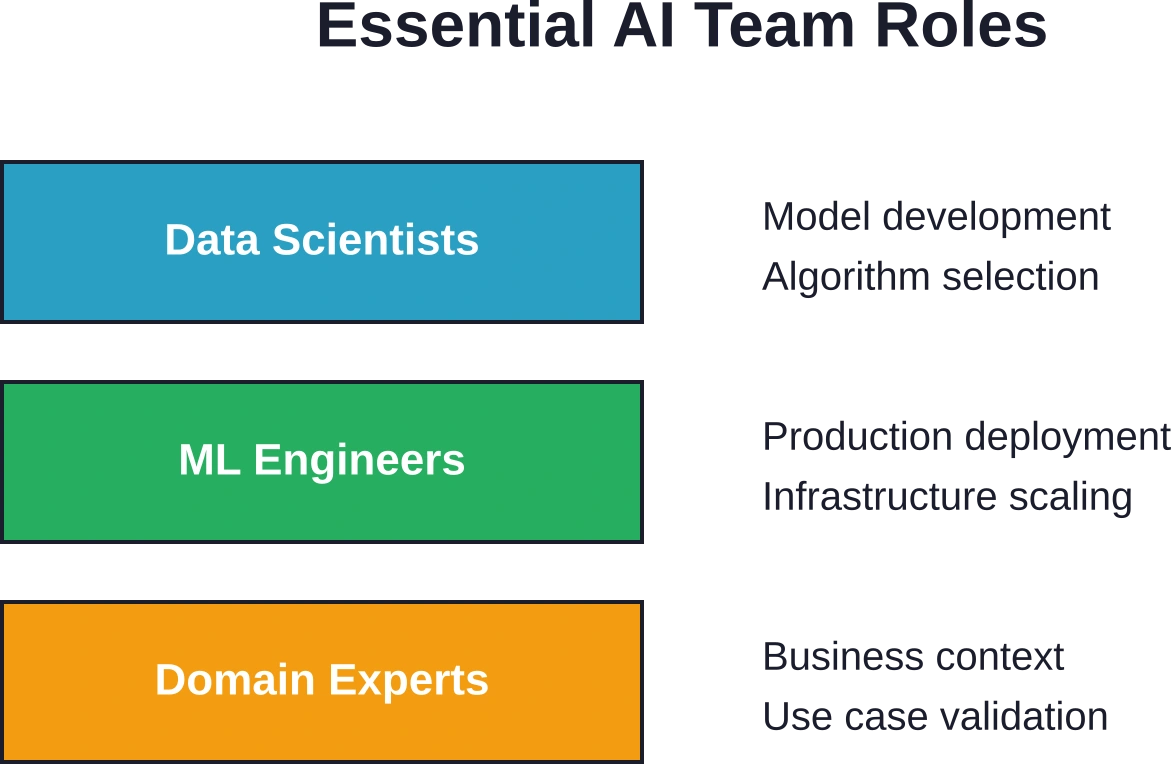
Successful implementation requires a mix of technical skills (data science, machine learning engineering, software development) and domain expertise (business knowledge, process understanding, user experience design).
But wait. Technical talent alone isn’t enough. Teams also need people who can translate between business stakeholders and technical implementers, manage change, and communicate AI capabilities and limitations to non-technical audiences.
Many organizations struggle to recruit specialized AI talent. Strategies include upskilling existing employees, partnering with external specialists for knowledge transfer, and focusing on practical deployment skills rather than theoretical research capabilities.
Establishing AI Governance Frameworks
Governance determines how organizations make decisions about AI development, deployment, and monitoring. Without clear governance, AI initiatives tend to proliferate in uncoordinated ways that create risk and waste resources.
Risk Management and Ethical Frameworks
The NIST AI Risk Management Framework provides structured guidance for identifying, assessing, and mitigating AI-related risks. This includes technical risks (model accuracy, robustness, security) and societal risks (bias, fairness, transparency, privacy).
Organizations need explicit policies addressing how AI systems will be tested for bias, who reviews high-stakes decisions, what level of explainability is required for different use cases, and how systems are monitored after deployment.
According to IEEE standards on ethical AI, organizations that don’t consider ethical criteria within their AI frameworks face expensive and damaging consequences. The EU AI Act imposes fines up to €35 million or 7% of global annual turnover for violations of prohibited AI practices, and up to €15 million or 3% for non-compliance with other obligations (such as high-risk system requirements).
Compliance and Regulatory Considerations
The regulatory landscape for AI continues to evolve rapidly. The White House has issued executive orders establishing national policy frameworks for AI that emphasize American leadership while requiring reliability and freedom from ideological bias in government AI systems.
Organizations operating across jurisdictions need to track requirements in each market. Compliance isn’t just about avoiding fines—it’s about building systems that earn user trust and withstand public scrutiny when things go wrong.
Practical governance includes documentation requirements, approval workflows for new AI use cases, regular audits of deployed systems, and clear accountability structures defining who is responsible when AI systems make mistakes.
Step-by-Step AI Implementation Process
Here’s a practical roadmap that organizations can adapt to their specific contexts. These steps don’t always follow a strict sequence—some activities happen in parallel, and iteration is normal.
Step 1: Identify and Prioritize Use Cases
Start by cataloging potential AI applications across the organization. Prioritize based on business value, feasibility, data availability, and strategic importance.
Best practice involves selecting initial projects that can demonstrate quick wins while building organizational capability. Success breeds momentum and executive support for larger initiatives.
Step 2: Conduct Data Readiness Assessment
For prioritized use cases, evaluate whether data exists in sufficient quality and quantity. Identify gaps and create plans to address them through data collection, cleaning, labeling, or acquisition.
This assessment often reveals that organizations need to invest in data infrastructure before they can effectively deploy AI. That’s normal—and it’s better to discover it early.
Step 3: Develop Proof of Concept
Build a limited-scope prototype that demonstrates technical feasibility and potential value. This isn’t production-ready software—it’s a learning exercise that tests assumptions and surfaces unexpected challenges.
Proof of concept projects should have clear success criteria, defined timelines, and planned decision points about whether to proceed, pivot, or stop.
Step 4: Test and Validate Models
Rigorous testing goes beyond technical accuracy metrics. Organizations need to evaluate fairness across demographic groups, robustness under edge cases, explainability of predictions, and alignment with business requirements.
Testing should involve domain experts who can identify mistakes that technical metrics miss. Does the model’s behavior make sense? Are there patterns that suggest problematic biases or data leakage?
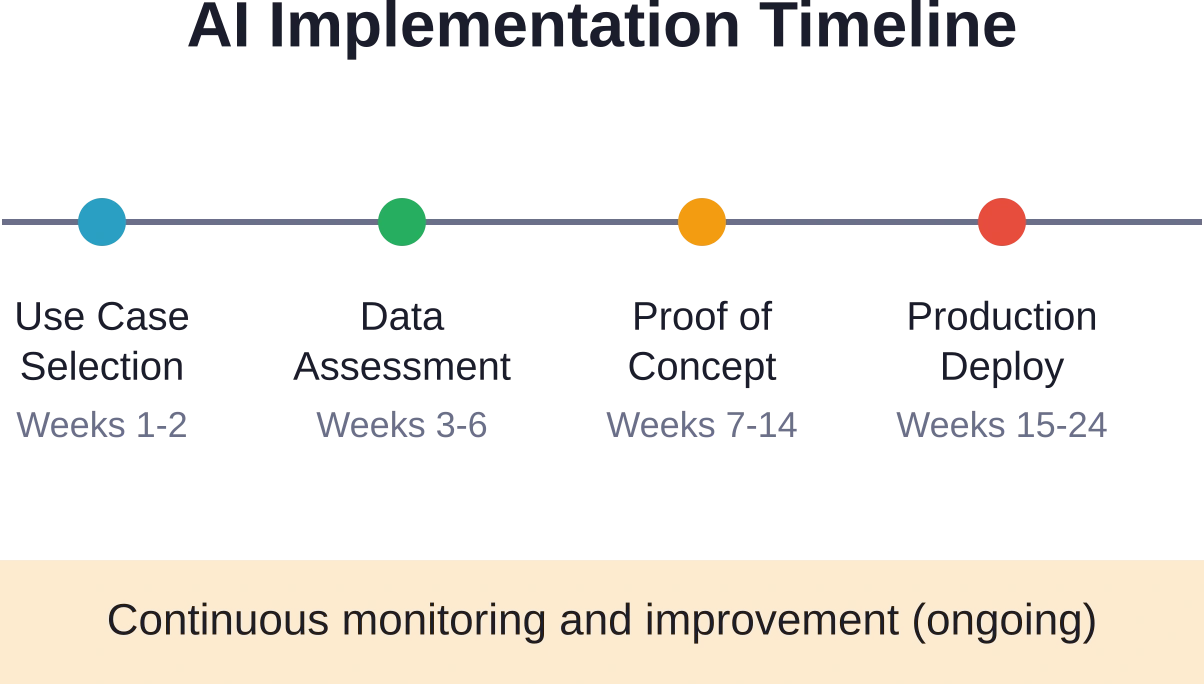
Step 5: Plan for Production Deployment
Moving from prototype to production requires infrastructure that supports reliability, scalability, security, and monitoring. This includes deployment pipelines, versioning systems, rollback capabilities, and performance tracking.
Organizations also need integration plans that connect AI systems to existing workflows, user interfaces, and data sources. The best AI model delivers zero value if people can’t actually use it in their daily work.
Step 6: Implement Monitoring and Continuous Improvement
AI systems degrade over time as data distributions shift and business contexts change. Continuous monitoring tracks technical performance, business outcomes, and potential issues like emerging bias patterns.
Organizations should establish feedback loops that capture user input, identify edge cases that need addressing, and trigger model retraining when performance drifts below acceptable thresholds.

Plan AI Implementation With AI Superior
AI implementation works better when companies know what problem they are solving before they choose a model, tool, or platform. AI Superior supports AI implementation through AI consulting, AI and data strategy, AI use case discovery, custom AI software development, machine learning, predictive analytics, business intelligence, and AI integration. This can be useful for teams that want to introduce AI into existing products or internal processes but need a more grounded plan first.
AI Superior can guide AI implementation through:
- AI use case discovery and validation
- AI and data strategy planning
- Machine learning and predictive analytics development
- Custom AI software and AI component development
- Integration of AI tools into existing workflows
👉Contact AI Superior to discuss how your company can move from an AI idea to a realistic implementation plan.
Real-World AI Implementation Examples
Learning from organizations that have successfully deployed AI at scale provides practical insights that generic advice can’t capture.
Department of Defense: GAMECHANGER
The Department of Defense developed GAMECHANGER. According to case study documentation, the tool would ‘save the Department billions of dollars, and lives.’ This AI tool addresses policy inaccessibility across Pentagon operations by making vast repositories of regulations searchable and comprehensible.
The project demonstrates how AI can solve non-combat business problems that impede organizational effectiveness. Making policy accessible might sound mundane, but in an organization the size of the DOD, it removes friction from countless daily decisions.
MIT Sloan Research Findings
Research from the MIT Sloan Management Review shows that companies like Colgate-Palmolive and Sanofi achieve practical success by focusing on small and medium-sized wins rather than attempting enterprise-wide transformation immediately.
This approach builds organizational learning, demonstrates value to skeptical stakeholders, and creates momentum for larger initiatives. It also reduces risk by containing failures to limited scope.
Enterprise AI Lessons from 51 Deployments
Stanford’s Digital Economy Lab published ‘The Enterprise AI Playbook: Lessons from 51 Successful Developments’ (Report Date 04/02/2026). The findings emphasize that executives deploying AI focus on practical implementation questions rather than abstract debates about AI’s potential.
Organizations that succeed treat AI implementation as a change management challenge, not just a technology project. They invest in training, adjust workflows, and create organizational structures that support AI adoption.
Common Challenges and How to Address Them
Even well-planned AI implementations encounter obstacles. Anticipating common challenges enables organizations to prepare mitigation strategies.
| Challenge | Impact | Mitigation Strategy |
|---|---|---|
| Poor data quality | Inaccurate models, unreliable outputs | Invest in data cleaning, establish data governance, implement quality monitoring |
| Team skill gaps | Slow development, technical debt | Upskill existing staff, partner with specialists, focus on practical deployment skills |
| User resistance | Low adoption, wasted investment | Involve users early, demonstrate clear benefits, provide adequate training |
| Integration complexity | Delays, cost overruns | Start with well-scoped projects, use standard APIs, plan integration from day one |
| Regulatory uncertainty | Compliance risk, deployment delays | Monitor regulatory developments, build flexible compliance frameworks, document decisions |
Data Quality Issues
Incomplete, inaccurate, or biased data undermines AI effectiveness. Organizations need to treat data quality as an ongoing operational concern, not a one-time cleanup project.
Strategies include implementing data validation at collection points, establishing clear ownership for data quality, and building monitoring that detects degradation before it impacts production systems.
Cultural Resistance to Change
People resist AI adoption when they fear job displacement, don’t understand how tools work, or have had bad experiences with previous technology initiatives.
Successful change management involves transparent communication about AI’s role, involving employees in design decisions, demonstrating how AI augments rather than replaces human work, and celebrating early wins.
Scaling Challenges
What works in a pilot often breaks at production scale. Infrastructure that handles a thousand predictions daily might collapse under a million.
Organizations need to plan for scalability from the beginning, even if initial deployment is small. This includes architecture decisions, technology selection, and cost modeling that accounts for growth.
Building an AI-Ready Culture
Technology and strategy matter, but culture often determines whether AI initiatives succeed or stall. Organizations need environments where experimentation is encouraged, failures are treated as learning opportunities, and cross-functional collaboration is normal.
Leadership plays a critical role. When executives communicate a clear vision for AI’s strategic importance and model curiosity about new capabilities, it signals that AI matters and resources will be made available.
Training shouldn’t target only technical teams. Business leaders need enough AI literacy to ask good questions, set realistic expectations, and identify promising applications. Frontline employees need to understand how AI tools augment their work and what limitations to watch for.
Organizations with strong AI cultures create forums for sharing learnings across teams, recognize people who drive adoption, and allocate time for exploration beyond immediate project deliverables.
Measuring AI Implementation Success
Organizations need clear metrics that connect AI initiatives to business outcomes. Technical metrics like model accuracy matter, but executives care about revenue impact, cost savings, customer satisfaction, and competitive position.
Strong measurement frameworks include:
- Business outcome metrics aligned to initial objectives
- Technical performance metrics for model quality and reliability
- Operational metrics tracking adoption, usage patterns, and user satisfaction
- Risk metrics monitoring bias, fairness, and compliance
- Financial metrics calculating ROI and total cost of ownership
Organizations should establish baseline measurements before AI deployment so they can demonstrate actual impact rather than relying on anecdotal claims.
Regular reporting to executive stakeholders maintains visibility and support. Honest communication about what’s working and what isn’t builds credibility and enables course corrections before small problems become big failures.
Future-Proofing Your AI Strategy
AI capabilities, regulatory requirements, and competitive dynamics all evolve rapidly. Implementation strategies need flexibility to adapt as circumstances change.
Organizations should avoid over-investing in specific tools or platforms that might become obsolete. Focusing on foundational capabilities—data infrastructure, governance frameworks, team skills, organizational culture—creates resilience regardless of which specific AI technologies dominate in the future.
Staying connected to developments in AI research, industry best practices, and regulatory evolution enables organizations to anticipate changes rather than react to them. This includes participating in industry groups, tracking publications from standards bodies like IEEE, and monitoring guidance from government agencies like NIST.
The most successful organizations treat AI implementation as a continuous journey rather than a destination. They build learning into their processes, adjust strategies based on results, and maintain the organizational agility to pursue new opportunities as they emerge.
Frequently Asked Questions
How long does AI implementation typically take?
Implementation timelines vary widely based on project scope and organizational readiness. Simple automation projects might deliver value in weeks, while enterprise-wide AI transformation typically requires 18-24 months or longer. A typical small to medium project may span approximately six months from use case selection through production deployment, though timelines vary based on organizational readiness and project scope.
What are the biggest risks in AI implementation?
Common risks include poor data quality producing unreliable outputs, algorithmic bias creating unfair outcomes, lack of user adoption wasting investment, compliance violations triggering regulatory penalties, and security vulnerabilities exposing sensitive data. Robust governance frameworks and risk management processes help organizations identify and mitigate these risks before they cause serious damage.
Do we need a separate AI team or can existing teams handle implementation?
It depends on scale and ambition. Small pilot projects can often be handled by existing teams with some external support or training. Larger strategic initiatives typically require dedicated resources with specialized skills. Many organizations use a hybrid approach—a small core AI team that partners with business units to deploy solutions in specific domains.
How much should we budget for AI implementation?
Budget requirements vary dramatically based on scope, existing infrastructure, and whether organizations build or buy solutions. Small pilot projects might cost tens of thousands of dollars, while enterprise implementations can require millions. Illustrating the scale of investment, major government initiatives can require millions of dollars, reflecting the scope and complexity of comprehensive AI programs.
What’s the difference between AI strategy and AI implementation strategy?
AI strategy defines the overall vision—what role AI will play in achieving business objectives, which capabilities to build, and how AI creates competitive advantage. Implementation strategy focuses on execution—the specific steps, resources, governance, and processes needed to turn strategic vision into working systems that deliver value.
How do we measure ROI for AI initiatives?
ROI measurement should connect directly to the business objectives defined at the outset. Calculate costs including technology, talent, data infrastructure, and ongoing operations. Measure benefits in terms of revenue growth, cost reduction, productivity gains, improved customer outcomes, or risk mitigation. The Los Angeles County Public Defender’s Office demonstrated clear ROI through 40% reduction in administrative processing time.
Should we build AI capabilities in-house or partner with vendors?
Most organizations use a combination. Standard capabilities like chatbots, document processing, or forecasting are often better purchased as services. Proprietary applications that create competitive differentiation or handle highly sensitive data may warrant in-house development. The decision depends on strategic importance, available talent, cost considerations, and speed requirements.
Conclusion: From Strategy to Action
AI implementation strategies succeed when organizations balance ambition with pragmatism. The technology offers genuine opportunities to transform business operations, improve decision-making, and create competitive advantages that weren’t possible before.
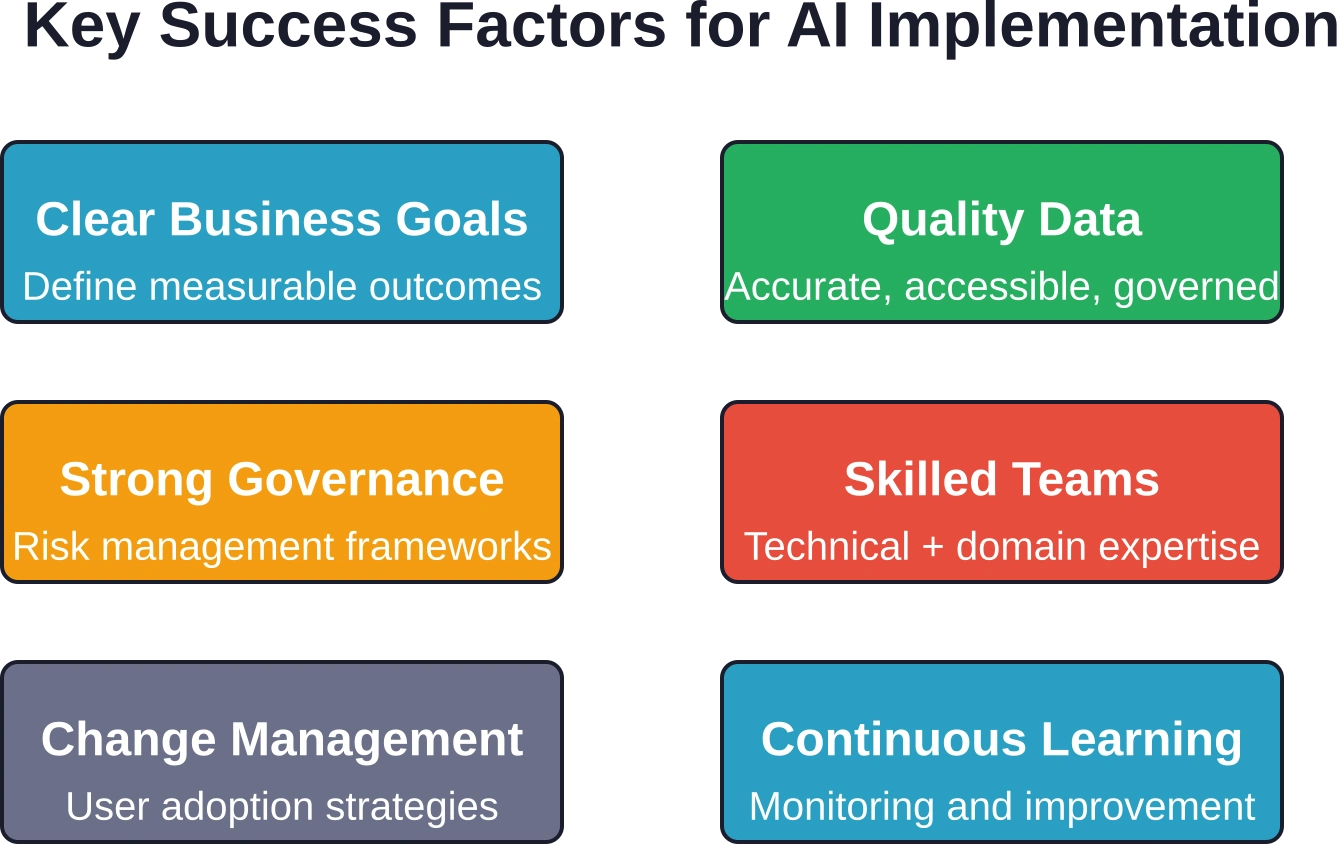
But technology alone doesn’t deliver those outcomes. Organizations need clear objectives, quality data, robust governance, skilled teams, and cultures that support continuous learning and adaptation.
The most important step is starting. Organizations that wait for perfect clarity, complete data, or guaranteed outcomes will fall behind competitors who embrace thoughtful experimentation and learn from both successes and failures.
Start small. Pick a well-scoped use case with clear business value and reasonable data availability. Build a proof of concept. Learn what works and what doesn’t. Scale what succeeds. Adjust what fails.
That iterative approach—grounded in strategic thinking but focused on practical execution—is how organizations move from AI hype to AI reality. The frameworks, examples, and lessons outlined here provide a roadmap. Now it’s time to adapt them to your specific context and take the first step.